Top videos

Did you know Canva for Education lets you create fully interactive documents; complete with embedded videos, clickable websites, and even Google Forms that can be filled out without leaving the page? And the best part? It's 100% free for teachers and schools.
In this step-by-step walkthrough, I show you exactly how to:
Embed playable YouTube videos
Add interactive website previews
Insert live Google Forms your audience can fill in without leaving the doc
Share it securely with your staff or students
This is a game-changer for flipped learning, staff training, newsletters, and student engagement.
Try it out and let me know how you’d use this in your classroom or school.
📌 Video Chapters:
0:00 Introduction
0:18 Canva Docs Overview
1:00 Creating Your First Interactive Document
2:00 Embedding YouTube Videos
3:00 Embedding Website Links and Previews
4:45 Inserting Interactive Google Forms
6:00 Sharing Options & Permissions
7:00 Final Thoughts
🔗 Activate your Canva for Education now: https://www.canva.com/education/
💚💚💚
Thank you all our Channel members! If you'd like to become a member as well follow this link:
https://www.youtube.com/channe....l/UC_Mv2BsvWR03-s7S5
And if you'd like to connect with me personally and support the channel even more, why not check out the Patreon here: https://www.patreon.com/eduflip
You can also join our Facebook Community here: https://www.facebook.com/groups/538644703169584
💚💚💚
SERVICES AND SOFTWARE I USE DAILY:
Video editing: https://sethideclercq.com/camtasia
Amazing screenshots: https://sethideclercq/Snagit
Website hosting: https://sethideclercq.com/bluehost
Screenshots and GIFs: https://sethideclercq.com/snagit
Courses: https://sethideclercq.com/teachable
Email lists and newsletter: https://sethideclercq.com/convertkit
Website building: https://sethideclercq.com/wix
GEAR AND RESOURCES:
https://www.amazon.com/shop/fl....ippedclassroomtutori
https://kit.co/FlippedTutorials
My TPT Store: https://www.teacherspayteachers.com/store/eduflip
Disclaimer: Some of these links are affiliate links where I'll earn a small commission if you make a purchase at no additional cost to you. These videos have been made for educational purposes and all views or opinions expressed are my own.
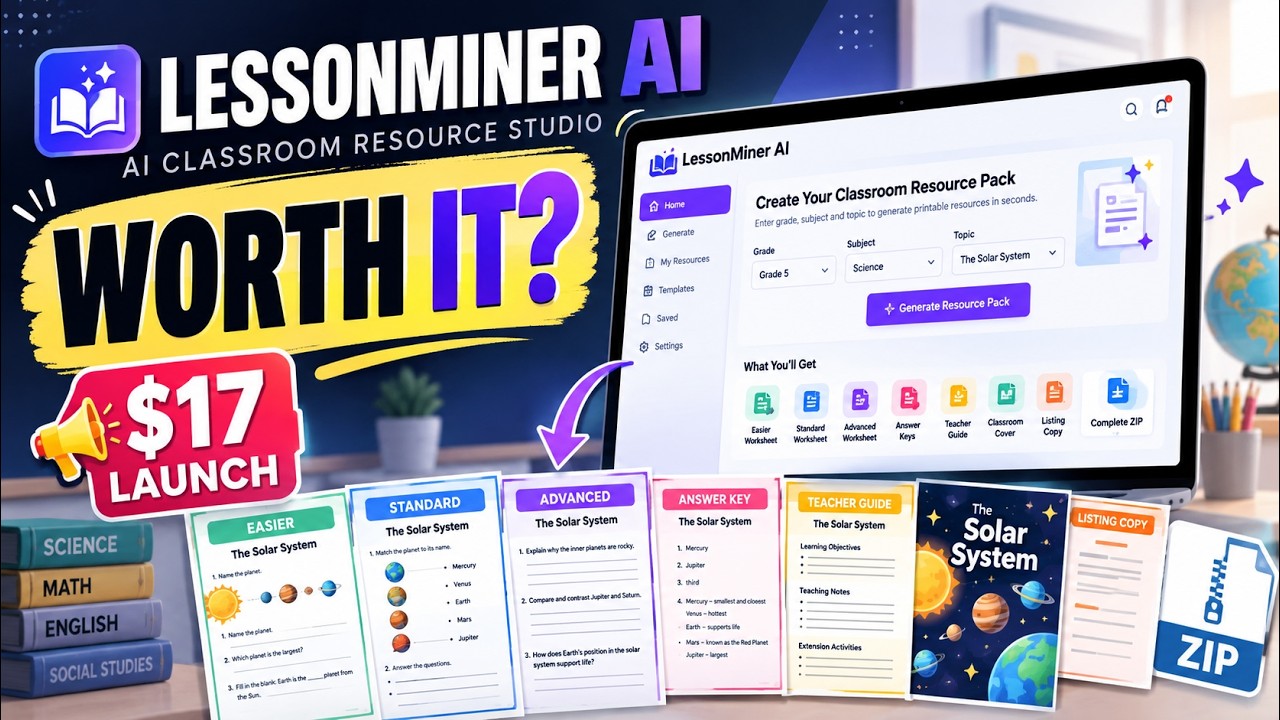
LessonMiner AI Review 2026
Can LessonMiner AI really make classroom resource creation easier?
In this review, we take a look at LessonMiner AI, an AI-powered classroom resource studio designed to generate complete educational resource packs from a grade, subject, and topic.
According to the product page, each resource pack can include easier, standard, and advanced worksheets, answer keys, a teacher guide, classroom cover, listing copy, and a complete ZIP package.
In this video, we cover:
• What LessonMiner AI is
• How the AI resource-generation workflow works
• The different worksheet difficulty levels
• Teacher guides and answer keys
• Seller-ready resources and listing copy
• Who the tool is designed for
• Pros and limitations
• Current pricing information
• Whether you should consider trying it
This is an independent review, so make sure to verify the current pricing, features, refund terms, and purchase conditions before buying.
👉 Check LessonMiner AI here: https://launchpadjv.com/o/537/23389
If you found the review useful, like the video, subscribe, turn on notifications, and comment below with the AI tool you'd like me to review next.
#LessonMinerAI
#AIForTeachers
#AITools
#EducationAI
#TeacherTools
#AIEducation
#EdTech
#ClassroomResources
#AIReview
#AITools2026

We keep asking how AI can help students succeed. But what are they really learning?
In this thoughtful and challenging TEDx talk, university instructor and UX designer Charlie Gedeon explores how artificial intelligence is revealing and accelerating the cracks in modern education. From students outsourcing decisions to ChatGPT to the quiet disappearance of critical thinking, Charlie unpacks how AI is reinforcing a system built to reward grades over growth.
With personal anecdotes, sharp systems thinking, and a call for collective responsibility, this talk asks: If AI is the teacher, what is the lesson? Charlie Gedeon is a university instructor, entrepreneur, and interaction designer. He studies how technology changes how we think and learn, and how systems shape behaviour. His work focuses on reimagining digital tools and learning experiences to support critical thinking, rather than replace it.
This talk was given at a TEDx event using the TED conference format but independently organized by a local community. Learn more at https://www.ted.com/tedx

Students examine various materials to investigate how they interact with light. They use five characteristics—translucency, transparency, opaqueness, reflectivity and refractivity—to describe how light interacts with the objects.
View the full activity on TeachEngineering:
https://www.teachengineering.o....rg/activities/view/c
TeachEngineering has over 1,500 FREE lessons and activities. Visit https://www.teachengineering.org/ for more
Music - Orange Octopus

This video shows you everything you need to know for finding factors and the greatest common factor.
In this video we cover:
* What is a factor
* How to find the greatest common factor
* Examples and extra practice
* How these concepts are used elsewhere in math
Other Videos Mentioned:
A Step by Step Guide to Simplifying Fractions: https://youtu.be/E_81dn_OYOA
Check out my post and free printable worksheet on factors and the greatest common factor here: https://improvedmath.com/findi....ng-factors-and-the-g
Improved math is a channel created to provide additional instruction on essential math concepts. I’m not a math teacher, I’m an accountant. I know firsthand how important math concepts are in the real world.
Teachers, parents, guardians, homeschoolers, and students can use these videos to help reinforce math skills.
For more information on math topics or for free additional resources, you can also visit my website at improvedmath.com
https://www.youtube.com/c/ImprovedMath
https://www.tiktok.com/@improvedmath1?
https://www.pinterest.com/improvedmath/
Don’t forget to like, share, and subscribe!
#multiplesandfactors
#whatarefactors
#factorsinmath
#howtofindfactors
#factors
#greatestcommonfactor
#simplifyingfractions
#mathtips

The Toronto Raptors and TurboTax have partnered up to teach high school students the importance of managing their finances.
Subscribe to CTV News to watch more videos: https://www.youtube.com/ctvnews
Connect with CTV News:
For live updates and latest headlines visit: http://www.ctvnews.ca/
For breaking news, fast, download the CTV News App: https://www.ctvnews.ca/app
Must-watch stories and full programs at http://www.ctvnews.ca/video
CTV News on TikTok: https://www.tiktok.com/discover/CTV-News
CTV News on X (formerly Twitter): https://twitter.com/CTVNews
CTV News on Reddit: https://www.reddit.com/user/CTVNEWS
CTV News on LinkedIn: https://ca.linkedin.com/company/ctv-news
---
CTV News is Canada's most-watched news organization both locally and nationally, and has a network of national, international, and local news operations.
#ctvnews #ctvnationalnews #canadiannews

Mixed Fraction Trick | Fast Simplify Trick | Simplification Trick in Hindi #shorts #simplification
#Simplificationtricks #Simplification #fraction #shorts
Simplification Tricks, Simplification, Simplicity, Simplify your space, Simplification by sahil sir, Simplilearn, Simplification Tricks in maths for bank exams, Simplification by ashish arora, Simplifying fractions, Simplify class 6, Simplify class 7, Simplify class 8, Simplify fractions, Simplify fractions class 6, Simplify fractions class 7, Simplify fractions 4th grade, Simplify fractions 5th grade, Simplify fractions maths, Simplify fractions multiply, Simplify fractions grade 4,
Mixed Fraction | Maths Tricks | Math Tricks |Short Trick #shorts #matheasytricks
Addition of Fractions | Math Concept #saralstudypoint #shorts
addition of fractions class 6, addition of fractions for class 7, addition of fractions class 6 in hindi, addition of fractions for class 7 in hindi, addition of fractions class 7 in telugu, addition of fractions on number line, addition of fractions for class 7 in malayalam, addition of fractions for class 7 in hindi, addition of fractions with different denominators, addition of fraction, addition fraction, What is fraction, What is fractionin hindi, What is fraction for class 4, What is fraction for class 5, What is fraction for class 6, What is fraction for class 7, What is fraction in maths, What is fraction in tamil, What is fraction class 3, What is fraction class 8, What is fraction for class 5 in hindi, fraction math, fraction and decimals class 7, fraction class 5, fraction math, fraction by sahil sir, fraction class 6, fraction division, fraction and decimals, fraction Tricks in Hindi, fraction value by arun sir
#shorts #mathstrick #shorts #short #trendingshorts #viralshorts #viralvideo #shortsfeed #youtubeshorts #youtubeshortsindia #youtubeviral #youtubeviralshorts #shortsvideo #shortsvideos #shorts_video #shortsbeta #shortsyoutube #shortsstatus #shortsviral #shortsindia #maths #trending #Mathtrick #easytrick #youtubeshort #trick #saralstudypoint #easy_solution #fast_calculation #short_trick #mathsmasti #mathsshorts #mathstrick #Tricks #mathsmasti #shorttrick #easytrick #trending #shorts_video #average #trick #math #Maths #saralstudypointshorts #mymathlab #ap #mathswatch #multiplication #statistics #mymaths #mathsworkout #mathpractice #a2motivation #arvindarora #shortvideo #ARVIDARORA #imagicmath @a2_sir #backtobasics #BACKTOBASICS #imagicmath #fastmathtrick #vedicmath #vedicMathTutorial
fast calculation, short trick, shorts, short, shortvideo, firstshortvideo, Maths Tricks, youtubeshorts, math trick, math short trick, easy calculation, fast method, fast trick, math magic, math masti, vaidik math, math magician, math funda, maths, matheasytrick, बिना पेन पेपर के, MathTricks, Maths Trick, Fraction Trick, bhinn, भिन्न
easytrick, math trick, math tricks, short answer, vaidik math, fast math
Math quiz | Math puzzles | Tricky Math | Mindbooster | Mathmagic #shorts # saralstudypoint
Fast Simplify Trick | Simplification Trick in Hindi #shorts #simplification

#englishgrammar #study #tense #温習 #revision #preposition #學英文 #英語語法 #英語初學者 #刻意練習
-----------------------------------------------------------------------------------
💛Please SUBSCRIBE to our channel, LIKE, and SHARE: @learnfast101
💛歡迎訂閱我們的頻道、點讚、分享: @learnfast101
-----------------------------------------------------------------------------------
今天的頻道主要溫習prepositions,考你25句日常句子的運用。每天花10分鐘,循環不停學英文,讓你輕鬆溫習英語文法不同的範疇。你會發現英文能力會不知不覺間神速進步!
Welcome to watch our videos 歡迎觀看我們所創作的其他影片
👉🏻1) Basic Conversation 會話 https://www.youtube.com/playli....st?list=PLPoPxSDq_eP
👉🏻2) Grammar 語法 https://www.youtube.com/playli....st?list=PLPoPxSDq_eP
👉🏻3)English Speaking https://www.youtube.com/playli....st?list=PLPoPxSDq_eP
👉🏻4)Funny Jokes 笑話 https://www.youtube.com/playli....st?list=PLPoPxSDq_eP
👉🏻5)Vocabulary 詞彙 https://www.youtube.com/playli....st?list=PLPoPxSDq_eP
👉🏻6)English Idioms 英語成語 https://www.youtube.com/playli....st?list=PLPoPxSDq_eP
👉🏻7)Revision Exercise 重温練習 https://www.youtube.com/playli....st?list=PLPoPxSDq_eP
👉🏻8)Fun Games 趣遊戲味 https://www.youtube.com/playli....st?list=PLPoPxSDq_eP
👉🏻9) Tongue Twister 繞口令 https://www.youtube.com/playli....st?list=PLPoPxSDq_eP
👉🏻10)Writing a composition 作文 https://www.youtube.com/playli....st?list=PLPoPxSDq_eP
-----------------------------------------------------------------------------------
Daily revision 25_Prepositions_BGM info
Candy by Sakura Girl | https://soundcloud.com/sakuragirl_official Music promoted by https://www.chosic.com/free-music/all/ Creative Commons CC BY 3.0 https://creativecommons.org/licenses/by/3.0/

Visit https://www.abcmouse.com/learn/youtube
to learn more about our award-winning online learning program for children 2-8!
🎒✨ Is your little one getting ready for their first day of school? This uplifting ABCmouse song is all about building confidence, courage, kindness, and excitement for learning! Sing along with “I Get to Go to School Today!” as we celebrate making friends, trying our best, and discovering how fun school can be. 🚌📚
🎶 Lyrics – Sing Along! 🎶
I woke up feeling really good, yes it’s true
True, true, true,
I’m going to my favorite place, that’s my school
School, school, school
I’m gonna see all of my friends, and tell them hi
Hi, hi, hi
Today is gonna be so great, do you know why?
Why, why, why?
Because…
Chorus:
I get to go to school today
Oh I can’t wait, oh I can’t wait
Gonna learn, gonna play, oh it’s gonna be great
I get to go to school today, yeah!
I always try my very best, to be on time
Time, time, time
No matter who I’m with at school, I’m always kind
Kind, kind, kind
When we learn, I’ll do my best, I’m gonna try
Try, try, try
It’s gonna be the best day, do you know why, why, why, why?
Cause…
I get to learn so many things
I get to run and dance and sing
I get to have lunch with my friends
I get to do it all again and again
I get to read in the reading nook
I get to learn how to read more books
My teacher is so proud of me
Going to school makes me SO HAPPY!
👉 Discover more fun learning songs and educational videos by subscribing to our YouTube channel at https://YouTube.com/ABCmouse
.
And visit https://www.abcmouse.com/learn/youtube
to find out more about our award-winning online learning program for children 2–8!
© Age of Learning, Inc. All rights reserved.

It's time to learn about fun animals! In this animal learning video for kids, you will learn about dogs, owls, polar bears, turtles and more! I hope you enjoy these videos and that you have an AMAZING DAY!
Thanks for watching!
Daniel
"Homeschool Pop"
00:00 Introduction
0:22 Dogs
7:36 Owls
13:44 Elephants
19:47 Polar bears
27:54 Turtles
35:22 Rabbits
❤️ Homeschool Pop? Support my channel by clicking here: http://homeschoolpop.com
Music credits:
"Tech Live", "River Fire", "Doobly Doo", "Angel Share", "Teddy Bear Waltz"
Kevin MacLeod (incompetech.com)
Licensed under Creative Commons: By Attribution 3.0 License
http://creativecommons.org/licenses/by/3.0/
Photo credit:
Baby Siberian eagle-owls at the Screech Owl Sanctuary, St. Columb Major, Cornwall. P.D. Johnson. 25 May 2015 https://creativecommons.org/li....censes/by/2.0/deed.e
Thanks again for watching!
Daniel

Debbie Irwin narrates this explainer video for Sadlier Vocabulary. For over 180 years, William H. Sadlier, Inc. has prepared K–12 students for success in academics with rigorous English Language Arts and Mathematics programs and in their faith life with Catholic-formation programs. Sadlier offers a variety of educational solutions from print to technology.
_________________________________________________________________________________________________
Debbie Irwin is a Voiceover Talent with 20+ years in the industry. A sophisticated voice on worldwide projects. Strategically guiding her coaching students in the art & business of voiceover.
To learn more information or reach out, please visit:
-Website: https://debbieirwin.com/
-LinkedIn: https://www.linkedin.com/compa....ny/debbie-irwin-voic
-Facebook: https://www.facebook.com/DebbieIrwinVO
-Instagram: https://www.instagram.com/debbieirwinvo/
-Twitter: https://twitter.com/DebbieIrwinVO

打造你的超級大腦:Gemini 與 NotebookLM 的雙效知識管理術
想要打造專屬的超級大腦嗎?這部影片將教你如何完美結合 Gemini 與 NotebookLM,透過 AI 雙向同步技術徹底革新你的知識管理流程。在資訊爆炸的時代,特教老師與教育工作者常面臨資料超載的困擾,我們將手把手示範如何將海量文獻轉化為精確的行動指南。從資料收集、重點消化到最終報告生成,這套高效協作流程能確保內容兼具創意發想與事實精準度,大幅提升你的研究與備課效率。
💡 常見問題 (FAQ)
Q:Gemini 與 NotebookLM 在知識管理中的角色分工有何不同?
Gemini 定位為「創意工作台」,擅長邏輯推理、專案規劃與跨領域的創意生成;NotebookLM 則是「資料分析室」,專注於處理使用者上傳的特定文件,其核心優勢在於精確提取重點、整理脈絡,並嚴格標示資訊的引用來源,確保內容 100% 來自原始資料。
Q:如何確保 Gemini 生成的報告內容具備事實根據?
最佳實作路徑是先將資料同步至 NotebookLM 進行「消化」,利用其事實查核功能產生精確摘要與比較表,再將這些經由 NotebookLM 整理後的精華內容帶回 Gemini 進行最終的文案潤飾與格式生成。這種「進去、處理、再出來」的流程能有效避免 AI 產生幻覺。
Q:在使用 AI 雙向同步功能時,有哪些必須注意的限制?
首先,部分新功能採分批開放,若帳號尚未出現選項請耐心等待;其次,若遇同步延遲,請直接「重新整理網頁」即可解決多數問題;最後必須警惕,刪除 NotebookLM 內的筆記本屬於永久性操作,兩端內容會同時移除且無法復原。
影片章節時間軸
00:00 打造超級大腦:AI 知識管理新時代的挑戰
01:08 核心技術揭秘:什麼是 AI 雙向同步?
01:48 認識你的助手:Gemini 創意台與 NotebookLM 分析室
03:04 三步驟高效工作流:收集、消化、到生成
05:02 實戰必看:使用前的三項重要提醒與風險管理
標籤與訂閱行動
#AI好友實驗室 #Gemini #NotebookLM #人工智慧 #知識管理 #特教工具 #生產力提升
🚀 立即行動:
訂閱頻道並開啟小鈴鐺,掌握最新的 AI 教學資訊!
如果您需要影片中提到的「市場研究報告提示詞範本」,請在評論區留言「超級大腦」,我將私訊提供給您,助您快速上手這套強大的 AI 工具組合。

Monster Math Squad | FULL EPISODE COMPILATION | Picky Eater’s Picnic A Muffin Mystery Who’s on First
Welcome to WildBrain Learning for Kids! Click here for more videos just like this: https://www.youtube.com/watch?v=kZ_8WG4AYiw&list=PL2F3nYtGth8ekgeYv_-G8GCouZt9Kz1Qp&index=2&t=0s
SUBSCRIBE to Learning for Kids ➡️➡️➡️ https://www.youtube.com/channel/UC101…
To see more of the Monster Math Squad, be sure to check out the playlist below:
https://www.youtube.com/watch?v=S54WKXvvYnQ&list=PL2F3nYtGth8cdCU5BCAU3-Zc-DIOeH6To&index=19
Calling all parents… Any questions/suggestions? Chat to us:
http://bit.ly/WB-Twitter | http://bit.ly/WB-Facebook | http://www.wildbrain.com
Learning for Kids brings you a fun, interactive, brand new series for you to learn your numbers, Monster Math Squad. Monster Math Squad stars MAX, LILY and GOO. While they may not be the biggest, or bravest (or even the brainiest) monsters on the block, the Squad love nothing better than to put their monster minds together and use their math skills to overcome any obstacle they face… even ones with two left feet or ten thumbs.
Each story features a job for the Squad, helping a monster with a unique problem. Along the way they face a variety of small challenges that require learning and using numeracy skills en route to and saving the day. The Monster Math Squad are quite simply mad for math and all things “mathy”… counting, measuring, sizing, sorting, exploring shapes, patterns, time… you name it, it’s all math to these monsters. For the Monster Math Squad, math can solve any problem. The series’ mission is to promote the love of numeracy, the idea that math is everywhere, and math is fun!
Monster Math Squad is a great way to teach young children and kids how to solve math problems. It’s an early learning programme designed to engage children in the world of math in a fun and creative way. The show is also suitable to teach math to toddlers and make it interesting. Unleash the power of mathematics for children with Monster Math Squad. Stay tuned to Learning for Kids for more of the Monster Math Squad, the show that teaches mathematics to children.
Learning For Kids is the only destination for children, kids, toddlers, babies in kindergarten, nursery and school to learn the basic key skills on YouTube. Learning for Kids encourages children to sing, dance, move, explore and learn their way through their early years.
Learning for Kids is part of the WildBrain family. We make fun, fresh content for parents and their little ones everywhere to enjoy.
What do you want to see on Learning for Kids? Tell us in the comments section below!
#Learn #KidsVideo #Children

When you think about the Statue of Liberty, what comes to mind? What do you know about it or its history? In this video for kids, you will learn lots of interesting facts about the history, construction, and significance of this beautiful monument. For instance, it's official name is Liberty Enlightening the World, not Statue of Liberty. It was designed to honor the end of enslavement in the United States.
This monument was a gift from France. The designer was a French sculptor, Frederic Bartholdi. He helped raise money for the statue's construction and picked the New York harbor for its display. It cost the equivalent of $14,000,000 in modern day! However, while Bartholdi was the designer, the original idea was from and anti-enslavement activist, Edouard de Laboulaye.
One fun fact is that the inside of the statue was built by none other than the engineer of the Eiffel Tower itself! Alexandre-Gustave Eiffel, builder of the Eiffel tower, was also responsible for constructing the interior of Lady Liberty (a nickname for the statue). The statue was built in pieces over a period of nine years. Then they had to take it apart, ship it to the United States, and reconstruct it, which took six months.
Here are some cool statistics. The statue weighs 225 tons and, with its pedestal, stands 305 feet tall! Lady Liberty's head is about 17 feet tall, and her nose alone is roughly 4.5 feet long. The right arm is 42 feet long, and the index finger is 8 feet long! Additionally, the outside layer is made of copper, so the statue was actually originally brown. But because the copper oxidized when exposed to water in the air, it turned green.
We hope you and your student(s) enjoyed learning about this beautiful monument! If you want even more information, head over to our website and download one of our many lesson plans, full of activities, worksheets, and more!
https://learnbright.org/lesson....s/social-studies/sta
What you will learn in Statue of Liberty Facts for Kids:
0:00 Introduction
0:30 Statue of Liberty's official name and purpose
1:34 Built in pieces over 9 years
2:16 Other statistics about the statue
3:15 Modeled after the Roman goddess, Libertas, and symbolism
4:24 Review of the facts
Thank you for watching and learning with us! We’re constantly releasing new content and videos, so click that “Subscribe” button and you’ll get notified.
Find and Follow Us Online:
Facebook: https://www.facebook.com/LearnBright/
Instagram: https://instagram.com/LearnBrightEducation
Pinterest: https://pinterest.com/LearnBrightEducation
YouTube: @LearnBright
Website: https://learnbright.org/
*Teachers and Parents! Did you know? In addition to these great videos, we have also created a library of high-quality and engaging lessons for your elementary aged student(s). Visit us and sign up for a free account, and you'll instantly have access to thousands of lesson plans, learning materials, teaching instructions, activities, and assignments that your kids will really enjoy! We hope to see you soon!
Browse our entire collection of Social Studies lesson plans: https://learnbright.org/lessons/?filter_subject=social-studies
#StatueOfLiberty
#LadyLiberty

This chemistry video tutorial explains the concept of heisenberg's uncertainty principle in a simplified way. His principle applies mostly for small particles and events. As the uncertainty in the position of a particle increases, the uncertainty in momentum decreases. This video contains some math practice problems that illustrate Heisenberg's uncertainty principle.
Speed of Light, Frequency, Wavelength:
https://www.youtube.com/watch?v=LgYMxH1LCdo
Photon Energy:
https://www.youtube.com/watch?v=PYNSopwd1l4
The Photoelectric Effect:
https://www.youtube.com/watch?v=-LECEvusk8E
De Broglie Wavelength:
https://www.youtube.com/watch?v=cYyFPFU6s_A
The Bohr Model of Hydrogen:
https://www.youtube.com/watch?v=mXxsT1ut35Q
Heisenberg's Uncertainty Principle:
https://www.youtube.com/watch?v=BNYz5EKXVeI
________________________________
Intro to Quantum Numbers:
https://www.youtube.com/watch?v=eRIN9CPDrpo
Orbitals & Atomic Energy Levels:
https://www.youtube.com/watch?v=4sLXUr2HWIs
Maximum Number of Electrons:
https://www.youtube.com/watch?v=UNE-7AuiMGs
Intro to Electron Configuration:
https://www.youtube.com/watch?v=NIwcDnFjj98
Electron Configuration Exceptions:
https://www.youtube.com/watch?v=Ur2PuzJ7KWs
Noble Gas Notation:
https://www.youtube.com/watch?v=6MAKMnZdfbs
Electron Configuration of Ions:
https://www.youtube.com/watch?v=nlZa8lN_-Ds
_______________________________
Orbital Diagrams:
https://www.youtube.com/watch?v=6dRdMy9tgzE
Paired & Unpaired Electrons:
https://www.youtube.com/watch?v=xwWJf48yfNs
Aufbau's Principle & Hund's Rule:
https://www.youtube.com/watch?v=C6afrc1QS6Y
Paramagnetic & Diamagnetic Elements:
https://www.youtube.com/watch?v=SO983iq9GaI
Valence Electrons & Periodic Table:
https://www.youtube.com/watch?v=FPk2ziB9iX0
Effective Nuclear Charge:
https://www.youtube.com/watch?v=JDsMR1bHGO4
_________________________________
Slater's Rule:
https://www.youtube.com/watch?v=TaYUOiEe6OA
How To Identify The Element:
https://www.youtube.com/watch?v=4qwJIJUaIeQ
Quantum Numbers - Mega Review:
https://www.youtube.com/watch?v=lPptuKlCM6k
Quantum Numbers - Practice Test:
https://www.youtube.com/watch?v=E-nOH18dF-c
Final Exams and Video Playlists:
https://www.video-tutor.net/
Full-Length Videos and Worksheets:
https://www.patreon.com/MathSc....ienceTutor/collectio

See Khanmigo in action - then try it out for yourself: http://khan.co/try-khanmigo

Someone asked me recently to make a video on accent marks and what they are for. You might watch the video on syllables before this video if you don’t know what they are.
Please like the video and share with others who could benefit. More Spanish lessons coming.
Request a topic you’d like for me to go over in a future video!
👍Please share this video with others and like it to help me get the word out on my videos!
And let me know about other troublesome topics you’d like in bite-sized form.
🔔 Subscribe for more Spanish lessons: http://bit.ly/XGe7we
Special Offer: Get a discount off your first 6 months with code CHATEOBOT! Sign up at: https://www.senorjordan.com/chat
Social Media:
* YouTube: https://www.youtube.com/SeñorJordan
* Find “señor jordan videos” on Facebook, Twitter, Instagram, and TikTok
* Soundcloud: senorjordanspanish
Enjoying the content? Consider buying me a taco!
https://ko-fi.com/senorjordan
🌐 Private Lessons Available:
Interested in improving your Spanish conversational skills? Contact me: www.senorjordan.com/clases
📚 Practice Your Spanish with My Books!
https://www.tprsbooks.com/shop/?_product_type=novel&_author=jeremy-senor-jordan&_product_language_filter=spanish
#spanish #SpanishHelp #SpanishLearning #FYP #foryourpage #senorjordan #senorjordanvideos #señorjordan #AprendeEspañol #ayudaenespañol #profesdeespañol #spanishteachers #PracticeSpanish #BasicSpanish #SpanishGrammar #Grammar #SimpleSpanish #español #SpanishLessons #FreeSpanish #SpanishMadeSimple #SpanishBite

Google has officially rebranded NotebookLM as Gemini Notebook, bringing powerful new AI features designed for educators, students, researchers, and professionals. In this complete 2026 guide, you'll learn how to use Gemini Notebook to create lesson plans, generate quizzes, build study guides, make mind maps, create flashcards, summarize PDFs, analyze YouTube videos, and even turn your documents into podcast-style Audio Overviews.
Whether you're a teacher looking to save hours of lesson preparation or a student who wants a smarter way to study, this tutorial covers everything you need to get started with Google's latest AI-powered learning workspace.
📌 In this video you'll learn:
NotebookLM's new identity as Gemini Notebook
What's new in the 2026 update
How teachers can create lesson plans in minutes
AI-powered quizzes, flashcards, and study guides
Mind Maps and Audio Overviews explained
Uploading PDFs, YouTube videos, websites, and lecture notes
Source-grounded AI responses with citations
Best use cases for teachers, students, and researchers
Tips and tricks to get the most out of Gemini Notebook
If this video helps you, don't forget to Like 👍, Share 📤, and Subscribe 🔔 for more AI tutorials, Google Gemini updates, productivity tools, and the latest technology guides.
#NotebookLM #GeminiNotebook #GoogleAI #AITools #AIForTeachers #LessonPlanning #EducationAI #TeacherTools #EdTech #AIInEducation #TeachingWithAI #AIForStudents #StudyWithAI #Productivity #GoogleGemini #AITutorial #ClassroomTechnology #DigitalLearning #TechTutorial #artificialintelligence

IGCSE Math | Simplify Algebraic Fractions | Part 2 (Q1 f-h) | IGCSE/GCSE Algebra Solutions | MathZip
Welcome to MathZip, your trusted guide for mastering IGCSE Algebra. In this video, we simplify algebraic fractions step by step—covering Q1 (a–e) with clear explanations and exam-style logic.
Previous Part:
https://www.youtube.com/playli....st?list=PL60Rdj6sJyB
🎯 Topics Covered:
Laws of indices
Rational expression simplification
Factoring and cancellation
IGCSE-style problem solving
📌 Perfect for learners preparing for IGCSE Mathematics (0580) or Additional Mathematics (0606).
🔔 Subscribe to MathZip for more topic-wise breakdowns and printable resources. 📥 Follow on Facebook for daily updates and practice sets.
#MathZip #IGCSEAlgebra #AlgebraicFractions #SimplifyExpressions #IGCSEMath #RationalExpressions #MathForEveryone #BangladeshMath #GlobalMath #AlgebraMadeEasy