Iba pa

We hope you are enjoying our large selection of engaging core & elective K-12 learning videos. New videos are added all the time - make sure you come back often to learn more! If you'd like us to cover any additional topics, please let us know. For practice, assessment, and many interactive activities that go along with each video, as well as a teacher/parent dashboard, go to Miacademy.co for Grades K-8 or Miaprep.com for grades 9-12!
Get a 35% discount on our website - practice games, quizzes, and more to go along with each video: https://www.parents.miacademy.....co/coupon?code=VIDEO
Follow along with Ashely and Mia as they teach you about indefinite pronouns.
We hope you are enjoying this video! For more in-depth learning, check out Miacademy.co (https://www.parents.miacademy.co/), an online learning platform with lessons and practice games that go along with our videos. Use coupon code VIDEOSPECIAL for a discount. Good for homeschoolers, Parents, Teachers, or anyone with kids in grades K-8.
Miacademy also offers many hands-on learning activities including a business simulation, writing in the Miacademy weekly, and creating artwork. Teaching social skills is also one of the key values at Miacademy. On the site, kids can interact safely in a moderated environment and share their artwork, videos, and ideas with each other.

In this video, you will learn all about the different types of turtles!
We hope you are enjoying our large selection of engaging core & elective K-12 learning videos. New videos are added all the time - make sure you come back often to learn more! If you'd like us to cover any additional topics, please let us know.
For practice, assessment, and many interactive activities that go along with each video, as well as a teacher/parent dashboard, go to Miacademy.co for Grades K-8 or Miaprep.com for grades 9-12!

We hope you are enjoying our large selection of engaging core & elective K-12 learning videos. New videos are added all the time - make sure you come back often to learn more! If you'd like us to cover any additional topics, please let us know. For practice, assessment, and many interactive activities that go along with each video, as well as a teacher/parent dashboard, go to Miacademy.co for Grades K-8 or Miaprep.com for grades 9-12!

Let's learn how to make the bed!
We hope you are enjoying our large selection of engaging core & elective K-12 learning videos. New videos are added all the time - make sure you come back often to learn more! If you’d like us to cover any additional topics, please let us know.
For practice, assessment, and many interactive activities that go along with each video, as well as a teacher/parent dashboard, go to Miacademy.co for Grades K-8 or Miaprep.com for grades 9-12!

Learn how to use and read a measuring cup.
We hope you are enjoying this video! For more in-depth learning, check out Miacademy.co (https://www.parents.miacademy.co/), an online learning platform with lessons and practice games that go along with our videos. Use coupon code VIDEOSPECIAL for a discount. Good for homeschoolers, Parents, Teachers, or anyone with kids in grades K-8.
Miacademy also offers many hands-on learning activities including a business simulation, writing in the Miacademy weekly, and creating artwork. Teaching social skills is also one of the key values at Miacademy. On the site, kids can interact safely in a moderated environment and share their artwork, videos, and ideas with each other.
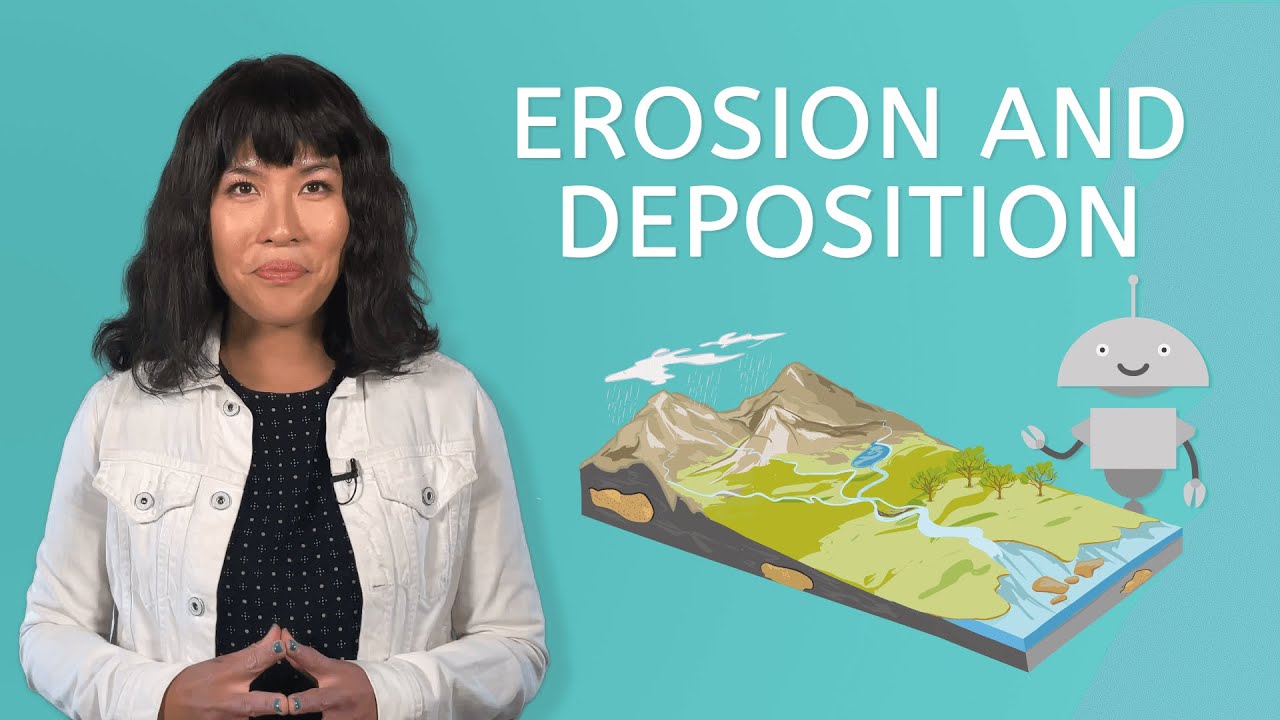
We hope you are enjoying our large selection of engaging core & elective K-12 learning videos. New videos are added all the time - make sure you come back often to learn more! If you'd like us to cover any additional topics, please let us know. For practice, assessment, and many interactive activities that go along with each video, as well as a teacher/parent dashboard, go to Miacademy.co for Grades K-8 or Miaprep.com for grades 9-12!
Get a 35% discount on our website - practice games, quizzes, and more to go along with each video: https://www.parents.miacademy.....co/coupon?code=VIDEO
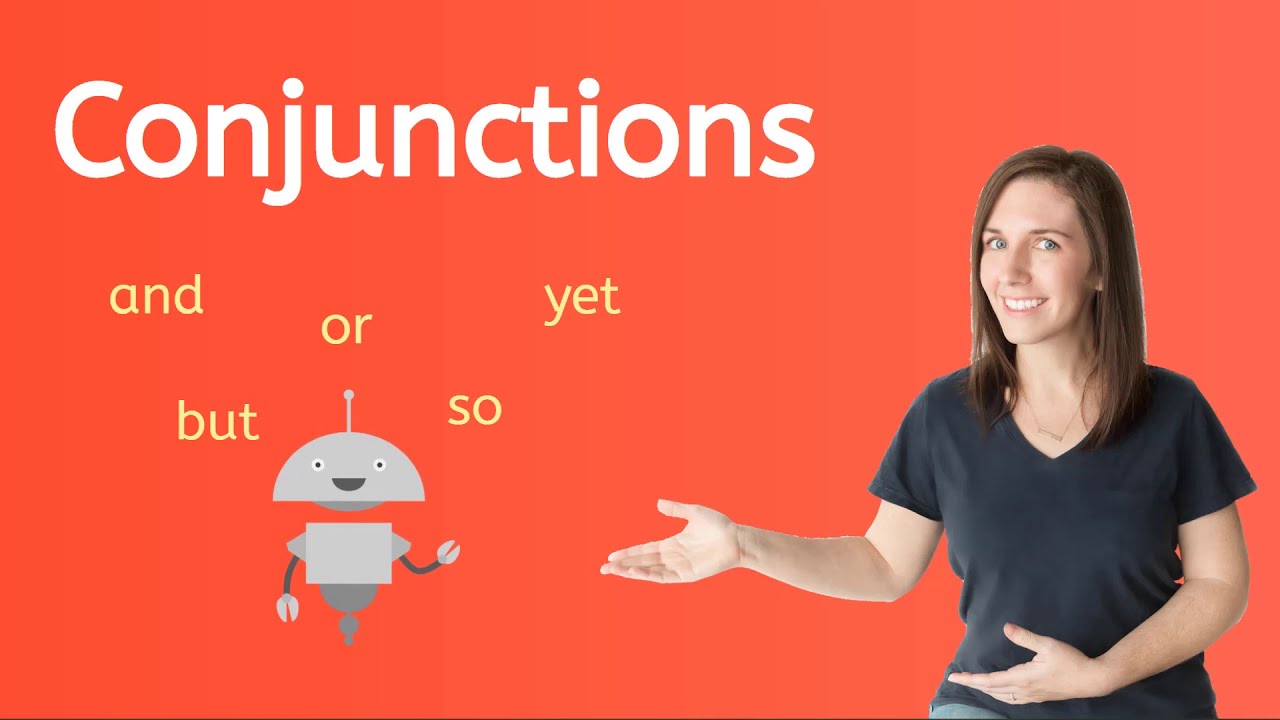
In this video, we will teach you all about conjunctions.
We hope you are enjoying our large selection of engaging core & elective K-12 learning videos. New videos are added all the time - make sure you come back often to learn more! If you'd like us to cover any additional topics, please let us know.
For practice, assessment, and many interactive activities that go along with each video, as well as a teacher/parent dashboard, go to Miacademy.co for Grades K-8 or Miaprep.com for grades 9-12!

Let's learn how and when we should call 911!
We hope you are enjoying our large selection of engaging core & elective K-12 learning videos. New videos are added all the time - make sure you come back often to learn more! If you'd like us to cover any additional topics, please let us know. For practice, assessment, and many interactive activities that go along with each video, as well as a teacher/parent dashboard, go to Miacademy.co for Grades K-8 or Miaprep.com for grades 9-12!

In this video we will look at how words are broken up into sound parts, or syllables.
We hope you are enjoying our large selection of engaging core & elective K-12 learning videos. New videos are added all the time - make sure you come back often to learn more! If you'd like us to cover any additional topics, please let us know.
For practice, assessment, and many interactive activities that go along with each video, as well as a teacher/parent dashboard, go to Miacademy.co for Grades K-8 or Miaprep.com for grades 9-12!
Learn about apostrophes.
We hope you are enjoying this video! For more in-depth learning, check out Miacademy.co (https://www.parents.miacademy.co/), an online learning platform with lessons and practice games that go along with our videos. Use coupon code VIDEOSPECIAL for a discount. Good for homeschoolers, Parents, Teachers, or anyone with kids in grades K-8.
Miacademy also offers many hands-on learning activities including a business simulation, writing in the Miacademy weekly, and creating artwork. Teaching social skills is also one of the key values at Miacademy. On the site, kids can interact safely in a moderated environment and share their artwork, videos, and ideas with each other.

Let's learn what to put in a first aid kit!
We hope you are enjoying our large selection of engaging core & elective K-12 learning videos. New videos are added all the time - make sure you come back often to learn more! If you'd like us to cover any additional topics, please let us know. For practice, assessment, and many interactive activities that go along with each video, as well as a teacher/parent dashboard, go to Miacademy.co for Grades K-8 or Miaprep.com for grades 9-12!

Let's learn how to sweep the floor with a broom!
We hope you are enjoying our large selection of engaging core & elective K-12 learning videos. New videos are added all the time - make sure you come back often to learn more! If you'd like us to cover any additional topics, please let us know. For practice, assessment, and many interactive activities that go along with each video, as well as a teacher/parent dashboard, go to Miacademy.co for Grades K-8 or Miaprep.com for grades 9-12!

Let's learn how to set the table!
We hope you are enjoying our large selection of engaging core & elective K-12 learning videos. New videos are added all the time - make sure you come back often to learn more! If you'd like us to cover any additional topics, please let us know. For practice, assessment, and many interactive activities that go along with each video, as well as a teacher/parent dashboard, go to Miacademy.co for Grades K-8 or Miaprep.com for grades 9-12!

Today we’re going to explain how exchangers...exchange heat. We’ll look at concentric tubes, finned tubes, plate heat exchangers, and shell-and-tube heat exchangers. And we’ll look at some equations to help us sort through heat transfer and decide what heat exchangers are best suited for our designs.
Crash Course Engineering is produced in association with PBS Digital Studios: https://www.youtube.com/playli....st?list=PL1mtdjDVOoO
***
RESOURCES:
https://www.northeastern.edu/l....andherr/stem-comics/
https://www.britannica.com/tec....hnology/heat-exchang
http://www.enggcyclopedia.com/....2012/03/finned-tube-
https://www.maxxtec.com/en/pro....duct/automatisch-aus
https://www.wcrhx.com/plate-heat-exchangers
http://www.thermopedia.com/content/1121/
https://www.britannica.com/science/heat-capacity
http://www.lytron.com/Tools-an....d-Technical-Referenc
http://www.sprawls.org/ppmi2/XRAYHEAT/
http://capstone.byu.edu/previo....us-projects/test-sta
Çengel, Yunus A., and Michael A. Boles. Thermodynamics: An Engineering Approach. 8th ed., McGraw-Hill Education.
***
Crash Course is on Patreon! You can support us directly by signing up at http://www.patreon.com/crashcourse
Thanks to the following Patrons for their generous monthly contributions that help keep Crash Course free for everyone forever:
Mark Brouwer, Erika & Alexa Saur, Glenn Elliott, Justin Zingsheim, Jessica Wode, Eric Prestemon, Kathrin Benoit, Tom Trval, Jason Saslow, Nathan Taylor, Divonne Holmes à Court. Brian Thomas Gossett, Khaled El Shalakany, Indika Siriwardena, SR Foxley, Sam Ferguson, Yasenia Cruz, Eric Koslow, Caleb Weeks, Tim Curwick, D.A. Noe, Shawn Arnold, Ruth Perez, Malcolm Callis, Ken Penttinen, Advait Shinde, William McGraw, Andrei Krishkevich, Rachel Bright, Mayumi Maeda, Kathy & Tim Philip, Jirat, Eric Kitchen, Ian Dundore, Chris Peters
--
Want to find Crash Course elsewhere on the internet?
Facebook - http://www.facebook.com/YouTubeCrashCourse
Twitter - http://www.twitter.com/TheCrashCourse
Tumblr - http://thecrashcourse.tumblr.com
Support Crash Course on Patreon: http://patreon.com/crashcourse
CC Kids: http://www.youtube.com/crashcoursekids
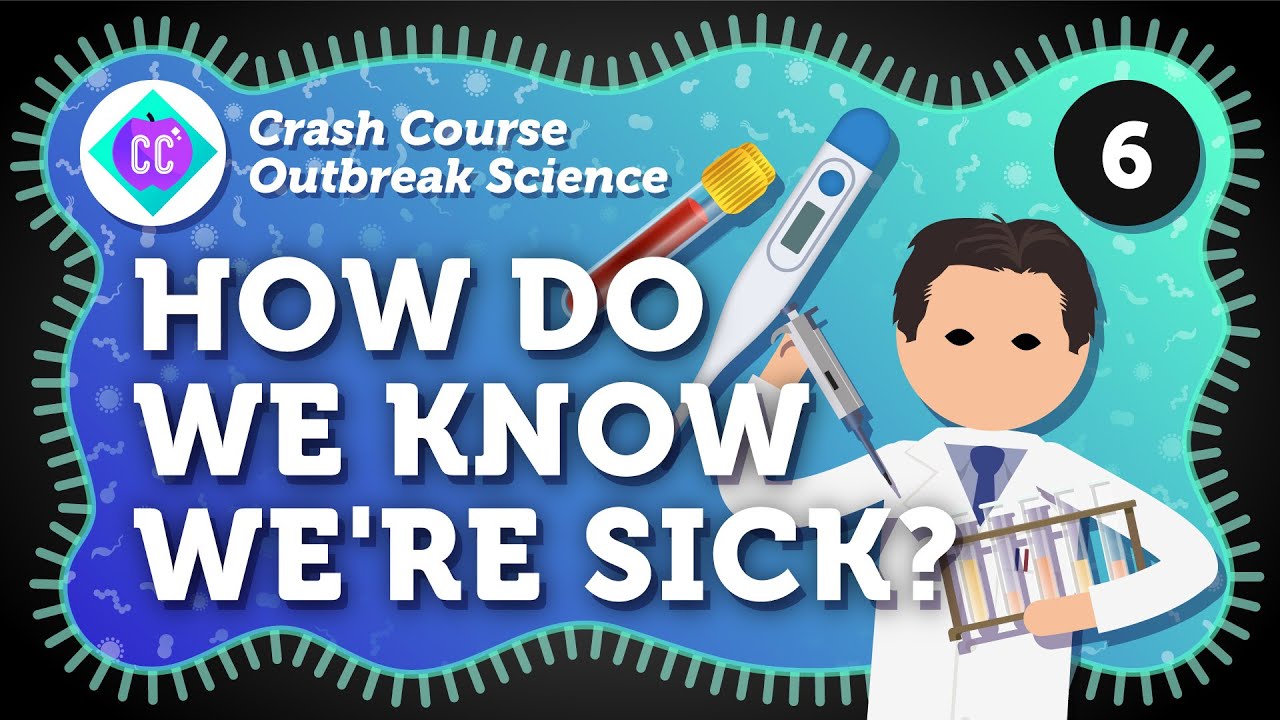
Sometimes, diagnosing patients is pretty easy, but other times... not so much. Luckily, in a medical setting we have tools that can help us figure out what's wrong with patients, and how to help them. In this episode of Crash Course Outbreak Science, we'll use clinical symptomatology and diagnostic testing to collect data and test our hypotheses about what may be wrong with some hypothetical patients, and use what we learn to help our patients get better and stop the disease from spreading to more people.
This episode of Crash Course Outbreak Science was produced by Complexly in partnership with Operation Outbreak and the Sabeti Lab at the Broad Institute of MIT and Harvard—with generous support from the Gordon and Betty Moore Foundation.
Sources:
Chapters 5 and 6 from the Operation Outbreak textbook (as provided by Todd Brown)
https://www.sciencedirect.com/....science/article/pii/
***
Watch our videos and review your learning with the Crash Course App!
Download here for Apple Devices: https://apple.co/3d4eyZo
Download here for Android Devices: https://bit.ly/2SrDulJ
Crash Course is on Patreon! You can support us directly by signing up at http://www.patreon.com/crashcourse
Thanks to the following patrons for their generous monthly contributions that help keep Crash Course free for everyone forever:
Shannon McCone, Amelia Ryczek, Ken Davidian, Brian Zachariah, Stephen Akuffo, Toni Miles, Oscar Pinto-Reyes, Erin Nicole, Steve Segreto, Michael M. Varughese, Kyle & Katherine Callahan, Laurel A Stevens, Vincent, Michael Wang, Stacey Gillespie, Jaime Willis, Krystle Young, Michael Dowling, Alexis B, Rene Duedam, Burt Humburg, Aziz, DAVID MORTON HUDSON, Perry Joyce, Scott Harrison, Mark & Susan Billian, Junrong Eric Zhu, Alan Bridgeman, Rachel Creager, Jennifer Smith, Matt Curls, Tim Kwist, Jonathan Zbikowski, Jennifer Killen, Sarah & Nathan Catchings, Brandon Westmoreland, team dorsey, Trevin Beattie, Divonne Holmes à Court, Eric Koslow, Jennifer Dineen, Indika Siriwardena, Khaled El Shalakany, Jason Rostoker, Shawn Arnold, Siobhán, Ken Penttinen, Nathan Taylor, William McGraw, Andrei Krishkevich, ThatAmericanClare, Rizwan Kassim, Sam Ferguson, Alex Hackman, Jirat, Katie Dean, neil matatall, TheDaemonCatJr, Wai Jack Sin, Ian Dundore, Matthew, Justin, Jessica Wode, Mark, Caleb Weeks
__
Want to find Crash Course elsewhere on the internet?
Facebook - http://www.facebook.com/YouTubeCrashCourse
Twitter - http://www.twitter.com/TheCrashCourse
Tumblr - http://thecrashcourse.tumblr.com
Support Crash Course on Patreon: http://patreon.com/crashcourse
CC Kids: http://www.youtube.com/crashcoursekids

So we ended the last episode nearing the close of the 1980s and Nintendo had become the dominant player in the home console market, but Sega, originally a slot machine game company during World War 2, was looking to get its own console into players’ homes. Sega’s first console wouldn't see much success, but with the introduction of Sonic the Hedgehog on the technologically superior Sega Genesis, Sega established itself as the new best thing in video games. This would be the start of a new round of console wars and the era that brought us more mature games including fighting games, 1st person shooters, and lots of sports games. This maturation of games also led us to the software ratings system by the ESRB. But Sega and Nintendo would not be the alone in the market for long, next week we’re going to talk about the entrance of technology monolith Sony and their introduction of the Playstation.
Crash Course is on Patreon! You can support us directly by signing up athttp://www.patreon.com/crashcourse
Thanks to the following Patrons for their generous monthly contributions that help keep Crash Course free for everyone forever:
Alyssa Nolden, Mark, SR Foxley, Kristina Lavoie, Sandra Aft, Eric Kitchen, Simun Niclasen, Eric Knight, Ian Dundore, Brian Thomas Gossett, Nicholas Bury, Daniel Baulig, Jessica Wode, Moritz Schmidt, Caleb Weeks, Tim Curwick, Alex S, Brian Roberds, Mayumi Maeda, Jeffrey Thompson, Montather, Noora Althani, Steve Marshall, Kathy & Tim philip, Robert Kunz, Jason A Saslow, Jirat, Jacob Ash, Christy Huddleston, and Chris Peters.
Want to find Crash Course elsewhere on the internet?
Facebook - http://www.facebook.com/YouTubeCrashC...
Twitter - http://www.twitter.com/TheCrashCourse
Tumblr - http://thecrashcourse.tumblr.com
Support Crash Course on Patreon: http://patreon.com/crashcourse
CC Kids: http://www.youtube.com/crashcoursekids

In the late 1950s and the early to mid-1960s, a Muslim minister named Malcolm X rose to prominence in the United States during the struggle for Civil Rights. Malcolm X was a member of and spokesperson for the Nation of Islam, and he was a vocal advocate for Black empowerment. His views differed significantly from a lot of the well-known Civil Rights activists of the day, and his views evolved during his ministry. Today, we’ll learn about Malcolm X’s origins, his work with the Nation of Islam, his break from that organization, and his eventual assassination.
Clint's book, How the Word is Passed is available now! https://bookshop.org/books/how....-the-word-is-passed-
VIDEO SOURCES
Peniel E. Joseph, Waiting ’ Til the Midnight Hour: A Narrative History of Black Power in America (New York: Henry Holt, 2006).
Malcolm X, The Autobiography of Malcolm X, With the assistance of Alex Haley (New York: Ballantine, 1992).
Manning Marable, Malcolm X: A Life of Reinvention (New York: Viking Press, 2011).
Ilyasah Shabazz, Growing up X: A Memoir by the Mother of Malcolm X (Penguin, 2003).
Watch our videos and review your learning with the Crash Course App!
Download here for Apple Devices: https://apple.co/3d4eyZo
Download here for Android Devices: https://bit.ly/2SrDulJ
Crash Course is on Patreon! You can support us directly by signing up at http://www.patreon.com/crashcourse
Thanks to the following patrons for their generous monthly contributions that help keep Crash Course free for everyone forever:
Justin Snyder, April Frazier, Dave Freeman, Hasan Jamal, DL Singfield, Jeremy Mysliwiec, Amelia Ryczek, Ken Davidian, Stephen Akuffo, Toni Miles, Steve Segreto, Michael M. Varughese, Kyle & Katherine Callahan, Laurel Stevens, Vincent, Michael Wang, Stacey Gillespie (Stacey J), Burt Humburg, Aziz Y, Shanta, DAVID MORTON HUDSON, Perry Joyce, Scott Harrison, Mark & Susan Billian, Junrong Eric Zhu, Alan Bridgeman, Rachel Creager, Breanna Bosso, Tim Kwist, Jonathan Zbikowski, Jennifer Killen, Sarah & Nathan Catchings, team dorsey, Trevin Beattie, Divonne Holmes à Court, Eric Koslow, Jennifer Dineen, Indika Siriwardena, Khaled El Shalakany, Jason Rostoker, Shawn Arnold, Siobhán, Ken Penttinen, Nathan Taylor, Les Aker, ClareG, Rizwan Kassim, Constance Urist, Alex Hackman, Jirat, Katie Dean, Avi Yashchin, NileMatotle, Wai Jack Sin, Ian Dundore, Justin, Mark, Caleb Weeks
__
Want to find Crash Course elsewhere on the internet?
Facebook - http://www.facebook.com/YouTubeCrashCourse
Twitter - http://www.twitter.com/TheCrashCourse
Instagram - https://www.instagram.com/thecrashcourse/
CC Kids: http://www.youtube.com/crashcoursekids

The European Renaissance may have started in Florence, but it pretty quickly moved out of Italy and spread the art, architecture, literature, and humanism across Europe to places like France, Spain, England, and the Low Countries.
SOURCES:
Hunt, Lynn et al. The Making of the West: Peoples and Cultures, 6th ed. Boston: Bedford St. Martins, 2019.
Jardine, Lisa. Erasmus, Man of Letters. Princeton: Princeton University Press, 1993.
Donald R. Kelley, Renaissance Humanism. Boston: Twayne, 1991.
Crash Course is on Patreon! You can support us directly by signing up at http://www.patreon.com/crashcourse
Thanks to the following patrons for their generous monthly contributions that help keep Crash Course free for everyone forever:
Eric Prestemon, Sam Buck, Mark Brouwer, Laura Busby, Zach Van Stanley, Bob Doye, Jennifer Killen, Naman Goel, Nathan Catchings, Brandon Westmoreland, dorsey, Indika Siriwardena, Kenneth F Penttinen, Trevin Beattie, Erika & Alexa Saur, Glenn Elliott, Justin Zingsheim, Jessica Wode, Tom Trval, Jason Saslow, Nathan Taylor, Brian Thomas Gossett, Khaled El Shalakany, SR Foxley, Yasenia Cruz, Eric Koslow, Caleb Weeks, Tim Curwick, D.A. Noe, Shawn Arnold, Malcolm Callis, William McGraw, Andrei Krishkevich, Rachel Bright, Jirat, Ian Dundore
--
Want to find Crash Course elsewhere on the internet?
Facebook - http://www.facebook.com/YouTubeCrashCourse
Twitter - http://www.twitter.com/TheCrashCourse
Tumblr - http://thecrashcourse.tumblr.com
Support Crash Course on Patreon: http://patreon.com/crashcourse
CC Kids: http://www.youtube.com/crashcoursekids
#crashcourse #history #europeanhistory

It can be daunting to move from the abstract idea stage to the realm of bank accounts, taxes, and liability. Sometimes, it can feel like you’re making arbitrary decisions, but we’re going to wade through the legalese together. Things are about to get legit.
Click here for the chart!
https://www.patreon.com/posts/crash-course-29734204?utm_medium=post_notification_email&utm_source=post_link&utm_campaign=patron_engagement
***
Crash Course is on Patreon! You can support us directly by signing up at http://www.patreon.com/crashcourse
Thanks to the following patrons for their generous monthly contributions that help keep Crash Course free for everyone forever:
Eric Prestemon, Sam Buck, Mark Brouwer, Indika Siriwardena, Avi Yashchin, Timothy J Kwist, Brian Thomas Gossett, Haixiang N/A Liu, Jonathan Zbikowski, Siobhan Sabino, Zach Van Stanley, Jennifer Killen, Nathan Catchings, Brandon Westmoreland, dorsey, Kenneth F Penttinen, Trevin Beattie, Erika & Alexa Saur, Justin Zingsheim, Jessica Wode, Tom Trval, Jason Saslow, Nathan Taylor, Khaled El Shalakany, SR Foxley, Yasenia Cruz, Eric Koslow, Caleb Weeks, Tim Curwick, David Noe, Shawn Arnold, Andrei Krishkevich, Rachel Bright, Jirat, Ian Dundore
--
Want to find Crash Course elsewhere on the internet?
Facebook - http://www.facebook.com/YouTubeCrashCourse
Twitter - http://www.twitter.com/TheCrashCourse
Tumblr - http://thecrashcourse.tumblr.com
Support Crash Course on Patreon: http://patreon.com/crashcourse
CC Kids: http://www.youtube.com/crashcoursekids

Apple Devices: https://apps.apple.com/us/app/....crash-course-watch-a
Android Devices: https://play.google.com/store/apps/details?id=com.complexly.thecrashcourse&hl=en_US
Today we're so excited to announce the free Crash Course App! (Available now for Apple and Android phones and tablets.) The app is a portal to find all of our thousands of videos and a platform to help you review what you've learned in those videos. At the heart of the app are decks which are essentially really beautiful flashcards that transform into multiple choice questions in quiz mode. The app currently supports decks for all episodes of Anatomy & Physiology, Chemistry, and Organic Chemistry, and we'll be continually adding more content. So please download the app and let us know what you think!
Crash Course is on Patreon! You can support us directly by signing up at http://www.patreon.com/crashcourse
Thanks to the following patrons for their generous monthly contributions that help keep Crash Course free for everyone forever:
Eric Prestemon, Sam Buck, Mark Brouwer, William McGraw, Siobhan Sabino, Jason Saslow, Jennifer Killen, Jon & Jennifer Smith, DAVID NOE, Jonathan Zbikowski, Shawn Arnold, Trevin Beattie, Matthew Curls, Rachel Bright, Khaled El Shalakany, Ian Dundore, Kenneth F Penttinen, Eric Koslow, TimothyJ Kwist, Indika Siriwardena, Caleb Weeks, HAIXIANGN/A LIU, Nathan Taylor, Andrei Krishkevich, Sam Ferguson, Brian Thomas Gossett, SR Foxley, Tom Trval, Justin Zingsheim, Brandon Westmoreland, dorsey, Jessica Wode, Nathan Catchings, Yasenia Cruz, Jirat
--
Want to find Crash Course elsewhere on the internet?
Facebook - http://www.facebook.com/YouTubeCrashCourse
Twitter - http://www.twitter.com/TheCrashCourse
Tumblr - http://thecrashcourse.tumblr.com
Support Crash Course on Patreon: http://patreon.com/crashcourse
CC Kids: http://www.youtube.com/crashcoursekids
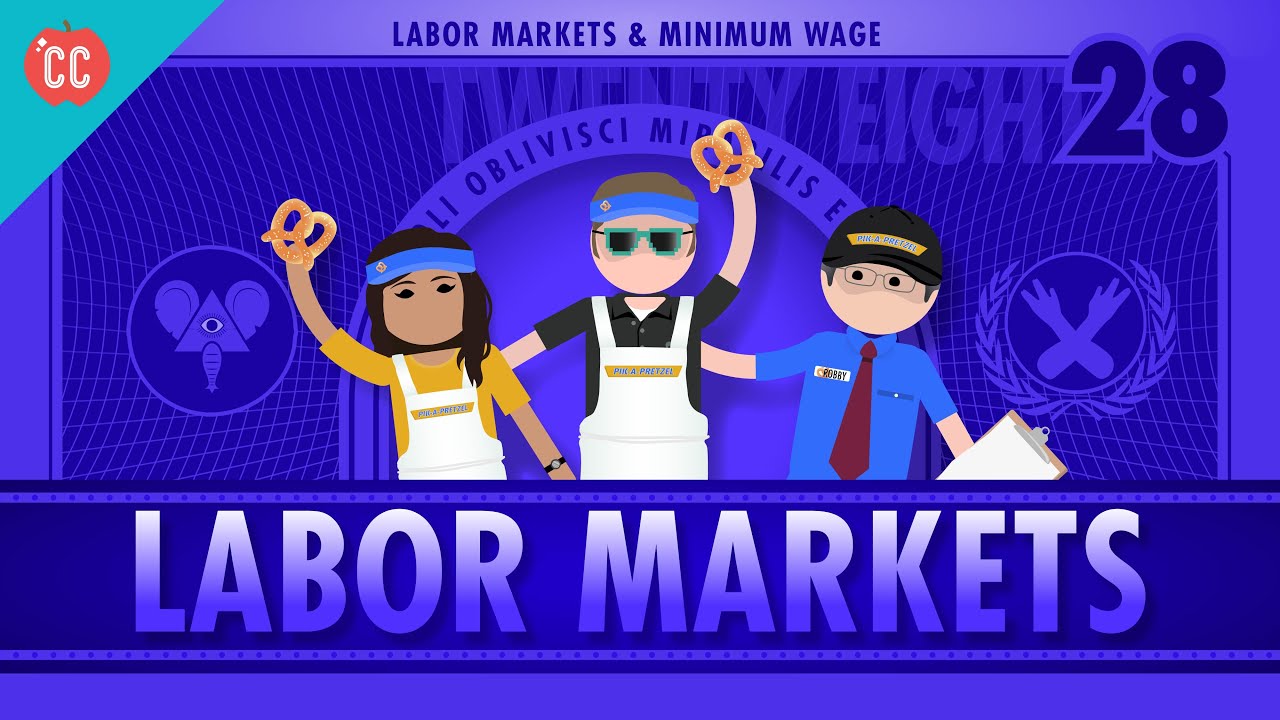
How much should you get paid for your job? Well, that depends on a lot of factors. Your skill set, the demand for the skills you have, and what other people are getting paid around you all factor in. In a lot of ways, labor markets work on supply and demand, just like many of the markets we talk about in Crash Course Econ. But, again, there aren't a lot of pure, true markets in the world. There are all kinds of oddities and regulations that change the way labor markets work. One common (and kind of controversial one) is the minimum wage. The minimum wage has potential upsides and downsides, and we'll take a look at the various arguments for an against it.
Crash Course is on Patreon! You can support us directly by signing up at http://www.patreon.com/crashcourse
Thanks to the following Patrons for their generous monthly contributions that help keep Crash Course free for everyone forever:
Mark, Eric Kitchen, Jessica Wode, Jeffrey Thompson, Steve Marshall, Moritz Schmidt, Robert Kunz, Tim Curwick, Jason A Saslow, SR Foxley, Elliot Beter, Jacob Ash, Christian, Jan Schmid, Jirat, Christy Huddleston, Daniel Baulig, Chris Peters, Anna-Ester Volozh, Ian Dundore, Caleb Weeks
--
Want to find Crash Course elsewhere on the internet?
Facebook - http://www.facebook.com/YouTubeCrashCourse
Twitter - http://www.twitter.com/TheCrashCourse
Tumblr - http://thecrashcourse.tumblr.com
Support Crash Course on Patreon: http://patreon.com/crashcourse
CC Kids: http://www.youtube.com/crashcoursekids
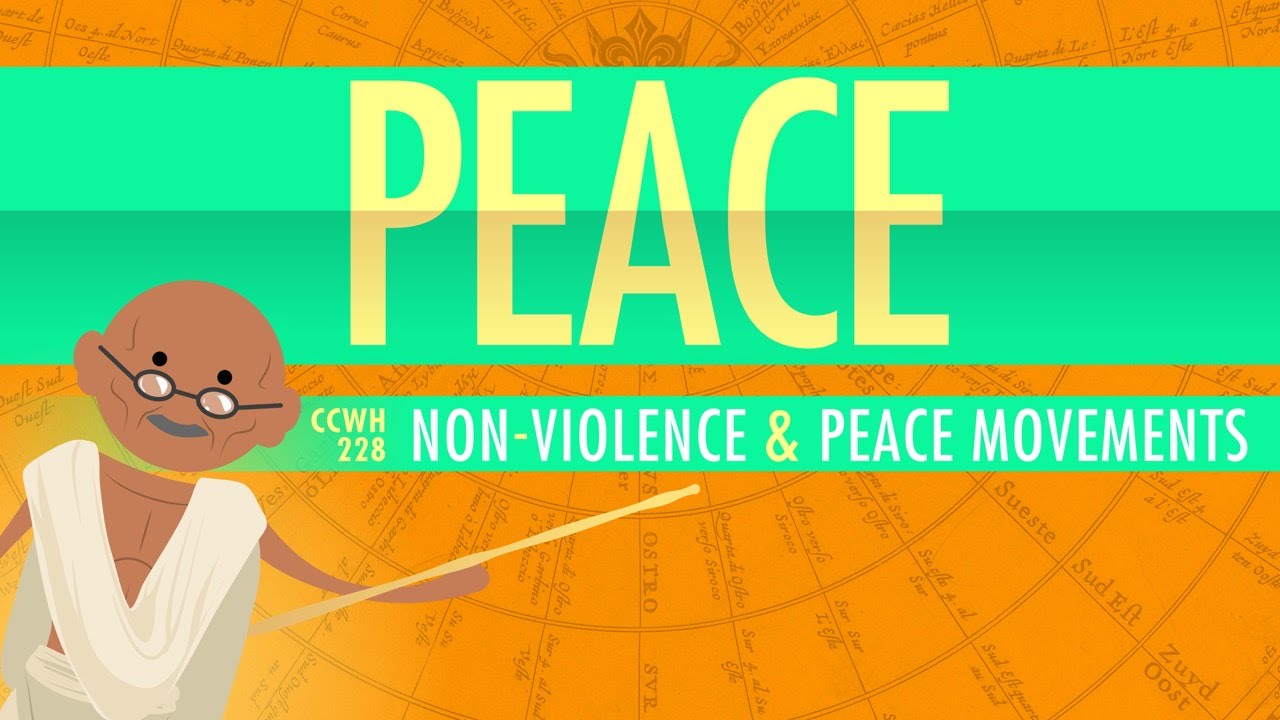
In which John Green teaches you about nonviolence and peace movements in the 20th century. What is nonviolence? What is a peace movement? Well. traditionally, humans often resort to violence when they come into conflict. In the 20th century, it became much more common for people to enact change by means of nonviolence, and there was a common thread of connection between many of the most notable advocates of peaceful change. Crash Course will take you from Gandhi to Gregg to Bayard Rustin to Martin Luther King, Jr, to the Cold War to Arab Spring along a path of nonviolent resistance and peaceful change. It's pretty great.
Citation 1: King, Martin Luther, Jr., Farewell Statement for All India Radio, 9 March 1959.
Crash Course is on Patreon! You can support us directly by signing up at http://www.patreon.com/crashcourse
Want to find Crash Course elsewhere on the internet?
Facebook - http://www.facebook.com/YouTubeCrashCourse
Twitter - http://www.twitter.com/TheCrashCourse
Instagram - https://www.instagram.com/thecrashcourse/
CC Kids: http://www.youtube.com/crashcoursekids
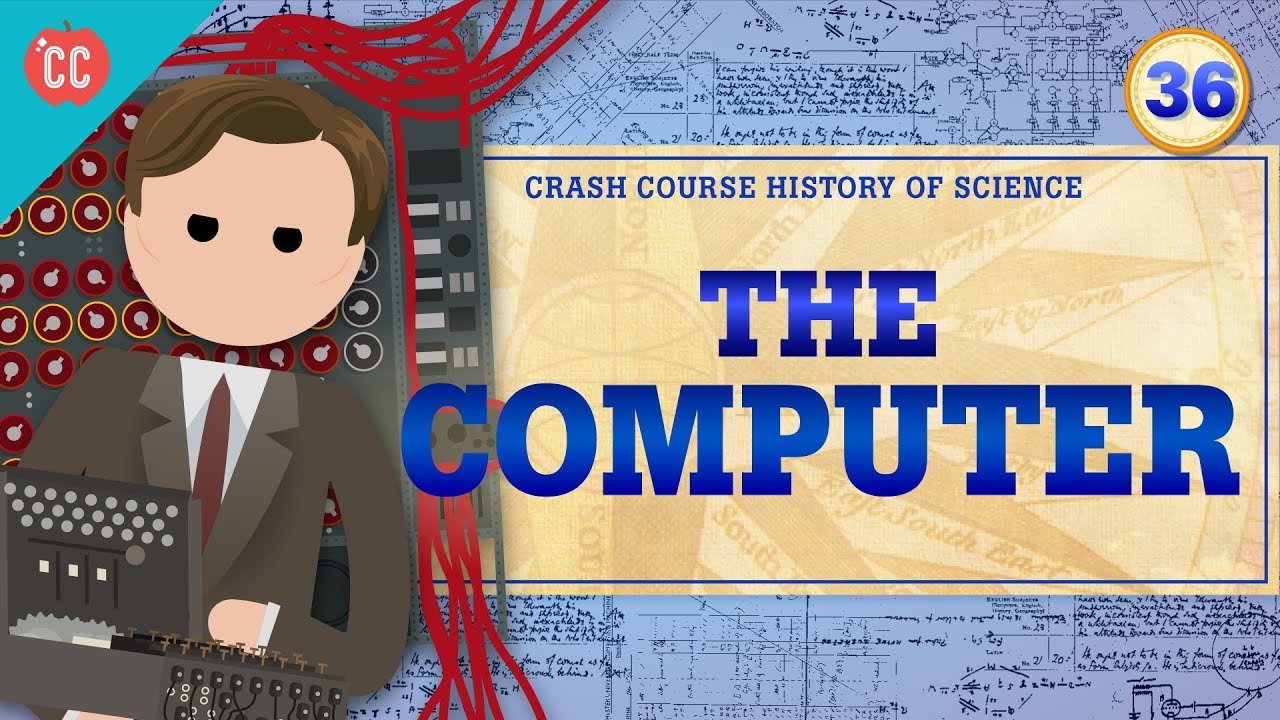
Computers and computing have changed a lot over the History of Science but ESPECIALLY over the last 100 years. In this episode of Crash Course History of Science, we have a look at that history around World War Two and how that conflict forced changes in computing.
***
Crash Course is on Patreon! You can support us directly by signing up at http://www.patreon.com/crashcourse
Thanks to the following Patrons for their generous monthly contributions that help keep Crash Course free for everyone forever:
Eric Prestemon, Sam Buck, Mark Brouwer, Bob Doye, Jennifer Killen, Naman Goel, Patrick Wiener II, Nathan Catchings, Efrain R. Pedroza, Brandon Westmoreland, dorsey, Indika Siriwardena, James Hughes, Kenneth F Penttinen, Trevin Beattie, Satya Ridhima Parvathaneni, Erika & Alexa Saur, Glenn Elliott, Justin Zingsheim, Jessica Wode, Kathrin Benoit, Tom Trval, Jason Saslow, Nathan Taylor, Brian Thomas Gossett, Khaled El Shalakany, SR Foxley, Sam Ferguson, Yasenia Cruz, Eric Koslow, Caleb Weeks, Tim Curwick, D.A. Noe, Shawn Arnold, Malcolm Callis, Advait Shinde, William McGraw, Andrei Krishkevich, Rachel Bright, Jirat, Ian Dundore
--
Want to find Crash Course elsewhere on the internet?
Facebook - http://www.facebook.com/YouTubeCrashCourse
Twitter - http://www.twitter.com/TheCrashCourse
Tumblr - http://thecrashcourse.tumblr.com
Support Crash Course on Patreon: http://patreon.com/crashcourse
CC Kids: http://www.youtube.com/crashcoursekids
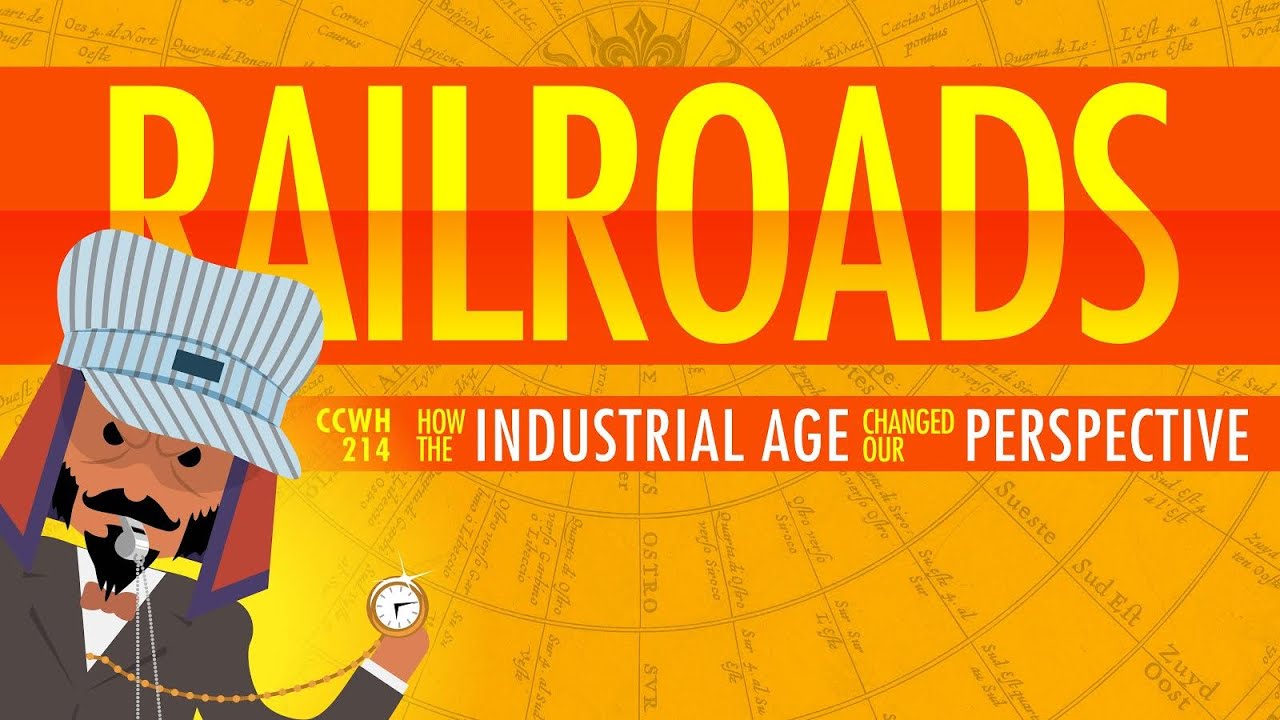
In which John Green teaches you about railroads and some of the ways they changed the world, and how they were a sort of microcosm for the Industrial Revolution as a whole. Prior to the invention of steam-powered railroads, pretty much all locomotion had been muscle-powered. You either walked where you wanted to go or rode on an animal to get where you were going. The railroad changed human perception of time and space, making long-distance travel much faster and easier. Railroads also changed habits, including increasing reading. People needed some sort of distraction to ensure they didn't have to talk to other people on the train. Like any new technology, railroads also scared people. All kinds of fears surrounded rail travel, but over time, people got over them. And the quality of boiler manufacturing improved, so the trains exploded less often, which also made people feel safer.
Crash Course is on Patreon! You can support us directly by signing up at http://www.patreon.com/crashcourse
Want to find Crash Course elsewhere on the internet?
Facebook - http://www.facebook.com/YouTubeCrashCourse
Twitter - http://www.twitter.com/TheCrashCourse
Instagram - https://www.instagram.com/thecrashcourse/
CC Kids: http://www.youtube.com/crashcoursekids