Neueste Videos

This video provides a basic introduction into the concept of electric fields. It explains how to calculate the magnitude and direction of an electric field created by a point charge as well as the net electric field produced by multiple point charges. It discusses the effect that an electric field has on positive and negative charges plus so much more. It contains plenty of examples and practice problems.
Full Videos on Patreon:
https://www.patreon.com/MathScienceTutor
Full 87 Minute Video - Part 1:
https://bit.ly/3ZfWyUU
Full 73 Minute Video - Part 2:
https://bit.ly/3WVnl7u
PDF Worksheet - 17 Questions:
https://bit.ly/3GJsJom
Physics PDF Worksheets:
https://www.video-tutor.net/ph....ysics-basic-introduc
______________________________
Join The Membership Program:
https://bit.ly/46xaQTR
Full 87 Minute Video - Part 1:
https://www.youtube.com/watch?v=MywUAlcqJng
Full 73 Minute Video - Part 2:
https://www.youtube.com/watch?v=-AWhL37lNdw
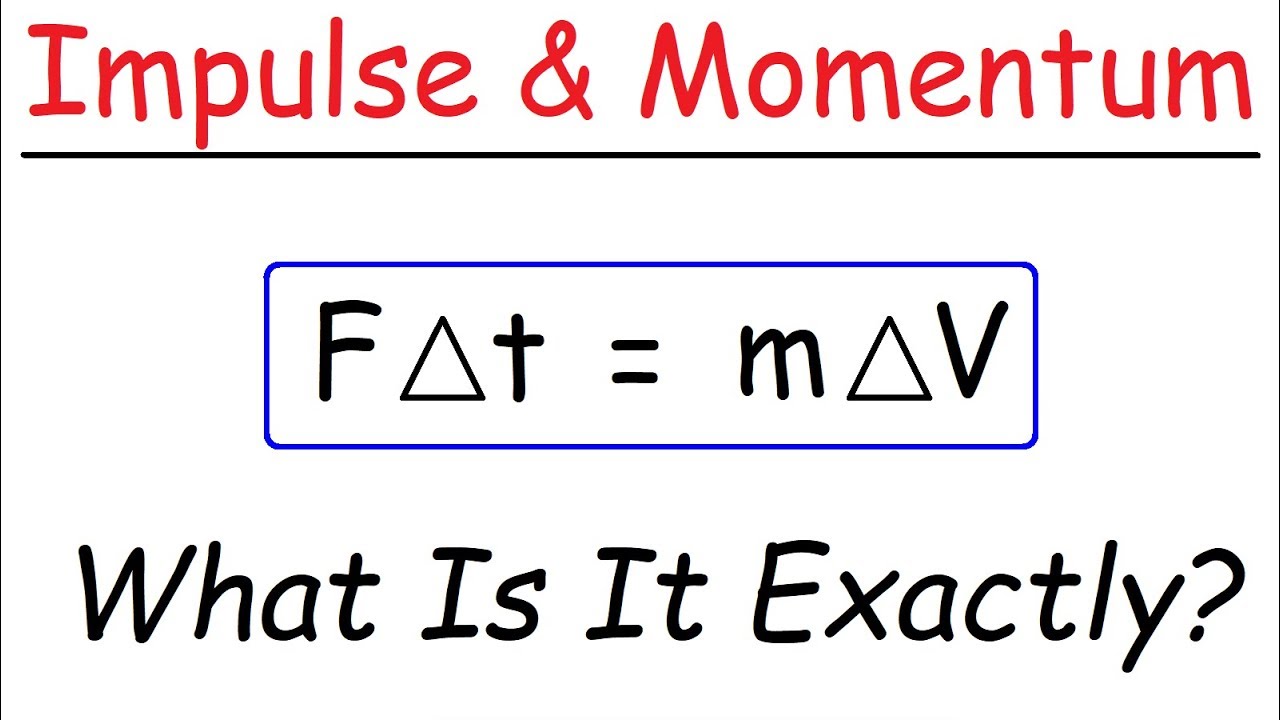
This physics video tutorial provides an introduction to impulse and momentum. It discusses the impulse momentum theorem and the definition of force using newton's second law.
Conservation of Momentum: https://www.youtube.com/watch?v=Fp7D5D8Bqjc
Rocket Propulsion:
https://www.youtube.com/watch?v=kvAf-Xouj8s
What Really Is a Force?
https://www.youtube.com/watch?v=mril0zFVJXQ
Inelastic Collisions:
https://www.youtube.com/watch?v=C1XuwHLacao
Impulse Momentum Theorem:
https://www.youtube.com/watch?v=1WIECGg71WY
____________________________
Force-Time Graphs:
https://www.youtube.com/watch?v=Bv9ry123zck
Ballistic Pendulum Problem:
https://www.youtube.com/watch?v=PUNKqLkELbQ
Elastic Collisions:
https://www.youtube.com/watch?v=CFbo_nBdBco
2D Collision Problems:
https://www.youtube.com/watch?v=9YRgHikdcqs
Impulse & Momentum Test Review:
https://www.youtube.com/watch?v=FfaEbqmvKQA
_____________________________
Center of Mass Problems:
https://www.youtube.com/watch?v=2uszSnvzBEU
Center of Mass - Calculus:
https://www.youtube.com/watch?v=SWu_i-19Rn0
Intro to Rotational Motion:
https://www.youtube.com/watch?v=WQ9AH2S8B6Y
Full-Length Videos and Worksheets:
https://www.patreon.com/MathSc....ienceTutor/collectio
Physics PDF Worksheets:
https://www.video-tutor.net/ph....ysics-basic-introduc
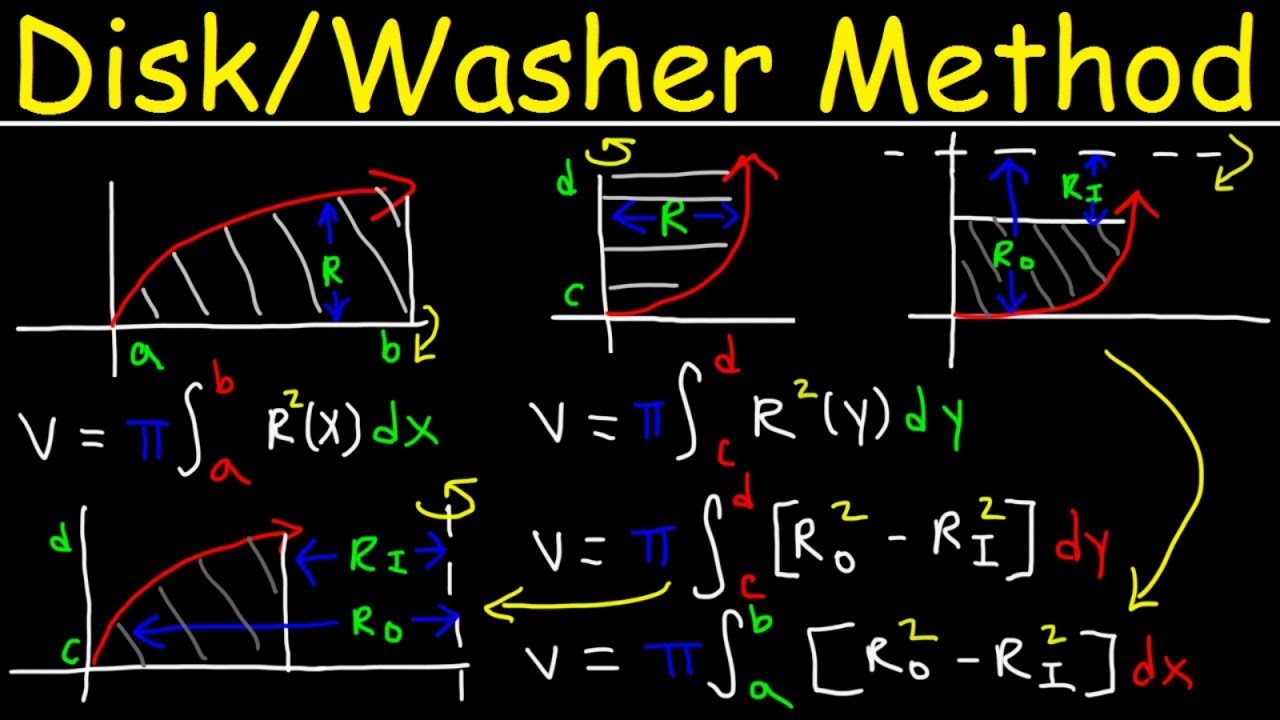
This calculus video tutorial explains how to use the disk method and the washer method to calculate the volume of a solid when the region enclosed by the curves are rotated around the x axis, y axis, and non axis or another line parallel to the x or y axis. This video contains plenty of examples and practice problems for you to work on. It shows you how to set up and evaluate the definite integral. Techniques include expanding a binomial expression and basic integration rules.
Full 1 Hour 44 Minute Video:
https://www.patreon.com/MathScienceTutor
Direct Link to The Full Video:
https://bit.ly/2V17469
_________________________________
Full 1 Hour 44 Minute Video:
https://www.youtube.com/watch?v=7CMTMCS0Zq0
Join The Membership Program:
https://bit.ly/46xaQTR

This video tutorial shows you how to graph conic sections such as circles, ellipses, parabolas, and hyperbolas and how to write it in standard form by completing the square.
Conic Sections - Basic Introduction: https://www.youtube.com/watch?v=YWHyovdHqkg
Finding The Radius and Center of a Circle:
https://www.youtube.com/watch?v=vSw9VAM8hfY
Writing Equations and Graphing Circles:
https://www.youtube.com/watch?v=u_39J-syjB0
Writing Equations of Ellipses:
https://www.youtube.com/watch?v=OPSCKXXvWiM
Circumference of an Ellipse:
https://www.youtube.com/watch?v=r5pl_stL4c0
Area of an Ellipse:
https://www.youtube.com/watch?v=Mw3MeDLL8d4
____________________________
Eccentricity of an Ellipse:
https://www.youtube.com/watch?v=9hyQksn80ug
Hyperbolas - Conic Sections:
https://www.youtube.com/watch?v=Iu-4-fizlD4
Parabolas - Focus and Directrix:
https://www.youtube.com/watch?v=KYgmOTLbuqE
How To Find The Vertex of a Parabola:
https://www.youtube.com/watch?v=qsA3e5lGwKo
Conic Sections Quiz:
https://www.youtube.com/watch?v=vqZO_CrEdPs
_____________________________
Arithmetic Sequences:
https://www.youtube.com/watch?v=XZJdyPkCxuE
Geometric Sequences:
https://www.youtube.com/watch?v=zRKZ0-kOUZM
Probability - Basic Intro:
https://www.youtube.com/watch?v=SkidyDQuupA
Intro to Statistics:
https://www.youtube.com/watch?v=XZo4xyJXCak
Final Exams and Videos Playlists:
https://www.video-tutor.net/

This calculus video tutorial explains the concept of implicit differentiation and how to use it to differentiate trig functions using the product rule, quotient rule - fractions, and chain rule.
Derivatives - Fast Review: https://www.youtube.com/watch?v=5yfh5cf4-0w&t=1s
Derivatives - The Product Rule - f*g:
https://www.youtube.com/watch?v=17X5g9QArTc
Derivatives - The Quotient Rule:
https://www.youtube.com/watch?v=8jVDEcQ0wXk
Derivatives - The Chain Rule:
https://www.youtube.com/watch?v=HaHsqDjWMLU
Derivatives - Composite Functions:
https://www.youtube.com/watch?v=vNXjMTv4vHs
__________________________________
Implicit Differentiation:
https://www.youtube.com/watch?v=xbviQHhU1rA
Derivatives of Inverse Trig Functions:
https://www.youtube.com/watch?v=KbYW9FDm-Zk
Derivatives of Exponential Functions:
https://www.youtube.com/watch?v=yg_497u6JnA
Derivatives of Logarithmic Functions:
https://www.youtube.com/watch?v=Dp9sgIvaKPk
Logarithmic Differentiation:
https://www.youtube.com/watch?v=9z1Dz60mWcQ
___________________________________
Derivatives - Using Logarithms:
https://www.youtube.com/watch?v=VnB59SrT0PY
Derivatives of Inverse Functions:
https://www.youtube.com/watch?v=Hw6ltuCEtuU
Derivatives - Differentiation Rules:
https://www.youtube.com/watch?v=IvLpN1G1Ncg
Derivatives - Function Notations:
https://www.youtube.com/watch?v=7BK_mmYckmI
Derivatives - The Reciprocal Rule:
https://www.youtube.com/watch?v=dsqD5zg9hLY
_________________________________
Final Exams and Video Playlists:
https://www.video-tutor.net/
Full-Length Videos and Worksheets:
https://www.patreon.com/MathSc....ienceTutor/collectio

This chemistry video tutorial explains the concept of heisenberg's uncertainty principle in a simplified way. His principle applies mostly for small particles and events. As the uncertainty in the position of a particle increases, the uncertainty in momentum decreases. This video contains some math practice problems that illustrate Heisenberg's uncertainty principle.
Speed of Light, Frequency, Wavelength:
https://www.youtube.com/watch?v=LgYMxH1LCdo
Photon Energy:
https://www.youtube.com/watch?v=PYNSopwd1l4
The Photoelectric Effect:
https://www.youtube.com/watch?v=-LECEvusk8E
De Broglie Wavelength:
https://www.youtube.com/watch?v=cYyFPFU6s_A
The Bohr Model of Hydrogen:
https://www.youtube.com/watch?v=mXxsT1ut35Q
Heisenberg's Uncertainty Principle:
https://www.youtube.com/watch?v=BNYz5EKXVeI
________________________________
Intro to Quantum Numbers:
https://www.youtube.com/watch?v=eRIN9CPDrpo
Orbitals & Atomic Energy Levels:
https://www.youtube.com/watch?v=4sLXUr2HWIs
Maximum Number of Electrons:
https://www.youtube.com/watch?v=UNE-7AuiMGs
Intro to Electron Configuration:
https://www.youtube.com/watch?v=NIwcDnFjj98
Electron Configuration Exceptions:
https://www.youtube.com/watch?v=Ur2PuzJ7KWs
Noble Gas Notation:
https://www.youtube.com/watch?v=6MAKMnZdfbs
Electron Configuration of Ions:
https://www.youtube.com/watch?v=nlZa8lN_-Ds
_______________________________
Orbital Diagrams:
https://www.youtube.com/watch?v=6dRdMy9tgzE
Paired & Unpaired Electrons:
https://www.youtube.com/watch?v=xwWJf48yfNs
Aufbau's Principle & Hund's Rule:
https://www.youtube.com/watch?v=C6afrc1QS6Y
Paramagnetic & Diamagnetic Elements:
https://www.youtube.com/watch?v=SO983iq9GaI
Valence Electrons & Periodic Table:
https://www.youtube.com/watch?v=FPk2ziB9iX0
Effective Nuclear Charge:
https://www.youtube.com/watch?v=JDsMR1bHGO4
_________________________________
Slater's Rule:
https://www.youtube.com/watch?v=TaYUOiEe6OA
How To Identify The Element:
https://www.youtube.com/watch?v=4qwJIJUaIeQ
Quantum Numbers - Mega Review:
https://www.youtube.com/watch?v=lPptuKlCM6k
Quantum Numbers - Practice Test:
https://www.youtube.com/watch?v=E-nOH18dF-c
Final Exams and Video Playlists:
https://www.video-tutor.net/
Full-Length Videos and Worksheets:
https://www.patreon.com/MathSc....ienceTutor/collectio

This calculus 2 video tutorial provides a basic introduction into the integral test for convergence and divergence of a series with improper integrals. To perform the integral test, let the sequence be equal to a function that is continuous, positive, and decreasing on the interval [1, infinity). If these conditions are met, then the infinite series will converge if the definite integral from 1 to infinity converges. If the integral test is divergent, then the series is divergent as well. Examples and practice problems include integration techniques such as u-substitution, power rule for integration, trigonometric substitution which leads to inverse tangent functions, and completing the square before integration. The divergent harmonic series is included in this video as well.
Improper Integrals:
https://www.youtube.com/watch?v=ND9cEdfCFr0
Converging & Diverging Sequences:
https://www.youtube.com/watch?v=XdkoTb8PEG0
Monotonic & Bounded Sequences:
https://www.youtube.com/watch?v=tHy3TXmZpF0
Absolute Value Theorem - Sequences:
https://www.youtube.com/watch?v=kH5Zqg5j-3M
Squeeze Theorem - Sequences:
https://www.youtube.com/watch?v=21loY9MBK3A
________________________________
Geometric Series & Sequences:
https://www.youtube.com/watch?v=zRKZ0-kOUZM
Introduction to Series - Convergence:
https://www.youtube.com/watch?v=zg9N2gAf6a4
Divergence Test For Series:
https://www.youtube.com/watch?v=nC_IU1IzzS4
Harmonic Series:
https://www.youtube.com/watch?v=OqBZCycIYfw
Telescoping Series:
https://www.youtube.com/watch?v=XVkdhU6nJbo
__________________________________
Integral Test For Divergence:
https://www.youtube.com/watch?v=f9SJz4-UaQQ
Remainder Estimate - Integral Test:
https://www.youtube.com/watch?v=vaU5DDcTfZk
P-Series:
https://www.youtube.com/watch?v=x621rtIwb_4
Direct Comparison Test:
https://www.youtube.com/watch?v=oZtAgihok5s
Limit Comparison Test:
https://www.youtube.com/watch?v=LBxYQ0TJxYM
___________________________________
Calculus Final Exam and Video Playlists:
https://www.video-tutor.net/
Full-Length Videos and Worksheets:
https://www.patreon.com/MathSc....ienceTutor/collectio
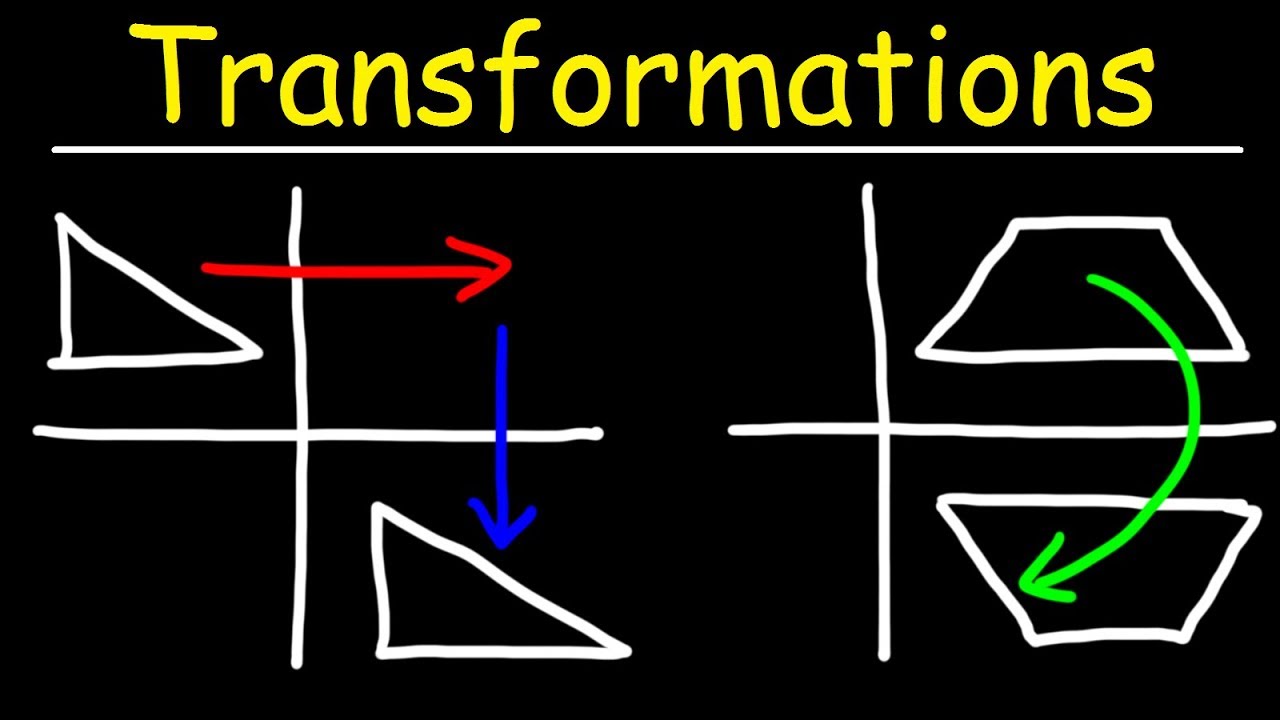
This geometry video tutorial focuses on translations reflections and rotations of geometric figures such as triangles and quadrilaterals. Transformations include horizontal and vertical translations, reflection about a line of symmetry such as the x-axis, y-axis and origin as well as rotating a figure clockwise and counterclockwise by 90 degrees and 180 on a coordinate plane. This video contains plenty of examples and practice problems.
Circles - Chords, Radius, & Diameter: https://www.youtube.com/watch?v=Bczg2VIDfhE
Central Angles, Arcs, & Chords: https://www.youtube.com/watch?v=PUNHdOl-E_w
Tangent Lines and Secant Lines: https://www.youtube.com/watch?v=XWqP9T7-HXM
Circles - Tangents, Secants, & Chords: https://www.youtube.com/watch?v=nd46bA9DKE0
Tangent - Tangent Angle Theorem: https://www.youtube.com/watch?v=c3NOVIRyuVw
Inscribed & Circumscribed Polygons: https://www.youtube.com/watch?v=lvS4dNlqQAc
Circles - Power Theorems: https://www.youtube.com/watch?v=KFV70dj5OMw
Circle Theorems: https://www.youtube.com/watch?v=GppOSNTi5OA
2 Column Proofs With Circles: https://www.youtube.com/watch?v=_PT7WpRj8ro
Circles - Geometry: https://www.youtube.com/watch?v=tJSjTiJeO94
Incenter, Circumcenter, & Orthocenter: https://www.youtube.com/watch?v=EZ4rHobpDOA
Distance Between a Point and a Line: https://www.youtube.com/watch?v=5BDrdI3rdQY
Area of a Triangle With Vertices: https://www.youtube.com/watch?v=70zQzMPNIKQ
Coordinate Geometry: https://www.youtube.com/watch?v=PXnAKcBipKM
______________________________________________________________________________________________
Lines, Rays, Line Segments, & Angles: https://www.youtube.com/watch?v=oeO8f0taQDA
Angle Bisector Theorem - Midpoints: https://www.youtube.com/watch?v=2I7ghedeoec
Complementary & Supplementary Angles: https://www.youtube.com/watch?v=MKgsObfVHmk
Alternate Interior & Exterior Angles: https://www.youtube.com/watch?v=e4o7X6LyX-I
2 Column Proofs of Congruent Segments: https://www.youtube.com/watch?v=cboityRIf4Q
Triangle Congruence - SSS, SAS, ASA: https://www.youtube.com/watch?v=jWHOF6cFbpw
Hypotenuse Leg Theorem - HL Postulate: https://www.youtube.com/watch?v=DKSTjS0n3mY
Altitude, Median, Midpoint & P. Bisector: https://www.youtube.com/watch?v=SyzkgBjXtIs
The Exterior Angle Theorem: https://www.youtube.com/watch?v=ndqxxAUDF5Y
______________________________________________________________________________________________
Polygons: https://www.youtube.com/watch?v=E_-3ulbtcLk
Quadrilaterals: https://www.youtube.com/watch?v=ogcH3eM5beM
Parallelograms: https://www.youtube.com/watch?v=t42sLuns4Qs
Skew Lines: https://www.youtube.com/watch?v=cemF45vNOhg
Points, Lines, Planes, & Segments: https://www.youtube.com/watch?v=dDWjhRfBsKM
Triangle Similarity - SSS, SAS, & AAA: https://www.youtube.com/watch?v=VXlFEilh-cw
Trigonometric Ratios: https://www.youtube.com/watch?v=9-eHMMpQC2k
_______________________________________________________________________________________________
Area - Rectangles, Triangles, & Circles: https://www.youtube.com/watch?v=JnLDmw3bbuw
Area of a Rhombus: https://www.youtube.com/watch?v=3Jx9gGpGbrA
Area of Regular Polygons: https://www.youtube.com/watch?v=bwyYgCGNOQ4
3D Shapes - Faces, Edges, & Vertices: https://www.youtube.com/watch?v=Wmwe1fmR1SM
Volume of a Rectangular Prism: https://www.youtube.com/watch?v=rNIKbT0-ywU
Triangular Prism - Lateral Area: https://www.youtube.com/watch?v=PljECBkHQpg
Surface Area - Hexagonal Prism: https://www.youtube.com/watch?v=JKyF2r-bIC0
Diagonal Length of a Cube: https://www.youtube.com/watch?v=wr3EvQZzoRI
______________________________________________________________________________________________
Geometry Review - Study Guide: https://www.youtube.com/watch?v=KtZai86htng
Geometry Final Exam Review Questions: https://www.youtube.com/watch?v=puxjcvBL2IE
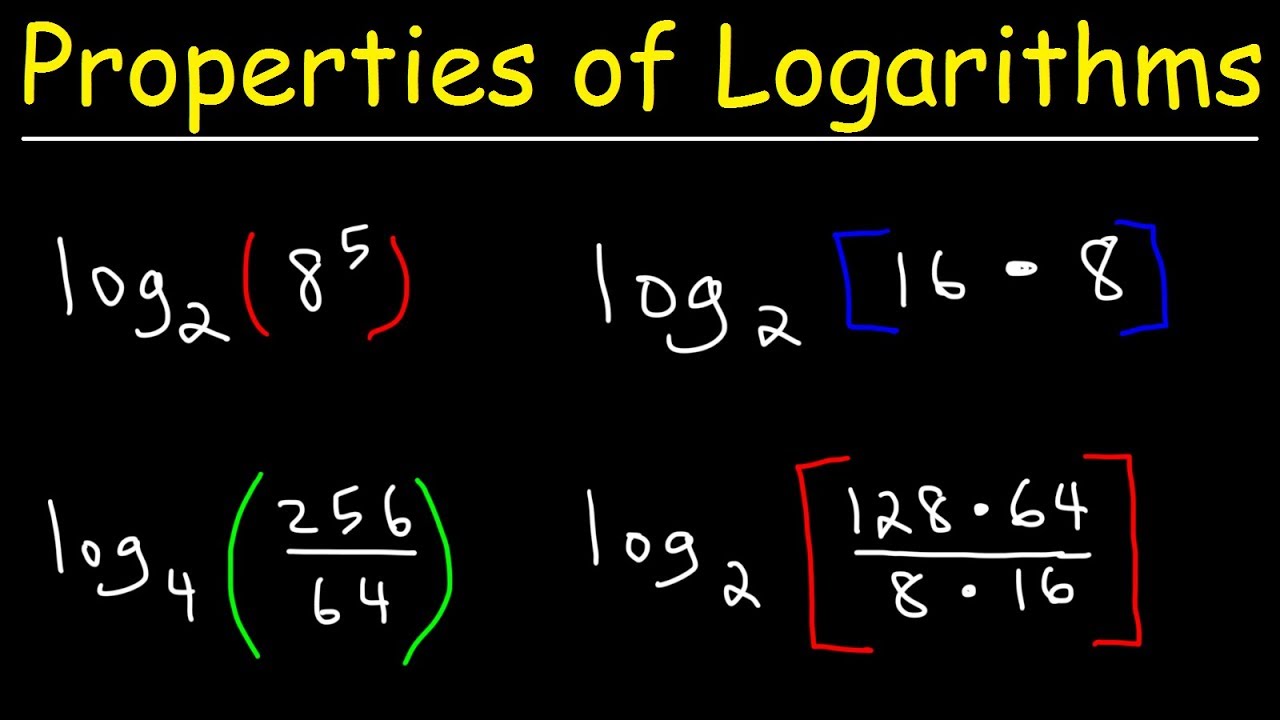
This algebra video tutorial provides a basic introduction into the properties of logarithms. It explains how to evaluate logarithmic expressions without a calculator using basic properties of logarithmic functions.
Logarithms - The Easy Way!
https://www.youtube.com/watch?v=kqVpPSzkTYA
Log to Exponential Form:
https://www.youtube.com/watch?v=f0C1KL7GkqY
Change of Base Formula:
https://www.youtube.com/watch?v=FFm-zaFW_X4
Change of Base Log Problem:
https://www.youtube.com/watch?v=p7hD9VdXv9U
Properties of Logarithms:
https://www.youtube.com/watch?v=Jtv9Lnf7Zw8
____________________________________
Expanding Logarithmic Expressions:
https://www.youtube.com/watch?v=OIz-5MyJA3g
Condensing Logarithmic Expressions:
https://www.youtube.com/watch?v=luRrOlsB4cY
Natural Logarithms:
https://www.youtube.com/watch?v=daUlTsnCNRQ
Solving Exponential Equations:
https://www.youtube.com/watch?v=9tutJ5xrRwg
Exponential Equations - Quadratic Form:
https://www.youtube.com/watch?v=yNgmVu0R_T8
_______________________________________
Solving Logarithmic Equations:
https://www.youtube.com/watch?v=fnhFneOz6n8
Graphing Logarithmic Functions:
https://www.youtube.com/watch?v=-nptxS9rZNA
Graphing Exponential Functions:
https://www.youtube.com/watch?v=DASfP8KAyvs
Compound Interest Word Problems:
https://www.youtube.com/watch?v=Hn0eLcOSQGw
Logarithms Practice Problems:
https://www.youtube.com/watch?v=7DVbQKI600k
_______________________________________
Final Exams and Video Playlists:
https://www.video-tutor.net/
Full-Length Videos and Worksheets:
https://www.patreon.com/MathSc....ienceTutor/collectio

This physics video tutorial explains how to calculate the acceleration of a pulley system with two masses with and without kinetic friction. It also discusses how determine the tension in the rope as well. The formulas and equations are all provided in the two practice problems & examples presented in this tutorial. The full version of this video also explains how to solve the pulley problem with two hanging masses as well as how to determine the direction in which the system will move. It also explains how to solve pulley problems with inclined planes.
Full 1 Hour 28 Minute Video:
https://www.patreon.com/MathScienceTutor
Direct Link to The Full Video:
https://bit.ly/3QdBavj
PDF Worksheet - 8 Problems:
https://bit.ly/3X9hAT0
Physics PDF Worksheets:
https://www.video-tutor.net/ph....ysics-basic-introduc
__________________________________
YouTube Membership:
https://bit.ly/46xaQTR
Full 1 Hour 28 Minute Video:
https://www.youtube.com/watch?v=EJeIk8MzbHE
This video is for those of you who are considering joining my YouTube Channel Membership Program.
Join The YouTube Membership Program:
https://www.youtube.com/channe....l/UCEWpbFLzoYGPfuWUM
Patreon Membership Program:
https://www.patreon.com/MathScienceTutor
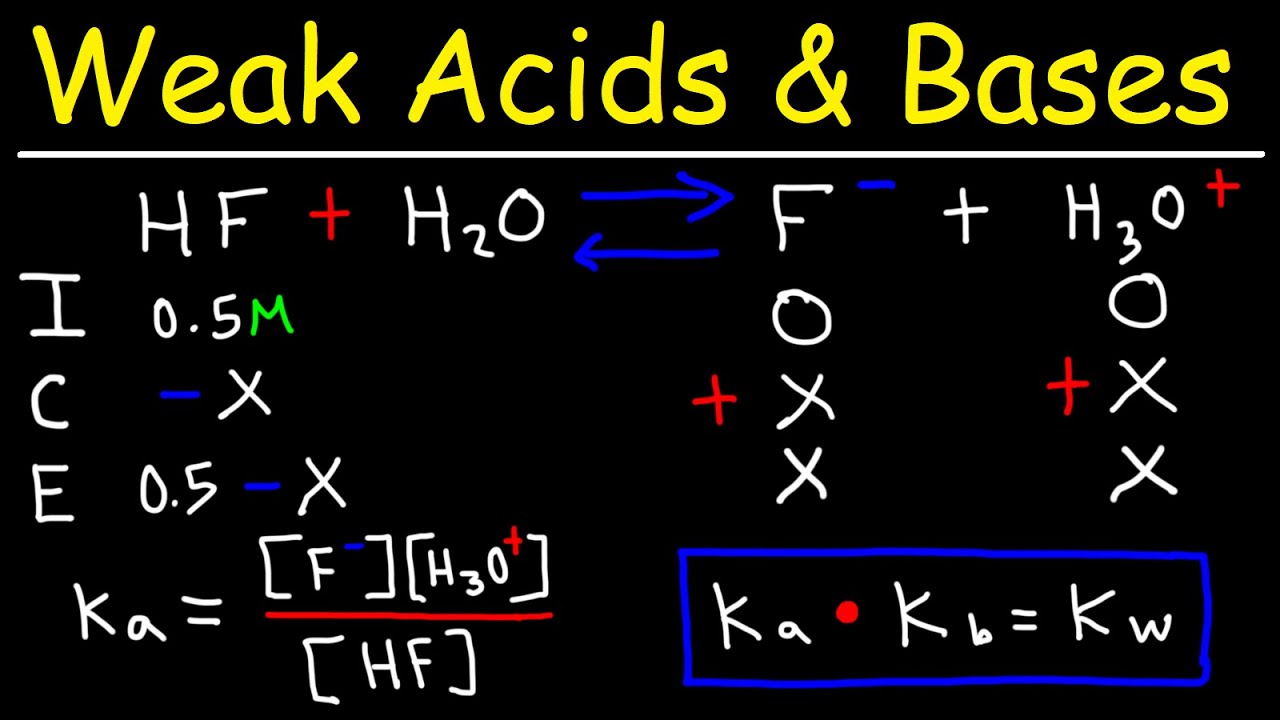
This chemistry video explains how to calculate the pH of a weak acid and a weak base. It explains how to calculate the percent ionization of a weak acid using the acid dissociation constant Ka.
Get The Full 1 Hour 33 Minute Video: https://www.patreon.com/MathScienceTutor
PDF Worksheet - 19 Questions:
https://bit.ly/3IAV0i7
Direct Link to The Full Video:
https://bit.ly/3GQUPy0
Chemistry PDF Worksheets:
https://www.video-tutor.net/ch....emistry-basic-introd
__________________________________
Full 1 Hour 33 Minute on YouTube:
https://www.youtube.com/watch?v=d7zYDKS1ovw
Join The YouTube Membership Program:
https://bit.ly/46xaQTR
General Chemistry 2 Final Exam Review:
https://www.youtube.com/watch?v=lSmJN1_uVpI
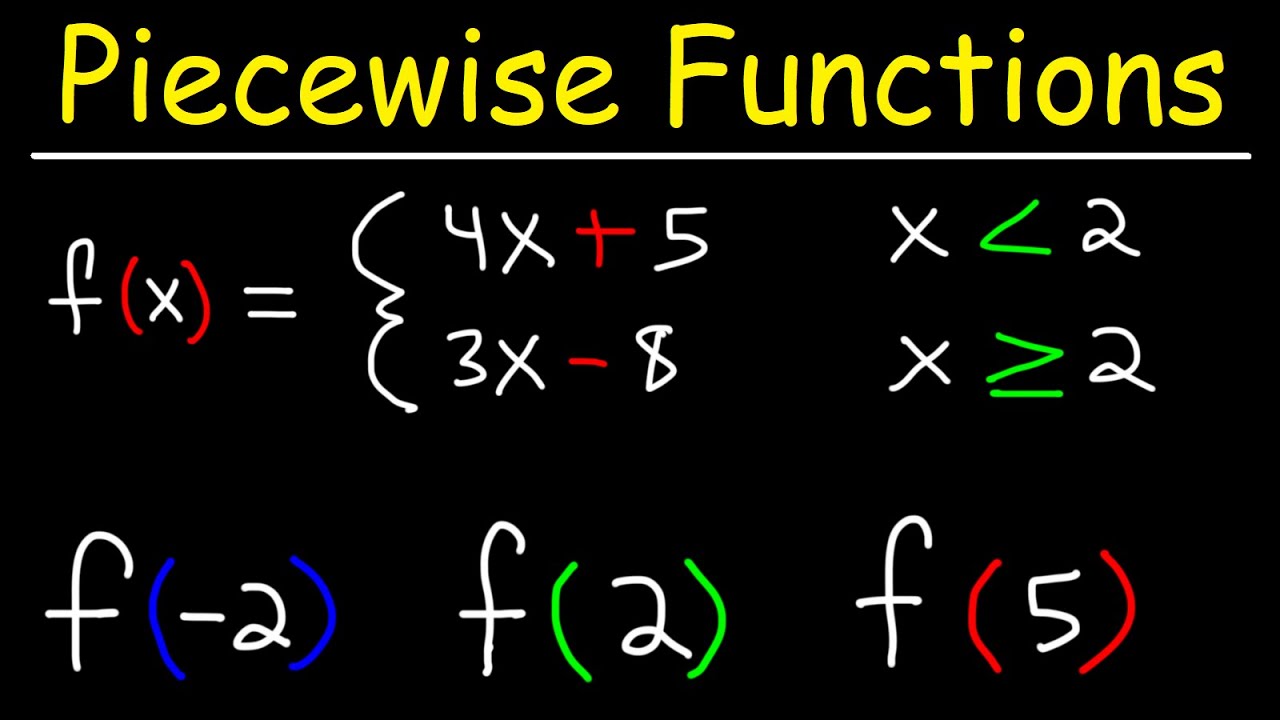
This precalculus video tutorial provides a basic introduction on evaluating piecewise functions. It contains plenty of examples and practice problems.
Introduction to Functions: https://www.youtube.com/watch?v=DrEXTC6mIO8
Evaluating Functions:
https://www.youtube.com/watch?v=HyNie_PYgsY
Function Operations:
https://www.youtube.com/watch?v=3gaxVHVI4cI
Increasing and Decreasing Functions:
https://www.youtube.com/watch?v=Dyl7jPlJXOM
Relative Maximum & Minimum Values:
https://www.youtube.com/watch?v=GaltHJF6WyI
_____________________________________
Relations and Functions:
https://www.youtube.com/watch?v=wbBY2tTqXDA
Domain and Range From a Graph:
https://www.youtube.com/watch?v=KirGQOwjBVI
How To Find The Domain of a Function:
https://www.youtube.com/watch?v=djT6-YamHaA
Average Rate of Change of a Function:
https://www.youtube.com/watch?v=f_Q0qlwlclQ
The Difference Quotient of a Function:
https://www.youtube.com/watch?v=qQgVomi8lCc
_____________________________________
Evaluating Piecewise Functions:
https://www.youtube.com/watch?v=OYOXMyFKotc
Graphing Piecewise Functions:
https://www.youtube.com/watch?v=Uzw9tsGq2Pw
Composite Functions:
https://www.youtube.com/watch?v=ZFPkQkURSxk
How To Evaluate Composite Functions:
https://www.youtube.com/watch?v=6vQxIG4lJ3w
Composite Functions - Data Table:
https://www.youtube.com/watch?v=6vQxIG4lJ3w
Comp. of 3 Functions - Data Table:
https://www.youtube.com/watch?v=Ote1KvW6BXw
Decomposing Functions:
https://www.youtube.com/watch?v=NmfaC7etZms
_________________________________
Introduction to Inverse Functions:
https://www.youtube.com/watch?v=TN4ybFiuV3k
How To Find The Inverse of a Function:
https://www.youtube.com/watch?v=2zeYEx4eTdc
Verifying Inverse Functions:
https://www.youtube.com/watch?v=6QamgSPprjA
Horizontal Line Test - 1 to 1 Functions:
https://www.youtube.com/watch?v=6u9Qh1Vi_Qw
Vertical Line Test:
https://www.youtube.com/watch?v=Mxe2lX1htNk
Graphing Inverse Functions:
https://www.youtube.com/watch?v=ukEtad_aml4
Composite and Inverse Functions:
https://www.youtube.com/watch?v=GEgFmxxOJno
__________________________________
Even and Odd Functions:
https://www.youtube.com/watch?v=fKyBOLsqRlo
Transformations of Functions:
https://www.youtube.com/watch?v=Tmdrjs9xufc
Linear Functions:
https://www.youtube.com/watch?v=BtcKotD6Ni8
Functions and Graphs - Problems:
https://www.youtube.com/watch?v=kvU9sOzT2mk
Functions - Test Review:
https://www.youtube.com/watch?v=1xATmTI-YY8
______________________________________
Final Exams and Video Playlists:
https://www.video-tutor.net/
Full-Length Videos and Worksheets:
https://www.patreon.com/MathSc....ienceTutor/collectio

This video shows you how to calculate the theoretical and percent yield in chemistry. The theoretical yield is the maximum amount of product that can be produced in a reaction. The percent yield is equal to the actual yield divided by the theoretical yield times 100%.
Introduction to Moles:
https://www.youtube.com/watch?v=EowJsC7phzw
How To Calculate The Molar Mass:
https://www.youtube.com/watch?v=c_zHROisdP4
How To Convert Grams to Moles:
https://www.youtube.com/watch?v=irYPta9G_sw
How To Convert Moles to Grams:
https://www.youtube.com/watch?v=Bj3fr5pEn7U
Moles to Atoms Conversion:
https://www.youtube.com/watch?v=mpHQZ1PrkUI
Grams to Molecules Conversion:
https://www.youtube.com/watch?v=Ch16s4kYH1Q
_________________________________
Grams to Atoms:
https://www.youtube.com/watch?v=RFCtPjZ4Vzk
Moles, Atoms, & Grams Conversions:
https://www.youtube.com/watch?v=i1EPgeu_fJ8
How To Balance Chemical Equations:
https://www.youtube.com/watch?v=iUARzSxcKzk
Stoichiometry - Basic Introduction:
https://www.youtube.com/watch?v=7Cfq0ilw7ps
Avogadro's Number:
https://www.youtube.com/watch?v=74-X94OP2XI
_________________________________
Limiting Reactant Problems:
https://www.youtube.com/watch?v=IWtkhAv4RTo
Excess Reactant Problems:
https://www.youtube.com/watch?v=-7UloVZFG00
Theoretical & Percent Yield:
https://www.youtube.com/watch?v=hhEfqa_x7RQ
Percent Yield - More Examples:
https://www.youtube.com/watch?v=w1njGAkc8og
Percent Error:
https://www.youtube.com/watch?v=JbEo46uV6d4
_________________________________
Percent Composition By Mass:
https://www.youtube.com/watch?v=bGmbyztdCHE
Empirical Formula Problems:
https://www.youtube.com/watch?v=JeSSucG-CVw
Empirical Formula - Hydrated Compounds:
https://www.youtube.com/watch?v=gl_QAO5y9Ig
Combustion Analysis:
https://www.youtube.com/watch?v=uvR7zNJ1KoI
Stoichiometry Practice Test:
https://www.youtube.com/watch?v=mP2Yg8alyR0
_______________________________________
Final Exams and Video Playlists:
https://www.video-tutor.net/
Full-Length Videos and Worksheets:
https://www.patreon.com/MathSc....ienceTutor/collectio
This algebra video tutorial explains how to simplify algebraic expressions with parentheses and variables by using the distributive property and by combining like terms.
Algebra For Beginners: https://www.youtube.com/watch?v=MHeirBPOI6w
How To Evaluate Algebraic Expressions:
https://www.youtube.com/watch?v=-VCUcRtQjx8
Combining Like Terms:
https://www.youtube.com/watch?v=BSCSNAF_aQg
How To Solve Linear Equations:
https://www.youtube.com/watch?v=7DPWeBszNSM
Linear Equations Review:
https://www.youtube.com/watch?v=Ft2_QtXAnh8
_______________________________________
Introduction to Exponents:
https://www.youtube.com/watch?v=ZtTO8uUGy2Y
Simplifying Exponents:
https://www.youtube.com/watch?v=Zt2fdy3zrZU
Negative Exponents:
https://www.youtube.com/watch?v=TKj8kEofbAw
Fractional Exponents:
https://www.youtube.com/watch?v=GipavLCnke0
Exponentiation and Tetration:
https://www.youtube.com/watch?v=S3s9cWWnZj0
______________________________________
Introduction to Polynomials:
https://www.youtube.com/watch?v=Rxx4HepHI_E
Adding & Multiplying Polynomials:
https://www.youtube.com/watch?v=ZvL9aDGNHqA
Dividing Polynomials By Monomials:
https://www.youtube.com/watch?v=KyHXWAp7UGo
Factoring Trinomials & Polynomials:
https://www.youtube.com/watch?v=9MUDAr1PnlE
Systems of Equations:
https://www.youtube.com/watch?v=oKqtgz2eo-Y
_______________________________________
Final Exams and Video Playlists:
https://www.video-tutor.net/
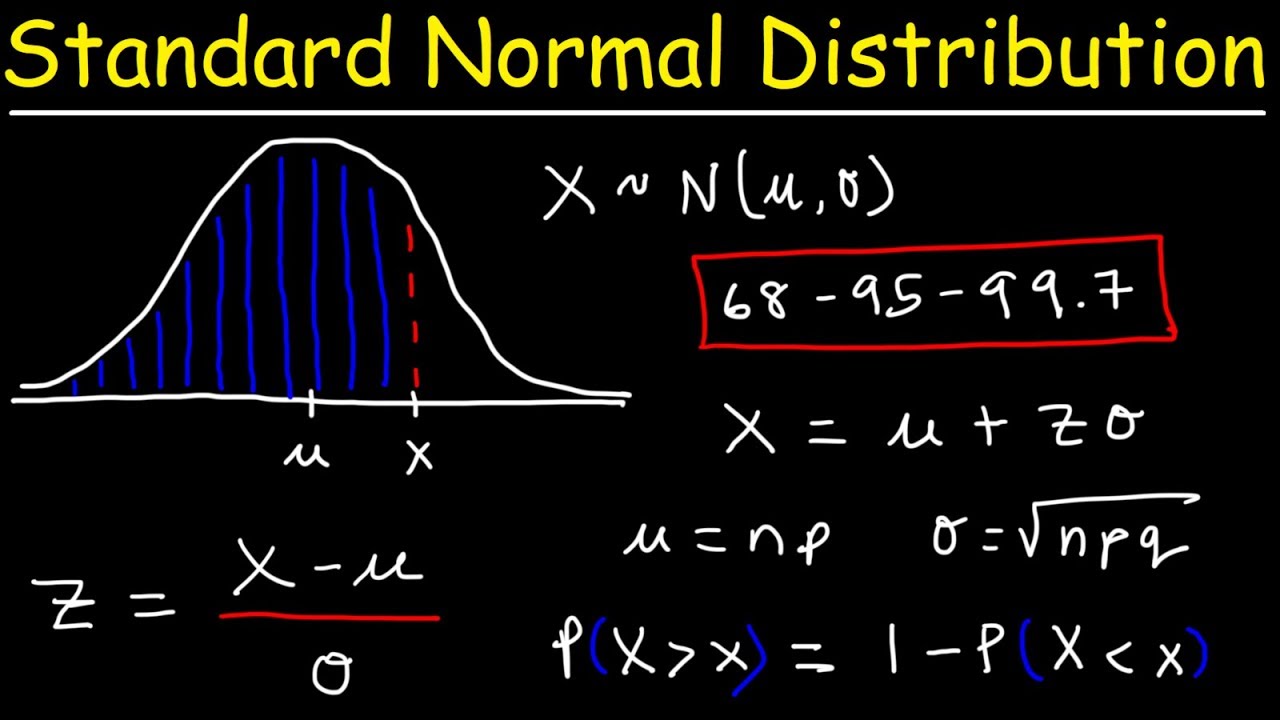
This statistics video tutorial provides a basic introduction into standard normal distributions. It explains how to find the Z-score given a value of x as well as the mean and standard deviation. It explains how to determine the probability by finding the area under the curve represented by f(x) - the probability density function using the empirical rule and the Z-tables. This video contains plenty of examples and practice problems.
Here is a list of topics:
0:00 - Introduction into standard normal distributions
6:55 - How To Find The Z-scores Given x
8:37 - How To Calculate x Given The Z Score
10:33 - Calculating Probability Using The Empirical Rule
20:24 - How To Use Z-Scores To Determine The Area Under The Curve
22:44 - How To Use Standard Normal Distribution Z-Tables
24:31 - How To Solve Probability Problems Using Z-Tables
34:15 - How To Find The 90th Percentile
42:43 - How To Calculate The Mean and Standard Deviation of a Random Sample
Introduction to Probability:
https://www.youtube.com/watch?v=SkidyDQuupA
Probability Formulas:
https://www.youtube.com/watch?v=bddckR734aM
Probability Explained:
https://www.youtube.com/watch?v=UORztmWGY6Q
Probability With Geometry:
https://www.youtube.com/watch?v=DeH5aHWxEaI
Probability of Complementary Events:
https://www.youtube.com/watch?v=0T-CaQCiSf4
Conditional Probability:
https://www.youtube.com/watch?v=sqDVrXq_eh0
__________________________________
Independent and Dependent Events:
https://www.youtube.com/watch?v=lWAdPyvm400
Probability of Mutual Exclusive Events:
https://www.youtube.com/watch?v=X6usGgwXFyU
Multiplication and Addition Rule:
https://www.youtube.com/watch?v=94AmzeR9n2w
Compound Probability:
https://www.youtube.com/watch?v=EHU6pVSczb4
Expected Value:
https://www.youtube.com/watch?v=b6VK2VPMXNI
Probability Tree Diagrams:
https://www.youtube.com/watch?v=w4wKXVwtGac
___________________________________
Bayes Theorem:
https://www.youtube.com/watch?v=OByl4RJxnKA
Probability - Binomial Distribution:
https://www.youtube.com/watch?v=3PWKQiLK41M
Probability - Geometric Distribution:
https://www.youtube.com/watch?v=d5iAWPnrH6w
Probability - Poisson Distribution:
https://www.youtube.com/watch?v=m0o-585xwW0
Continuous Probability Distributions:
https://www.youtube.com/watch?v=QxqxdQ_g2uw
Probability Density Functions:
https://www.youtube.com/watch?v=3xAIWiTJCvE
__________________________________
Probability - Uniform Distributions:
https://www.youtube.com/watch?v=KfunVw-0AH0
Probability - Exponential Distributions:
https://www.youtube.com/watch?v=J3KSjZFVbis
Probability - Normal Distributions (Calculus):
https://www.youtube.com/watch?v=gHBL5Zau3NE
Probability - Standard Normal Distributions:
https://www.youtube.com/watch?v=CjF_yQ2N638
Probability - The Law of Large Numbers:
https://www.youtube.com/watch?v=ihTpK6dXSas
___________________________________
Final Exams and Video Playlists:
https://www.video-tutor.net/

This finance video tutorial explains how to calculate the compound interest on an annual, quarterly, and monthly basis.
Logarithms - The Easy Way! https://www.youtube.com/watch?v=kqVpPSzkTYA
Log to Exponential Form:
https://www.youtube.com/watch?v=f0C1KL7GkqY
Change of Base Formula:
https://www.youtube.com/watch?v=FFm-zaFW_X4
Change of Base Log Problem:
https://www.youtube.com/watch?v=p7hD9VdXv9U
Properties of Logarithms:
https://www.youtube.com/watch?v=Jtv9Lnf7Zw8
____________________________________
Expanding Logarithmic Expressions:
https://www.youtube.com/watch?v=OIz-5MyJA3g
Condensing Logarithmic Expressions:
https://www.youtube.com/watch?v=luRrOlsB4cY
Natural Logarithms:
https://www.youtube.com/watch?v=daUlTsnCNRQ
Solving Exponential Equations:
https://www.youtube.com/watch?v=9tutJ5xrRwg
Exponential Equations - Quadratic Form:
https://www.youtube.com/watch?v=yNgmVu0R_T8
_______________________________________
Solving Logarithmic Equations:
https://www.youtube.com/watch?v=fnhFneOz6n8
Graphing Logarithmic Functions:
https://www.youtube.com/watch?v=-nptxS9rZNA
Graphing Exponential Functions:
https://www.youtube.com/watch?v=DASfP8KAyvs
Compound Interest Word Problems:
https://www.youtube.com/watch?v=Hn0eLcOSQGw
Logarithms Practice Problems:
https://www.youtube.com/watch?v=7DVbQKI600k
_______________________________________
Final Exams and Video Playlists:
https://www.video-tutor.net/
Full-Length Videos and Worksheets:
https://www.patreon.com/MathSc....ienceTutor/collectio
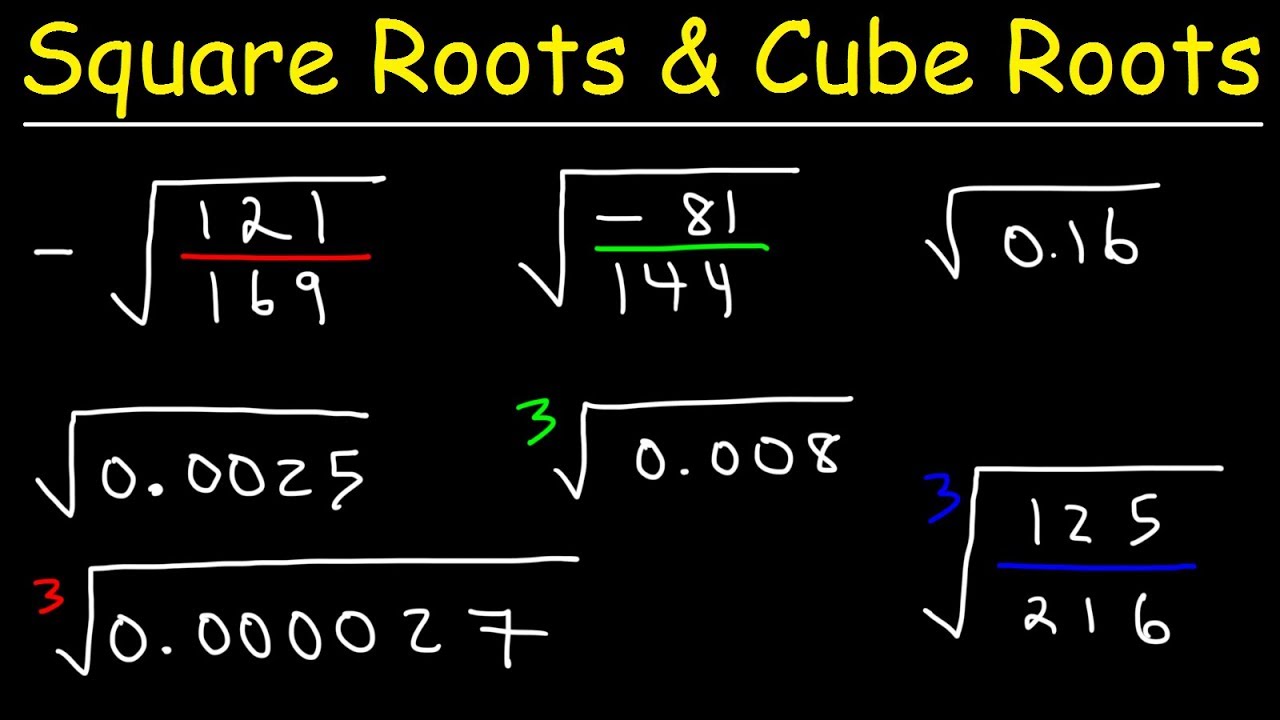
This algebra video tutorial provides a basic introduction into square roots and cube roots. It explains how to determine the square roots of negative numbers, and imaginary numbers. It also explains how to determine the cube root of positive and negative numbers as well. In addition, it mentions how to calculate the square root and cube root of certain decimal numbers. This algebra video tutorial contains plenty of examples and practice problems.
Square Roots and Cube Roots:
https://www.youtube.com/watch?v=IWzPle0KDPo
Simplifying Radical Expressions:
https://www.youtube.com/watch?v=U7AXF75rC00
Multiplying Radical Expressions:
https://www.youtube.com/watch?v=i0TMNeOwpSg
Adding & Subtracting Radicals:
https://www.youtube.com/watch?v=83wXAgwcWH0
Simplifying Cube Root Expressions:
https://www.youtube.com/watch?v=VdUNTsf14qs
__________________________________
Rationalizing The Denominator:
https://www.youtube.com/watch?v=5j8a75aHaSE
Multiplying Radicals With Different Indices:
https://www.youtube.com/watch?v=onOQMAcnj8U
How To Solve Radical Equations:
https://www.youtube.com/watch?v=0gicD4STzpg
Solving Equations With Cube Roots:
https://www.youtube.com/watch?v=mg8aS58vsN8
Solving Complex Radical Equations:
https://www.youtube.com/watch?v=laEeUSZr83s
____________________________________
How To Graph Radical Functions:
https://www.youtube.com/watch?v=8t9_IXFzH_M
Domain of Radical Functions:
https://www.youtube.com/watch?v=fOlon31vEU4
How To Graph Cube Root Functions:
https://www.youtube.com/watch?v=qxR6p_xDnho
Radical Expressions - Test Review:
https://www.youtube.com/watch?v=wOcc5EoOojE
____________________________________
Final Exams and Video Playlists:
https://www.video-tutor.net/
Full-Length Videos and Worksheets:
https://www.patreon.com/MathSc....ienceTutor/collectio
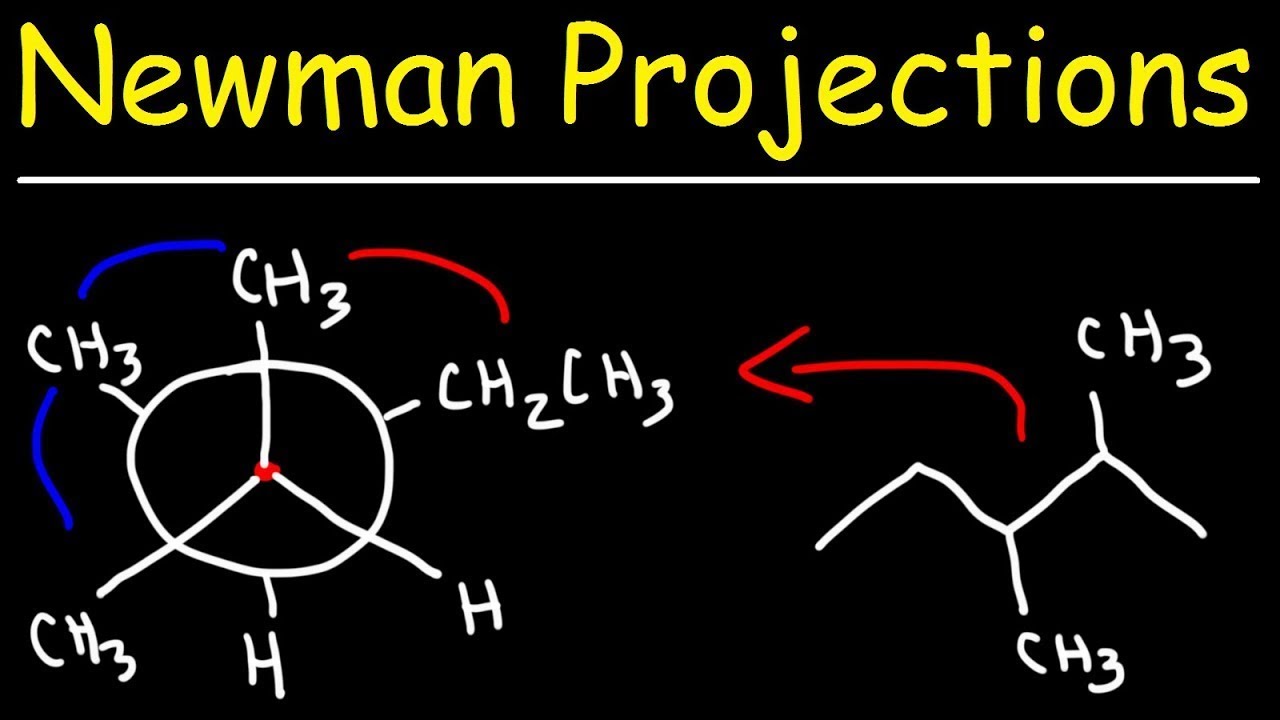
This organic chemistry video tutorial provides a basic introduction into newman projections. It explains how to draw the newman projections of ethane, butane, and 2,3-dimethylpentane. It explains how to draw the eclipsed and staggered conformations of ethane as well as the gauche and anti conformations of butane. It explains how to use conformational analysis to determine which conformation is most stable.
Access The Full 1 Hour Video:
https://www.patreon.com/MathScienceTutor
Direct Link to The Full Video:
https://bit.ly/3itPNy2
PDF Worksheet - 8 Practice Problems:
https://bit.ly/3X5l35t
Organic Chemistry PDF Worksheets:
https://www.video-tutor.net/orgo-chem.html
_______________________________________
Join The YouTube Membership Program:
https://bit.ly/46xaQTR
Full 1 Hour Video on YouTube:
https://www.youtube.com/watch?v=mXKkn8IghPU

This physics video tutorial provides a basic introduction into relative velocity problems in one dimension. It explains the concept of the frame of reference and how it's used to determine the relative velocity of an object with another regardless if the two items are traveling in the same direction or in the opposite direction. This video contains a few examples of car and train problems traveling in the same direction and in the opposite direction toward each other. It provides all of the formulas and equations needed to calculate the relative velocity.
Full 55 Minute Video:
https://www.patreon.com/MathScienceTutor
Direct Link to The Full Video:
https://bit.ly/3jTERKn
PDF Worksheet - 7 Questions:
https://bit.ly/3X23fYE
Physics PDF Worksheets:
https://www.video-tutor.net/ph....ysics-basic-introduc
______________________________
Join The Program:
https://bit.ly/46xaQTR
Full Video on YouTube:
https://www.youtube.com/watch?v=DuyWdHMeY5g
Relative Velocity Formulas + Notes:
https://www.video-tutor.net/re....lative-velocity-phys
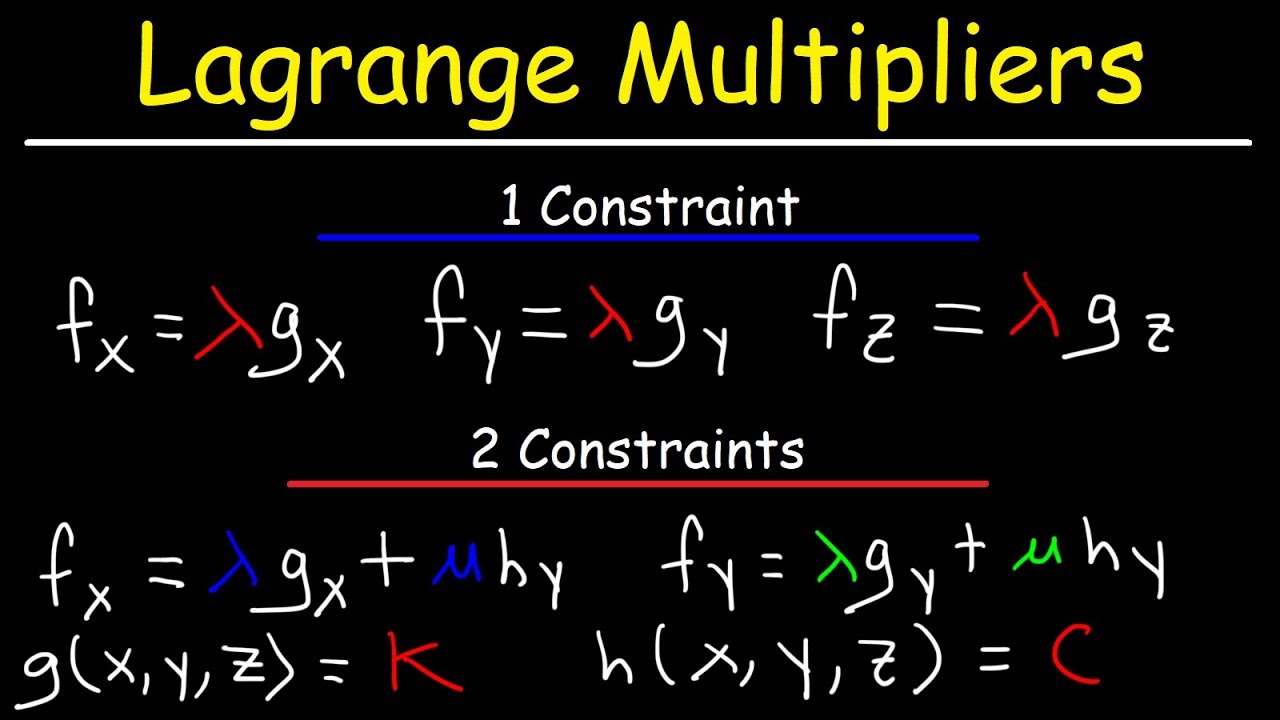
This calculus 3 video tutorial provides a basic introduction into lagrange multipliers. It explains how to find the maximum and minimum values of a function with 1 constraint and with 2 constraints.
Lines & Planes - Intersection: https://www.youtube.com/watch?v=_W3aVWsMp14
Angle Between Two Planes:
https://www.youtube.com/watch?v=7G07dPSlWbY
Distance Between Point and Plane:
https://www.youtube.com/watch?v=zWMTTRJ0l4w
Chain Rule - Partial Derivatives:
https://www.youtube.com/watch?v=XipB_uEexF0
Implicit Partial Differentiation:
https://www.youtube.com/watch?v=OBELQIPH5xY
________________________________
Directional Derivatives:
https://www.youtube.com/watch?v=CnVes9TdnPo
Limits of Multivariable Functions:
https://www.youtube.com/watch?v=E1lMMBpz8YM
Double Integrals:
https://www.youtube.com/watch?v=BJ_0FURo9RE
Local Extrema & Critical Points:
https://www.youtube.com/watch?v=UID893EosM8
Absolute Extrema - Max & Min:
https://www.youtube.com/watch?v=Hg38kfK5w4E
________________________________
Lagrange Multipliers:
https://www.youtube.com/watch?v=5-CUqogfPLY
Triple Integrals:
https://www.youtube.com/watch?v=7iy83x8bv6o
2nd Order - Differential Equations:
https://www.youtube.com/watch?v=uI2xt8nTOlQ
Undetermined Coefficients:
https://www.youtube.com/watch?v=P3fc6v191mA
Variation of Parameters:
https://www.youtube.com/watch?v=Ik3YW1JGr_A
________________________________
Final Exams and Video Playlists:
https://www.video-tutor.net/
Full-Length Videos and Worksheets:
https://www.patreon.com/MathSc....ienceTutor/collectio
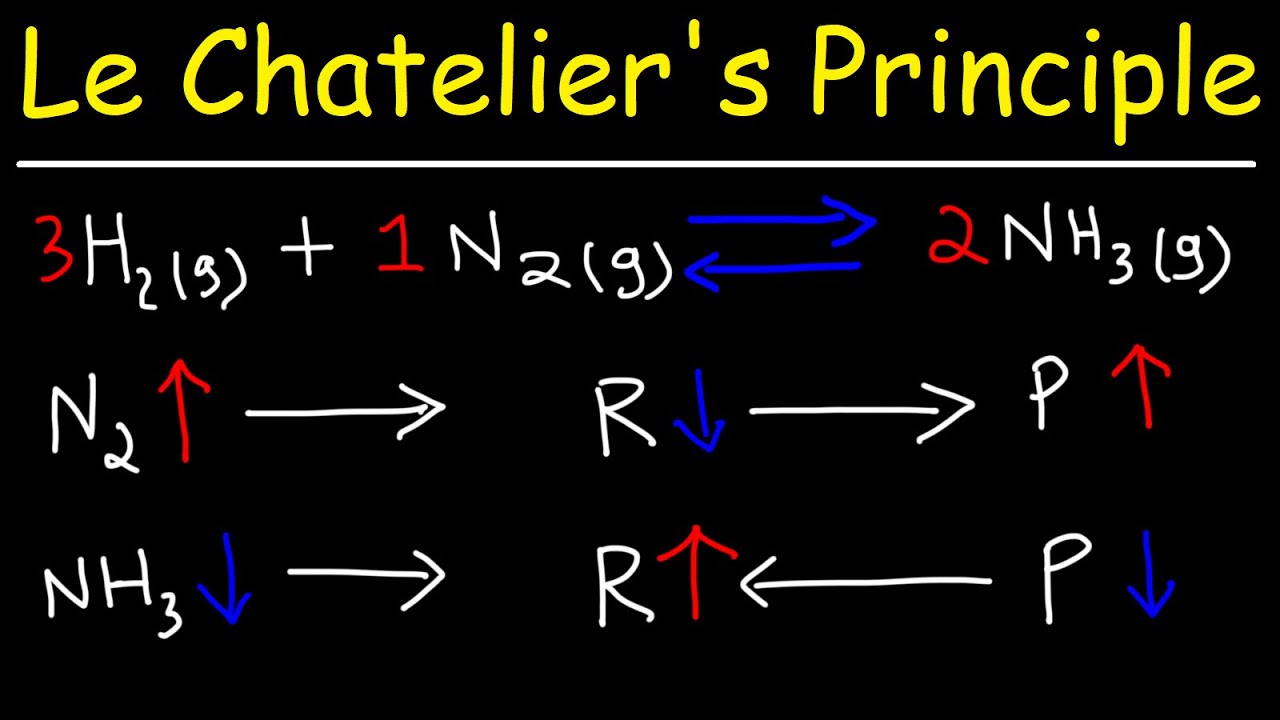
This chemistry video tutorial provides a basic introduction into Le Chatelier's Principle of chemical equilibrium. It explains how to determine which direction the reaction will shift if the concentrations of the reactants or the products increase in value. It discusses the effect of adding a catalyst or an inert gas on the position of equilibrium. It also discusses the effect of changing the volume and pressure on equilibrium.
Get The Full 1 Hour 10 Min Video:
https://www.patreon.com/MathScienceTutor
PDF Worksheet With 7 Questions:
https://bit.ly/3Gn3ve6
Direct Link to The Full Video:
https://bit.ly/3XadZVa
Chemistry PDF Worksheets:
https://www.video-tutor.net/ch....emistry-basic-introd
_____________________________
Full 1 Hour Video on YouTube:
https://www.youtube.com/watch?v=FCar3eoanXU
Join The YouTube Membership Program:
https://bit.ly/46xaQTR

This organic chemistry video tutorial provides a basic introduction into aldehydes and ketones.
Here is a list of topics:
1. Reduction of Aldehydes and Ketones With NaBH4
2. Reduction of Esters and Acid Chlorides With LiAlH4
3. Reduction of Acid Chlorides to Aldehydes Using LiAl(OR)3H
4. Reduction of Carboxylic Acids to Primary Alcohols
5. Reduction of Amides to Amines Using LiAlH4
6. Reduction of Ketones to Alcohols Using Catalytic Hydrogenation With a Raney Nickel Catalyst
7. Reduction of Imines and Nitriles to Amines
8. Reaction of Aldehydes and Ketones With a Grignard Reagent
9. Formation of Imines With Primary Amines
10. Formation of Enamines With Secondary Amines
11. Reductive Amination of Ketones Using NaBH3CN
12. Reactivity of Aldehydes and Ketones
13. Formation of Hydrates From Aldehydes
14. Hemiacetal and Acetal Formation
15. Protecting Groups Using Acetals
16. Chemioselective Reactions
17. Formation of Thioacetals
18. Clemmensen Reduction of Ketones to Alkanes
19. Wolff Kisher Reduction of Ketones to Alkanes
20. Oxidation of Aldehydes to Carboxylic Acids Using The Tollens Reagent
21. Cyanohydrin Formation Reaction Mechanism
22. Wittig Reaction Mechanism
23. Baeyer Villager Oxidation Reaction
24. Direct Addition vs Conjugate Addition of alpha beta unsaturated ketones
Subscribe:
https://www.youtube.com/channe....l/UCEWpbFLzoYGPfuWUM
Access to Premium Videos:
https://www.patreon.com/MathScienceTutor
https://www.facebook.com/MathScienceTutoring/
New Organic Chemistry Playlist
https://www.youtube.com/watch?v=6unef5Hz6SU&index=1&list=PL0o_zxa4K1BXP7TUO7656wg0uF1xYnwgm&t=0s
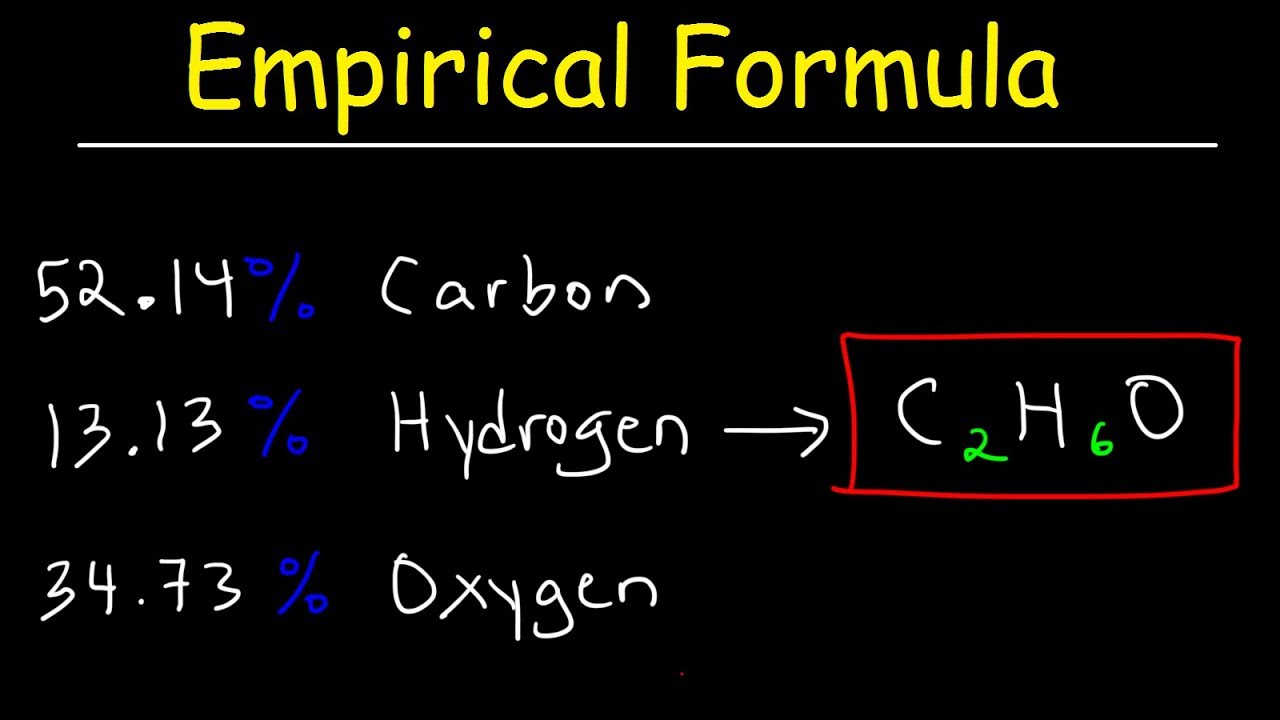
This chemistry video tutorial explains how to find the empirical formula given the mass in grams or from the percent composition of each element in a compound. If you're given the mass percent, you can simply treat it as if you were given the mass in grams. This video explains how to find the molecular formula given the molar mass of the compound. You can do this once you have the empirical formula. This video explains all of it. It has plenty of practice problems and examples for you to master this lesson.
Introduction to Moles:
https://www.youtube.com/watch?v=EowJsC7phzw
How To Calculate The Molar Mass:
https://www.youtube.com/watch?v=c_zHROisdP4
How To Convert Grams to Moles:
https://www.youtube.com/watch?v=irYPta9G_sw
How To Convert Moles to Grams:
https://www.youtube.com/watch?v=Bj3fr5pEn7U
Moles to Atoms Conversion:
https://www.youtube.com/watch?v=mpHQZ1PrkUI
Grams to Molecules Conversion:
https://www.youtube.com/watch?v=Ch16s4kYH1Q
_________________________________
Grams to Atoms:
https://www.youtube.com/watch?v=RFCtPjZ4Vzk
Moles, Atoms, & Grams Conversions:
https://www.youtube.com/watch?v=i1EPgeu_fJ8
How To Balance Chemical Equations:
https://www.youtube.com/watch?v=iUARzSxcKzk
Stoichiometry - Basic Introduction:
https://www.youtube.com/watch?v=7Cfq0ilw7ps
Avogadro's Number:
https://www.youtube.com/watch?v=74-X94OP2XI
_________________________________
Limiting Reactant Problems:
https://www.youtube.com/watch?v=IWtkhAv4RTo
Excess Reactant Problems:
https://www.youtube.com/watch?v=-7UloVZFG00
Theoretical & Percent Yield:
https://www.youtube.com/watch?v=hhEfqa_x7RQ
Percent Yield - More Examples:
https://www.youtube.com/watch?v=w1njGAkc8og
Percent Error:
https://www.youtube.com/watch?v=JbEo46uV6d4
_________________________________
Percent Composition By Mass:
https://www.youtube.com/watch?v=bGmbyztdCHE
Empirical Formula Problems:
https://www.youtube.com/watch?v=JeSSucG-CVw
Empirical Formula - Hydrated Compounds:
https://www.youtube.com/watch?v=gl_QAO5y9Ig
Combustion Analysis:
https://www.youtube.com/watch?v=uvR7zNJ1KoI
Stoichiometry Practice Test:
https://www.youtube.com/watch?v=mP2Yg8alyR0
_______________________________________
Final Exams and Video Playlists:
https://www.video-tutor.net/
Full-Length Videos and Worksheets:
https://www.patreon.com/MathSc....ienceTutor/collectio
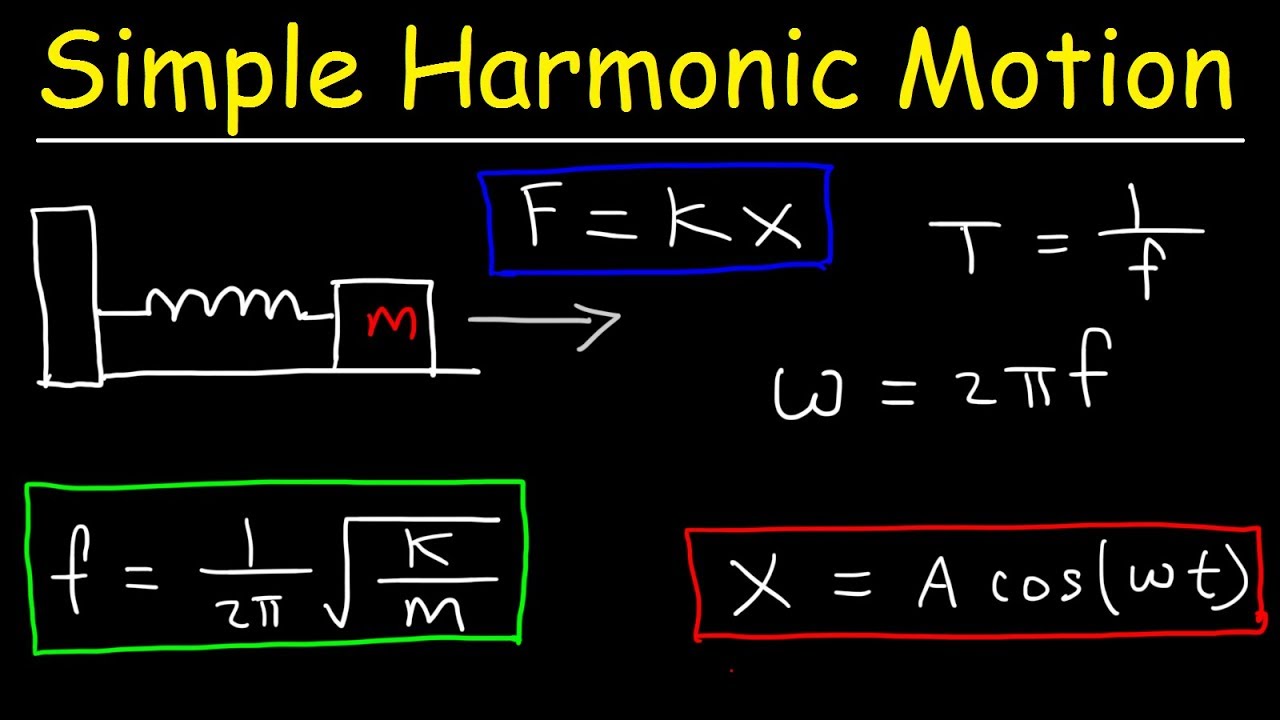
This physics video tutorial provides a basic introduction into how to solve simple harmonic motion problems in physics. It explains how to calculate the frequency, period, spring constant and the angular frequency of a mass-spring system. It also explains how to find the amplitude and frequency from a displacement cosine equation.
Intro to Pressure:
https://www.youtube.com/watch?v=kkq8ruV8_Jw
Fluid Pressure Review:
https://www.youtube.com/watch?v=nUKUzpRgdbY
Simple Harmonic Motion:
https://www.youtube.com/watch?v=_Gnke2x3vT8
Energy In a Simple Harmonic Oscillator:
https://www.youtube.com/watch?v=QvnmfBqdVIQ
Simple Harmonic Motion Review:
https://www.youtube.com/watch?v=iubb3eFBQ9U
The Simple Pendulum:
https://www.youtube.com/watch?v=1Q15fgz-lUk
_______________________________
The Physical Pendulum:
https://www.youtube.com/watch?v=scIVIhChL1I
Mechanical Waves Problems:
https://www.youtube.com/watch?v=qm1hDJrIYwE
Wave Speed on a String:
https://www.youtube.com/watch?v=vEzftaDL7fM
Standing Waves on a String:
https://www.youtube.com/watch?v=-8nn8hb0H8o
Speed of Sound In Matter:
https://www.youtube.com/watch?v=kr4nOru3JZU
Sound Intensity Physics Problems:
https://www.youtube.com/watch?v=6ZQYALZqZNQ
_______________________________
Sound Intensity Level:
https://www.youtube.com/watch?v=twppI9Eizp8
Beat Frequency:
https://www.youtube.com/watch?v=M-OMq4QsPfY
Standing Waves In Organ Pipes:
https://www.youtube.com/watch?v=7eyYNNUojEc
Doppler Effect Physics Problems:
https://www.youtube.com/watch?v=WiTQxNaKAYA
Sound Waves Review:
https://www.youtube.com/watch?v=yVBtcAEHLfU
Physics PDF Worksheets:
https://www.video-tutor.net/ph....ysics-basic-introduc