Latest videos

Students learn about electrical connections, how they work and their pervasiveness in our world. They consider the usefulness of wireless electrical connections for connecting electrical devices. Morse code is introduced as a communication method that takes advantage of on/off states to transmit messages by electrical bursts sent via wires, light or sound. They learn the Morse code rules and translate a few phrases into Morse code. Specifically, they learn about a wireless connection type known as Bluetooth that can be used to control LEGO robots remotely from Android devices, which leads into the associated activity.
View the full lesson on TeachEngineering:
https://www.teachengineering.o....rg/lessons/view/umo_
TeachEngineering has over 1,900 FREE lessons and activities. Visit http://www.TeachEngineering.org for more!

While we know air exists around us all the time, we usually do not notice the air pressure. During this activity, students use Bernoulli's principle to manipulate air pressure so its influence can be seen on the objects around us.
View the full activity at TeachEngineering:
https://www.teachengineering.o....rg/activities/view/c
TeachEngineering has over 1,500 FREE lessons and activities. Visit http://www.TeachEngineering.org for more!
Music: Aimless Amos

Students learn about biomimicry and how engineers often imitate nature in the design of innovative new products. They demonstrate their knowledge of biomimicry by practicing brainstorming and designing a new product based on what they know about animals and nature.
View the full activity on TeachEngineering:
https://www.teachengineering.o....rg/activities/view/c
TeachEngineering has over 1,500 FREE lessons and activities. Visit https://www.teachengineering.org/ for more
Music: Sunday Spirit

Students explore the basics of DC circuits, analyzing the light from light bulbs when connected in series and parallel circuits. Ohm's law and the equation for power dissipated by a circuit are the two primary equations used to explore circuits connected in series and parallel. Students measure and see the effect of power dissipation from the light bulbs. Kirchhoff's voltage law is used to show how two resistor elements add in series, while Kirchhoff's current law is used to explain how two resistor elements add when in parallel. Students also learn how electrical engineers apply this knowledge to solve problems. Power dissipation is particularly important with the introduction of LED bulbs and claims of energy efficiency, and understanding how power dissipation is calculated helps when evaluating these types of claims. This activity is designed to introduce students to the concepts needed to understand how circuits can be reduced algebraically.
View the full lesson on TeachEngineering:
https://www.teachengineering.o....rg/activities/view/w
TeachEngineering has over 1,500 FREE lessons and activities. Visit https://www.teachengineering.org/ for more
Music: Life_of_Riley
Artist: Kevin MacLeod

Students learn about the types of waves and how they change direction, as well as basic wave properties such as wavelength, frequency, amplitude and speed. During the presentation of lecture information on wave characteristics and properties, students take notes using a handout. Then they label wave parts on a worksheet diagram and draw their own waves with specified properties (crest, trough and wavelength). They also make observations about the waves they drew to determine which has the highest and the lowest frequency. With this knowledge, students better understand waves and are a step closer to understanding how humans see color.
View the full lesson on TeachEngineering:
https://www.teachengineering.o....rg/lessons/view/clem
TeachEngineering has over 1,500 FREE lessons and activities. Visit https://www.teachengineering.org/ for more

In this lesson, students learn about work as defined by physical science and see that work is made easier through the use of simple machines. Already encountering simple machines everyday, students will learn about their widespread uses in improving everyday life. This lesson serves as the starting point for the Simple Machines Unit.
View the full lesson on TeachEngineering:
https://www.teachengineering.o....rg/lessons/view/cub_
TeachEngineering has over 1,500 FREE lessons and activities. Visit https://www.teachengineering.org/ for more

Students use the associated activity to learn about atoms and their structure (protons, electrons, neutrons) — the building blocks of matter. They see how scientific discoveries about atoms and molecules influence new technologies developed by engineers.
View the full lesson on TeachEngineering: https://www.teachengineering.o....rg/lessons/view/cub_
TeachEngineering has over 1,500 FREE lessons and activities. Visit https://www.teachengineering.org/ for more

After a discussion about what a parachute is and how it works, students create parachutes using different materials that they think will work best. They test their designs, and then contribute to a class discussion (and possible journal writing) to report which paper materials worked best.
View the full activity on TeachEngineering:
https://www.teachengineering.o....rg/activities/view/d
TeachEngineering has over 1,500 FREE lessons and activities. Visit https://www.teachengineering.org/ for more!
Music: Safety Net - Riot

Students determine their carbon footprints by answering questions about their everyday lifestyle choices. Then they engineer plans to reduce them. Students learn about their personal impacts on global climate change and how they can help the environment.
View the full lesson on TeachEngineering: https://www.teachengineering.o....rg/lessons/view/cub_
TeachEngineering has over 1,500 FREE lessons and activities. Visit https://www.teachengineering.org/ for more

Students use gumdrops and toothpicks to make lithium atom models. Using these models, they investigate the makeup of atoms, including their relative size. Students are then asked to form molecules out of atoms, much in the same way they constructed atoms out of the particles that atoms are made of. Students also practice adding and subtracting electrons from an atom and determining the overall charges on atoms.
View the full activity on TeachEngineering: https://www.teachengineering.o....rg/activities/view/c
TeachEngineering has over 1,500 FREE lessons and activities. Visit http://www.TeachEngineering.org for more!
Music: Night at the Dance Hall - Twin Musicom
Night at the Dance Hall by Twin Musicom is licensed under a Creative Commons Attribution license (https://creativecommons.org/licenses/by/4.0/)
Source: http://www.twinmusicom.org/son....g/309/night-at-the-d
Artist: http://www.twinmusicom.org

Given an assortment of unknown metals to identify, student pairs consider what unique intrinsic (aka intensive) metal properties (such as density, viscosity, boiling or melting point) could be tested. For the provided activity materials (copper, aluminum, zinc, iron or brass), density is the only property that can be measured so groups experimentally determine the density of the "mystery" metal objects. They devise an experimental procedure to measure mass and volume in order to calculate density. They calculate average density of all the pieces (also via the graphing method if computer tools area available). Then students analyze their own data compared to class data and perform error analysis. Through this inquiry-based activity, students design their own experiments, thus experiencing scientific investigation and experimentation first hand. A provided PowerPoint® file and information sheet helps to introduce the five metals, including information on their history, properties and uses.
View the full lesson on TeachEngineering:
https://www.teachengineering.o....rg/activities/view/u
TeachEngineering has over 1,900 FREE lessons and activities. Visit https://www.teachengineering.org/ for more
Music: Coupe
By: The Grand Affair

Students create their own anemometers—instruments for measuring wind speed. They see how an anemometer measures wind speed by taking measurements at various school locations. They also learn about different types of anemometers, real-world applications, and how wind speed information helps engineers decide where to place wind turbines.
View the full activity on TeachEngineering: https://www.teachengineering.o....rg/activities/view/c
TeachEngineering has over 1,500 FREE lessons and activities. Visit http://www.TeachEngineering.org for more!
Music: Ukulele - Bensound.com
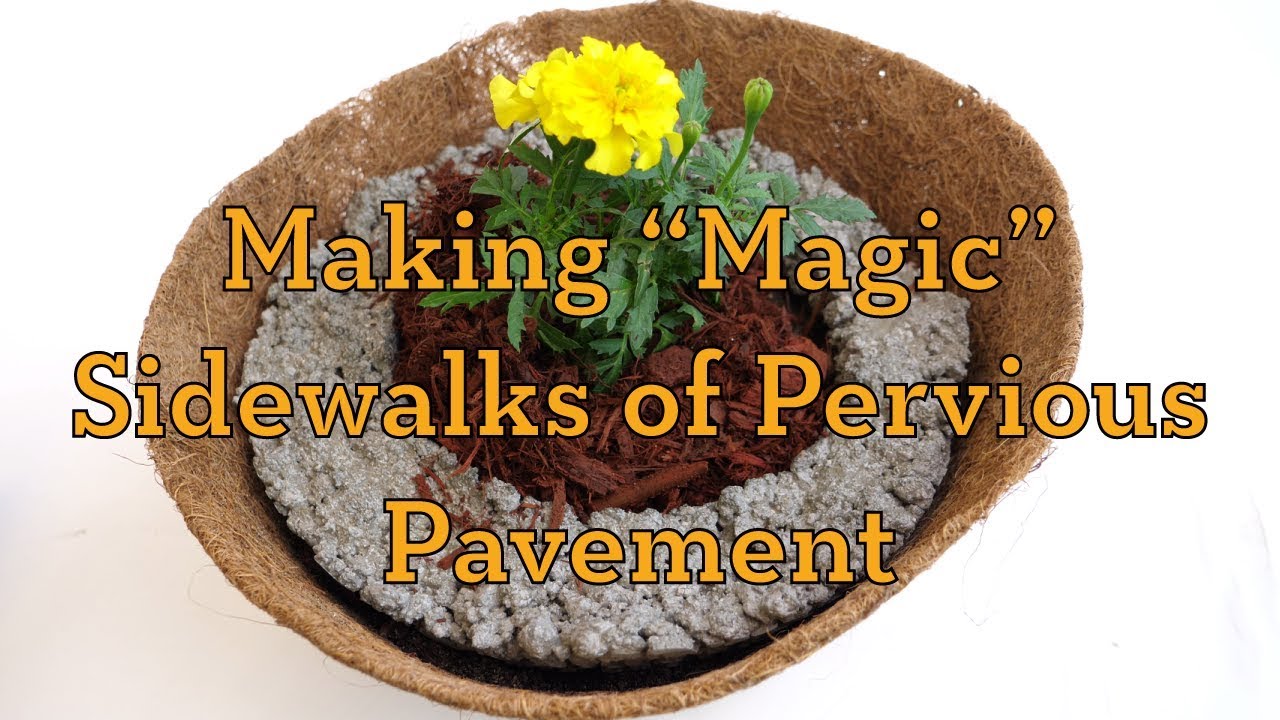
Students use everyday building materials—sand, pea gravel, cement and water—to create and test pervious pavement. They learn what materials make up a traditional, impervious concrete mix and how pervious pavement mixes differ. Groups are challenged to create their own pervious pavement mixes, experimenting with material ratios to evaluate how infiltration rates change with different mix combinations.
View the full activity at TeachEngineering:
https://www.teachengineering.o....rg/activities/view/u
TeachEngineering has over 1,500 FREE lessons and activities. Visit https://www.teachengineering.org/ for more!
Music: Komputo - Francis Preve

Students investigate how mountains are formed. Concepts include the composition and structure of the Earth's tectonic plates and tectonic plate boundaries, with an emphasis on plate convergence as it relates to mountain formation. Students learn that geotechnical engineers design technologies to measure movement of tectonic plates and mountain formation, as well as design to alter the mountain environment to create safe and dependable roadways and tunnels.
View the full lesson on TeachEngineering:
https://www.teachengineering.o....rg/lessons/view/cub_
TeachEngineering has over 1,500 FREE lessons and activities. Visit https://www.teachengineering.org/ for more

Students learn how engineers transform wind energy into electrical energy by building their own miniature wind turbines and measuring the electrical current they produce. They explore how design and position affect the electrical energy production.
View the full activity on TeachEngineering: https://www.teachengineering.o....rg/activities/view/c
TeachEngineering has over 1,500 FREE lessons and activities. Visit http://www.TeachEngineering.org for more!
Music: Happy Rock - Bensound.com

Posed with a paradigmatic engineering problem, students consider and explore mathematical algorithms and/or geometric concepts to devise possible solutions. The problem: How should a robotic vacuum move in order to best clean a floor of unknown shape and dimensions? They grapple with what could be a complex problem by brainstorming ideas, presenting the best idea for a solution and analyzing all presented solutions, and then are introduced to an elegant solution. Rather than elaborately calculating the most efficient route and keeping track of which tiles the robot has visited, a random number generator determines which direction the robot will take when it hits a barrier. Students are able to visually confirm how an unfamiliar programming concept (a random number generator) can make for a simple and efficient program that causes an EV3 robot (that is suitably equipped) to clean a bare floor. Then students think of other uses for random numbers.
View the full activity at TeachEngineering:
https://www.teachengineering.o....rg/activities/view/s
TeachEngineering has over 1,500 FREE lessons and activities. Visit http://www.TeachEngineering.org for more!
Music: Elite Syncopations - E's Jammy Jams

Simple machines are devices with few or no moving parts that make work easier. Students are introduced to the six types of simple machines — the wedge, wheel and axle, lever, inclined plane, screw, and pulley — in the context of the construction of a pyramid, gaining high-level insights into tools that have been used since ancient times and are still in use today. In two hands-on activities, students begin their own pyramid design by performing materials calculations, and evaluating and selecting a construction site. The six simple machines are examined in more depth in subsequent lessons in this unit.
View the full lesson on TeachEngineering: https://www.teachengineering.o....rg/lessons/view/cub_
TeachEngineering has over 1,500 FREE lessons and activities. Visit https://www.teachengineering.org/ for more

Students randomly select jelly beans (or other candy) that represent genes for several human traits such as tongue-rolling ability and eye color. Then, working in pairs, students randomly choose new pairs of jelly beans from those corresponding to their own genotypes. The new pairs are placed on toothpicks to represent the chromosomes of the couple's offspring. Finally, students compare genotypes and phenotypes of parents and offspring for all the pairs in the class. In particular, they look for cases in which parents and offspring share the exact same genotype and/or phenotype, and consider how the results would differ if they repeated the simulation using more than four traits.
View the full activity on TeachEngineering:
https://www.teachengineering.o....rg/activities/view/d
TeachEngineering has over 1,500 FREE lessons and activities. Visit https://www.teachengineering.org/ for more!
Music: Cold Funk Funkorama

What do enzymes and engineering have in common? As a catalyst that creates a chemical reaction, enzymes are a unique substance that chemical engineers can learn from to create their own unique chemical designs. In this lesson, students learn about enzymes, study how enzymes work in our digestive system, and discuss enzymes are used in laundry detergents. Students relate to the idea that enzymes digest the food in the human body, and that enzymes can also be used to digest food stains on clothing.
View the full lesson on Teach Engineering:
https://www.teachengineering.o....rg/lessons/view/uof-
Teach Engineering has over 1,500 FREE lessons and activities. Visit https://www.teachengineering.org/ for more


In the everyday electrical devices we use — calculators, remote controls and cell phones — a voltage source such as a battery is required to close the circuit and operate the device. In this hands-on activity, students use batteries, wires, small light bulbs and light bulb holders to learn the difference between an open circuit and a closed circuit, and understand that electric current only occurs in a closed circuit.
View the full activity at TeachEngineering:
https://www.teachengineering.o....rg/activities/view/c
TeachEngineering has over 1,500 FREE lessons and activities. Visit http://www.TeachEngineering.org for more!
Music: Cosmos - Silent Partnet

Students make a proportional model of blood out of red gelatin, a plastic bag, and rice. They learn about the different components that make up blood and investigate what happens when the arteries and veins experience buildup from cholesterol. They will then work in pairs to brainstorm ways to clean our clogged arteries.
View the full activity on TeachEngineering:
https://www.teachengineering.o....rg/activities/view/c
TeachEngineering has over 1,500 FREE lessons and activities. Visit https://www.teachengineering.org/ for more
Music- Sunday Spirit

Students are introduced to the distinctive properties of mixtures and solutions. A class demonstration led by the teachers gives students the opportunity to compare and contrast the physical characteristics of a few simple mixtures and solutions. They discuss the separation of mixtures and solutions back into their original components as well as different engineering applications of mixtures and solutions.
View the full lesson on TeachEngineering:
https://www.teachengineering.o....rg/lessons/view/cub_
TeachEngineering has over 1,500 FREE lessons and activities. Visit https://www.teachengineering.org/ for more

Students use a small quantity of modeling clay to make boats that float in a tub of water. The object is to build boats that hold as much weight as possible without sinking. In the process of designing and testing their prototype creations, students discover some of the basic principles of boat design, gain first-hand experience with concepts such as buoyancy and density, and experience the steps of the engineering design process.
View the full activity at TeachEngineering:
https://www.teachengineering.o....rg/activities/view/d
TeachEngineering has over 1,500 FREE lessons and activities. Visit https://www.teachengineering.org/ for more!
Music: Hyperfun - Kevin MacLeod
Hyperfun by Kevin MacLeod is licensed under a Creative Commons Attribution license (https://creativecommons.org/licenses/by/4.0/)
Source: http://incompetech.com/music/r....oyalty-free/index.ht
Artist: http://incompetech.com/
Students are introduced to the futuristic concept of the moon as a place people can inhabit. They brainstorm what people would need to live on the moon and then design a fantastic Moon colony and decide how to power it. Students use the engineering design process, which includes researching various types of energy sources and evaluating which would be best for their moon colonies.
View the full activity at TeachEngineering:
https://www.teachengineering.o....rg/activities/view/c
TeachEngineering has over 1,500 FREE lessons and activities. Visit http://www.TeachEngineering.org for more!
Music: Sophomore Makeout - Silent Partner