Top videos
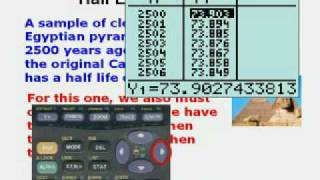
WEBSITE: http://www.teachertube.com The video shows how to use the exponential regression feature on the TI83 and TI84 series calculators to determine exponential functions. It also shows how to evaluate the functions. Specific examples include growth rate half life and musical tone problems. The video also shows how to paste the function from the regression to the function editor to speed up the evaluation process and eliminate opportunities for mistakes.

K-12 educators discuss the value of Education Week/edweek.org and how it helps them in their professions. ____________________
Want more stories about schools across the nation, including the latest news and unique perspectives on education issues? Visit www.edweek.org.
About Education Week:
Education Week is America’s most trusted source of independent K-12 education news, analysis, and opinion. Our work serves to raise the level of understanding and discourse about education among school and district leaders, policymakers, researchers, teachers, and the public. Published by the nonprofit organization Editorial Projects in Education, Education Week has been providing award-winning coverage of the field for over 35 years.
Follow Education Week:
- Subscribe to our Channel: http://www.youtube.com/subscri....ption_center?add_use
- On Facebook at https://www.facebook.com/edweek/
- On Twitter at https://twitter.com/educationweek/
- On LinkedIn at https://www.linkedin.com/company/education-week
To license video footage from Editorial Projects in Education please contact the Education Week Library at library@epe.org.
WEBSITE: http://www.teachertube.com Change decimal to fractions and fractions to decimals.

Meet Zoey—author, adventurer, and online student who lets nothing get in her way! Hear her talk about the ideas behind some of her advocacy projects, how she’s accomplished some pretty incredible goals, and how her efforts have directly benefited her community.
Zoey’s mom describes her spunk, her passions, and how she’s grown with the freedom and flexibility online school provides. Zoey also lets us in on what she’s planning next!
K12 is proud to provide quality online learning for students like Zoey, giving her an education option that lets her confidence and abilities soar! We’re celebrating 25 years of K12-powered schools, but like Zoey, we’re just getting started! Learn more at: https://bit.ly/4gvVtzU
Thousands of parents and educators are turning to the kids’ learning app that makes real learning truly fun. Try Kids Academy with
3-day FREE TRIAL! https://bit.ly/2GuGyL2
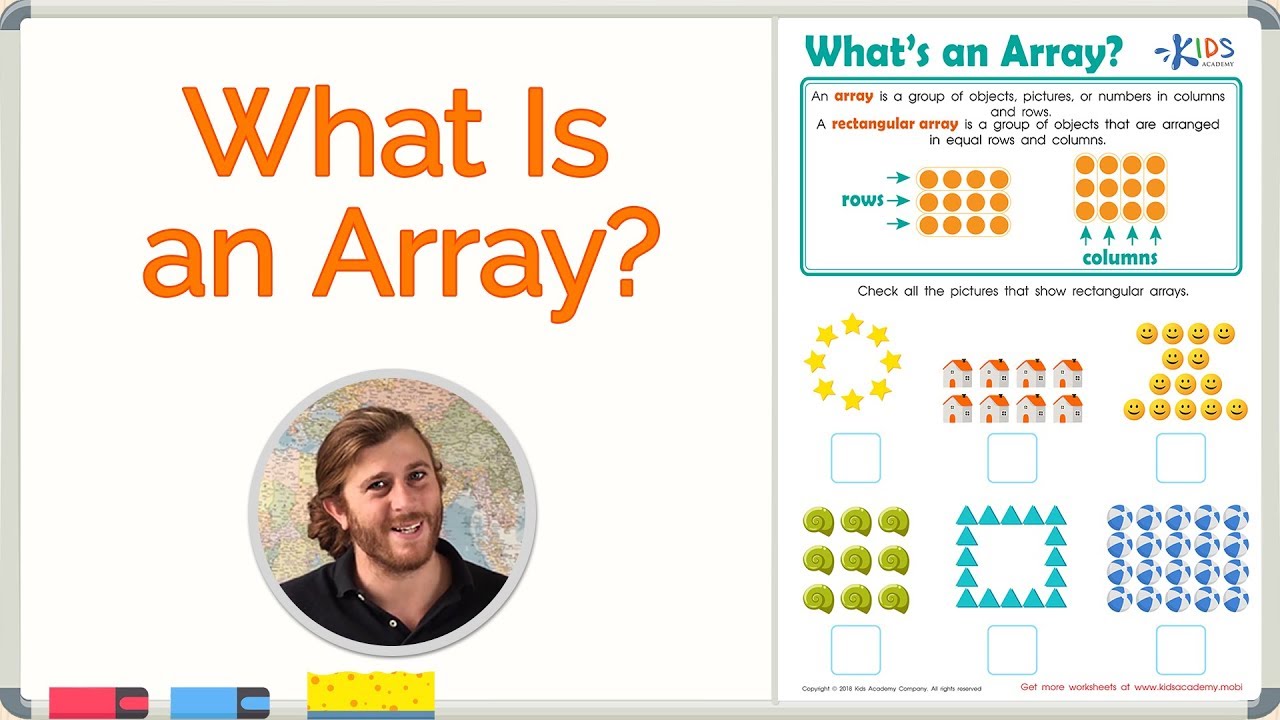
Arrays for Kids | 2nd Grade Math | Kids Academy
Students need simpler things, tables, and representations to learn the concepts of addition, subtraction, multiplication, and even division. Now, this is exactly where an array comes in handy. For those who don’t know, an array consists of numbers and objects etc that are arranged in columns and rows.
Arrays are useful representations of concepts like multiplication. These arrays help in making the students understand these processes easily without getting confused.
It’s basic maths for kids and for examples of an array and more explanation on how it works, you can opt to learn math online for kids.
Arrays are pretty useful to teach students the different mathematical concepts and well, thanks to the internet that we now have several online platforms where we can learn and teach the little ones on how to incorporate arrays in multiplication and division.
Subscribe to our channel: https://goo.gl/iG2Bdr
#TalentedAndGifted #LearnWithKidsAcademy
Kids Academy Talented and Gifted Program for kids aged 2-10:
*****
Connect with us on :
App Store: https://smart.link/59833db06a6b8
Google Play: https://smart.link/597210af6eb83
Our website: http://www.kidsacademy.mobi
Facebook: https://www.facebook.com/KidsAcademyC...
Twitter: https://twitter.com/KidsAcademyCo
In the latest edition of Kids Teach, K12 CEO James Rhyu sits down in the studio with
Emma, Laila, and Maliya—three student fashion experts—to discuss their field, in which James admits he has a lot to learn. Hear about how they became interested in fashion from both personal expression and business perspectives, and learn about the support networks helping them reach for their dreams.
When the students get to ask the questions, James gives some insight about his career path and what it now means for him to be making an impact in the online education sector that’s opening up opportunities for more students than ever.

Students learn about one-axis rotations, and specifically how to rotate objects both physically and mentally to understand the concept. They practice drawing one-axis rotations through a group exercise using cube blocks to create shapes and then drawing those shapes from various x-, y- and z-axis rotation perspectives on triangle-dot paper (isometric paper). They learn the right-hand rule to explore rotations of objects. A worksheet is provided. This activity is part of a multi-activity series towards improving spatial visualization skills.
View the full activity on TeachEngineering:
https://www.teachengineering.o....rg/activities/view/c
TeachEngineering has over 1,500 FREE lessons and activities. Visit https://www.teachengineering.org/ for more
Music: Sky Scraper - Geographer

Come join us as we discuss how GeoGebra can greatly help teachers actively engage students with learning math remotely!

Through a teacher-led class demo, students observe a simple water cycle model to better understand its role in pollutant transport. Using kitchen or lab equipment, the demo simulates a point source of pollution in a lake and the resulting environmental consequences—one way in which pollution is affected by the water cycle. A student worksheet is provided.
This engineering curriculum aligns to Next Generation Science Standards (NGSS).
View the full activity on TeachEngineering:
https://www.teachengineering.o....rg/activities/view/c
TeachEngineering has over 1,500 FREE lessons and activities. Visit https://www.teachengineering.org/ for more
Music: Blue Macaw

Sliders are the best part of GeoGebra! I'll explain the basics and show you some simple examples of what you can do with them.
00:00 - Intro
01:08 - Creating and Using a Slider
03:31 - Other Ways to Create Sliders
05:04 - Moveable Points
07:06 - Building Animations Using Sliders
11:36 - Outro

Sequences can hold sequences, and so create 2 dimensional arrays (for example an array of points here).

Key Questions:
What part(s) of the surface equations cause the slide to spiral upward? How do we know? Explain.
If the 2nd term of the right side of each equation was eliminated, what would the surface look like?

Using spaghetti and marshmallows, students experiment with different structures to determine which ones are able to handle the greatest amount of load. Their experiments help them to further understand the effects that compression and tension forces have with respect to the strength of structures. Spaghetti cannot hold much tension or compression; therefore, it breaks very easily. Marshmallows handle compression well, but do not hold up to tension.
View the full activity at TeachEngineering:
https://www.teachengineering.o....rg/activities/view/c
TeachEngineering has over 1,500 FREE lessons and activities. Visit https://www.teachengineering.org/ for more!
Music: Toe Jam - Diamond Ortiz

🎉 New to #GeoGebra Notes: Insert a table! Hyperlink cells. Dare to be different? You can rotate tables, texts, & videos too. 🙃 https://www.geogebra.org/notes


Students use their understanding of projectile physics and fluid dynamics to find the water pressure in water guns. By measuring the range of the water jets, they are able to calculate the theoretical pressure. Students create graphs to analyze how the predicted pressure relates to the number of times they pump the water gun before shooting.
View the full activity at TeachEngineering:
https://www.teachengineering.o....rg/activities/view/c
TeachEngineering has over 1,500 FREE lessons and activities. Visit http://www.TeachEngineering.org for more!
Music: New Land

Student pairs are given 10 minutes to create the biggest box possible using one piece of construction paper. Teams use only scissors and tape to each construct a box and determine how much puffed rice it can hold. Then, to meet the challenge, they improve their designs to create bigger boxes. They plot the class data, comparing measured to calculated volumes for each box, seeing the mathematical relationship. They discuss how the concepts of volume and design iteration are important for engineers. Making 3-D shapes also supports the development of spatial visualization skills. This activity and its associated lesson and activity all employ volume and geometry to cultivate seeing patterns and understanding scale models, practices used in engineering design to analyze the effectiveness of proposed design solutions.
View the full activity at TeachEngineering: https://www.teachengineering.o....rg/activities/view/c
TeachEngineering has over 1,500 FREE lessons and activities. Visit http://www.TeachEngineering.org for more!
Music: Milos - Eveningland


Students dream up and draw their own designs for futuristic and fanciful flying machines. They learn that doodling, sketching and brainstorming are related to the invention process, and about the early inventions that contributed to the history of flight and the state of modern aircraft. For brainstorming practice, they generate ideas for creative alternate uses for every day objects. Then, guided by a worksheet, they use their imaginations and apply their knowledge of aircraft design and the forces acting on them (gained from the previous lessons in the Airplanes unit) to design and create their own innovative flying machine models made from classroom construction and recycled
View the full activity on TeachEngineering:
https://www.teachengineering.o....rg/activities/view/c
TeachEngineering has over 1,500 FREE lessons and activities. Visit https://www.teachengineering.org/ for more
Music: Night at the Dance Hall