Top videos

We ventured into the Utah countryside to visit some of the best loved Land Art works of the 1970s, Robert Smithson's Spiral Jetty and Nancy Holt's Sun Tunnels, and check out the art that is happening there now. Also featured: William Lamson's Mineralogy, The Center for Land Use Interpretation, and lots and lots of salt.
For more information on Robert Smithson’s Spiral Jetty and Nancy Holt’s Sun Tunnels: http://www.diaart.org/
To support our channel, visit: http://www.patreon.com/artassignment.
Thanks to our Grandmaster of the Arts Indianapolis Homes Realty, and all of our patrons, especially Lawrence Abrahamson, Patrick Hanna, M12 Studio, Robert Rupp, and Constance Urist.
Subscribe for new episodes of The Art Assignment every other Thursday!
--
Follow us elsewhere for the full Art Assignment experience:
Tumblr: http://theartassignment.com
Response Tumblr: http://all.theartassignment.com
Twitter: http://twitter.com/artassignment
Instagram: http://instagram.com/theartassignment/
Facebook: http://www.facebook.com/theartassignment
and don't forget Reddit!: http://www.reddit.com/r/TheArtAssignment
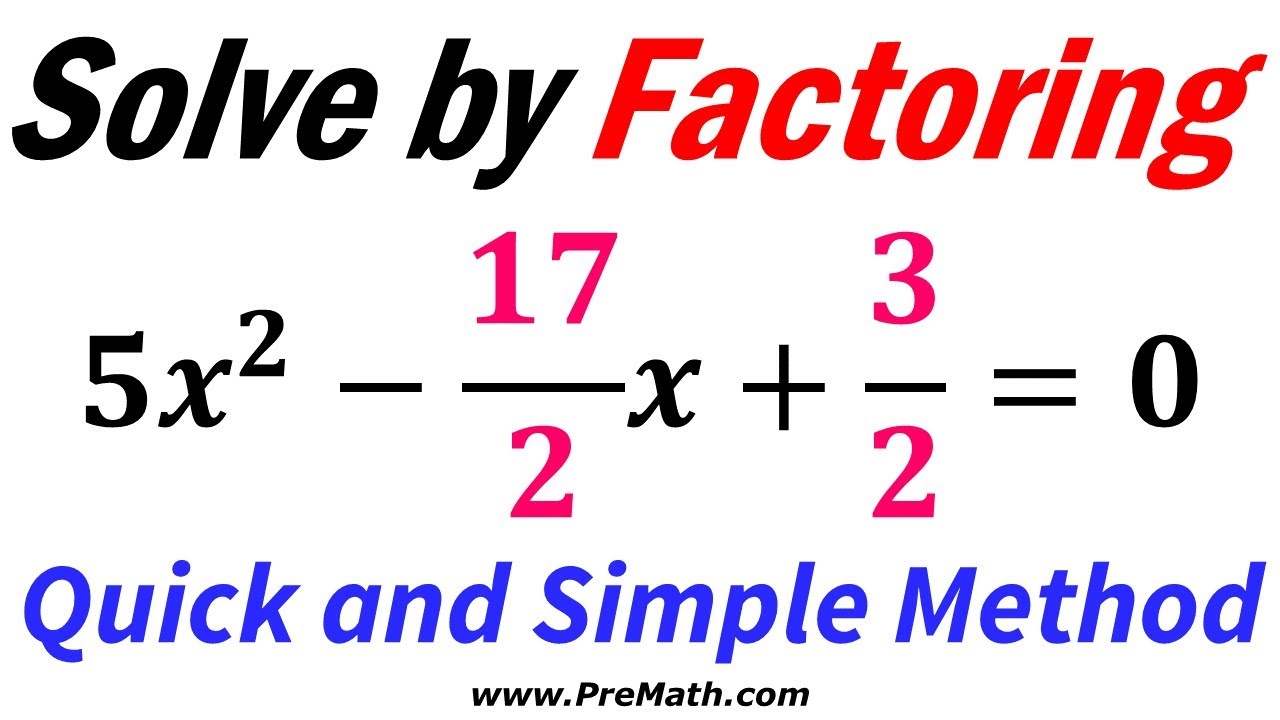
Learn how to Solve Quadratic Equations Involving Fractions by using the Factoring Method. Leading coefficient is other than 1. Step-by-Step Tutorial by PreMath.com

TabletClass Math:
https://tcmathacademy.com/
Math help with solving an equation with fractions. For more math help to include math lessons, practice problems and math tutorials check out my full math help program at https://tcmathacademy.com/
Math Notes:
Pre-Algebra Notes: https://tabletclass-math.creat....or-spring.com/listin
Algebra Notes: https://tabletclass-math.creat....or-spring.com/listin
Geometry Notes: https://tabletclass-math.creat....or-spring.com/listin
Algebra 2 / Trig Notes: https://tabletclass-math.creat....or-spring.com/listin

Three girls shared a packet of
sweets. The first girl received 2/5 of
the sweets. The second girl
received 5/9 of the remainder. And
Join this channel to get access to perks:
https://www.youtube.com/channe....l/UCYxAOG6Kz3t_haF45
Follow my YouTube Short channel @Tambuwal YouTube Shorts
We’re on PATREON! Join the community
https://www.patreon.com/itsokaytobesmart
↓↓↓ More info and sources below ↓↓↓
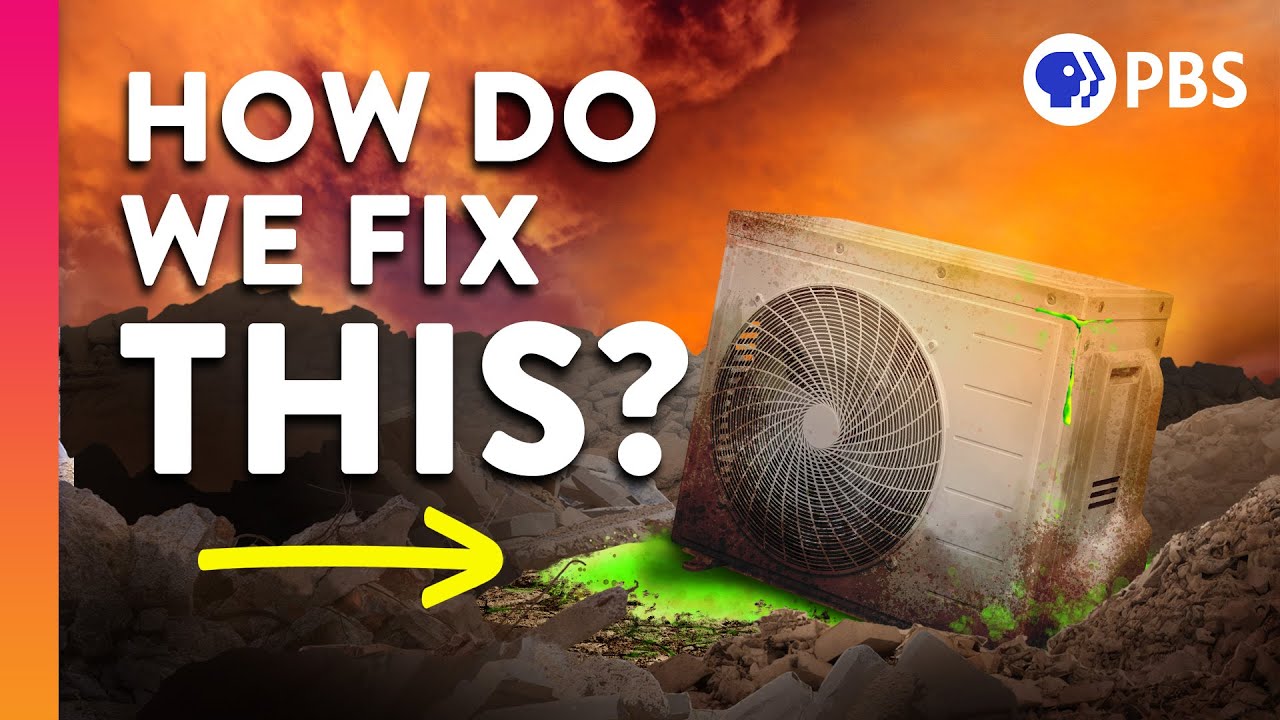
As the Earth warms due to human-caused climate change, billions of people in the developing world will face life-threatening heat waves, raising the demand for air conditioning. But powering all of that cooling is going to take more energy, which will require burning more fossil fuels! Are there new air conditioning technologies on the horizon that could solve this paradox?
NOTE: A previous version of this video had a graph at 6:19 with incorrect values. The video has been updated with the correct graph.
Aerial photography by Jeff Arnold
Written by Eli Kintisch and Joe Hanson
SUBSCRIBE so you don’t miss a video! ►► http://bit.ly/iotbs_sub
-----------
High fives to all our Brain Trust Patrons:
Millennial Glacier
paul andre bouis
Mark Littlehale
Ali Freiburger
Mehdi Damou
Barbora Bei
Burt Humburg
dani bowman
David Johnston
Salih Arslan
Baerbel Winkler
Robert Young
Eric Meer
Dustin
Karen Haskell
Join us on Patreon!
https://patreon.com/itsokaytobesmart
Twitter
http://www.twitter.com/DrJoeHanson
http://www.twitter.com/okaytobesmart
Instagram
http://www.instagram.com/DrJoeHanson
http://www.instagram.com/okaytobesmart
Merch
https://store.dftba.com/collec....tions/its-okay-to-be
Facebook
https://www.facebook.com/itsokaytobesmartpbs/
This episode of Be Smart is licensed exclusively to YouTube.

Thousands of parents and educators are turning to the kids’ learning app that makes real learning truly fun. Try Kids Academy with
3-day FREE TRIAL! https://bit.ly/2GuGyL2
Rhymes, songs, and fingerplays are some of the best activities you can do with your child to prepare them for future success in reading, language and math. Through these activities, children increase their vocabularies and learn the sound and rhythm of speech. Fingerplays provide the extra benefit of improving small motor muscles in their hands. This leads to better writing skills later. These fun videos from Kids Academy leave children smiling, and provide them with learning experiences.
The first song is the popular counting tune, The Ants Go Marching. Children count up to 10 using predictable text. Children sing the “ants go marching one by one” and then “two by two” all the way to 10. The Ants Go Marching lyrics also include fun rhymes. Phonemic awareness begins with recognition of rhyming words. This video is ideal for counting and rhyming fun.
Continue singing with the fingerplay Daddy Finger. Children sing along to the lyrics that are easy to remember and participate in acting out the song with their own hands. The creators of the video use bright, engaging animation to make the song come to life with child-friendly themes throughout.
And what song time would be complete without a visit to Old MacDonald’s Farm? This favorite of kids everywhere doesn’t disappoint. Farmer MacDonald travels through the farm on his tractor. All farm animals are present and the animals and their sounds will delight your little one.
This video series ends with a fun twist to the song Row, Row Your Boat. The video shows two children on an adventure in their boat and encounter different animals along the way. Children participate in this song with squeaks, roars, screams, and more!
Begin your next song and activity time with the Ants Go Marching song. Enjoy time with your preschooler singing, playing, and learning.
Subscribe to our channel: https://goo.gl/iG2Bdr
Connect with us on :
Facebook: https://www.facebook.com/KidsAcademyC...
Twitter: https://twitter.com/KidsAcademyCo
Install for free our Kids Academy Talented and Gifted Program for kids aged 2-10:
App Store: https://smart.link/59833db06a6b8
Google Play: https://smart.link/5a1bea3272481
Our website: https://www.kidsacademy.mobi/

Slime molds are intelligent, but they are single-celled creatures with no brains.
How is that possible?
↓ More info and sources below ↓
I really hope you guys check out Deep Look, it’s one of my favorite channels, full of great 4K, micro-world goodness! http://goo.gl/8NwXqt
Many thanks to Prof. Andy Adamatzky (UWE Bristol) for slime mold culturing advice.
Special thanks to the following for providing Dictyostelium microscope footage:
Prof. John Bonner (Princeton)
Prof. David Knecht (Univ. of Connecticut)
Prof. Richard Firtel (UCSD)
Prof. Jeremy Pickett-Heaps (Univ. of Melbourne)
References/further reading:
“Intelligence in Nature” by Jeremy Narby http://amzn.to/23HvtKG
“The Social Amoebae - The Biology of Cellular Slime Molds” by John Bonner http://amzn.to/1MEmmCR
Nakagaki, Toshiyuki. "Smart behavior of true slime mold in a labyrinth."Research in Microbiology 152.9 (2001): 767-770.
Nakagaki, Toshiyuki, Hiroyasu Yamada, and Masahiko Hara. "Smart network solutions in an amoeboid organism." Biophysical chemistry 107.1 (2004): 1-5.
Adamatzky, Andrew. Physarum machines: computers from slime mould. Vol. 74. World Scientific, 2010.
Have an idea for an episode or an amazing science question you want answered? Leave a comment or check us out at the links below!
Like us on Facebook: http://www.facebook.com/itsokaytobesmart
Follow on Twitter: http://twitter.com/okaytobesmart
http://twitter.com/jtotheizzoe
Follow on Tumblr: http://www.itsokaytobesmart.com
Follow on Instagram: http://instagram.com/jtotheizzoe
Follow on Snapchat: YoDrJoe
-----------------
It’s Okay To Be Smart is written and hosted by Joe Hanson, Ph.D.
Follow me on Twitter: @jtotheizzoe
Produced by PBS Digital Studios: http://www.youtube.com/user/pbsdigitalstudios
Music via APM
Stock images from Shutterstock http://www.shutterstock.com
Stock footage from Videoblocks (unless otherwise noted) http://www.videoblocks.com
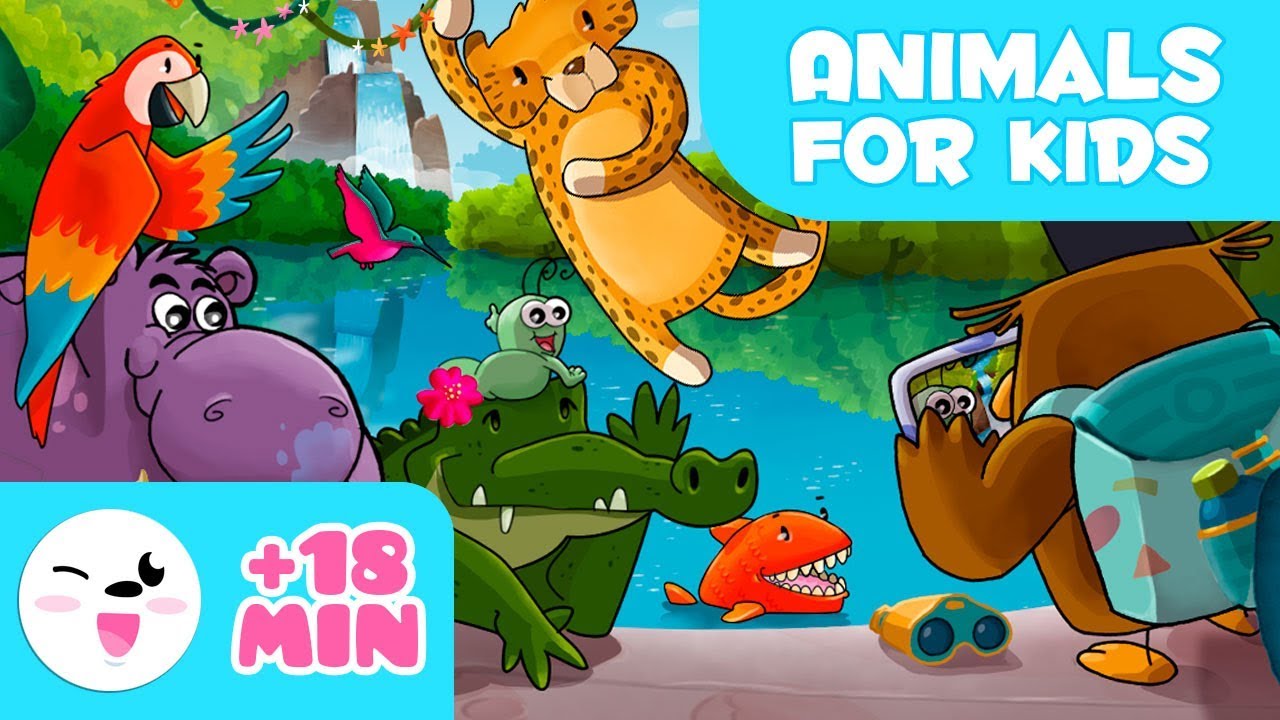
Educational video where children can follow animals into Yellowstone National Park, the African Savannah, desert areas and the North Pole's ecosystems.
Thanks for visiting us! If you want your children to smile and learn, subscribe! :D
"Kolitas, A Trip Through Nature” is an interactive story for children from ages 3 to 10. Friends from the Kolitas world will help out on this incredible adventure where children can explore ecosystems with typical plants and animals. Nature for children, in a fun and educational way. Enjoy and learn to respect nature with the characters from the Kolitas world!
Why is it good for children to see Smile and Learn’s videos?
+We only upload our own content, designed by educators so that children smile and learn while watching a video.
+All of our content reinforces educational values, encouraging the use of multiple intelligences and language learning.
*If you like our videos, download “The Smart Library” now. You’ll discover more than 30 interactive games and stories for children designed by educators. The stories are based on VALUES like friendship, respect, and generosity, and our games cover all of the MULTIPLE INTELLIGENCES. All our content is in SPANISH, ENGLISH, and FRENCH.
The perfect tool to use in and out of school.
Download it today!
-Apple Store: http://bit.ly/Biblioteca_Inteligente_...
-Google Play: http://bit.ly/Biblioteca_Inteligente_...
For more information, visit our website: https://smileandlearn.net/
If you want the latest news and new stories or games:
Follow us on:
+Facebook: https://www.facebook.com/Smileandlearn
+Instagram: https://www.instagram.com/smileandlea...
+Twitter: https://twitter.com/smileandlearn
+Pinterest: https://es.pinterest.com/smileandlearn/
Thank you for trusting us with your children's education!
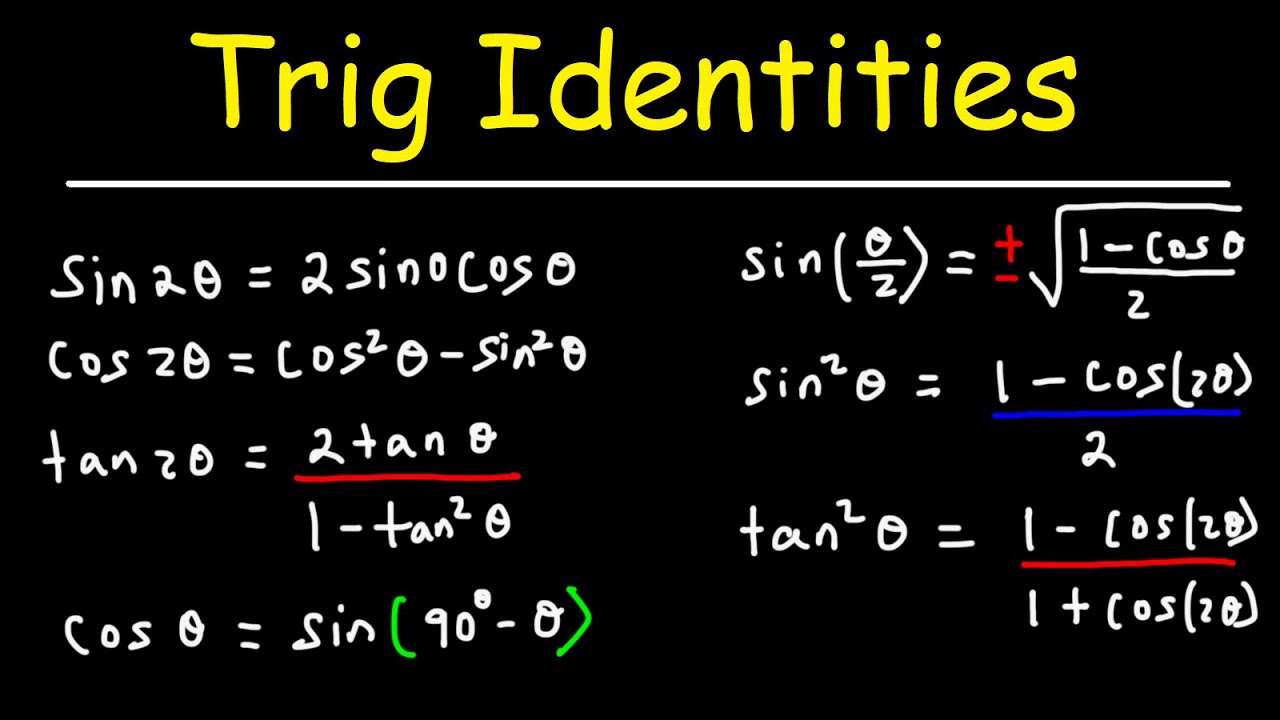
This trigonometry video tutorial discusses common trig identities and formulas such as the pythagorean identites, reciprocal identites, quotient identities, even odd identities, cofunction identities, double angle formulas, half angle formulas, sum and difference identities, power reducing formlas, product to sum identities, and sum to product identities.
Access Full-Length Premium Videos: https://www.patreon.com/MathScienceTutor
_____________________________________________________________________________________________
Trigonometry - Basic Introduction: https://www.youtube.com/watch?v=g8VCHoSk5_o
Introduction to Angles: https://www.youtube.com/watch?v=oxhXz9_uyiM
Radians and Degrees: https://www.youtube.com/watch?v=JmLN3QxshlE
What Exactly Is a Radian? https://www.youtube.com/watch?v=CHCWXAkozHM
Coterminal Angles: https://www.youtube.com/watch?v=RkMhGwp8pv4
Decimal Degrees to DMS: https://www.youtube.com/watch?v=W9kousU6AI0
Arc Length of a Circle and Sector Area: https://www.youtube.com/watch?v=C9z3FXS7nlo
Linear Speed and Angular Velocity: https://www.youtube.com/watch?v=FgTvlGm9jgE
Clock to Angle Problems: https://www.youtube.com/watch?v=LEHYr0XfSyI
The Unit Circle: https://www.youtube.com/watch?v=57VrEiEPD1I
______________________________________________________________________________________________
Reference Angles: https://www.youtube.com/watch?v=E-xFXpVo14o
The Six Trigonometric Functions: https://www.youtube.com/watch?v=WvoFgL4P_rw
How To Solve Right Triangles: https://www.youtube.com/watch?v=i3bjEOA5_zc
Reciprocal Identities: https://www.youtube.com/watch?v=UeuuFqbTYgA
Quotient Identities: https://www.youtube.com/watch?v=7PVKbyLFY5U
Even and Odd Trigonometric Identities: https://www.youtube.com/watch?v=5p8hokJ3Cqo
Pythagorean Identities: https://www.youtube.com/watch?v=TpADRvW8zm8
Trig Functions - Periodic Properties: https://www.youtube.com/watch?v=8Z60_yXX4xA
Trigonometry For Beginners: https://www.youtube.com/watch?v=PUB0TaZ7bhA
The Exact Value of Trig Functions: https://www.youtube.com/watch?v=bTdjcvm6pPo
Special Right Triangles - 30 60 90: https://www.youtube.com/watch?v=p70UBGCHZrQ
Special Right Triangles - 45 45 90: https://www.youtube.com/watch?v=xzMirNSv1d0
Cofunction Identities: https://www.youtube.com/watch?v=35fxto48HZY
______________________________________________________________________________________________
Angle of Elevation Problems: https://www.youtube.com/watch?v=uyKvSe6Ltgs
Evaluating Trig Functions Given a Point: https://www.youtube.com/watch?v=P8rdY2ahkms
Exact Value of 5 Remaining Trig Functions: https://www.youtube.com/watch?v=H7GwDntpGUY
Evaluate Trig Functions - Reference Angles: https://www.youtube.com/watch?v=V8LEHEzdU2U
How To Graph Trig Functions: https://www.youtube.com/watch?v=fo_q9mEAFp4
How To Graph Sine and Cosine: https://www.youtube.com/watch?v=bm8oYKKlCXI
Evaluating Inverse Trig Functions: https://www.youtube.com/watch?v=jt7p-mCC0ng
Finding The Missing Side of a Triangle: https://www.youtube.com/watch?v=tielQ3ejh70
Finding The Missing Angle of a Triangle: https://www.youtube.com/watch?v=4Dv5IFqATrc
Two Triangle Trigonometry Problems: https://www.youtube.com/watch?v=OTP885mApV8
Bearings Vs Direction - Word Problems: https://www.youtube.com/watch?v=jyi5zW8mavs
Two Triangle Problems - More Examples: https://www.youtube.com/watch?v=QM1T6eL8t48
_____________________________________________________________________________________________
Verifying Trig Identities: https://www.youtube.com/watch?v=Rf05H8ogHLg
Trigonometry Final Exam Review: https://www.youtube.com/watch?v=OAsbx4TEnL0

Educational video to learn how to write and count from 1 to 3 in a fun way. Let's learn how to count together. This video is part of a larger collection of videos and its objective is for young kids to learn the numbers, through several different examples. Each number explanation includes a song. Ideal for early childhood education.
Thanks for visiting us! If you want your children to smile and learn, subscribe! :D
We only upload our own content, designed by educators so that children smile and learn while watching a video.
All of our content reinforces educational values, encouraging the use of multiple intelligences and language learning.
If you like our videos, download Smile and Learn now. You’ll discover more than 5.000 activities for children aged 3 to 12 yeards, all designed by educators. We have 250 games and interactive stories and over 280 videos in five languages: English, Spanish, Portuguese, Italian and French. Try a month for free and start the adventure!
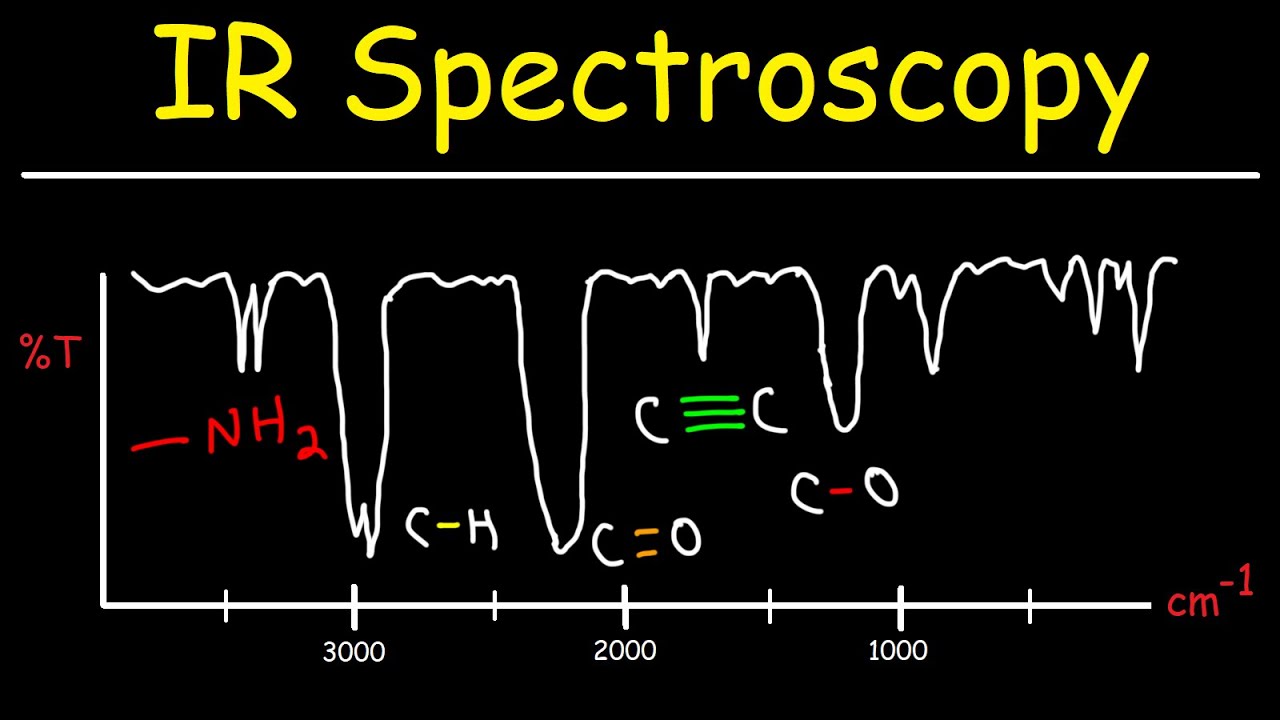
This organic chemistry video tutorial provides a basic introduction into IR spectroscopy. It explains how to identify and distinguish functional groups such as carboxylic acids, alcohols, aldehydes, ketones, ethers, esters, amines, and amides given an IR spectrum.
Alcohol Reactions - HBr, PBr3, & SOCl2:
https://www.youtube.com/watch?v=4PDs3ygNsv4
Free Radical Reactions:
https://www.youtube.com/watch?v=w9RAULFkqKQ
Reactions Summary:
https://www.youtube.com/watch?v=nkh0egRNQz0
Organic Chemistry 1 Final Exam Review:
https://www.youtube.com/watch?v=ej2pSWw6U3w
Mass Spectrometry:
https://www.youtube.com/watch?v=VUIPYnWLSDE
______________________________
Proton NMR Spectroscopy:
https://www.youtube.com/watch?v=vejKDb1dBn8
Carbon-13 NMR Spectroscopy:
https://www.youtube.com/watch?v=QUVTATcXE9Y
Ethers and Epoxides:
https://www.youtube.com/watch?v=BxRLJhHjqMc
Diels Alder Reaction:
https://www.youtube.com/watch?v=sBmoP6KwK-8
Organic Chemistry 2 Final Exam Review:
https://www.youtube.com/watch?v=T5NaUdVfAOc

Video for the smallest kids to learn about the letter “I”. They learn its sound, the way to write it and words with the letter all in a fun way.
Thanks for visiting us! If you want your children to smile and learn, subscribe! :D
This video is part of a series of videos for young learners to work on the alphabet. Each video focuses on a letter, in this case the letter "i". Children learn how it sounds and how to write it. The video goes over words that start with the letter to check its sound and there’s a sing-a-long to practice!
Why is it good for children to see Smile and Learn’s videos?
+We only upload our own content, designed by educators so that children smile and learn while watching a video.
+All of our content reinforces educational values, encouraging the use of multiple intelligences and language learning.
*If you like our videos, download “The Smart Library” now. You’ll discover more than 30 interactive games and stories for children designed by educators. The stories are based on VALUES like friendship, respect, and generosity, and our games cover all of the MULTIPLE INTELLIGENCES. All our content is in SPANISH, ENGLISH, and FRENCH.
The perfect tool to use in and out of school.
Download it today!
-Apple Store: http://bit.ly/Biblioteca_Inteligente_...
-Google Play: http://bit.ly/Biblioteca_Inteligente_...
For more information, visit our website: https://smileandlearn.net/
If you want the latest news and new stories or games:
Follow us on:
+Facebook: https://www.facebook.com/Smileandlearn
+Instagram: https://www.instagram.com/smileandlea...
+Twitter: https://twitter.com/smileandlearn
+Pinterest: https://es.pinterest.com/smileandlearn/
Thank you for trusting us with your children's education!

This finance video tutorial explains how to calculate the compound interest on an annual, quarterly, and monthly basis.
Logarithms - The Easy Way! https://www.youtube.com/watch?v=kqVpPSzkTYA
Log to Exponential Form:
https://www.youtube.com/watch?v=f0C1KL7GkqY
Change of Base Formula:
https://www.youtube.com/watch?v=FFm-zaFW_X4
Change of Base Log Problem:
https://www.youtube.com/watch?v=p7hD9VdXv9U
Properties of Logarithms:
https://www.youtube.com/watch?v=Jtv9Lnf7Zw8
____________________________________
Expanding Logarithmic Expressions:
https://www.youtube.com/watch?v=OIz-5MyJA3g
Condensing Logarithmic Expressions:
https://www.youtube.com/watch?v=luRrOlsB4cY
Natural Logarithms:
https://www.youtube.com/watch?v=daUlTsnCNRQ
Solving Exponential Equations:
https://www.youtube.com/watch?v=9tutJ5xrRwg
Exponential Equations - Quadratic Form:
https://www.youtube.com/watch?v=yNgmVu0R_T8
_______________________________________
Solving Logarithmic Equations:
https://www.youtube.com/watch?v=fnhFneOz6n8
Graphing Logarithmic Functions:
https://www.youtube.com/watch?v=-nptxS9rZNA
Graphing Exponential Functions:
https://www.youtube.com/watch?v=DASfP8KAyvs
Compound Interest Word Problems:
https://www.youtube.com/watch?v=Hn0eLcOSQGw
Logarithms Practice Problems:
https://www.youtube.com/watch?v=7DVbQKI600k
_______________________________________
Final Exams and Video Playlists:
https://www.video-tutor.net/
Full-Length Videos and Worksheets:
https://www.patreon.com/MathSc....ienceTutor/collectio


This video tutorial provides a basic introduction into qualitative and quantitative data.
Introduction to Statistics: https://www.youtube.com/watch?v=XZo4xyJXCak
Descriptive Vs Inferential Statistics:
https://www.youtube.com/watch?v=VHYOuWu9jQI
Qualitative and Quantitative Data:
https://www.youtube.com/watch?v=5rUVYWfZOb8
Statistic Vs Parameter:
https://www.youtube.com/watch?v=Mb9BuEkbaHQ
Scales of Measurement:
https://www.youtube.com/watch?v=LuBD49SFpWs
__________________________________
Mean, Median, Mode, & Range:
https://www.youtube.com/watch?v=A1mQ9kD-i9I
Weighted Mean & Averages:
https://www.youtube.com/watch?v=LdrBNhWw9AM
Find Missing Value Given The Mean:
https://www.youtube.com/watch?v=l8KrAo089_U
Excel - Mean, Median, Mode, & Range:
https://www.youtube.com/watch?v=k17_euuiTKw
Arithmetic, Geometric, & Harmonic Mean:
https://www.youtube.com/watch?v=6G6i8vSa8Zs
___________________________________
Simple Frequency Tables:
https://www.youtube.com/watch?v=lyRbCwDDnJo
Relative Frequency Distribution Table:
https://www.youtube.com/watch?v=gq3FPpm2yvA
Cumulative Relative Frequency Table:
https://www.youtube.com/watch?v=6hJGa4Zp62M
Dot Plots and Frequency Tables:
https://www.youtube.com/watch?v=Iu17mY1VfZU
Stem and Leaf Plots:
https://www.youtube.com/watch?v=MUCvUgGfzdo
____________________________________
Final Exams and Video Playlists:
https://www.video-tutor.net/

This video tutorial explains how to calculate the probability of complementary events as well as AND/OR events using the sample space of a six-sided die.
Introduction to Probability: https://www.youtube.com/watch?v=SkidyDQuupA
Probability Formulas:
https://www.youtube.com/watch?v=bddckR734aM
Probability Explained:
https://www.youtube.com/watch?v=UORztmWGY6Q
Probability With Geometry:
https://www.youtube.com/watch?v=DeH5aHWxEaI
Probability of Complementary Events:
https://www.youtube.com/watch?v=0T-CaQCiSf4
Conditional Probability:
https://www.youtube.com/watch?v=sqDVrXq_eh0
__________________________________
Independent and Dependent Events:
https://www.youtube.com/watch?v=lWAdPyvm400
Probability of Mutual Exclusive Events:
https://www.youtube.com/watch?v=X6usGgwXFyU
Multiplication and Addition Rule:
https://www.youtube.com/watch?v=94AmzeR9n2w
Compound Probability:
https://www.youtube.com/watch?v=EHU6pVSczb4
Expected Value:
https://www.youtube.com/watch?v=b6VK2VPMXNI
Probability Tree Diagrams:
https://www.youtube.com/watch?v=w4wKXVwtGac
___________________________________
Bayes Theorem:
https://www.youtube.com/watch?v=OByl4RJxnKA
Probability - Binomial Distribution:
https://www.youtube.com/watch?v=3PWKQiLK41M
Probability - Geometric Distribution:
https://www.youtube.com/watch?v=d5iAWPnrH6w
Probability - Poisson Distribution:
https://www.youtube.com/watch?v=m0o-585xwW0
Continuous Probability Distributions:
https://www.youtube.com/watch?v=QxqxdQ_g2uw
Probability Density Functions:
https://www.youtube.com/watch?v=3xAIWiTJCvE
__________________________________
Probability - Uniform Distributions:
https://www.youtube.com/watch?v=KfunVw-0AH0
Probability - Exponential Distributions:
https://www.youtube.com/watch?v=J3KSjZFVbis
Probability - Normal Distributions (Calculus):
https://www.youtube.com/watch?v=gHBL5Zau3NE
Probability - Standard Normal Distributions:
https://www.youtube.com/watch?v=CjF_yQ2N638
Probability - The Law of Large Numbers:
https://www.youtube.com/watch?v=ihTpK6dXSas
___________________________________
Final Exams and Video Playlists:
https://www.video-tutor.net/
Full-Length Videos and Worksheets:
https://www.patreon.com/MathSc....ienceTutor/collectio
What is social deviance? Who defines what is deviant and how to people come to behave that way? Today we’re going to explore biological and psychological approaches to explaining deviance, including what each perspective can bring to the table, and their inherent limitations. From there, we’ll explain the sociological perspective and the social foundations of deviance.
Crash Course is made with Adobe Creative Cloud. Get a free trial here: https://www.adobe.com/creativecloud.html
***
Sunflower student movement in Taiwan by Artemas Liu https://www.flickr.com/photos/....48144725@N02/1376431 (CC BY 2.0)
***
Crash Course is on Patreon! You can support us directly by signing up at http://www.patreon.com/crashcourse
Thanks to the following Patrons for their generous monthly contributions that help keep Crash Course free for everyone forever:
Mark, Les Aker, Bob Kunz, mark austin, William McGraw, Jeffrey Thompson, Ruth Perez, Jason A Saslow, Shawn Arnold, Eric Prestemon, Malcolm Callis, Steve Marshall, Advait Shinde, Rachel Bright, Khaled El Shalakany, Ian Dundore, The Great Dionysus, Tim Curwick, Ken Penttinen, Dominic Dos Santos, Caleb Weeks, Kathrin Janßen, Nathan Taylor, Yana Leonor, Andrei Krishkevich, Brian Thomas Gossett, Chris Peters, Kathy & Tim Philip, Mayumi Maeda, Eric Kitchen, SR Foxley, Tom Trval, Andrea Bareis, Moritz Schmidt, Gianna Phelps, Jessica Wode, Daniel Baulig, Jirat
--
Want to find Crash Course elsewhere on the internet?
Facebook - http://www.facebook.com/YouTubeCrashCourse
Twitter - http://www.twitter.com/TheCrashCourse
Tumblr - http://thecrashcourse.tumblr.com
Support Crash Course on Patreon: http://patreon.com/crashcourse
CC Kids: http://www.youtube.com/crashcoursekids
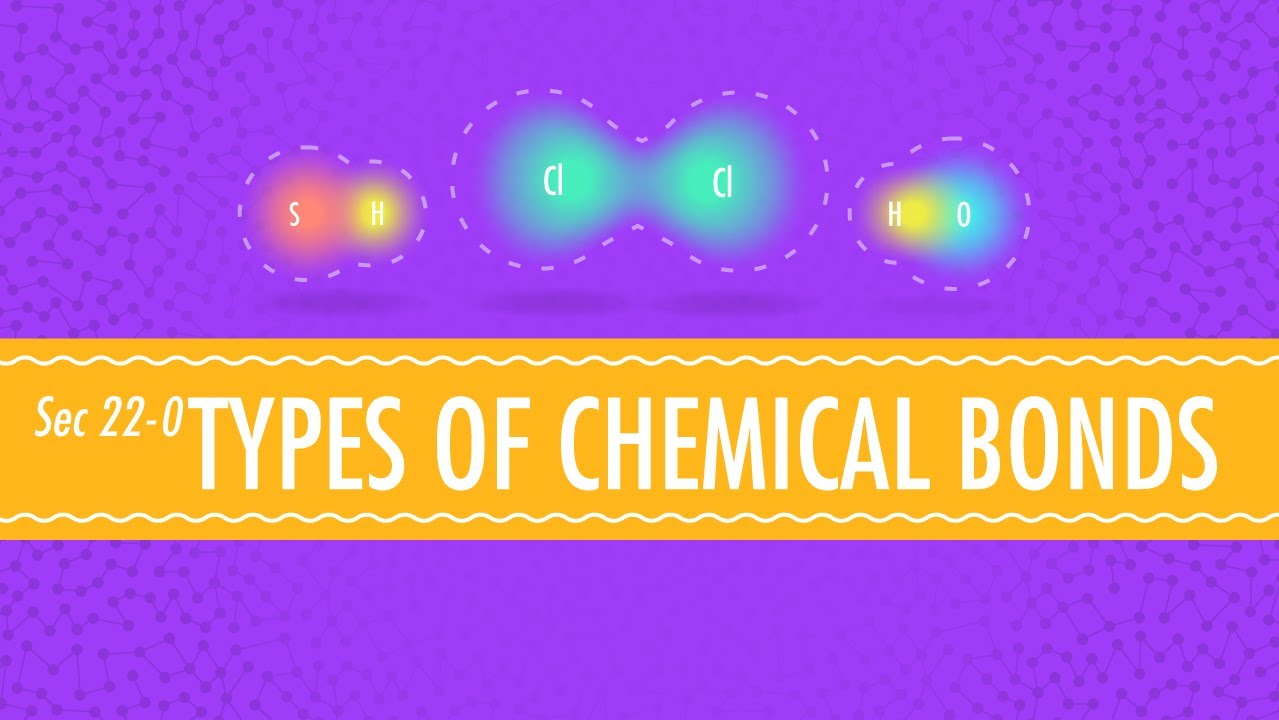
Atoms are a lot like us - we call their relationships "bonds," and there are many different types. Each kind of atomic relationship requires a different type of energy, but they all do best when they settle into the lowest stress situation possible. The nature of the bond between atoms is related to the distance between them and, like people, it also depends on how positive or negative they are. Unlike human relationships, we can analyze exactly what makes chemical relationships work, and that's what this episode is all about.
If you are paying attention, you will learn that chemical bonds form in order to minimize the energy difference between two atoms or ions; that those chemical bonds may be covalent if atoms share electrons, and that covalent bonds can share those electrons evenly or unevenly; that bonds can also be ionic if the electrons are transferred instead of shared: and how to calculate the energy transferred in an ionic bond using Coulomb's Law.
Pssst... we made flashcards to help you review the content in this episode! Find them on the free Crash Course App!
Download it here for Apple Devices: https://apple.co/3d4eyZo
Download it here for Android Devices: https://bit.ly/2SrDulJ
--
Table of Contents
Bonds Minimize Energy 01:38
Covalent Bonds 03:18
Ionic Bonds 05:37
Coulomb's Law 05:51
Crash Course is on Patreon! You can support us directly by signing up at http://www.patreon.com/crashcourse
Want to find Crash Course elsewhere on the internet?
Facebook - http://www.facebook.com/YouTubeCrashCourse
Twitter - http://www.twitter.com/TheCrashCourse
Instagram - https://www.instagram.com/thecrashcourse/
CC Kids: http://www.youtube.com/crashcoursekids

In which Adriene Hill and Jacob Clifford teach you about specialization and trade, and how countries decide whether they're going to make stuff or trade for stuff. You'll learn about things like comparative advantage, the production possibilities frontier and how to make pizza!
Crash Course is now on Patreon! You can support us directly by signing up at http://www.patreon.com/crashcourse
Thanks to the following Patrons for their generous monthly contributions that help keep Crash Course free for everyone forever:
Mark Brouwer, Jan Schmid, Anna-Ester Volozh, Robert Kunz, Jason A Saslow, Christian Ludvigsen, Chris Peters, Brad Wardell, Beatrice Jin, Roger C. Rocha, Eric Knight, Jessica Simmons, Jeffrey Thompson, Elliot Beter, Today I Found Out, James Craver, Ian Dundore, Jessica Wode, SR Foxley, Sandra Aft, Jacob Ash, Steve Marshall
TO: Sarah M.
FROM: Anthony M.
"Making our own history awesome! Happy 3 year Anniversary!"
TO: Everyone
FROM: Someone
"The earth is but one country, and mankind its citizens."
Thank you so much to all of our awesome supporters for their contributions to help make Crash Course possible and freely available for everyone forever:
Nathanial R. Castronovo, Eefje Savelkoul, Nupur Maheshwari, Jacob J., Dominik Steenken, Shai Belfer, Stefan Bjerring Henriksen
James Kribs, Hugo Jobly, Tim Eramo
Want to find Crash Course elsewhere on the internet?
Facebook - http://www.facebook.com/YouTubeCrashCourse
Twitter - http://www.twitter.com/TheCrashCourse
Tumblr - http://thecrashcourse.tumblr.com
Support Crash Course on Patreon: http://patreon.com/crashcourse
CC Kids: http://www.youtube.com/crashcoursekids

For centuries, the mystery of the pyramids has baffled the world — how did ancient Egyptians move millions of massive stone blocks without modern machines? Now, archaeologists may have cracked the code. From hidden canals to clever engineering tricks, new evidence is rewriting history and revealing just how advanced this ancient civilization really was. Get ready to uncover the secrets of Egypt like never before.
Animation is created by Bright Side.
----------------------------------------------------------------------------------------
Music from TheSoul Sound: https://thesoul-sound.com/
Check our Bright Side podcast on Spotify and leave a positive review! https://open.spotify.com/show/....0hUkPxD34jRLrMrJux4V
Subscribe to Bright Side: https://goo.gl/rQTJZz
----------------------------------------------------------------------------------------
Our Social Media:
Facebook: https://www.facebook.com/brightplanet/
Instagram: https://www.instagram.com/brightside.official
TikTok: https://www.tiktok.com/@bright....side.official?lang=e
Stock materials (photos, footages and other):
https://www.depositphotos.com
https://www.shutterstock.com
https://www.eastnews.ru
----------------------------------------------------------------------------------------
For more videos and articles visit: http://www.brightside.me
----------------------------------------------------------------------------------------
This video is made for entertainment purposes. We do not make any warranties about the completeness, safety and reliability. Any action you take upon the information in this video is strictly at your own risk, and we will not be liable for any damages or losses. It is the viewer's responsibility to use judgement, care and precaution if you plan to replicate.