Top videos

This story is about telling the truth and explains to kids that lies can be dangerous for everyone. In the anthill, there is an ant that doesn’t tell the truth and this causes a big problem for everyone.
Thanks for visiting us! If you want your children to smile and learn, subscribe! :D
Why is it good for children to see Smile and Learn’s videos?
+We only upload our own content, designed by educators so that children smile and learn while watching a video.
+All of our content reinforces educational values, encouraging the use of multiple intelligences and language learning.
*If you like our videos, download “The Smart Library” now. You’ll discover more than 30 interactive games and stories for children designed by educators. The stories are based on VALUES like friendship, respect, and generosity, and our games cover all of the MULTIPLE INTELLIGENCES. All our content is in SPANISH, ENGLISH, and FRENCH.
The perfect tool to use in and out of school.
Download it today!
-Apple Store: http://bit.ly/Biblioteca_Intel....igente_SmileandLearn
-Google Play: http://bit.ly/Biblioteca_Inteligente_GooglePlay
For more information, visit our website: https://smileandlearn.net/
If you want the latest news and new stories or games:
Follow us on:
+Facebook: https://www.facebook.com/Smileandlearn
+Instagram: https://www.instagram.com/smileandlearnapp/
+Twitter: https://twitter.com/smileandlearn
+Pinterest: https://es.pinterest.com/smileandlearn/
Thank you for trusting us with your children's education!

...and other Christmas mysteries answered with science!
Viewers like you help make PBS (Thank you 😃) . Support your local PBS Member Station here: https://to.pbs.org/PBSDSDonate
Subscribe to It's Okay To Be Smart: http://bit.ly/iotbs_sub
Happy Holidays! Ever wonder how Santa could possibly manage to deliver all those presents in a single night? Or what gives red-nosed reindeer the ability to fly? And why do your Christmas lights get tangled in knots no matter how carefully you put the away?!
Here's some Christmas-themed science, as our gift to you. See you in 2015!
SOURCES:
Why Christmas lights tangle: "Spontaneous knotting of an agitated string" http://www.pnas.org/content/104/42/16432
Apollo 8 "Santa sighting" https://archive.org/details/Apollo8Highlights
Santa's reindeer are probably female: http://www.livescience.com/321....49-are-santas-reinde
Reindeer hair is hollow and "buoyant" http://www.ncbi.nlm.nih.gov/pubmed/6150798
Reindeer really do have red noses: http://www.bmj.com/content/345..../bmj.e8311.full.pdf+
Reindeer eyes change color: http://phenomena.nationalgeogr....aphic.com/2013/10/29
Santa's challenge (check my math!): http://bit.ly/1sOW15q
Produced for PBS Digital Studios
Joe Hanson - Creator/Host/Writer
Joe Nicolosi - Director
Amanda Fox - Producer, Spotzen Inc
Kate Eads - Associate Producer
Andrew Matthews - Editing/Motion Graphics
Katie Graham - Director of Photography
John Knudsen - Gaffer
Dalton Allen - Post-Production Intern
Theme music:
"Ouroboros" by Kevin MacLeod
-----------
Join us on Patreon!
https://patreon.com/itsokaytobesmart
Twitter
http://www.twitter.com/DrJoeHanson
http://www.twitter.com/okaytobesmart
Instagram
http://www.instagram.com/DrJoeHanson
http://www.instagram.com/okaytobesmart
Merch
https://store.dftba.com/collec....tions/its-okay-to-be
Facebook
https://www.facebook.com/itsokaytobesmartpbs/
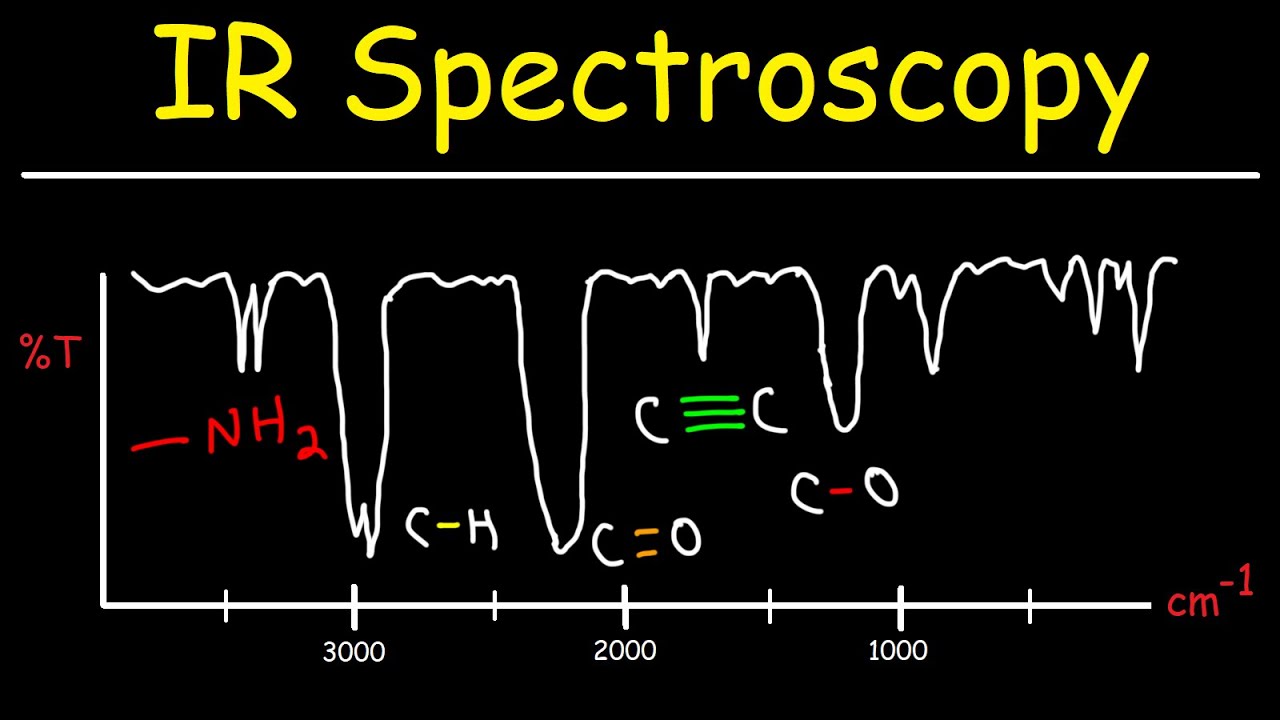
This organic chemistry video tutorial provides a basic introduction into IR spectroscopy. It explains how to identify and distinguish functional groups such as carboxylic acids, alcohols, aldehydes, ketones, ethers, esters, amines, and amides given an IR spectrum.
Alcohol Reactions - HBr, PBr3, & SOCl2:
https://www.youtube.com/watch?v=4PDs3ygNsv4
Free Radical Reactions:
https://www.youtube.com/watch?v=w9RAULFkqKQ
Reactions Summary:
https://www.youtube.com/watch?v=nkh0egRNQz0
Organic Chemistry 1 Final Exam Review:
https://www.youtube.com/watch?v=ej2pSWw6U3w
Mass Spectrometry:
https://www.youtube.com/watch?v=VUIPYnWLSDE
______________________________
Proton NMR Spectroscopy:
https://www.youtube.com/watch?v=vejKDb1dBn8
Carbon-13 NMR Spectroscopy:
https://www.youtube.com/watch?v=QUVTATcXE9Y
Ethers and Epoxides:
https://www.youtube.com/watch?v=BxRLJhHjqMc
Diels Alder Reaction:
https://www.youtube.com/watch?v=sBmoP6KwK-8
Organic Chemistry 2 Final Exam Review:
https://www.youtube.com/watch?v=T5NaUdVfAOc
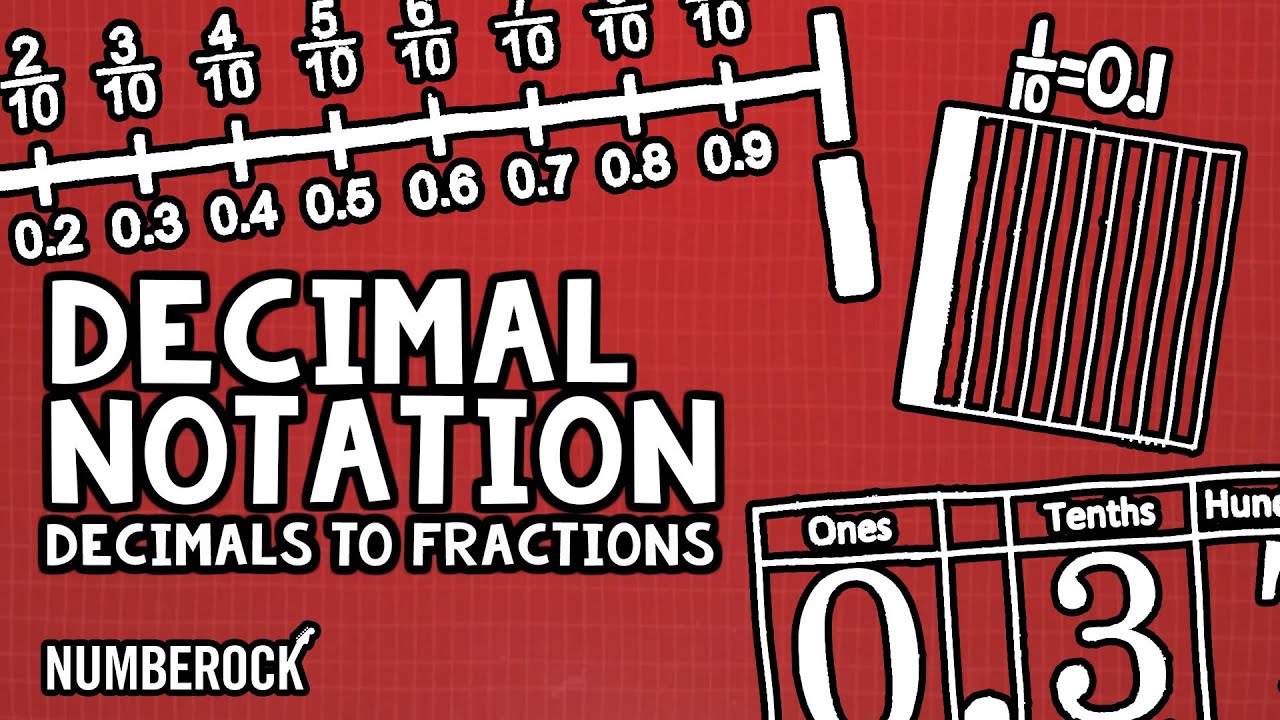
4th Grade teachers, explore Numberock’s equally fun teaching resources with a free month of access available for a limited time at http://numberock.com/letsrockmath
Learn all about converting fractions to decimals in this song about decimal notation. Relating fractions to decimals opens up a whole new world for students as they learn about our base ten number system, and this song will take them to that new world in style. The bridge of this song uniquely covers the labeling of a specified point that represents a decimal number to the tenths or hundredths place on a number line.
This song targets learning standards from 4th Grade - 5th Grade.
Thank you for watching our Decimal Notation | Relating Fractions to Decimals Song
»»-------------¤-------------««»»-------------¤-------------««
Newly Available for Website Subscribers:
1. Number Notes | Highly-visual math worksheets that integrate drawing and creative processes that make problem-solving and note-taking way more fun.
Research has shown that resources like these worksheets help students to integrate their artistic side with the mathematical side of their brain and as a result aides with long-term memory retention.
Our own research has shown us that teachers who try these activities love them! It seems to be a natural extension beyond song and video and into additional visual learning tools that when used in concert with our videos, cater to the many different types of learners that in your classroom - especially those non-mathy types.
Hope to see you at https://learnmore.numberock.com/free-dn.

This finance video tutorial explains how to calculate the compound interest on an annual, quarterly, and monthly basis.
Logarithms - The Easy Way! https://www.youtube.com/watch?v=kqVpPSzkTYA
Log to Exponential Form:
https://www.youtube.com/watch?v=f0C1KL7GkqY
Change of Base Formula:
https://www.youtube.com/watch?v=FFm-zaFW_X4
Change of Base Log Problem:
https://www.youtube.com/watch?v=p7hD9VdXv9U
Properties of Logarithms:
https://www.youtube.com/watch?v=Jtv9Lnf7Zw8
____________________________________
Expanding Logarithmic Expressions:
https://www.youtube.com/watch?v=OIz-5MyJA3g
Condensing Logarithmic Expressions:
https://www.youtube.com/watch?v=luRrOlsB4cY
Natural Logarithms:
https://www.youtube.com/watch?v=daUlTsnCNRQ
Solving Exponential Equations:
https://www.youtube.com/watch?v=9tutJ5xrRwg
Exponential Equations - Quadratic Form:
https://www.youtube.com/watch?v=yNgmVu0R_T8
_______________________________________
Solving Logarithmic Equations:
https://www.youtube.com/watch?v=fnhFneOz6n8
Graphing Logarithmic Functions:
https://www.youtube.com/watch?v=-nptxS9rZNA
Graphing Exponential Functions:
https://www.youtube.com/watch?v=DASfP8KAyvs
Compound Interest Word Problems:
https://www.youtube.com/watch?v=Hn0eLcOSQGw
Logarithms Practice Problems:
https://www.youtube.com/watch?v=7DVbQKI600k
_______________________________________
Final Exams and Video Playlists:
https://www.video-tutor.net/
Full-Length Videos and Worksheets:
https://www.patreon.com/MathSc....ienceTutor/collectio

Addition of Fractions|Fraction of liked fractions|Adding Fractions
#maths #fraction #grade4 #graee5 #grade6
#highschool #commonentranceexam
#lantern #onlineeducator
#fraction #lcm #decimal #numeracy

شرح عرض " أستاذي معي " على منصتنا
بشكل احترافي + طريقة التسجيل 👇
https://onetice.com/pub-oustadi/
Onetice 📲
Scientists tend to be careful and resistant to big claims. So evidence for the possible end of the living world took a while to be seen as such. In this episode of Crash Course History of Science, Hank talks to us about where Climate Science started and how it works today.
***
Crash Course is on Patreon! You can support us directly by signing up at http://www.patreon.com/crashcourse
Thanks to the following patrons for their generous monthly contributions that help keep Crash Course free for everyone forever:
Eric Prestemon, Sam Buck, Mark Brouwer, Laura Busby, Zach Van Stanley, Bob Doye, Jennifer Killen, Naman Goel, Nathan Catchings, Brandon Westmoreland, dorsey, Indika Siriwardena, Kenneth F Penttinen, Trevin Beattie, Erika & Alexa Saur, Glenn Elliott, Justin Zingsheim, Jessica Wode, Tom Trval, Jason Saslow, Nathan Taylor, Brian Thomas Gossett, Khaled El Shalakany, SR Foxley, Yasenia Cruz, Eric Koslow, Caleb Weeks, Tim Curwick, D.A. Noe, Shawn Arnold, Malcolm Callis, William McGraw, Andrei Krishkevich, Rachel Bright, Jirat, Ian Dundore
--
Want to find Crash Course elsewhere on the internet?
Facebook - http://www.facebook.com/YouTubeCrashCourse
Twitter - http://www.twitter.com/TheCrashCourse
Tumblr - http://thecrashcourse.tumblr.com
Support Crash Course on Patreon: http://patreon.com/crashcourse
CC Kids: http://www.youtube.com/crashcoursekids

This video tutorial provides a basic introduction into qualitative and quantitative data.
Introduction to Statistics: https://www.youtube.com/watch?v=XZo4xyJXCak
Descriptive Vs Inferential Statistics:
https://www.youtube.com/watch?v=VHYOuWu9jQI
Qualitative and Quantitative Data:
https://www.youtube.com/watch?v=5rUVYWfZOb8
Statistic Vs Parameter:
https://www.youtube.com/watch?v=Mb9BuEkbaHQ
Scales of Measurement:
https://www.youtube.com/watch?v=LuBD49SFpWs
__________________________________
Mean, Median, Mode, & Range:
https://www.youtube.com/watch?v=A1mQ9kD-i9I
Weighted Mean & Averages:
https://www.youtube.com/watch?v=LdrBNhWw9AM
Find Missing Value Given The Mean:
https://www.youtube.com/watch?v=l8KrAo089_U
Excel - Mean, Median, Mode, & Range:
https://www.youtube.com/watch?v=k17_euuiTKw
Arithmetic, Geometric, & Harmonic Mean:
https://www.youtube.com/watch?v=6G6i8vSa8Zs
___________________________________
Simple Frequency Tables:
https://www.youtube.com/watch?v=lyRbCwDDnJo
Relative Frequency Distribution Table:
https://www.youtube.com/watch?v=gq3FPpm2yvA
Cumulative Relative Frequency Table:
https://www.youtube.com/watch?v=6hJGa4Zp62M
Dot Plots and Frequency Tables:
https://www.youtube.com/watch?v=Iu17mY1VfZU
Stem and Leaf Plots:
https://www.youtube.com/watch?v=MUCvUgGfzdo
____________________________________
Final Exams and Video Playlists:
https://www.video-tutor.net/

This week on AI The Podcast, hosts David Maples and Virginia Huling return from a brief hiatus with one of their most consequential episodes yet. Five major stories broke in the same week — and when you zoom out, they tell a single, urgent story: artificial intelligence is forcing a fundamental collision between technology, human nature, and the economy. From a landmark executive order signed by President Trump to Anthropic's surprise IPO filing, from mass tech layoffs blamed on AI to a California university system tearing itself apart over AI integration, this week's headlines are not isolated events — they are cause and effect, cascading in real time.
Chapter Markers
[00:00:00] — Welcome Back & Setting the Stage
[00:02:30] — Today's Episode: Five Stories, One Collision
[00:04:00] — BREAKING: Trump Signs AI Executive Order
[00:10:00] — Anthropic Files for IPO — The Race to Public Markets
[00:13:00] — The End of AI Subsidies: What Rising Prices Mean for Your Business
[00:17:00] — AI Washing — Are Tech Layoffs Really About AI?
[00:22:30] — A University System Goes All In on AI — and Tears Itself Apart
[00:29:30] — What 370,000 College Essays Tell Us About AI and Creativity
[00:36:00] — Pope Leo XIV, Anthropic, and the Moral Imperative of AI
[00:42:30] — Connecting the Dots: What Does It Mean to Be Human in 2026?
[00:44:30] — Listener Actions & Closing
Articles discussed this week:
Anthropic moves toward IPO, stepping up race with OpenAI: https://www.reuters.com/busine....ss/ai-giant-anthropi
Is A.I. Replacing Tech Workers or Providing an Excuse for Job Cuts?: https://www.nytimes.com/2026/0....6/01/technology/ai-t
A University System Went All In on A.I. Now It’s Tearing Itself Apart: https://www.nytimes.com/2026/0....6/01/magazine/ai-uni
What 370,000 College Essays Tell Us About A.I.’s Effects on Creativity: https://www.nytimes.com/2026/0....5/27/opinion/writing
To Understand Pope Leo’s Efforts on A.I., Look at the Man Shaking His Hand: https://www.nytimes.com/2026/0....5/26/us/pope-leo-ai-
Resources
AI The Podcast Official Website: https://aithepodcast.com/
David Maples' Website: https://davidmaples.com/
Virginia Huling's Website: https://virginiahuling.com/
The Buck Stops Here Podcast: https://thebuckstopsherepodcast.com/
Support AI The Podcast!
If you found value in today’s episode, please help us keep cutting through the hype and delivering actionable AI insights!
Subscribe & Review: Please follow the show and leave us a 5-star review on Apple Podcasts and Spotify. Your feedback is the #1 way you can help other business owners find the show!
Share the Knowledge: Know an entrepreneur or colleague trying to navigate the AI landscape? Text or email them a link to this episode.

This video tutorial explains how to calculate the probability of complementary events as well as AND/OR events using the sample space of a six-sided die.
Introduction to Probability: https://www.youtube.com/watch?v=SkidyDQuupA
Probability Formulas:
https://www.youtube.com/watch?v=bddckR734aM
Probability Explained:
https://www.youtube.com/watch?v=UORztmWGY6Q
Probability With Geometry:
https://www.youtube.com/watch?v=DeH5aHWxEaI
Probability of Complementary Events:
https://www.youtube.com/watch?v=0T-CaQCiSf4
Conditional Probability:
https://www.youtube.com/watch?v=sqDVrXq_eh0
__________________________________
Independent and Dependent Events:
https://www.youtube.com/watch?v=lWAdPyvm400
Probability of Mutual Exclusive Events:
https://www.youtube.com/watch?v=X6usGgwXFyU
Multiplication and Addition Rule:
https://www.youtube.com/watch?v=94AmzeR9n2w
Compound Probability:
https://www.youtube.com/watch?v=EHU6pVSczb4
Expected Value:
https://www.youtube.com/watch?v=b6VK2VPMXNI
Probability Tree Diagrams:
https://www.youtube.com/watch?v=w4wKXVwtGac
___________________________________
Bayes Theorem:
https://www.youtube.com/watch?v=OByl4RJxnKA
Probability - Binomial Distribution:
https://www.youtube.com/watch?v=3PWKQiLK41M
Probability - Geometric Distribution:
https://www.youtube.com/watch?v=d5iAWPnrH6w
Probability - Poisson Distribution:
https://www.youtube.com/watch?v=m0o-585xwW0
Continuous Probability Distributions:
https://www.youtube.com/watch?v=QxqxdQ_g2uw
Probability Density Functions:
https://www.youtube.com/watch?v=3xAIWiTJCvE
__________________________________
Probability - Uniform Distributions:
https://www.youtube.com/watch?v=KfunVw-0AH0
Probability - Exponential Distributions:
https://www.youtube.com/watch?v=J3KSjZFVbis
Probability - Normal Distributions (Calculus):
https://www.youtube.com/watch?v=gHBL5Zau3NE
Probability - Standard Normal Distributions:
https://www.youtube.com/watch?v=CjF_yQ2N638
Probability - The Law of Large Numbers:
https://www.youtube.com/watch?v=ihTpK6dXSas
___________________________________
Final Exams and Video Playlists:
https://www.video-tutor.net/
Full-Length Videos and Worksheets:
https://www.patreon.com/MathSc....ienceTutor/collectio

How do lenses work? How do they form images? Well, in order to understand how optics work, we have to understand the physics of light. In this episode of Crash Course Physics, Shini talks to us about optical instruments and how they make magnification possible.
--
Produced in collaboration with PBS Digital Studios: http://youtube.com/pbsdigitalstudios
--
Want to find Crash Course elsewhere on the internet?
Facebook - http://www.facebook.com/YouTubeCrashC...
Twitter - http://www.twitter.com/TheCrashCourse
Tumblr - http://thecrashcourse.tumblr.com
Support CrashCourse on Patreon: http://www.patreon.com/crashcourse
CC Kids: http://www.youtube.com/crashcoursekids
What is culture? How do we define it and how does it change? We’ll explore different categories of culture, like low culture, high culture, and sub-cultures. We'll also revisit our founding theories to consider both a structural functionalist and a conflict theory perspective on what cultures mean for society.
Crash Course is made with Adobe Creative Cloud. Get a free trial here: https://www.adobe.com/creativecloud.html
***
Crash Course is on Patreon! You can support us directly by signing up at http://www.patreon.com/crashcourse
Thanks to the following Patrons for their generous monthly contributions that help keep Crash Course free for everyone forever:
Mark, Les Aker, Bob Kunz, Mark Austin, William McGraw, Jeffrey Thompson, Ruth Perez, Jason A Saslow, Eric Prestemon, Malcolm Callis, Steve Marshall, Advait Shinde, Rachel Bright, Ian Dundore, Tim Curwick, Ken Penttinen, Dominic Dos Santos, Caleb Weeks, Frantic Gonzalez, Kathrin Janßen, Nathan Taylor, Yana Leonor, Andrei Krishkevich, Brian Thomas Gossett, Chris Peters, Kathy & Tim Philip, Mayumi Maeda, Eric Kitchen, SR Foxley, Tom Trval, Andrea Bareis, Moritz Schmidt, Jessica Wode, Daniel Baulig, Jirat
--
Want to find Crash Course elsewhere on the internet?
Facebook - http://www.facebook.com/YouTubeCrashCourse
Twitter - http://www.twitter.com/TheCrashCourse
Tumblr - http://thecrashcourse.tumblr.com
Support Crash Course on Patreon: http://patreon.com/crashcourse
CC Kids: http://www.youtube.com/crashcoursekids

In the 1920s, there was a blossoming of all kinds of art made by African Americans in the New York neighborhood Harlem. Let's call it a renaissance. While all the arts were having a great run, some extremely interesting things were happening in the theater. Writers like Langston Hughes and Zora Neale Hurston were writing plays, and black theater companies were drawing larger audiences than ever before.
Crash Course is on Patreon! You can support us directly by signing up at http://www.patreon.com/crashcourse
Thanks to the following Patrons for their generous monthly contributions that help keep Crash Course free for everyone forever:
Sam Buck, Mark Brouwer, Jennifer French Lee, Brandon Westmoreland, dorsey, Indika Siriwardena, James Hughes, Kenneth F Penttinen, Trevin Beattie, Satya Ridhima Parvathaneni, Erika & Alexa Saur, Glenn Elliott, Justin Zingsheim, Jessica Wode, Eric Prestemon, Kathrin Benoit, Tom Trval, Jason Saslow, Nathan Taylor, Brian Thomas Gossett, Khaled El Shalakany, SR Foxley, Sam Ferguson, Yasenia Cruz, Eric Koslow, Caleb Weeks, Tim Curwick, D.A. Noe, Shawn Arnold, Malcolm Callis, Advait Shinde, William McGraw, Andrei Krishkevich, Rachel Bright, Kathy & Tim Philip, Jirat, Ian Dundore
--
Want to find Crash Course elsewhere on the internet?
Facebook - http://www.facebook.com/YouTubeCrashCourse
Twitter - http://www.twitter.com/TheCrashCourse
Tumblr - http://thecrashcourse.tumblr.com
Support Crash Course on Patreon: http://patreon.com/crashcourse
CC Kids: http://www.youtube.com/crashcoursekids

Kære venner
Her er en ny video med mine gange / vendespil.
Ud over de almindelige gode spil med tabellerne, giver jeg også en række bud på sjove breaks ag aktiviteter fyldt med god matematiksnak.
Eleverne er super glade for de her kort, og de opdager næsten ikke, at vi øver os.
De nye kort kan findes her: https://anettekmatematik.com/p....roduct/gange-vendesp
Og de gamle kort til print (og video) findes her: https://anettekmatematik.com/gange-vendespil/
Kh Anette
Følg mig gerne her:
https://facebook.com/anettekmatematik/
https://instagram.com/anettekmatematik/
https://www.youtube.com/channe....l/UCR8PqEuBE7OlORn2y
https://anettekmatematik.com/
#værkstedsundervisning
#legoglæring
#anettekmatematik

Kære venner
Hent materialet gratis her: https://anettekmatematik.com/b....roker-1-hvor-mange-e
Dette er mit brøk værksted nr 1, hvor eleverne øver sig i at genkende brøker.
Værkstedet indeholder brikker til flere forskellige spil og lege med brøker. Der er også indlagt bevægelse i 2 af legene, så de er gode til at skabe afveksling i timerne.
Du kan snart finde flere brøkværksteder her på min kanal, og hent som altid materialerne gratis på min hjemmeside.
Kh Anette K
Jeg vil blive rigtig glad, hvis du vil følge mig på alle mine kanaler
https://facebook.com/anettekmatematik/
https://instagram.com/anettekmatematik/
https://www.youtube.com/channe....l/UCR8PqEuBE7OlORn2y
https://anettekmatematik.com/
#brøker #brøkregning #lærmatematik

In which John Green teaches you WHY World War I started. Or tries to anyway. With this kind of thing, it's kind of hard to assign blame to any one of the nations involved. Did the fault lie with Austria-Hungary? Germany? Russia? Julius Caesar? One thing we can say for sure is that you can't blame the United States of America for this one. Woohoo! Well, you can hardly blame the US.
Crash Course is on Patreon! You can support us directly by signing up at http://www.patreon.com/crashcourse
Want to find Crash Course elsewhere on the internet?
Facebook - http://www.facebook.com/YouTubeCrashCourse
Twitter - http://www.twitter.com/TheCrashCourse
Instagram - https://www.instagram.com/thecrashcourse/
CC Kids: http://www.youtube.com/crashcoursekids
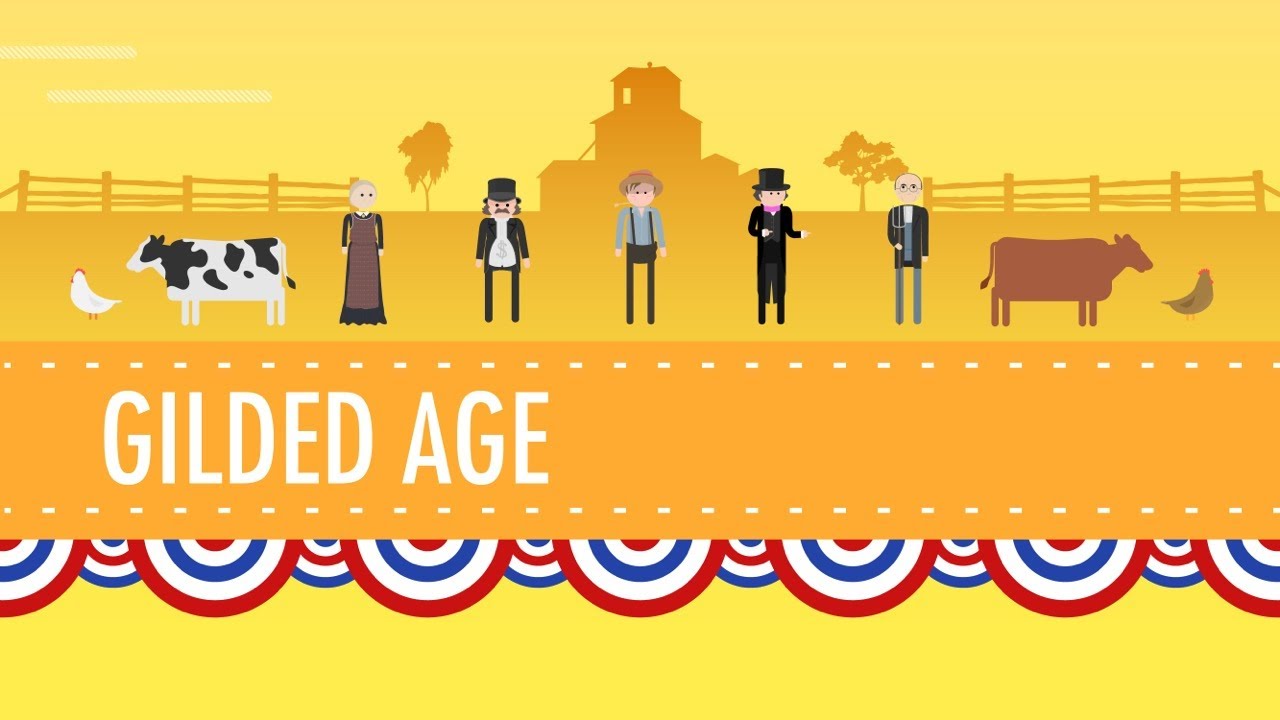
In which John Green teaches you about the Gilded Age and its politics. What, you may ask, is the Gilded Age? The term comes from a book by Mark Twain and Charles Dudley Warner titled, "The Gilded Age." You may see a pattern emerging here. It started in the 1870s and continued on until the turn of the 20th century. The era is called Gilded because of the massive inequality that existed in the United States. Gilded Age politics were marked by a number of phenomena, most of them having to do with corruption. On the local and state level, political machines wielded enormous power. John gets into details about the most famous political machine, Tammany Hall. Tammany Hall ran New York City for a long, long time, notably under Boss Tweed. Graft, kickbacks, and voter fraud were rampant, but not just at the local level. Ulysses S. Grant ran one of the most scandalous presidential administrations in U.S. history, and John will tell you about two of the best-known scandals, the Credit Mobilier scandal, and the Whiskey Ring. There were a few attempts at reform during this time, notably the Civil Service Act of 1883 and the Sherman Anti-trust act of 1890. John will also get into the Grange Movement of the western farmers, and the Populist Party that arose from that movement. The Populists, who threw in their lot with William Jennings Bryan, never managed to get it together and win a presidency, and they faded after 1896. This brings us to the Progressive Era, which we'll get into in the next episode!
Hey teachers and students - Check out CommonLit's free collection of reading passages and curriculum resources to learn more about the events of this episode. The Gilded Age was marked by the success of the richest coupled with inequality and corruption. Repeated factory disasters, such as the triangle shirtwaist factory fire revealed the unsafe working conditions of the urban poor: https://www.commonlit.org/text....s/the-triangle-shirt
Meanwhile, workers began to join unions and strike for better working conditions: https://www.commonlit.org/text....s/the-coeur-d-alene-
Chapters:
Introduction: The Gilded Age 00:00
The Political Machine 1:23
Mystery Document 1:56
"Boss" Tweed & the County Courthouse 3:07
Tammany Politicians 4:11
Credit Mobilier & Bribing Congress 5:18
The Whiskey Ring 6:08
Gilded Age Republicans 6:46
The Civil Service Act & the Sherman Anti-Trust Act 7:27
Local Government Reforms 8:07
The Farmers' Alliance 8:46
The People's (Populist) Party 9:36
Populist Leaders 11:15
William Jennings Bryan's Presidential Campaign 11:42
Credits 13:19
Crash Course is on Patreon! You can support us directly by signing up at http://www.patreon.com/crashcourse
Want to find Crash Course elsewhere on the internet?
Facebook - http://www.facebook.com/YouTubeCrashCourse
Twitter - http://www.twitter.com/TheCrashCourse
Instagram - https://www.instagram.com/thecrashcourse/
CC Kids: http://www.youtube.com/crashcoursekids

Enslaved people resisted their condition in a range of different ways. Oftentimes those ways were small and personal. There were also times when that resistance took on larger, more dramatic forms, like with slave uprisings and rebellions. Today, we'll learn about the Stono Rebellion, which was an uprising led by enslaved people in South Carolina in 1784. We'll also talk about ways that enslaved people resisted in general and methods like enforced illiteracy used by those who sought to keep people in bondage.
Clint's book, How the Word is Passed is available now! https://bookshop.org/a/3859/9780316492935
Sources and References
Ira Berlin, Many Thousands Gone: The First Two Centuries of Slavery in North America (Cambridge: The Belknap Press of Harvard University Press, 1998.
Winthrop Jordan, White Over Black: American Attitudes Toward the Negro, 1550-1812 (Chapel Hill: University of North Carolina Press, 1968, reprinted in 2012)
Peter Wood, Black Majority: Negroes in Colonial South Carolina from 1670 through the Stono Rebellion (New York: W.W. Norton & Company, 1974).
Watch our videos and review your learning with the Crash Course App!
Download here for Apple Devices: https://apple.co/3d4eyZo
Download here for Android Devices: https://bit.ly/2SrDulJ
Crash Course is on Patreon! You can support us directly by signing up at http://www.patreon.com/crashcourse
Thanks to the following patrons for their generous monthly contributions that help keep Crash Course free for everyone forever:
Vincent, Emilee Murphy, Michael Wang, Jordan willis, Krystle Young, Michael Dowling, Alexis B, Rene Duedam, Burt Humburg, Aziz, Nick, DAVID MORTON HUDSON, Perry Joyce, Scott Harrison, Mark & Susan Billian, Junrong Eric Zhu, Alan Bridgeman, Rachel Creager, Jennifer Smith, Matt Curls, Tim Kwist, Jonathan Zbikowski, Jennifer Killen, Sarah & Nathan Catchings, Brandon Westmoreland, team dorsey, Trevin Beattie, Divonne Holmes à Court, Eric Koslow, Indika Siriwardena, Khaled El Shalakany, Shawn Arnold, Siobhán, Ken Penttinen, Nathan Taylor, William McGraw, Andrei Krishkevich, Sam Ferguson, Eric Prestemon, Jirat, TheDaemonCatJr, Wai Jack Sin, Ian Dundore, Jason A Saslow, Justin, Jessica Wode, Mark, Caleb Weeks
Sources and References
-Ira Berlin, Many Thousands Gone: The First Two Centuries of Slavery in North America (Cambridge: The Belknap Press of Harvard University Press, 1998.
-Winthrop Jordan, White Over Black: American Attitudes Toward the Negro, 1550-1812 (Chapel Hill: University of North Carolina Press, 1968, reprinted in 2012)
-Peter Wood, Black Majority: Negroes in Colonial South Carolina from 1670 through the Stono Rebellion (New York: W.W. Norton & Company, 1974).
__
Want to find Crash Course elsewhere on the internet?
Facebook - http://www.facebook.com/YouTubeCrashCourse
Twitter - http://www.twitter.com/TheCrashCourse
Tumblr - http://thecrashcourse.tumblr.com
Support Crash Course on Patreon: http://patreon.com/crashcourse
CC Kids: http://www.youtube.com/crashcoursekids
#crachcourse #history #rebellion

Educational video for kids that talks about the characteristics and types of communication. Communication is how we transmit and receive information. It allows us to share ideas and express our emotions. In all communication, there are the following elements: the sender, the receiver, the message, the channel and the code. The sender is the person who transmits the information. The receiver is the person who receives that information. The message is the information being transmitted. The channel is how that information is shared. The code is the system used to transmit the information (i.e. the language, such as Spanish, English or Chinese).
Communication can be both verbal and non-verbal. Verbal communication takes place when we use words or sign language. It is spoken or written language, like what we use in a conversation or when writing a letter or a text message to a friend. Non-verbal communication occurs through gestures, images or sounds. It goes beyond what we say with words. For example, waving allows us to communicate with others without using words.
This video is a very useful and interesting resource for children. It is perfect to explain to children what communication is. It is an excellent video for elementary school.
Thanks for visiting us! If you want your children to smile and learn, subscribe! :D
If you like our videos, download Smile and Learn now. You’ll discover thousands of activities for children aged 3 to 12 years, all designed by educators. We have hundreds of games, interactive stories and videos in five languages: English, Spanish, Portuguese, Italian, Turkish and French. Try a month for free and start the adventure!
www.smileandlearn.com