Top videos

Kaikki, mitä lukion aloittavan opiskelijan tarvitsee tietää MAY1-kurssilla geogebra-ohjelmasta.

Canva Tutorial für Lehrer / Lehrerinnen - ein Kurzer Überblick was du mit Canva alles für die Schule machen kannst.
#LehrerTutorial #Lehrerapps #EdTech #EdTechTutorial #Schule4.0
Hier kommst du direkt zur kostenlosen Anmeldung für Lehrer:
www.Canva.com/education (die Sprache kannst du selbstständig auf Deutsch ändern).
Schaue auch gerne auf meinem Blog vorbei, für mehr Tutorials rund um die Themen Schule und Digitalisierung. www.DigitaleKreide.com
Folge mir auch bei:
Instagram: https://www.instagram.com/digitalekreide/
Oder Unterstütze meinen Youtube Channel mit:
Buy me a coffee - Support: https://www.buymeacoffee.com/digitalekreide

https://www.patreon.com/homeschoolpop In this episode of Fridays with Homeschool Pop I share about the most popular core school subject and talk about how Constitution Day is coming up!
Daniel
"Homeschool Pop"
Music credits:
Daily Beetle, Jerry Five, Master of the Feast, Cloud Dancer
Link: https://incompetech.filmmusic.....io/song/5759-blippy-
License: http://creativecommons.org/licenses/by/4.0/

Insect facts! Learn all about insects with these insect facts for kids!
This was originally uploaded as a shortened version of my "Insects for Kids" video back when YouTube allowed comments on videos made for children.
❤️ the videos? Consider supporting the channel here: http://homeschoolpop.com
Thanks for learning with me! I think you are super awesome and I hope to see you again soon!
Daniel
"Homeschool Pop"

Bat facts! Learn all about bats with these bat facts for kids!
This was originally uploaded as a shortened version of my "Bats for Kids" video back when YouTube allowed comments on videos made for children.
❤️ the videos? Consider supporting the channel here: http://homeschoolpop.com
Thanks for learning with me! I think you are super awesome and I hope to see you again soon!
Daniel
"Homeschool Pop"
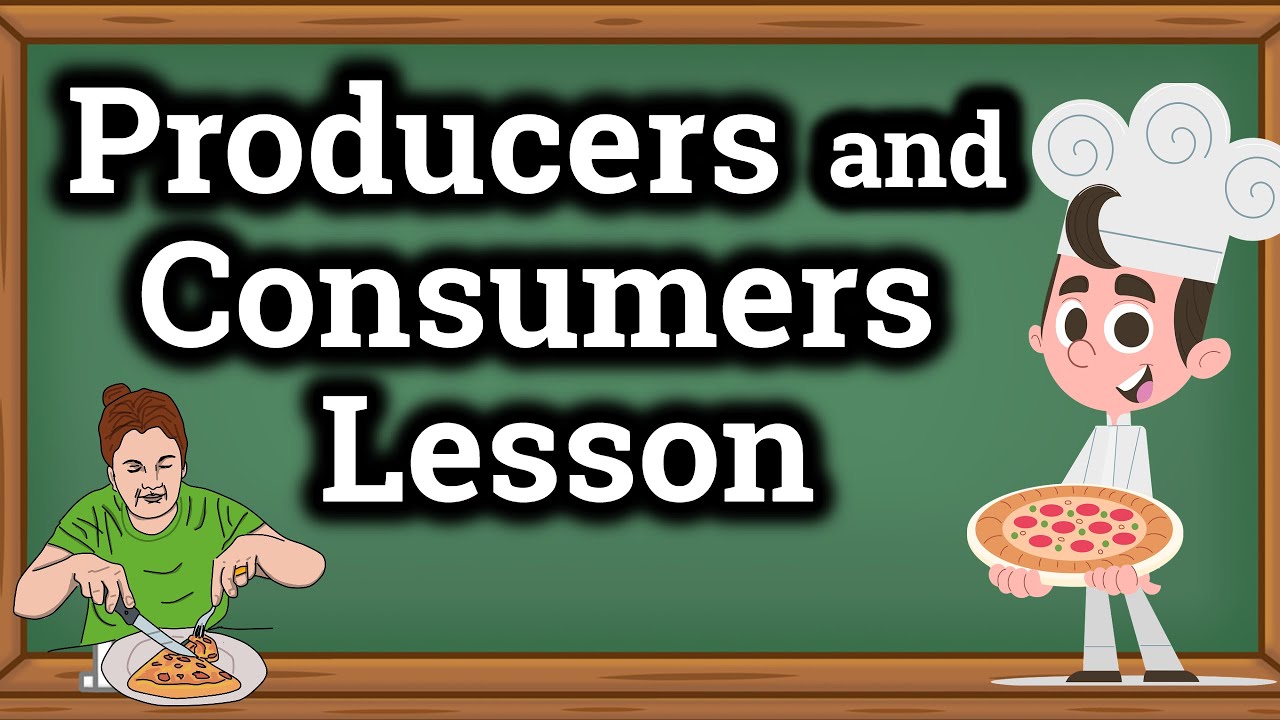
WOW! It is time to learn about producers and consumers in this video for kids of all ages! Producers and consumers are fun and easy to learn in this classroom video! Learn the difference between producers and consumers and how to pick them out!
Homeschool Pop offers a unique, dynamic learning experience. We strive to have the right balance of silliness and learning to keep students engaged as we look at producers and consumers!
We hope you enjoyed the classroom edition of the producers and consumers video! Thanks for watching, and we hope you will keep watching and learning. You are awesome!
Producers and Consumers for Kids | Classroom Video

https://www.patreon.com/homeschoolpop See just how easy and fun subtraction is with this basic math lesson! This is a remastered and extended version of the subtraction video I created last year. I hope you enjoy!!
00:00 What is subtraction?
1:12 Subtracting carrots
1:36 Subtracting at the bakery
3:24 Subtraction game
❤️ Homeschool Pop? Join my team and get tattoos here: http://homeschoolpop.com
Music credits:
Paradise Found, New Friendly, Cloud Dancer, Pinball Spring, Voltaic, Future Cha Cha, Derp Nugget, Equatorial Complex, Sunflower Dance Party, Doobly Doo, Basic Implosion, Getting it Done by Kevin MacLeod
Link: https://incompetech.filmmusic.io
License: http://creativecommons.org/licenses/by/4.0/
Thanks for watching!
I hope to see you next video!
Daniel
"Homeschool Pop"

In these animal learning videos for kids, you will learn about tigers, horses, dolphins, bats and more! This animal learning video compilation will make learning about animals FUN and exciting!
00:00 Tigers
7:14 Horses
16:12 Foxes
22:48 Amphibians
27:53 Dolphins
32:55 Bats
40:28 Penguins
46:38 Reptiles
52:17 Tigers again
❤️ Homeschool Pop? Join our team and get tattoos here: http://homeschoolpop.com
Thanks for learning with us today! We hope to see you next video!
Homeschool Pop Team

YAY!! These 1st Grade kids learning videos are fun! This compilation includes even and odd, other math and even science videos! 1st grade learning is a blast with Homeschool Pop!
❤ Homeschool Pop? Join our team and get tattoos here: http://homeschoolpop.com
☃ You are SO cool! Say hello below, we would love to hear from you!
Thanks for watching this 1st Grade kids learning videos compilation! We hope to see you again soon!
Homeschool Pop Team
1st Grade Kids Learning Videos Compilation

What happens when you decrease the pressure around a liquid? It boils. Water boils at room temperature once the pressure is low enough. What is interesting is that this decreases the temperature of the liquid. The fastest molecules escape, leaving the slower ones behind.
Using this trick with liquid nitrogen, it is possible to create solid nitrogen at a temperature of -210C. We then poured the solid and liquid nitrogen mixture onto a tray of water. The surface of the water became so cold that CO2 solidified out of the atmosphere on its surface. Then, since CO2 does not pass through the liquid phase at atmospheric pressure, it was propelled on the water surface by jets of gas as it sublimed.
Huge thanks to the Palais de la Decouverte.
Music by Kevin MacLeod of Incompetech.com (Mirage)

This musical instrument is 400,000+ years old and still growing. 🌏 Get exclusive NordVPN deal here ➵ https://NordVPN.com/veritasium It’s risk free with Nord’s 30 day money-back guarantee!✌
Special thanks to Luray Caverns - https://luraycaverns.com/
A massive thanks to Rob Scallon, please check out his YouTube channel -- he posts some incredible videos, like this one -- https://youtu.be/cVqqNigImtU?si=otDDVq_00xB3qCy6
▀▀▀
Join us on Patreon for early access videos, bonus content, and to support Veritasium! https://ve42.co/PatreonDE
Patrons: Adam Foreman, Albert Wenger, Alexander Tamas, Anton Ragin, Autodidactic Studios, Bertrand Serlet, Blake Byers, Bruce, Dave Kircher, David Johnston, Evgeny Skvortsov, Farbod Mansorian, Garrett Mueller, Gnare, Greg Scopel, I. H., Juan Benet, KeyWestr, Kyi, Lee Redden, Marinus Kuivenhoven, Matthias Wrobel, Meekay, Michael Krugman, Orlando Bassotto, Paul Peijzel, Richard Sundvall, Sam Lutfi, Spilmann Reed, TTST, Tj Steyn, Ubiquity Ventures, gpoly, meg noah, wolfee
If you’re looking for a molecular modeling kit, try Snatoms, a kit I invented where the atoms snap together magnetically - https://ve42.co/SnatomsV
▀▀▀
Directed by Petr Lebedev
Written by Petr Lebedev
Edited by Jack Saxon
Animated by Jakub Misiek, Fabio Albertelli and Andrew Neet
Filmed by Henry van Dyck, Sumeet Kulkarni and Petr Lebedev
Additional research by Gabe Strong and Geeta Thakur
Produced by Petr Lebedev, Derek Muller, Emily Zhang, Rob Beasley Spence and Tori Brittain
Thumbnail contributions by Ben Powell, Ren Hurley and Peter Sheppard
Additional video/photos supplied by Getty Images, Storyblocks
Music from Epidemic Sound
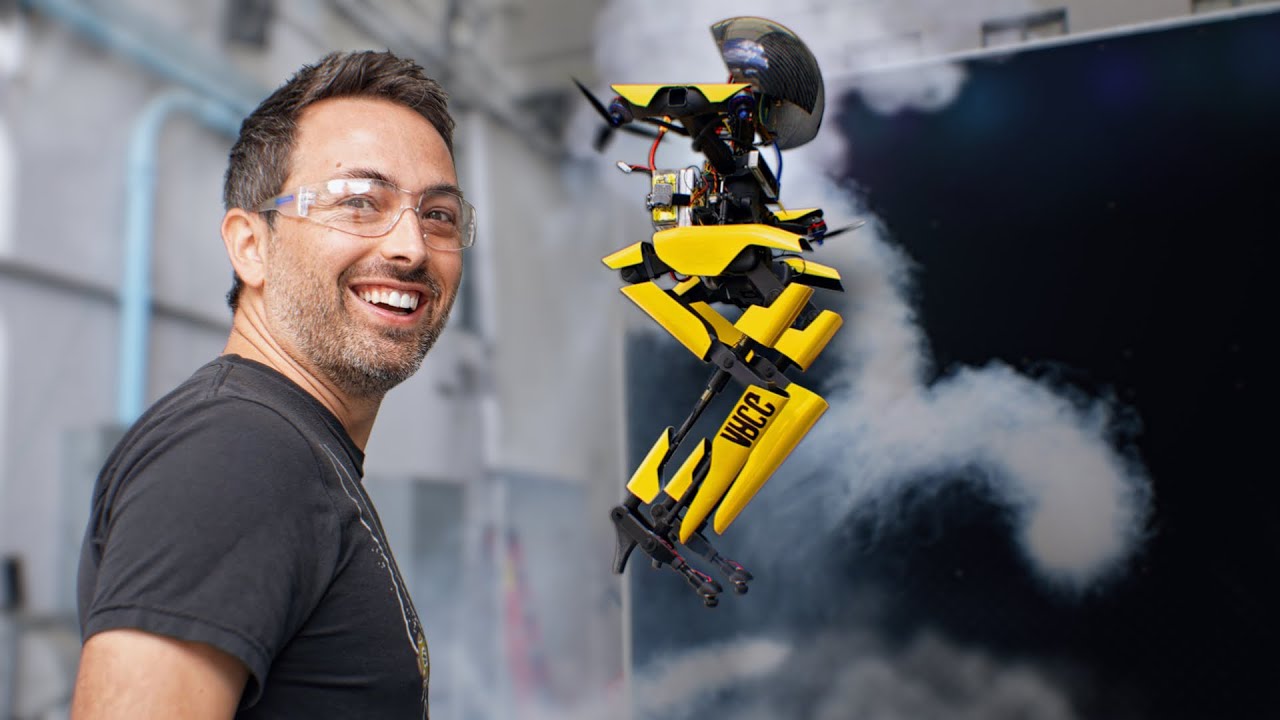
This is a #robot that walks, flies, #skateboards, #slacklines, and might do much more one day. A portion of this video was sponsored by Bluehost. Start building a website with Bluehost today. Use my link to receive more than 65% off: https://bluehost.com/track/veritasium #Bluehost #BHcreator
Thanks to Prof. Soon-Jo Chung and everyone at the Aerospace Robotics and Control Lab at Caltech for the tour!
https://aerospacerobotics.caltech.edu/
▀▀▀▀▀▀▀▀▀▀▀▀▀▀▀▀▀▀▀▀▀▀▀▀▀▀
References:
Kim, K., Spieler, P., Lupu, S., Ramezani, A., Chung, S. (2021). A bipedal walking robot that can fly, slackline, and skateboard. Science Robotics. — https://www.science.org/doi/10.....1126/scirobotics.ab
▀▀▀▀▀▀▀▀▀▀▀▀▀▀▀▀▀▀▀▀▀▀▀▀▀▀
Special thanks to Patreon supporters: S S, Andrew, Benedikt Heinen, Diffbot, Micah Mangione, MJP, Gnare, Dave Kircher, Edward Larsen, Burt Humburg, Blake Byers, Dumky, Evgeny Skvortsov, Meekay, Bill Linder, Paul Peijzel, Mac Malkawi, Michael Schneider, Big Badaboom, Ludovic Robillard, jim buckmaster, Juan Benet, Ruslan Khroma, Robert Blum, Richard Sundvall, Lee Redden, Vincent, Marinus Kuivenhoven, Alfred Wallace, Clayton Greenwell, Michael Krugman, Cy 'kkm' K'Nelson, Sam Lutfi, Ron Neal
▀▀▀▀▀▀▀▀▀▀▀▀▀▀▀▀▀▀▀▀▀▀▀▀▀▀
Written by Derek Muller
Filmed by Derek Muller, Trenton Oliver, and Emily Zhang
Edited by Trenton Oliver
Produced by Derek Muller, Petr Lebedev, and Emily Zhang

Robots of the future may be softer, squishier and bendier than robots today. This could make them ideal for space exploration. Check out http://kiwico.com/Veritasium50 for 50% off your first month of any subscription!
On Thursday February 18th, 2021 the NASA Perseverance Rover will land on Mars. It is a wonderful robot, made out of steel and wire — but will future robots look like Perseverance? There is an emerging field of research on "soft robots", where the machines are flexible. These soft robots have many advantages over traditional robots — they're safer, lighter, more flexible and can change their shape and size.
NASA is investigating the use of soft robots for space missions. For future visits to Enceladus or Europa, a lander could cut a hole in the ice and then insert a compliant robot through the hole. This robot could then grow and change shape on the other side.
References:
N. S. Usevitch, Z. M. Hammond, M. Schwager, A. M. Okamura, E. W. Hawkes, S. Follmer, An untethered isoperimetric soft robot. Sci. Robot. 4,
https://ve42.co/Hammond2020 — paper about the truss robot
https://ve42.co/Usevitch2020 — press release and video about the truss robot
Electronics-free pneumatic circuits for controlling soft-legged robots
Dylan Drotman1, Saurabh Jadhav, David Sharp, Christian Chan, Michael T. Tolley Sci. Robot. 6, eaay2627 (2021)
https://ve42.co/Drotman — paper about the turtle robot
Special thanks to Patreon supporters:
Jim Osmun, Tyson McDowell, Ludovic Robillard, jim buckmaster, Robert, fanime96, Marc Forand, Juan Benet, Ruslan Khroma, Robert Blum, Grace O'Maille KRON x Arc iOS, Richard Sundvall, Lee Redden, Vincent, Lyvann Ferrusca, Alfred Wallace, Arjun Chakroborty, Joar Wandborg, Clayton Greenwell, Pindex , Michael Krugman, Cy 'kkm' K'Nelson, Sam Lutfi, Ron Neal, Bryan Baker
Video supplied by Getty Images
Thanks to Zachary Hammond for showing me the soft truss robot
Filmed by Derek Muller
Edited and GFX by Trenton Oliver
Animation by Ivy Tello
Music by Jonny Hyman
Thumbnail by Ignat Berbeci, Dan Meyer

To get started planning a fulfilling career that does a lot of good, go to https://80000hours.org/kurzgesagt for your free career guide.
Sources & further reading:
https://sites.google.com/view/....sources-boltzmannbra
Absolutely everything you think about yourself and the universe could be an illusion. As far as you know, you are real and exist in a universe that was born 14 billion years ago and that gave rise to galaxies, stars, the Earth, and finally you. Except, maybe not.
OUR CHANNELS
▀▀▀▀▀▀▀▀▀▀▀▀▀▀▀▀▀▀▀▀▀▀▀▀▀▀
German: https://kgs.link/youtubeDE
Spanish: https://kgs.link/youtubeES
French: https://kgs.link/youtubeFR
Portuguese: https://kgs.link/youtubePT
Arabic: https://kgs.link/youtubeAR
Hindi: https://kgs.link/youtubeHI
Japanese: https://kgs.link/youtubeJA
Korean: https://kgs.link/youtubeKO
HOW CAN YOU SUPPORT US?
▀▀▀▀▀▀▀▀▀▀▀▀▀▀▀▀▀▀▀▀▀▀▀▀▀▀
This is how we make our living and it would be a pleasure if you support us!
Get Products designed with ❤ https://shop-us.kurzgesagt.org
Join the Patreon Bird Army 🐧 https://kgs.link/patreon
DISCUSSIONS & SOCIAL MEDIA
▀▀▀▀▀▀▀▀▀▀▀▀▀▀▀▀▀▀▀▀▀▀▀▀▀▀
TikTok: https://kgs.link/tiktok
Reddit: https://kgs.link/reddit
Instagram: https://kgs.link/instagram
Twitter: https://kgs.link/twitter
Facebook: https://kgs.link/facebook
Discord: https://kgs.link/discord
Newsletter: https://kgs.link/newsletter
OUR VOICE
▀▀▀▀▀▀▀▀▀▀▀▀▀▀▀▀▀▀▀▀▀▀▀▀▀▀
The Kurzgesagt voice is from
Steve Taylor: https://kgs.link/youtube-voice
OUR MUSIC ♬♪
▀▀▀▀▀▀▀▀▀▀▀▀▀▀▀▀▀▀▀▀▀▀▀▀▀▀
700+ minutes of Kurzgesagt Soundtracks by Epic Mountain:
Spotify: https://kgs.link/music-spotify
Soundcloud: https://kgs.link/music-soundcloud
Bandcamp: https://kgs.link/music-bandcamp
Youtube: https://kgs.link/music-youtube
Facebook: https://kgs.link/music-facebook
The Soundtrack of this video:
Soundcloud: https://bit.ly/44HSBtH
Bandcamp: https://bit.ly/3RkSOjh
If you want to help us caption this video, please send subtitles to subtitle@kurzgesagt.org
You can find info on what subtitle files work on YouTube here:
https://support.google.com/youtube/answer/2734698?hl=en-GB&ref_topic=7296214
Thank you!
🐦🐧🐤 PATREON BIRD ARMY 🐤🐧🐦
▀▀▀▀▀▀▀▀▀▀▀▀▀▀▀▀▀▀▀▀▀▀▀▀▀▀
Many Thanks to our wonderful Patreons (from http://kgs.link/patreon) who support us every month and made this video possible:
Rebecca Lin, 金山俊 那須, Britnei Tweedy, Ryan, 슝 김, Tyler, Kathi, Ivan Milani, Rico Aarntzen, Nikita Khlebushkin, Christopher Kyle Horton, Valentin Binotto, Nico Riemann, Jesse Plung, Timothy Dooley, Yasheen Sewnarain, saif samer, Taki Reizen, Dragon force Secret art, Jasper Narvil, Alexander Rajaković, TheDoxy, Martijn Gerritsen, Bogdan, Manuel Berdin, Karen Epstein, Sinjid, Peyton, Adi Wabisabi, Infinitae Aetas, Ruben Iusim, febilly, Reyansh Baralay, Ecunna Versity, Stefan Mermans, Nicholas Fernald, Enrique Gonzalez, Jimmy W, Andrew Keenan Richardson, DeMar M., Jordan, chrisby, Niklas Sommer, Kathi, Jakob, Christina Woodbury, Scientist Keo, Dante Jerlich, NekuSoul, Frivack, Adrian, Robin Z., Zeal, MontanaMonarch, Matthew Watson, 민호 김, Mason Edmonds, Nils Hegenbart, Snail, Israel, Ariel Grucza, The Awkward Yeti, Don B, Andreas Andreas, Xeovis

Pre-order our book YOU ARE AN ARTIST (which includes new assignments!) here: http://bit.ly/2kplj2h So much news! Here's your to-do list:
1) Visit our Patreon page!: http://www.patreon.com/artassignment
2) Join our Extra Credit art making group: http://www.facebook.com/groups..../artassignmentextrac
3) Admire our awesome t-shirts: http://store.dftba.com/collect....ions/the-art-assignm
4) Fill out the annual PBS Digital Studios Survey: http://www.surveymonkey.com/r/pbsds2017
Oh, and don't forget to subscribe for new episodes of The Art Assignment every other Thursday!
--
Follow us elsewhere for the full Art Assignment experience:
Website: http://www.theartassignment.com
Instagram: http://instagram.com/theartassignment/
Extra Credit Group: http://www.facebook.com/groups..../artassignmentextrac
tumblr: http://theartassignment.tumblr.com/
All responses tumblr: http://all.theartassignment.com
Twitter: http://twitter.com/artassignment
Facebook: http://www.facebook.com/theartassignment
and maybe Reddit?: http://www.reddit.com/r/TheArtAssignment

Cécile McLorin Salvant is a visual artist and Grammy Award-winning jazz singer, and she shares with us an art assignment. Create your own Theme and Variation Cut-Out by following the instructions below. And check out Prideland on PBS Voices!: youtube.com/pbsvoices.
1. Draw a simple outline of a human body
2. Do this until you find one you really like
3. Then draw variations of that outline playing with the limbs and proportions
4. Copy your favorite four outlines to stiff paper or cardboard
5. Cut them out, tape a piece of string to them, and hang wherever you like
Share your work with the hashtag #youareanartist and/or tag us on Instagram or Twitter. Or join our Facebook group to share your work with a community of artists:
Learn more about Cécile McLorin Salvant: http://www.cecilemclorinsalvant.com
Thanks to our Grandmasters of the Arts Divide By Zero Collection and David Golden, and to all of our patrons, especially Anthony Chivetta, Rich Clarey, Iain Eudailey, Tom Forwood, Patrick Hanna, Andrew Huynh, Eve Leonard, Audrey Mak Tung, David Moore, Jane Quale, Gabriel Civita Ramirez, Andrew Sheeler, Boris Silantiev, Josh Thomas, Constance Urist, and Roberta Zaphiriou. To support our channel, visit: http://www.patreon.com/artassignment.
Subscribe for new episodes of The Art Assignment every other Thursday.

Pre-order our book YOU ARE AN ARTIST (which includes new assignments!) here: http://bit.ly/2kplj2h
This assignment comes to you from Chicago based artist Geof Oppenheimer. Geof's work reflects personal experience and the social and political atmosphere they were created in, and he wants you to make an object that does the same.
John Green and Sarah Green then discusses what embarrasses us overtime and what we no longer find embarrassing. Sarah then takes us to art history to show where the "Idealized Body" began.
INSTRUCTIONS - Embarrassing Object
1. Create something that makes you feel uncomfortable, out of a material or group of materials
2. Document it and upload using #theartassignment
3. Fame and glory (Your work might be in a future episode)

Overview is back on @pbsterra! Watch now : https://youtu.be/NYA6GF1uAa8
Join us on Patreon! https://patreon.com/itsokaytobesmart
↓↓↓ More info and sources below ↓↓↓
Why do the same, self-repeating patterns appear in trees, rivers, lightning, and even inside our own bodies? Is there some secret, hidden rule of nature or mathematics that makes these intricate designs appear all over the place? Let’s talk about fractals.
References: https://sites.google.com/view/....besmart-fractalsinna
SUBSCRIBE so you don’t miss a video! ►► http://bit.ly/iotbs_sub
-----------
High fives to all our Brain Trust Patrons:
Ed Eyden
Jennifer Burton
Charles Horton, Jr
Holly, Brett, and Ashe Bullion
Jaap Westera
Mehdi Damou
Barbora Bei
Burt Humburg
dani bowman
David Johnston
Baerbel Winkler
Eric Meer
Karen Haskell
Join us on Patreon!
https://patreon.com/itsokaytobesmart
Instagram
http://www.instagram.com/DrJoeHanson
http://www.instagram.com/okaytobesmart
Facebook
https://www.facebook.com/itsokaytobesmartpbs/

Viewers like you help make PBS (Thank you 😃) . Support your local PBS Member Station here: https://to.pbs.org/PBSDSDonate
Follow me to Vsauce3!! http://bit.ly/1zUxn7a
Twitter: @okaytobesmart @jtotheizzoe Instagram: @jtotheizzoe
↓ More info and sources below ↓
Will artificial intelligence ever surpass human intelligence? And if that happens, will AI be good or bad? Is evil AI like we see in Avengers: Age of Ultron… inevitable?
READ THIS FOR MORE:
Wait But Why: The Road To Superintelligence
Part 1: http://waitbutwhy.com/2015/01/....artificial-intellige
Part 2: http://waitbutwhy.com/2015/01/....artificial-intellige
The smiley face thought experiment is my take on the famous "paperclip maximizer", read more about it here: http://wiki.lesswrong.com/wiki/Paperclip_maximizer
Special thanks to Jake from Vsauce3!
Have an idea for an episode or an amazing science question you want answered? Leave a comment below!
Follow on Twitter: http://twitter.com/okaytobesmart
http://twitter.com/jtotheizzoe
Follow on Tumblr: http://www.itsokaytobesmart.com
Follow on Instagram: http://instagram.com/jtotheizzoe
-----------------
It's Okay To Be Smart is written and hosted by Joe Hanson, Ph.DFollow me on Twitter: @jtotheizzoe
Email me: itsokaytobesmart AT gmail DOT com
Facebook: http://www.facebook.com/itsokaytobesmart
Google+ https://plus.google.com/+itsokaytobesmart
For more awesome science, check out: http://www.itsokaytobesmart.com
Produced by PBS Digital Studios: http://www.youtube.com/user/pbsdigitalstudios
Joe Hanson - Creator/Host/Writer
Joe Nicolosi - Director
Amanda Fox - Producer, Spotzen IncKate Eads - Associate Producer
Andrew Matthews - Editing/Motion Graphics/Animation
Dan Silver - Production Assistant
Dalton Allen - Post-Production Intern
Theme music:
"Ouroboros" by Kevin MacLeod
Other music via APM
Stock images from Shutterstock, stock footage from Videoblocks
-----------------
Last week's video:
Superbugs: The Empire Strikes Bacteria https://www.youtube.com/watch?v=fyRyZ1zKtyA
More videos:
Why Does February Have 28 Days? https://www.youtube.com/watch?v=AgKaHTh-_Gs
Why Vaccines Work https://www.youtube.com/watch?v=3aNhzLUL2ys
Why Are Some People Left-Handed? https://www.youtube.com/watch?v=NPvMUpcxPSA
Where Does the Smell of Rain Come From? https://www.youtube.com/watch?v=lGcE5x8s0B8

Another YouTube #shorts from Dr. Joe! Subscribe for more fun science stories
Join us on Patreon!
https://patreon.com/itsokaytobesmart
Instagram
http://www.instagram.com/DrJoeHanson
http://www.instagram.com/okaytobesmart
Facebook
https://www.facebook.com/itsokaytobesmartpbs/

Our mission? Make math fun, engaging, and oh-so-easy for both you & your students. Our library of lesson materials is not only super-affordable but is also FREE to try out at http://numberock.com/letsrockmath.
Thank you for watching our Adding Mixed Numbers song and learning about fractions with us!

In this video, I'll show you how to add fractions and mixed numbers with the same and different denominators.
#addingsimplefractionsandmixedfractions
#addingfractions
#filkoreantv #Math&EnglishTV
You can watch other videos by clicking the link below.
Divisibility rules for 2,5 and 10
https://youtu.be/VRrvDasqIEo
Divisibility rules for 3, 6 and 9
https://youtu.be/Cj4VLhZ7584
Divisibility rules for 4, 8, 11 and 12
https://youtu.be/JiDdtnQxI1U
Divisibility Rule for 7
https://youtu.be/wAreAjCSqow
How to Solve Equations Involving Different Operations
https://youtu.be/jxgPerdbMaM
How to Find the Greatest Common Factor
https://youtu.be/aJD6I71vJcU
HOW TO ADD DECIMAL NUMBERS
https://youtu.be/RGGi7VVRb6I
HOW TO DIVIDE FRACTIONS
https://youtu.be/xi9-42YB8KQ
HOW TO MULTIPLY MIXED NUMBERS
https://youtu.be/lL8Rqmwt0kg
HOW TO ROUND OFF DECIMAL NUMBERS
https://youtu.be/7N9t4Q9takw
HOW TO READ AND WRITE DECIMAL NUMBERS
https://youtu.be/sKFlbr4-Z4o
How to Identify the Place value of decimal numbers
https://youtu.be/Hk_9MEI6V9M
How to Multiply Fractions
https://youtu.be/XcBK4kz5V50
How to change improper fractions to mixed numbers and mixed numbers to improper fractions
https://youtu.be/YiVFKEBkit4
Thank you so much for watching. Please subscribe to our channel.
God bless!
how to add mixed numbers
how to add mixed fractions
how to add mixed fractions with unlike denominators
how to add and subtract mixed numbers
how to add and subtract mixed fractions
adding and subtracting mixed numbers
adding and subtracting mixed fractions
adding and subtracting fractions
adding and subtracting mixed fractions
adding and Subtracting Simple Fractions and Mixed Fractions without or with Regrouping
adding and subtracting mixed numbers and fractions with dissimilar fractions
adding and subtracting mixed numbers and fractions with unlike denominators
adding and subtracting mixed numbers and fractions with different fractions
how to add and subtract mixed numbers and fractions with unlike denominators
how to add and subtract mixed numbers and fractions with different denominators
how to add and subtract mixed numbers and fractions with dissimilar fractions
how to add fractions with whole numbers and different denominators
how to add and subtract fractions with whole numbers and different denominators
how to add whole numbers and dissimilar fractions
how to add whole numbers and fractions with unlike denominators
adding whole numbers and dissimilar fractions
adding whole numbers and fractions with unlike denominators
how to add dissimilar fractions
how to add dissimilar fractions with mixed numbers
how to add unlike fractions
how to add dissimilar fractions step by step
how to add 3 dissimilar fractions
how to add fractions not the same denominators
how to solve addition of dissimilar fractions
how to solve dissimilar fractions
how to solve addition of Dissimilar Fractions step by step
Dissimilar Fractions
Adding fractions
Solving Fractions
How to add fractions
Sum of Fractions
Sum of Dissimilar Fractions
Examples of Fractions
Examples of Dissimilar Fractions
How to Add Dissimilar Fractions
Adding Dissimilar Fractions
Solving Dissimilar Fractions
Add and subtract simple fractions and mixed numbers without or with Regrouping
Adding and subtracting simple fractions and mixed numbers without or with Regrouping
Adds and subtracts simple fractions and mixed numbers without or with Regrouping
adding similar fractions
adding fractions with like denominators
adding fractions with the same denominators
how to add similar fractions
how to add fractions with like denominators
how to add fractions with the same denominators
adding and Subtracting Simple Fractions witout or with Regrouping
adding and Subtracting Simple Fractions and Mixed Numbers
adding and Subtracting Simple Fractions
adding and Subtracting basic fractions
adding and Subtracting Simple Fractions and Mixed Numbers with regrouping
add and subtract simple fractions
add and subtract simple fractions and mixed numbers
addition and subtraction of simple fractions and mixed numbers without or with regrouping
add and subtract simple fractions and mixed numbers without regrouping
math 6 quarter 1 week 1
math 6 quarter 1 module 1
grade 6 math quarter 1 week 1
grade 6 math
grade 6 math lessons
grade 6 math quarter 1 week 1
grade 6 math quarter 1

Our mission? Make math fun, engaging, and oh-so-easy for both you & your students. Our library of lesson materials is not only super-affordable but is also FREE to try out at http://numberock.com/letsrockmath.
Thank you for watching our mixed numbers and improper fractions song!

Class 4 Chapter Fraction ( Complete Chapter )
Learn what is Fraction, how to write fraction, what is numerator, denominator, half, one-third, one-fourth of a fraction, Proper, improper, like, unlike fraction. How to convert improper fraction to mixed fraction, comparing and ordering fractions, simplifying the fraction to its lowest form, add and subtract fractions - Class 4 Chapter Fractions.
-------------------------------
For more Class 4 maths videos -
https://learningnotebookyoutub....e.blogspot.com/p/cla
-------------------------------
Class 4 Maths course
https://www.youtube.com/playli....st?list=PLW6ZJtqCeoW
-------------------------------
Learning Notebook Website:
https://learningnotebookyoutube.blogspot.com/
-------------------------------
Support, like & subscribe my channel @LearningNotebook
Contact Email: LearningNotebookOfficial@gmail.com

Canva is a popular program for creating professional-grade graphic designs and other creativity projects, but to make the most of it, you used to need the Pro version. Luckily last year Canva released Canva for Education, which is completely free for educators and students, includes 1000s of pre-created education templates, allows you to create individual and collaborative assignments, and syncs with Learning Management Systems. Learn what it's all about in this week's education technology tutorial!
Sign up for a free Canva Education account: https://canva.com/edu-signup
Timestamps:
0:00 Introduction
1:07 Canva for Education Overview
2:45 Setting up Your Canva Account
5:05 Assign Templates to Individual Students
7:40 Collaborative Assignments in Canva
10:12 Graphic Design Projects
12:50 Video Projects
14:45 Teacher Templates
16:11 Google Classroom Banners
17:11 Conclusion
=======================================
Get started with our award-winning micro-courses for free at https://nextgenerationteacher.com
Become a member of this channel to support our work!
https://www.youtube.com/channe....l/UCd6vizTYlSgpR6zJ8
For tips, ideas, and resources for how to use education technology to increase engagement, rigor, and creativity in your classroom, visit: https://www.newedtechclassroom.com
Follow New EdTech Classroom on Twitter: https://twitter.com/newedtechclass
Facebook: https://www.facebook.com/NewEdTechClassroom
Instagram: https://www.instagram.com/newedtechclass/
TikTok: https://www.tiktok.com/@newedtechclass
LinkedIn: https://www.linkedin.com/compa....ny/the-new-edtech-cl