סרטונים מובילים
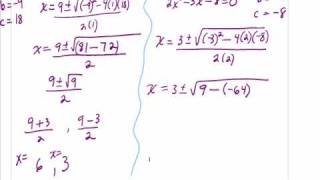
In this tutorial, I do another example, showing how to plot and sketch an algebraic equation on the x y coordinate system.
Join this channel to get access to perks:
https://www.youtube.com/channe....l/UCn2SbZWi4yTkmPUj5
:)
This tutorial demonstrates how to use the basic percentage equation to find the percent of something that is complete.
Join this channel to get access to perks:
https://www.youtube.com/channe....l/UCn2SbZWi4yTkmPUj5
:)
On this triangle congruence lesson, you will learn the difference between the Angle-Angle-Side AAS theorem and the Angle-Side-Angle ASA theorem (also known as the asa postulate) when proving triangle congruence and what are same side interior angles?
This lesson answers the questions: How do I prove that two triangles are congruent? What is ASA? What is AAS? What is the difference between ASA and AAS?
Our lessons are perfect for flipped classroom math teachers and students. This lesson is aligned with the common core learning standards for math and the SAT math curriculum as well.
Be sure to join our mailing list at http://www.mashupmath.com

Being able to add two numbers quickly is an important maths skill.
This lesson shows how to add quickly in your head, from left to right (the way you would say the answer), through carrying numbers forward.
Mental computation - practice it - especially addition, as this is the most common use of maths used in society.
To donate to the tecmath channel:https://paypal.me/tecmath
To support tecmath on Patreon: https://www.patreon.com/tecmath
To buy tecmath mechandise: https://teespring.com/stores/tecmath-store
How Many Faces, Edges And Vertices Does A Octagonal Prism Have?
Here we’ll look at how to work out the faces, edges of vertices of an octagonal prism.
We’ll start by counting the faces, these are the flat surfaces that make the 3D shape. An octagonal prism has 10 faces altogether - 2 octagonal faces, as well as 8 rectangular faces.
Next we’ll work out how many edges the shape has, which are where two faces meet. An octagonal prism has 24 edges.
Next we’ll count the corners of the shape(the corners). Get counting! An octagonal prism has 160 vertices.
For the full playlist for the faces, edges and Vertices of a whole lot of 3D shapes go to https://www.youtube.com/playli....st?list=PLjbxBzUM6SL
To donate to the tecmath channel: https://paypal.me/tecmath?locale.x=en_AU
To support tecmath on Patreon: https://www.patreon.com/tecmath
To buy tecmath mechandise: https://teespring.com/stores/tecmath-store
This tutorial looks at how to quickly and easily do long division using Vedic Math.
Learn to calculate long division as quickly as a calculator, without needing the guesswork often assosiated with standard long division.
This video is the last of four videos looking at this ingenious method. To donate to the tecmath channel: https://paypal.me/tecmath?locale.x=en_AU To donate to the tecmath channel: https://paypal.me/tecmath?locale.x=en_AU
To support tecmath on Patreon: https://www.patreon.com/tecmath
To buy tecmath mechandise: https://teespring.com/stores/tecmath-store
Use this method to solve algebra equations where you have variables on each side of the equation!
Solve algebra equations instantly - OK, maybe in about 10 seconds! This fast math trick for instant calculation will have you correctly answering algebraic equations with pronumerals on both sides - even beginners! To donate to the tecmath channel: https://paypal.me/tecmath?locale.x=en_AU To donate to the tecmath channel: https://paypal.me/tecmath?locale.x=en_AU
To support tecmath on Patreon: https://www.patreon.com/tecmath
To buy tecmath mechandise: https://teespring.com/stores/tecmath-store
Night Night, Groot
by Brendan Deneen
Illustrated by Cale Atkinson
Read by Let’s Read Stories
It's been a long day for baby Groot and he's ready to be tucked in for bed. Just as his eyes start to close, Rocket Raccoon bursts onto the scene! Groot can't go to sleep yet, there's a whole galaxy that needs to be defended and they must work together to save the day! Then maybe, just maybe, Groot will finally get the rest he deserves! Each spread includes a tiny Ant-Man, let's see if you can find him. . .
Tuck your little avenger into bed with this adorable bedtime story. Night, Night Groot is the perfect story to introduce your child to rhymes and sounds. Kid book read aloud can help your little one with recognizing letters and words, speaking english, communication and literacy. Relax with the guardians of the galaxy while your toddler falls in love with abcs and 123s. Perfect for kindergarteners, preschooler, 1st or 2nd graders. Thanks for watching!
Click here to purchase Night Night, Groot: https://www.amazon.com/Night-G....root-Brendan-Deneen/
Charlotte the Scientist Is Squished
by Camille Andros
Illustrated by Brianne Farley
Read by Let's Read Stories
Charlotte is a serious scientist. She solves important problems by following the scientific method. She has all the right equipment: protective glasses, a lab coat, a clipboard, and a magnifying glass. What she doesn’t have is space. She has so many brothers and sisters (she is a rabbit, after all) that she is too squished to work on her experiments! Can she use science to solve her problem? This funny, satisfying story is a playful introduction to the scientific method and perfect for sparking an interest in STEM subjects.
Click here to purchase Charlotte the Scientist Is Squished: https://www.amazon.com/Charlot....te-Scientist-Squishe
In which John Green discusses the strange and mutually beneficial relationship between a republic, the city-state of Venice, and an Empire, the Ottomans--and how studying history can help you to be a better boyfriend/girlfriend. Together, the Ottoman Empire and Venice grew wealthy by facilitating trade: The Venetians had ships and nautical expertise; the Ottomans had access to many of the most valuable goods in the world, especially pepper and grain. Working together across cultural and religious divides, they both become very rich, and the Ottomans became one of the most powerful political entities in the world. We also discuss how economic realities can overcome religious and political differences (in this case between Muslims and Christians), the doges of Venice, the sultans of the Ottoman empire, the janissaries, and the so-called slave aristocracy of the Ottoman Empire, and how money and knowledge from the Islamic world helped fuel and fund the European Renaissance. Also, there's a They Might Be Giants joke.
Chapters:
Introduction 00:00
Venice 1:02
Venetian Trade 1:26
Piazza San Marco 2:48
Venetian Imports, Exports, & Economy 3:45
Venetian Government 4:25
The Ottomans 4:46
Ottoman Sultans 5:21
An Open Letter to Ottoman Eunuchs 7:15
The Ottomans' and Venetians' Relationship 8:12
Credits 9:38
--
If you really want to read about Ottoman eunuchs (warning: it's explicit), here you go: http://en.wikipedia.org/wiki/Eunuch#Ottoman_Empire
--
Crash Course is on Patreon! You can support us directly by signing up at http://www.patreon.com/crashcourse
Want to find Crash Course elsewhere on the internet?
Facebook - http://www.facebook.com/YouTubeCrashCourse
Twitter - http://www.twitter.com/TheCrashCourse
Instagram - https://www.instagram.com/thecrashcourse/
CC Kids: http://www.youtube.com/crashcoursekids
Hank describes how cells regulate their contents and communicate with one another via mechanisms within the cell membrane.
"Concert" music used with permission from Chameleon Circuit.
This video uses sounds from Freesound.org
Table of Contents time codes:
1) Passive Transport - 1:17
2) Diffusion - 1:25
3) Osmosis - 2:12
4) Channel Proteins- 4:37
5) Active Transport - 4:58
6) ATP - 5:37
7) Transport Proteins - 6:19
8) Biolography - 6:37
9) Vesicular Transport - 9:02
10) Exocytosis - 9:21
11) Endocytosis - 9:50
12) Phagocytosis - 9:57
13) Pinocytosis - 10:29
14) Receptor-Mediated Endocytosis - 10:48
Crash Course is on Patreon! You can support us directly by signing up at http://www.patreon.com/crashcourse
Want to find Crash Course elsewhere on the internet?
Facebook - http://www.facebook.com/YouTubeCrashCourse
Twitter - http://www.twitter.com/TheCrashCourse
Instagram - https://www.instagram.com/thecrashcourse/
CC Kids: http://www.youtube.com/crashcoursekids
If you're interested in learning more about the Russian government's 2022 invasion of Ukraine, check out this vlogbrothers video published on 3/15/2022: https://www.youtube.com/watch?v=mMZYKxgc9TE
In which John Green teaches you how Russia evolved from a loose amalgamation of medieval principalities known as the Kievan Rus into the thriving democracy we know today. As you can imagine, there were a few bumps along the road. It turns out that our old friends the Mongols had quite a lot to do with unifying Russia. In yet another example of how surprisingly organized nomadic raiders can be, the Mongols brought the Kievan Rus together under a single leadership and concentrated power in Moscow. This set the stage for the various Ivans (the Great and the Terrible) to throw off the yoke and form a pan-Russian nation ruled by an autocratic leader. More than 500 years later, we still have autocratic leadership in Russia. All this, plus a rundown of some of our favorite atrocities of Ivan the Terrible, and a visit from Putin!
Chapters:
Introduction 00:00
The Kievan Rus 0:44
Trade in 11th-century Kiev (Kyiv) 1:28
Leadership & Government in Kiev (Kyiv) 2:15
Mongol Rule and the Era of Appanage Russia 2:50
The Mongols' Influence on Russia 3:19
How did Moscow become so prominent? 4:29
An Open Letter to Basil and Basil 6:11
Ivan the Great (Ivan III) Expands Moscow's Power 6:58
Ivan the Terrible (Ivan IV) 7:45
Credits 10:10
Crash Course is on Patreon! You can support us directly by signing up at http://www.patreon.com/crashcourse
Want to find Crash Course elsewhere on the internet?
Facebook - http://www.facebook.com/YouTubeCrashCourse
Twitter - http://www.twitter.com/TheCrashCourse
Instagram - https://www.instagram.com/thecrashcourse/
CC Kids: http://www.youtube.com/crashcoursekids
In which John Green teaches you about the early days of the Civil Rights movement. By way of providing context for this, John also talks a bit about wider America in the 1950s. The 1950s are a deeply nostalgic period for many Americans, but there is more than a little idealizing going on here. The 1950s were a time of economic expansion, new technologies, and a growing middle class. America was becoming a suburban nation thanks to cookie-cutter housing developments like the Levittowns. While the white working-class saw their wages and status improve, the proverbial rising tide wasn't lifting all proverbial ships. A lot of people were excluded from the prosperity of the 1950s. Segregation in housing and education made for some serious inequality for African Americans. As a result, the Civil Rights movement was born. John will talk about the early careers of Martin Luther King, Thurgood Marshall, Rosa Parks, and even Earl Warren. He'll teach you about Brown v Board of Education, the lesser-known Mendez vs Westminster, the Montgomery Bus Boycott, and all kinds of other stuff.
Hey teachers and students - Check out CommonLit's free collection of reading passages and curriculum resources to learn more about the events of this episode. The Civil Rights Movement gained national attention with the murder of Emmett Till in 1955: https://www.commonlit.org/texts/emmett-till
That same year, Rosa Parks refused to give up her seat on a Montgomery bus, beginning the Montgomery bus boycott: https://www.commonlit.org/text....s/rosa-parks-and-the
A young preacher named Martin Luther King Jr. gained national fame rallying support for the Montgomery bus boycott: https://www.commonlit.org/text....s/martin-luther-king
The end of segregation also began in the South with the Showdown in Little Rock in 1957: https://www.commonlit.org/text....s/showdown-in-little
Want to learn more about the Civil Rights movement? Check out these videos from Crash Course Black American History:
School Segregation and Brown v Board (#33): https://www.youtube.com/watch?v=NBlqcAEv4nk
Emmett Till (#34): https://www.youtube.com/watch?v=4HljsKwpv3g
The Montgomery Bus Boycott (#35): https://www.youtube.com/watch?v=ylOpide9dus
Martin Luther King, Jr (#36): https://www.youtube.com/watch?v=BmeUT7zH62E
---Crash Course Black American History will be uploading new videos through 2022!---
Chapters:
Introduction: The 1950s 00:00
The American Suburbs 2:01
The "Era of Consensus" 3:05
Segregation 4:10
Desegregating Schools 5:18
Mystery Document 6:50
The Aftermath of Brown vs. Board of Education 7:50
Rosa Parks & the Montgomery Bus Boycotts 8:29
Martin Luther King, Jr. 9:32
The Little Rock Nine 9:54
The Emergence of the Civil Rights Movement 10:30
Credits 11:25
Crash Course is on Patreon! You can support us directly by signing up at http://www.patreon.com/crashcourse
Want to find Crash Course elsewhere on the internet?
Facebook - http://www.facebook.com/YouTubeCrashCourse
Twitter - http://www.twitter.com/TheCrashCourse
Instagram - https://www.instagram.com/thecrashcourse/
CC Kids: http://www.youtube.com/crashcoursekids
Hank introduces us to biogeochemical cycles by describing his two favorites: carbon and water. The hydrologic cycle describes how water moves on, above, and below the surface of the Earth, driven by energy supplied by the sun and wind. The carbon cycle does the same... for carbon!
Table of Contents
1) Hydrologic Cycle - 1:15
A) Clouds - 2:13
B) Runoff - 3:06
C) Oceans - 3:41
D) Evapotranspiration - 4:25
2) Carbon Cycle - 5:12
A) Plants - 5:48
B) Fossil Fuels - 6:40
C) Oceans - 7:12
D) Global Warming - 7:35
References
http://ga.water.usgs.gov/edu/w....atercyclecondensatio
http://harvardmagazine.com/200....2/11/the-ocean-carbo
http://www.visionlearning.com/....library/module_viewe
Crash Course is on Patreon! You can support us directly by signing up at http://www.patreon.com/crashcourse
Want to find Crash Course elsewhere on the internet?
Facebook - http://www.facebook.com/YouTubeCrashCourse
Twitter - http://www.twitter.com/TheCrashCourse
Instagram - https://www.instagram.com/thecrashcourse/
CC Kids: http://www.youtube.com/crashcoursekids
Hank tells us about the city of Eukaryopolis - the animal cell that is responsible for all the cool things that happen in our bodies.
Table of Contents time codes
1) Robert Hooke 1:59
2) Cilia/Flagella 2:52
3) Cell Membrane 3:32
4) Cytoplasm/Cytoskeleton/Centrosomes 3:58
5) Endoplasmic Reticulum 4:41
6) Ribosomes 5:45
7) Golgi Apparatus 6:00
8) Lysosomes 6:47
9) Nucleus 7:06
10) Mitochondria 9:14
Crash Course is on Patreon! You can support us directly by signing up at http://www.patreon.com/crashcourse
Want to find Crash Course elsewhere on the internet?
Facebook - http://www.facebook.com/YouTubeCrashCourse
Twitter - http://www.twitter.com/TheCrashCourse
Instagram - https://www.instagram.com/thecrashcourse/
CC Kids: http://www.youtube.com/crashcoursekids
Geometric probabilities, and probabilities in general, allow us to guess how long we'll have to wait for something to happen. Today, we'll discuss how they can be used to figure out how many Bertie Bott's Every Flavour Beans you could eat before getting the dreaded vomit flavored bean, and how they can help us make decisions when there is a little uncertainty - like getting a Pikachu in a pack of Pokémon Cards! We'll finish off this unit on probability by taking a closer look at the Birthday Paradox (or birthday problem) which asks the question: how many people do you think need to be in a room for there to likely be a shared birthday? (It's likely much fewer than you would expect!)
Crash Course is on Patreon! You can support us directly by signing up at http://www.patreon.com/crashcourse
Thanks to the following Patrons for their generous monthly contributions that help keep Crash Course free for everyone forever:
Mark Brouwer, Glenn Elliott, Justin Zingsheim, Jessica Wode, Eric Prestemon, Kathrin Benoit, Tom Trval, Jason Saslow, Nathan Taylor, Divonne Holmes à Court, Brian Thomas Gossett, Khaled El Shalakany, Indika Siriwardena, SR Foxley, Sam Ferguson, Yasenia Cruz, Eric Koslow, Caleb Weeks, Tim Curwick, Evren Türkmenoğlu, D.A. Noe, Shawn Arnold, mark austin, Ruth Perez, Malcolm Callis, Ken Penttinen, Advait Shinde, Cody Carpenter, Annamaria Herrera, William McGraw, Bader AlGhamdi, Vaso, Melissa Briski, Joey Quek, Andrei Krishkevich, Rachel Bright, Alex S, Mayumi Maeda, Kathy & Tim Philip, Montather, Jirat, Eric Kitchen, Moritz Schmidt, Ian Dundore, Chris Peters, Sandra Aft, Steve Marshall
--
Want to find Crash Course elsewhere on the internet?
Facebook - http://www.facebook.com/YouTubeCrashCourse
Twitter - http://www.twitter.com/TheCrashCourse
Tumblr - http://thecrashcourse.tumblr.com
Support Crash Course on Patreon: http://patreon.com/crashcourse
CC Kids: http://www.youtube.com/crashcoursekids
In order to understand how we study the universe, we need to talk a little bit about light. Light is a form of energy. Its wavelength tells us its energy and color. Spectroscopy allows us to analyze those colors and determine an object’s temperature, density, spin, motion, and chemical composition.
Check out the Crash Course Astronomy solar system poster here: http://store.dftba.com/product....s/crashcourse-astron
--
Chapters:
Introduction 00:00
Light is a Wave 0:31
Electromagnetic Spectrum 1:32
How is Light Made? 3:19
Atomic Structure 4:47
Spectroscopy 7:14
Redshift vs Blueshift 8:26
Review 9:50
--
PBS Digital Studios: http://youtube.com/pbsdigitalstudios
Follow Phil on Twitter: https://twitter.com/badastronomer
Want to find Crash Course elsewhere on the internet?
Facebook - http://www.facebook.com/YouTubeCrashCourse
Twitter - http://www.twitter.com/TheCrashCourse
Tumblr - http://thecrashcourse.tumblr.com
Support CrashCourse on Patreon: http://www.patreon.com/crashcourse
--
PHOTOS/VIDEOS
Wavelengths http://imagine.gsfc.nasa.gov/e....ducators/gammaraybur [credit: Imagine the Universe! / NASA]
Observatories across spectrum http://imagine.gsfc.nasa.gov/I....mages/science/observ [credit: Imagine the Universe! / NASA]
Red hot spiral hotplate http://freefoodphotos.com/imag....elibrary/cooking/sli [credit: freefoodphotos.com]
The Crab Nebula http://en.wikipedia.org/wiki/N....ebula#/media/File:Cr [credit: NASA, ESA, J. Hester and A. Loll (Arizona State University)]
Building the Space Telescope Imaging Spectograph http://imgsrc.hubblesite.org/h....u/gallery/db/spacecr [credit: NASA]
VST images the Lagoon Nebula http://en.wikipedia.org/wiki/L....agoon_Nebula#/media/ [credit: ESO/VPHAS+ team]
Jupiter http://www.nasa.gov/images/con....tent/414987main_pia0 [credit: NASA/Johns Hopkins University Applied Physics Laboratory/Southwest Research Institute]
Venus http://en.wikipedia.org/wiki/A....tmosphere_of_Venus#/ [credit: NASA - NSSDC Photo Gallery Venus]
Ring Around SN 1987a, image 1 http://www.spacetelescope.org/images/opo9714e/ [credit: Jason Pun (NOAO) and SINS Collaboration]
Ring Around SN 1987a, image 2 http://www.spacetelescope.org/images/opo9714a/ [credit: George Sonneborn (GSFC) and NASA/ESA]
In this REALLY IMPORTANT EPISODE of Crash Course Psychology, Hank talks about how we remember and forget things, why our memories are fallible, and the dangers that can pose.
Want more videos about psychology? Check out our sister channel SciShow Psych at https://www.youtube.com/scishowpsych!
--
Chapters:
Introduction: The Banana Thief 00:00
How Memories are Stored 1:12
Memory Retrieval Cues 1:58
Priming & Context-Dependent Memory 2:45
State-Dependent & Mood-Congruent Memory 3:31
Serial Position, Primacy, & Recency Effects 3:52
How Information is Forgotten 4:43
Interference & Misinformation 6:21
Issues with Eyewitness Accounts 7:02
Review & Credits 9:25
--
Crash Course is on Patreon! You can support us directly by signing up at http://www.patreon.com/crashcourse
Want to find Crash Course elsewhere on the internet?
Facebook - http://www.facebook.com/YouTubeCrashCourse
Twitter - http://www.twitter.com/TheCrashCourse
Instagram - https://www.instagram.com/thecrashcourse/
CC Kids: http://www.youtube.com/crashcoursekids
It is now time to meet the system that helps your brain stay in touch with the outside world. We follow up last week's tour of the central nervous system with a look at your peripheral nervous system, its afferent and efferent divisions, how it processes information, the reflex arc, and what your brain has to say about pain.
Pssst... we made flashcards to help you review the content in this episode! Find them on the free Crash Course App!
Download it here for Apple Devices: https://apple.co/3d4eyZo
Download it here for Android Devices: https://bit.ly/2SrDulJ
Chapters:
Introduction: Peripheral Nervous System 00:00
Sensory Nerve Receptors: Thermoreceptors, Photoreceptors, Chemoreceptors, Mechanoreceptors, and Nociceptors 0:56
What is Pain? 1:54
How Pain is Processed 2:51
Pain Threshold vs Pain Tolerance 3:50
How the Brain Processes Pain 4:25
Afferent and Efferent Divisions 5:42
Five Steps of the Reflex Arc 6:38
What the Brain Says About Pain 8:09
Review 9:09
Credits 9:39
***
Crash Course is on Patreon! You can support us directly by signing up at http://www.patreon.com/crashcourse
Want to find Crash Course elsewhere on the internet?
Facebook - http://www.facebook.com/YouTubeCrashCourse
Twitter - http://www.twitter.com/TheCrashCourse
Instagram - https://www.instagram.com/thecrashcourse/
CC Kids: http://www.youtube.com/crashcoursekids
***SUPPORTER THANK YOU!***
Thank you so much to all of our awesome supporters for their contributions to help make Crash Course possible and freely available for everyone forever:
Dan Rajan
Josh Greenberg @wordlessrage
Tanmay Sheth
Chriztopher North
Teodora Miclaus
Jessica Baker
Julie Anne Mathieu
Moti Lieberman
Leanne Gover
www.justplainsomething.com
The first step in honing your new study skills is to take better notes. This week Thomas will tell you everything you need to know to come to class prepared and find a note-taking system that will help you retain and review like a champ.
Crash Course is made with Adobe Creative Cloud. Get a free trial here: https://www.adobe.com/creative....cloud/catalog/deskto
Resources:
Study on computer vs. paper note-taking: http://journals.sagepub.com/do....i/pdf/10.1177/095679
Evernote: https://evernote.com/
OneNote: https://www.onenote.com/
Dropbox Paper: https://paper.dropbox.com
Coggle (mind-mapping tool): https://coggle.it/
***
Crash Course is on Patreon! You can support us directly by signing up at http://www.patreon.com/crashcourse
Thanks to the following Patrons for their generous monthly contributions that help keep Crash Course free for everyone forever:
Mark, Les Aker, Bob Kunz, Mark Austin, William McGraw, Jeffrey Thompson, Ruth Perez, Jason A Saslow, D.A. Noe, Shawn Arnold, Eric Prestemon, Malcolm Callis, Advait Shinde, Rachel Bright, Khaled El Shalakany, Ian Dundore, Tim Curwick, Ken Penttinen, Dominic Dos Santos, Indika Siriwardena, Caleb Weeks, Kathrin Janßen, Nathan Taylor, Andrei Krishkevich, Brian Thomas Gossett, Chris Peters, Kathy & Tim Philip, Mayumi Maeda, Eric Kitchen, SR Foxley, Tom Trval, Cami Wilson, Moritz Schmidt, Jessica Wode, Daniel Baulig, Jirat
--
Want to find Crash Course elsewhere on the internet?
Facebook - http://www.facebook.com/YouTubeCrashCourse
Twitter - http://www.twitter.com/TheCrashCourse
Tumblr - http://thecrashcourse.tumblr.com
Support Crash Course on Patreon: http://patreon.com/crashcourse
CC Kids: http://www.youtube.com/crashcoursekids