Top videos
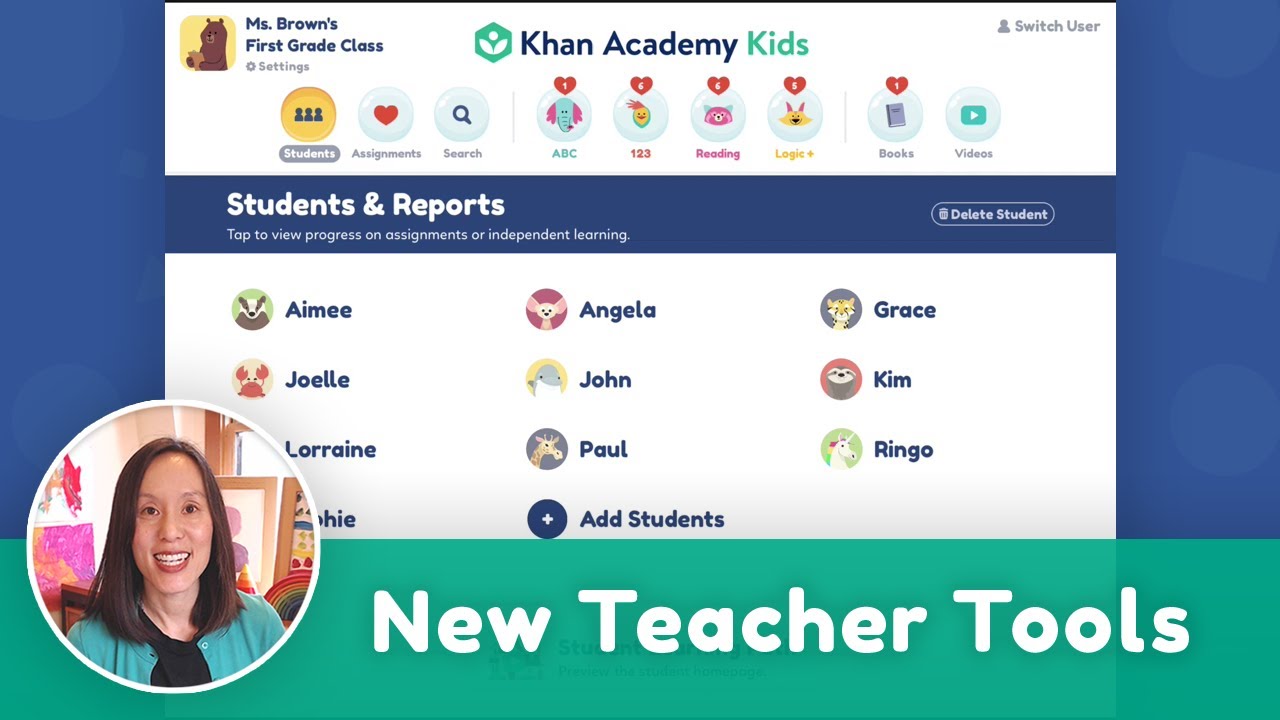
Khan Academy Kids now includes Teacher Tools that can support student learning in the classroom or at home.
With Teacher Tools, you can:
• Set up your class roster
• Sign in easily with Class Codes
• Assign lessons to students
• View reports to monitor student progress
• Search for lessons by CCSS and Head Start standards
To get these Teacher Tools, download or update the Khan Academy Kids app on iOS or Android, and set up an account as a teacher.
Learn more here: http://khan.co/KhanKids-TeacherTools
Khan Academy Kids is an award-winning educational app for students in Pre-K through 2nd grade. The app engages kids in core subjects like early literacy, reading, writing, language, and math, while encouraging creativity and building social-emotional skills.
Learn more about Khan Academy Kids, our free educational app for students in Pre-K through 2nd grade, at http://www.khankids.org
Available on Apple, Google Play, and Amazon app stores:
http://khan.co/KhanKids-YT-Apple
http://khan.co/KhanKids-YT-Google
http://khan.co/KhanKids-YT-Amazon
Questions? Reach our team at khankids@khanacademy.org.
#edtech #techtools #educationalapps #preschool #prek #kindergarten #firstgrade #secondgrade #remoteteaching #teacher #classroom #learninggames #teachertools #education #homeschool #appsforteachers

Practice Your Spanish With Chateo - a Spanish-speaking chatbot! | Get a discount off your first 6 months with code CHATEOBOT | Sign up at: https://www.senorjordan.com/chat
~~~~~~~~~~~~~~~~~~~~~~~~~~~~~~
Buy the Telling Time Packet here:
https://www.teacherspayteacher....s.com/Product/Tellin
SUBSCRIBE for more Spanish videos: http://bit.ly/XGe7we
and make sure to click the notification bell!
Follow me on Facebook: https://www.facebook.com/srjordanspanish
Tweet me: https://twitter.com/senorjordan
Check out my website: http://www.senorjordan.com
Follow me on Instagram: @senorjordanvideos
Listen to my music on Soundcloud:
https://soundcloud.com/senorjordanspanish
Listen to my music on Spotify:
https://open.spotify.com/artis....t/2nyJ9GgLNMckXCuBHU
Buy my songs on iTunes:
https://music.apple.com/us/artist/1621526948
Buy my songs on Amazon:
https://www.amazon.com/music/p....layer/artists/B09Z35
Donate to my video-making project:
https://paypal.me/srjordanvideos?country.x=US&locale.x=en_US
~~~~~~~~~~~~~~~~~~~~~~~~~~~~~~
See the full time-telling playlist here:
https://www.youtube.com/watch?v=PvPh6-9BgQU&list=PLPD6O-TouCqTECeAHM7KnFrtT9RevkfBd
This video is a revised version of this original video:
http://www.youtube.com/watch?v=tzC4GYVbwjk

TeacherTube User: Mrdube
TeacherTube URL: http://www.teachertube.com/vie....wVideo.php?video_id=
This is a math video lesson to help you with new math, math tricks, and or simple math questions you may have.
Courses on Khan Academy are always 100% free. Start practicing—and saving your progress—now: https://www.khanacademy.org/hu....manities/world-histo
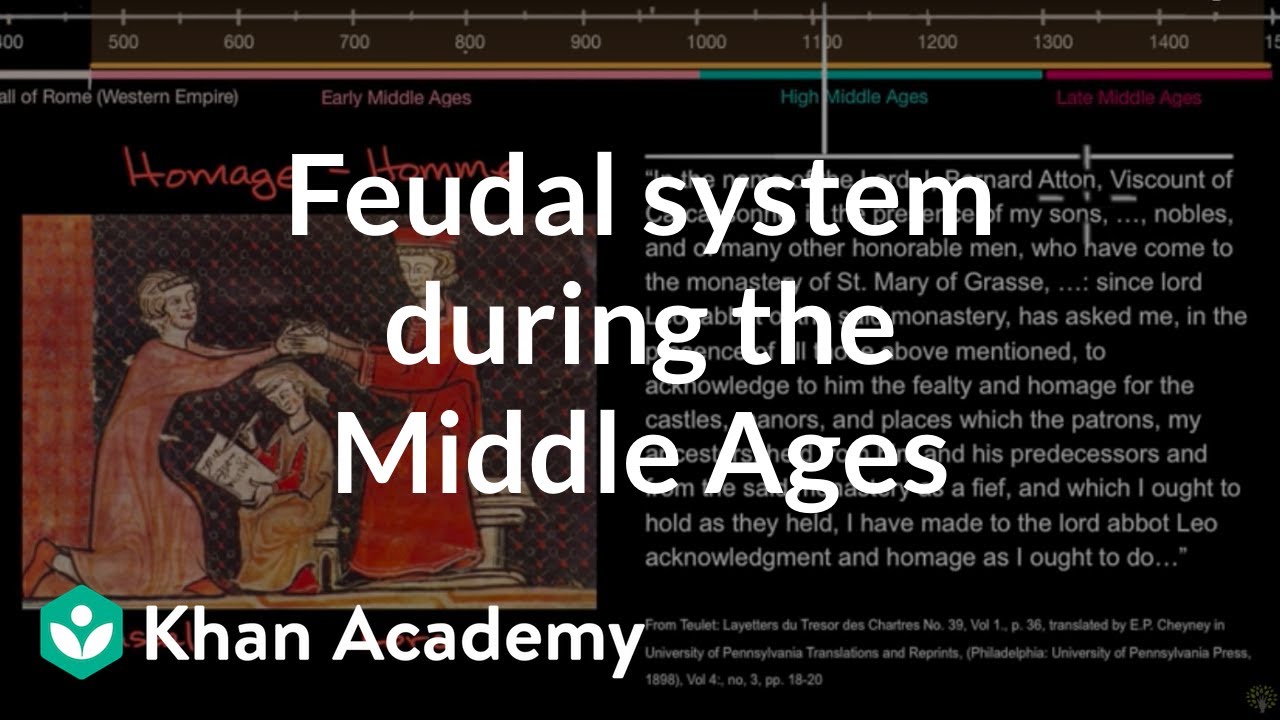
An overview of the Feudal System--the relationship of lords and vassals. Titles of nobility such as dukes, earls, counts, viscounts and barons. Homage and fealty.
Practice this yourself on Khan Academy right now: https://www.khanacademy.org/hu....manities/world-histo
Watch the next lesson: https://www.khanacademy.org/hu....manities/world-histo
Missed the previous lesson? Watch now: https://www.khanacademy.org/hu....manities/world-histo
World History on Khan Academy: From the earliest civilizations to the modern world, geography, religion, trade, and politics have bound peoples and nations together — and torn them apart. Take a journey through time and space and discover the fascinating history behind the complex world we inhabit today.
About Khan Academy: Khan Academy offers practice exercises, instructional videos, and a personalized learning dashboard that empower learners to study at their own pace in and outside of the classroom. We tackle math, science, computer programming, history, art history, economics, and more. Our math missions guide learners from kindergarten to calculus using state-of-the-art, adaptive technology that identifies strengths and learning gaps. We've also partnered with institutions like NASA, The Museum of Modern Art, The California Academy of Sciences, and MIT to offer specialized content.
For free. For everyone. Forever. #YouCanLearnAnything
Subscribe to KhanAcademy: https://www.youtube.com/subscr....iption_center?add_us

*Click CC to turn on subtitles in English to follow along*
Learn in the most natural way possible!
~~~~~~~~~~~~~
SUBSCRIBE for more Spanish videos: http://bit.ly/XGe7we
and make sure to click the notification bell!
Follow me on Facebook: https://www.facebook.com/srjordanspanish
Tweet me: https://twitter.com/senorjordan
Check out my website: http://www.senorjordan.com
Follow me on Instagram: @senorjordanvideos
Listen to my music on Soundcloud:
https://soundcloud.com/senorjordanspanish
Listen to my music on Spotify:
https://open.spotify.com/artis....t/2nyJ9GgLNMckXCuBHU
Buy my songs on iTunes:
https://music.apple.com/us/artist/1621526948
Buy my songs on Amazon:
https://www.amazon.com/music/p....layer/artists/B09Z35
Donate to my video-making project:
https://paypal.me/srjordanvideos?country.x=US&locale.x=en_US
~~~~~~~~~~~~~~~~~~~~~~~~~~~~~~

Courses on Khan Academy are always 100% free. Start practicing—and saving your progress—now: https://www.khanacademy.org/ma....th/geometry/xff63fac
Watch the next lesson: https://www.khanacademy.org/math/algebra2/conics_precalc/parabolas_precalc/v/finding-focus-and-directrix-from-vertex?utm_source=YT&utm_medium=Desc&utm_campaign=AlgebraII
Missed the previous lesson?
https://www.khanacademy.org/math/algebra2/conics_precalc/parabolas_precalc/v/using-the-focus-and-directrix-to-find-the-equation-of-a-parabola?utm_source=YT&utm_medium=Desc&utm_campaign=AlgebraII
Algebra II on Khan Academy: Your studies in algebra 1 have built a solid foundation from which you can explore linear equations, inequalities, and functions. In algebra 2 we build upon that foundation and not only extend our knowledge of algebra 1, but slowly become capable of tackling the BIG questions of the universe. We'll again touch on systems of equations, inequalities, and functions...but we'll also address exponential and logarithmic functions, logarithms, imaginary and complex numbers, conic sections, and matrices. Don't let these big words intimidate you. We're on this journey with you!
About Khan Academy: Khan Academy offers practice exercises, instructional videos, and a personalized learning dashboard that empower learners to study at their own pace in and outside of the classroom. We tackle math, science, computer programming, history, art history, economics, and more. Our math missions guide learners from kindergarten to calculus using state-of-the-art, adaptive technology that identifies strengths and learning gaps. We've also partnered with institutions like NASA, The Museum of Modern Art, The California Academy of Sciences, and MIT to offer specialized content.
For free. For everyone. Forever. #YouCanLearnAnything
Subscribe to Khan Academy’s Algebra II channel:
https://www.youtube.com/channe....l/UCsCA3_VozRtgUT7wW
Subscribe to Khan Academy: https://www.youtube.com/subscr....iption_center?add_us
Practice this lesson yourself on KhanAcademy.org right now: https://www.khanacademy.org/math/differential-equations/first-order-differential-equations/separable-equations/e/separable-differential-equations?utm_source=YT&utm_medium=Desc&utm_campaign=DifferentialEquations
Watch the next lesson: https://www.khanacademy.org/math/differential-equations/first-order-differential-equations/separable-equations/v/separable-differential-equations?utm_source=YT&utm_medium=Desc&utm_campaign=DifferentialEquations
Missed the previous lesson?
https://www.khanacademy.org/math/differential-equations/first-order-differential-equations/separable-equations/v/separable-differential-equations-introduction?utm_source=YT&utm_medium=Desc&utm_campaign=DifferentialEquations
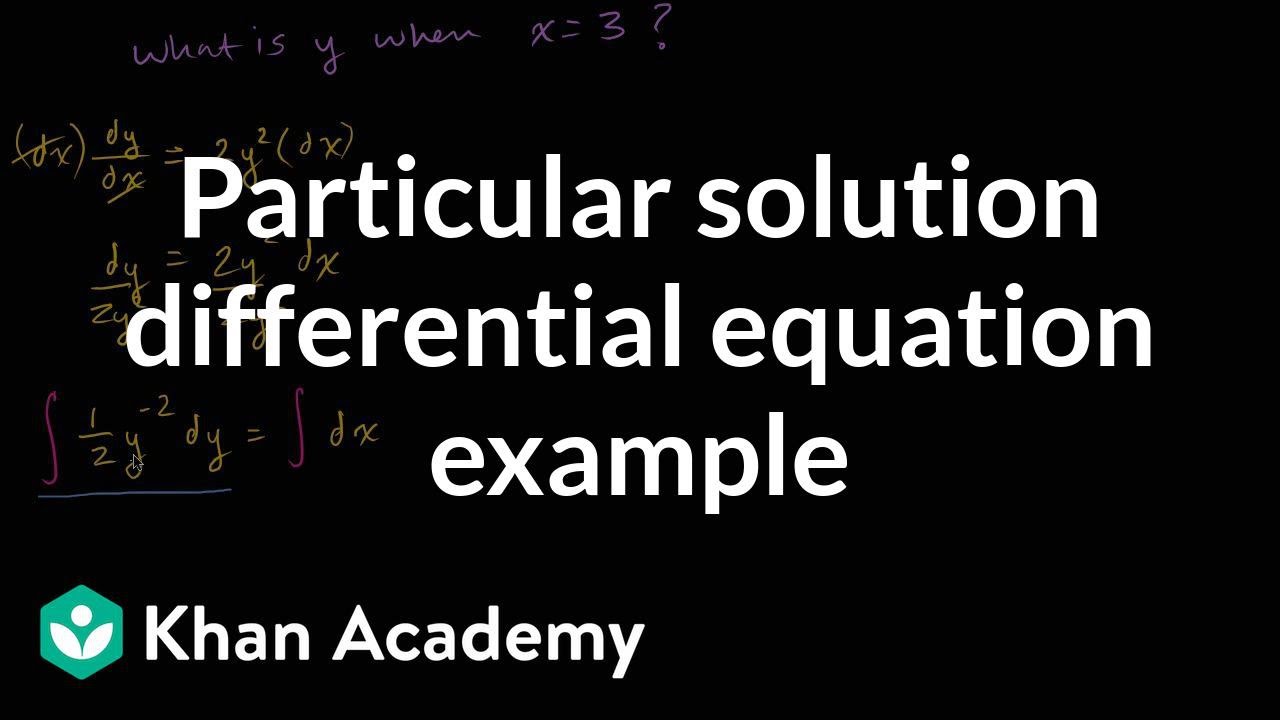
Differential Equations on Khan Academy: Differential equations, separable equations, exact equations, integrating factors, homogeneous equations.
About Khan Academy: Khan Academy offers practice exercises, instructional videos, and a personalized learning dashboard that empower learners to study at their own pace in and outside of the classroom. We tackle math, science, computer programming, history, art history, economics, and more. Our math missions guide learners from kindergarten to calculus using state-of-the-art, adaptive technology that identifies strengths and learning gaps. We've also partnered with institutions like NASA, The Museum of Modern Art, The California Academy of Sciences, and MIT to offer specialized content.
For free. For everyone. Forever. #YouCanLearnAnything
Subscribe to KhanAcademy’s Differential Equations channel:: https://www.youtube.com/channe....l/UCxSQHGkaDv8UKXE0T
Subscribe to KhanAcademy: https://www.youtube.com/subscr....iption_center?add_us

It's true that dinosaurs disappeared thousands of years ago when a gigantic meteor struck and wiped them out. But what if we told you that one of them may have survived all these years and is currently living in Africa? This is what some residents of Congo claim, who report seeing a gigantic, scaly creature. In this video, we'll discuss this and other mysteries, as well as gather untold stories about extraordinary animals that once roamed the earth and continue to fascinate the modern world.
Animation is created by Bright Side.
----------------------------------------------------------------------------------------
Music from TheSoul Sound: https://thesoul-sound.com/
Check our Bright Side podcast on Spotify and leave a positive review! https://open.spotify.com/show/....0hUkPxD34jRLrMrJux4V
Subscribe to Bright Side: https://goo.gl/rQTJZz
----------------------------------------------------------------------------------------
Our Social Media:
Facebook: https://www.facebook.com/brightplanet/
Instagram: https://www.instagram.com/brightside.official
TikTok: https://www.tiktok.com/@bright....side.official?lang=e
Stock materials (photos, footages and other):
https://www.depositphotos.com
https://www.shutterstock.com
https://www.eastnews.ru
----------------------------------------------------------------------------------------
For more videos and articles visit: http://www.brightside.me
----------------------------------------------------------------------------------------
This video is made for entertainment purposes. We do not make any warranties about the completeness, safety and reliability. Any action you take upon the information in this video is strictly at your own risk, and we will not be liable for any damages or losses. It is the viewer's responsibility to use judgement, care and precaution if you plan to replicate.

NOTE: We would like to correct two errors in this video. T-Rexes were not ornithischians; they were saurischians. Additionally, the correct pronunciation of giganotosaurus is jai-ga-nuh-tuh-saw-ruhs. We apologize for the inconvenience.
When you think about dinosaurs, is the tyrannosaurs rex the first to come to mind? Maybe not, but we're sure you have at least heard of it! In this video for kids, you will learn fun facts about this king of the tyrant lizards.
The tyrannosaurs rex, or T-Rex, was an apex predator. That means that it was at the very top of the food chain; it was prey to no other animal. From snout to tail, it was up to 40 feet long, and it weighed 7 to 8 tons. That's as long and as heavy as a modern school bus! Despite the large size, these creatures could run as fast as 25 miles per hour!
The T-Rex had a strong sense of smell that helped them find prey as well as potential mates. In fact, their sense of smell is really similar to that of a house cat! And technically, the T-Rex is a distant cousin of the chicken as well. Some scientists even think the T-Rex might have had feathers.
Now, what about the arms? Well, watch the video to find out about these small but strong appendages.
We hope you and your student(s) enjoyed learning about these four different landforms! If you want to learn even more, head over to our website and download one of our many free lesson plans about dinosaurs, full of activities, worksheets, and more!
https://learnbright.org/lessons/science/dinosaurs/
https://learnbright.org/lessons/science/fossils/
What you will learn in T-Rex Facts for Kids:
0:00 Introduction to the T-Rex
0:40 Physicality of the T-Rex
1:53 What it ate and how it found its prey
2:24 Arms of the T-Rex
3:23 How the T-Rex relates to chickens
4:00 Review of the facts
Check out some of our other dinosaur-related videos here:
Dinosaurs: https://youtu.be/dktnOPfE7Dc
Dinosaur Facts: https://youtu.be/Q5z5C1MFmT8
Extinction: https://youtu.be/ogLFEq1X0RM
Fossils: https://youtu.be/tyOjxjFHW-c
Thank you for watching and learning with us! We’re constantly releasing new content and videos, so click that “Subscribe” button and you’ll get notified.
Find and Follow Us Online:
Facebook: https://www.facebook.com/LearnBright/
Instagram: https://instagram.com/LearnBrightEducation
Pinterest: https://pinterest.com/LearnBrightEducation
YouTube: @LearnBright
Website: https://learnbright.org/
*Teachers and Parents! Did you know? In addition to these great videos, we have also created a library of high-quality and engaging lessons for your elementary aged student(s). Visit us, sign up for a free account, and instantly you'll have access to thousands of lesson plans, learning materials, teaching instructions, activities, and assignments that your kids will really enjoy! We hope to see you soon!
Browse our entire collection of Science lesson plans: https://learnbright.org/lessons/?filter_subject=science
#TRex
#tyrannosaurusrex
#TRexFactsForKids

In All about the UK for Kids, you will learn about the four countries that make up the United Kingdom. When people mention the UK, they are not talking about a country but about the countries that are part of it! Those four countries are England, Wales, Scotland, and Northern Ireland. And no, Northern Ireland is not the same as Ireland. Those are two separate countries, and Ireland is not part of the UK.
The official name of this collection of countries is the United Kingdom of Great Britain and Northern Ireland. That's because Great Britain constitutes England, Scotland, and Wales.
The largest country by both area and population is England. Believe it or not, even though Northern Ireland is an entire country, fewer people live there than in London, England! London is home to nearly 9 million people, while Northern Ireland in its entirely is home to about 1.8 million people.
There are some really interesting places to visit throughout the UK. One of them is Loch Ness in Scotland. The word "loch" means lake, so the loch ness monster is the monster of Lake Ness. Another fascinating place is the tower of Big Ben. What you may not know is that the actual name of Big Ben is Great Bell. And Big Ben doesn't refer to the tower but to the bell itself. Let's see what else you can learn!
We hope you and your student(s) enjoyed learning about George Washington Carver! If you want even more information, head over to our website and download one of our many free lesson plans, full of activities, worksheets, and more!
https://learnbright.org/lesson....s/social-studies/all
What you will learn in All about the UK for Kids:
0:00 Introduction to the United Kingdom
0:34 Countries that make up the UK and its geography
1:39 What is Great Britain?
2:21 Populations of the four countries
3:09 Various terrain and climate of the UK
4:27 History of the United Kingdom
5:18 The beginning of the Anglo-Saxons
6:29 Tourist landmarks and attractions
7:47 Review of the facts
Thank you for watching and learning with us! We’re constantly releasing new content and videos, so click that “Subscribe” button and you’ll get notified.
Find and Follow Us Online:
Facebook: https://www.facebook.com/LearnBright/
Instagram: https://instagram.com/LearnBrightEducation
Pinterest: https://pinterest.com/LearnBrightEducation
YouTube: @LearnBright
Website: https://learnbright.org/
*Teachers and Parents! Did you know? In addition to these great videos, we have also created a library of high quality and engaging lessons for your elementary aged student(s). Visit us and sign up for a free account, and you'll instantly have access to thousands of lesson plans, learning materials, teaching instructions, activities, and assignments that your kids will really enjoy! We hope to see you soon!
Browse our entire collection of Social Studies lesson plans: https://learnbright.org/lessons/?filter_subject=social-studies
#UnitedKingdom
#UnitedKingdomForKids
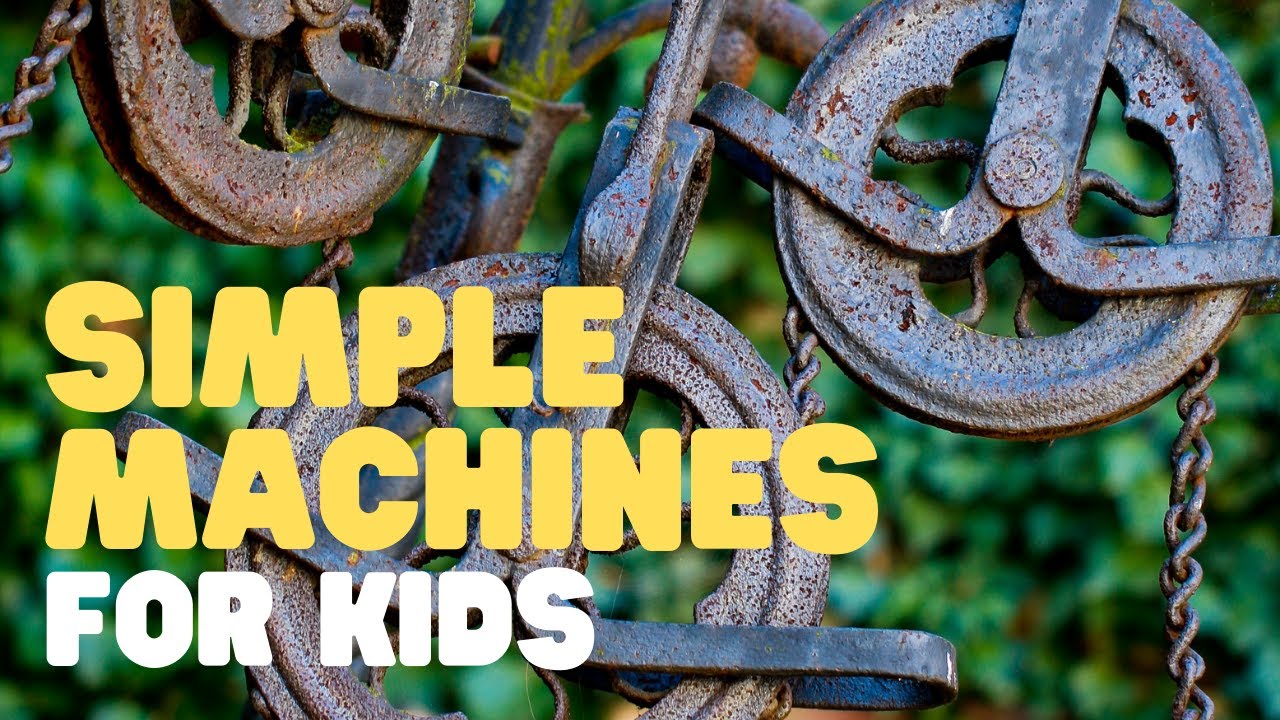
Simple Machines for Kids teaches all about the main 6 simple machines in a fun and interactive way. We will learn about the different simple machines, which are; Incline Plane, Lever, Wedge, Screw, Wheel and Axle, and the Pulley. Almost any machine is created with one of these elements.
The inclined plane can be found in many places. It is triangular shaped with a smooth and even surface and helps move objects to higher or lower places.
The lever is a beam with a ridge that freely rotates or moves on a pivot. It helps you move heavy objects with ease.
The wedge is often attached to a handle. Used for cutting, splitting, tightening, to hold back or together, or for scraping.
Screws are cylinders with a solid top at one end, and a pointed
tip at the other end. Used to hold things together as they pull or push the object.
The large disc is the wheel and the small cylinder is the axle. The wheel is one of the greatest inventions in human history, but would not work without the axle.
A wheel with a groove in it, and a rope in the groove is called a pulley. A pulley lifts or lowers objects of different weights with relative ease.
Looking for more resources on Simple Machines? Download our free lesson plans here:
Grades 1-4: https://learnbright.org/lesson....s/science/simple-mac
Grades 5-6: https://learnbright.org/lesson....s/science/simple-mac
Thank you for watching and learning with us! We’re constantly releasing new content and videos, so click that “Subscribe” button and you’ll get notified.
Find and Follow Us Online:
Facebook: https://www.facebook.com/LearnBright/
Instagram: https://instagram.com/LearnBrightEducation
Pinterest: https://pinterest.com/LearnBrightEducation
YouTube: https://www.youtube.com/LearnBright
Website: https://learnbright.org/
*Teachers and Parents! Did you know? In addition to these great videos, we have also created a library of high quality and engaging lessons for your elementary aged student(s). Visit us, sign up for a free account, and instantly you'll have access to thousands of lesson plans, learning materials, teaching instructions, activities, and assignments that your kids will really enjoy! We hope to see you soon!
Browse our entire collection of Science lesson plans: https://learnbright.org/lessons/?filter_subject=science
#SimpleMachines

TeacherTube User: Astalets
TeacherTube URL: http://www.teachertube.com/vie....wVideo.php?video_id=
This is a math video lesson to help you with new math, math tricks, and or simple math questions you may have.

SUSCRIBETE AQUÍ: https://bit.ly/3B8CNXP
¡ATENCIÓN AMIGOS!
¡Llegó la App de El Reino Infantil! ¡Totalmente gratuita!, Descárgala AQUÍ:
Para Android: http://bit.ly/ElReinoInfantil-PlayStore
Para iOS: http://bit.ly/ElReinoInfantil-AppleStore
Descubre juegos y canciones de tus personajes favoritos y disfruta horas de contenido de manera segura y confiable.
¡No te lo pierdas! ¡Súmete a la diversión!
Suscríbete ► http://bit.ly/SuscribeteElReinoInfantil
Síguenos/Follow us:
Facebook ► https://www.facebook.com/ElReinoInfantil
Instagram► https://www.instagram.com/reino_infantil/
Twitter ► https://twitter.com/Reino_Infantil
¡Encuentra todos nuestros productos exclusivos aquí!
►http://bit.ly/ElReinoInfantilWEB
Para colaborar con todas las familias que deben quedarse en sus hogares debido a la situación mundial actual, llegó la App de Juegos de canciones del Zoo, especial para los más pequeños de la casa. Podrán acceder a todos los juegos de forma gratuita. Sin necesidad de Wifi ni Internet.
Resuelve rompecabezas, aprende los números, descubre los colores y conoce las formas a través de fascinantes y divertidos mini juegos animados.
Disponible para sistema operativo Android a través de este link:
http://bit.ly/App-JuegosDeZoo-Android
¡Próximamente disponible también en sistema IOS!
Título Original: El Marinero Baila
Autor/Compositor: Canción Popular
Intérprete: Los Ratones Juguetones

Preparing a child for kindergarten can be a daunting task for any parent. Beyond the challenges of managing separation anxiety, some may also try and get their children “up to speed” by teaching them the alphabet or how to count from 1 to 10. For families whose first language is not English there are also language and cultural barriers to contend with. But what are the most important skills on day one? In Portland, Ore., a kindergarten preparedness program offers parents strategies to help prepare their children to hit the ground running. Teacher Donna Shinagawa shares six tips with us.
Learn More:
Most States Still Don't Require Full-Day Kindergarten, Report Finds Marva Hinton (7/9/2018)
https://blogs.edweek.org/edwee....k/early_years/2018/0

North Korea is one of the most isolated and closed off countries in the world. Its official name is the Democratic People's Republic of Korea. The country is roughly the size of the U.S. state of Pennsylvania. And its total population is estimated to be around 25 million people. In All about North Korea for Kids, you will learn a lot more about this country, even though it's not easy to visit.
The government in North Korea is communist, meaning that it controls the lives of most of its citizens, even down to people's haircut! There are only 28 approved haircuts, so every citizen must choose from that list which hair style they want. Citizens can also be arrested for watching certain movies or practicing certain religions. They are also not allowed to talk about ideas that go against the government.
The government also controls the media and news. Propaganda, or news that makes the country look good, is common in the country, and there is no internet access. In fact, most North Koreans have never even seen a computer. Additionally, few people are allowed to leave the country, and only a few people are allowed to visit. Those individuals can only see approved parts of North Korea and are watched closely.
When Japan lost the war in World War II, the Soviets gained control of northern half of the Korean peninsula, so North Korea became a communist country. The Americans controlled the southern half, so South Korea became a democratic country. When the Soviets left in 1948, many conflicts between the two Korean countries arose. After a resulting Korean war, the same family has maintained control of North Korea and kept it isolated from the world.
We hope you and your student(s) enjoyed learning about Anne Frank! If you want even more information, head over to our website and download one of our many free lesson plans, full of activities, worksheets, and more!
https://learnbright.org/lesson....s/social-studies/all
What you will learn in All about North Korea for Kids:
0:00 Introduction to the isolated country of North Korea
0:22 Geography of North Korea
1:32 Landscape and three main regions
2:56 Mineral resources and energy sources
3:22 Communist government and North Korean law
4:08 Unique ways North Korea is different from others
5:02 Why North Korea is closed off from the world
6:19 After Soviets left North Korea
7:13 Interesting landmarks and attractions
8:07 Review of the facts
Thank you for watching and learning with us! We’re constantly releasing new content and videos, so click that “Subscribe” button and you’ll get notified.
Find and Follow Us Online:
Facebook: https://www.facebook.com/LearnBright/
Instagram: https://instagram.com/LearnBrightEducation
Pinterest: https://pinterest.com/LearnBrightEducation
YouTube: @LearnBright
Website: https://learnbright.org/
*Teachers and Parents! Did you know? In addition to these great videos, we have also created a library of high-quality and engaging lessons for your elementary aged student(s). Visit us and sign up for a free account, and you'll instantly have access to thousands of lesson plans, learning materials, teaching instructions, activities, and assignments that your kids will really enjoy! We hope to see you soon!
Browse our entire collection of Social Studies lesson plans: https://learnbright.org/lessons/?filter_subject=social-studies
#NorthKorea
#AllAboutNorthKorea

Manual: GeoGebra in a Nutshell (from http://school-maths.com) - Parallelogram

#MatutongBumasa
#DalawantigPantig
#Pagpapantig
#Abakada
#Babebibobu
#Kakekikoku
#FilipinoReadingLesson
#ReadingLessonforKids
#ReadingLessonforGrade1
#TagalogReadingLesson
#PaanoMakakabasaNangMabilisAnBata
#PaanoTuruanBumasaangBata
#Abakada
#Pagpapantig
#BasicReadingLesson
#UnangHakbangsaPAgbasa
#FirstStepinReading
#ReadingLessonKinder
#learnHowToRead

Subscribe The Channel To Get More GeoGebra Activities with Tutorial.
.
.
Please Comment For Make The Videos Tutorial.
.
.
Thanks for Watching.
Follow On Instagram :-
https://www.instagram.com/_adii.3.1/

Intro: 0:08
Example 1: 0:55
Example 2: 3:25
This is a video on solving systems of equations by substitution. There are many ways to solve these types of equations and this is just one method. Follow the steps below if you are stuck and feel free to pause the video as you learn if I am going too fast.
Steps to solve
1. Identify the "easier" equation
2. Solve for a variable
3. Substitute your answer into the other equation
Follow me on Twitter: http://twitter.com/mathodman20
Follow me on Facebook: http://www.facebook.com/pages/....Mathodman20/36631664

Students learn the history of the waterwheel and common uses for water turbines today. They explore kinetic energy by creating their own experimental waterwheel from a two-liter plastic bottle. They investigate the transformations of energy involved in turning the blades of a hydro-turbine into work, and experiment with how weight affects the rotational rate of the waterwheel. Students also discuss and explore the characteristics of hydroelectric plants.
View the full activity on TeachEngineering: https://www.teachengineering.o....rg/activities/view/c
TeachEngineering has over 1,500 FREE lessons and activities. Visit http://www.TeachEngineering.org for more!
Music: Inevitable