Top videos

Visit https://www.abcmouse.com/learn/youtube to learn more about our award-winning online learning program for children 2-8!
👻🎵 Get ready for some spooky-silly fun with ABCmouse! Meet a friendly ghost who really loves toast in this catchy Halloween sing-along. With playful rhymes, silly surprises, and just the right amount of spooky, this song is perfect for preschoolers during Halloween season—or anytime they’re hungry for fun! 🍞🎃
👉 Discover more fun learning songs and educational videos by subscribing to our YouTube channel at https://YouTube.com/ABCmouse.
And visit https://www.abcmouse.com/learn/youtube to find out more about our award-winning online learning program for children 2–8!
© Age of Learning, Inc. All rights reserved.

This video shows how to use substitution to solve a system of two linear equations that involve fractions. The video is designed at the Intermediate Algebra level.

Pre-order our book YOU ARE AN ARTIST (which includes new assignments!) here: http://bit.ly/2kplj2h
This week Sarah breaks down why The Art Assignment sign-off cannot be "Please Don't Break the Law," and discusses artists Ai Weiwei and Pussy Riot who have broken the law for good reasons. What should our sign off be?
Please Break The Law: Reading List
(please suggest other readings in the comments)
Modernism
- Charles Baudelaire, "The Painter of Modern Life" (1863)
- Serge Guilbaut, Benjamin H.D. Buchloh, and David Solkin (eds), Modernism and Modernity (1983)
- Francis Frascina and Jonathan Harris (eds), Art in Modern Culture: An Anthology of Critical Texts (1992)
- Meyer Shapiro, Modern Art: 19th and 20th Century, Selected Papers, vol. 2 (1978)
The Avant-Garde
- Henri de Saint-Simon, "L'artiste, le savant et l'industriel" ("The artist, the scientist and the industrialist") (1825)
- Clement Greenberg's "Avant-Garde and Kitsch" (1939)
- Theodor Adorno and Max Horkheimer's "The Culture Industry: Enlightenment as Mass Deception" in Dialectic of Enlightenment (1944)
- Peter Bürger's "Theory of the Avant-Garde" (1974)
- Rosalind E. Krauss, The Originality of the Avant-Garde and Other Modernist Myths (1985)
- Hal Foster, "Who's Afraid of the Neo-Avant-Garde?" in The Return of the Real (1996)
- Matthew Witkovsky, ed., Avant-Garde Art in Everyday Life: Early Twentieth-Century European Modernism (2011)
Pussy Riot
- Masha Gessen's Words Will Break Cement: The Passion of Pussy Riot (2014)
- Pussy Riot's Pussy Riot!: A Punk Prayer For Freedom (2012)
- @Eng_Pussy_Riot
Ai Weiwei
- Ai Weiwei and Lee Ambrozy's Ai Weiwei's Blog: Writings, Interviews, and Digital Rants, 2006-2009 (2011)
- Kerry Brougher, Mami Kataoka, and Charles Merewether's Ai Weiwei: According to What? (2012)
- Alison Klayman's film AI WEIWEI: NEVER SORRY (2012)
- @aiww | @aiww_en
Art + civil disobedience
- Hannah Arendt's "Civil Disobedience" (1970)
- Randy Martin's Performance as Political Act: The Embodied Self (1990)
- Susan Sontag's Regarding the Pain of Others (2004)
- Slavoj Zizek's Violence: Six Sideways Reflections (2008)
- Nato Thompson, Living as Form: Socially Engaged Art from 1991-2011 (2012)
Thousands of parents and educators are turning to the kids’ learning app that makes real learning truly fun. Try Kids Academy with
3-day FREE TRIAL! https://bit.ly/2GuGyL2
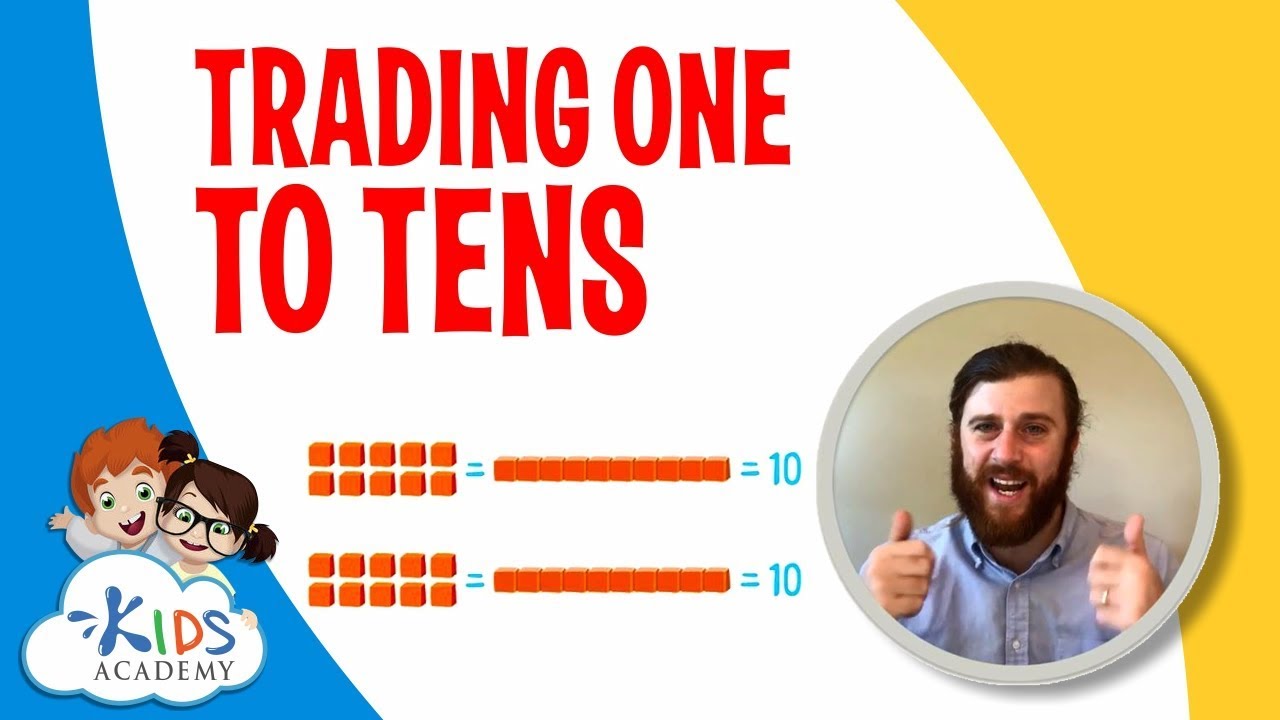
Welcome our new video: Trading One to Tens | 1st Grade | Math | Kids Academy
In this brief video, we teach you how you can learn trading one to tens. Now we know the concept of ones and tens. Let's just revise it. A double-digit number is made up of two parts, ones and tens.
The ones are the numbers that stand for themselves and have a clear meaning. For example, in number 12, 2 is at one’s place. So here 2 simply means number 2. However, the number 1 is not just 1, it is actually 10. To put it simply there are 10 cubes hidden inside this 1.
So, when you trade one to tens we know that inside every ten there are 10 cubes hidden inside. So, we will know that 10 cubes are equal to one long cube. Trading one to tens is a very basic and very important lesson for kids. So, make sure that this concept is clear in their mind.
Kids Academy, will help your child practice and apply basic math skills through fun puzzles and mini-games in our application.
Kids Academy will guide your little math explorer through intuitive lessons with the help of our professors. This App combines math and fun while mastering the basic Common Core Math Curriculum – math has never been so FUN until NOW.!
#TalentedAndGifted #LearnWithKidsAcademy
Kids Academy Talented and Gifted Program for kids aged 2-10:
Subscribe to our channel: https://goo.gl/iG2Bdr
*****
Connect with us on :
App Store: https://smart.link/59833db06a6b8
Google Play: https://smart.link/597210af6eb83
Our website: http://www.kidsacademy.mobi
Facebook: https://www.facebook.com/KidsAcademyCompany
Twitter: https://twitter.com/KidsAcademyCo

Hello Friends, Welcome To Maths-Logic in Telugu !!!
Addition of Fraction by LCM method || Adding Fractions with Common and Different Denominators
Cover Topic :-
1. Addition of Fraction
2. Adding fractions
3. Addition of Fraction by LCM method
4. Adding Fractions with Common Denominators
5. Adding Fractions with Different Denominators
6. Addition of unlike fractions
7. Add Fractions With Unlike Denominators
8. Adding three fractions
9. Fraction Based simplification
➤ If you are interested S U B S C R I B E !!! and share my videos with your Friends...
=== The best way to watch my videos is to look at my Playlists. ===
✅ Recommended Playlists: https://www.youtube.com/channe....l/UC8vcraVTzCKud06Va
➤ Follow Us on:
⯈ YouTube: https://www.youtube.com/channe....l/UC8vcraVTzCKud06Va
⯈ Facebook: https://www.facebook.com/MathsLogicTelugu
➤ Please keep supporting me with your valuable likes, shares, comments.
I hope they help :-)
-----Thank You for Watching-----
Music:- non copyrighted music From YouTube library
https://www.youtube.com/audiolibrary/music?nv=1
✿ Note: If you have any problem please share with me in comment and ask questions me in which you have doubt.
#mathslogicintelugu #fractions #additionoffraction #AdditionofFractionbyLCMmethod #Additionofunlikefractions #howtoaddfractions #addfractions

Download Opera for free: https://opr.as/Opera-browser-be-smart
SUBSCRIBE so you don’t miss a video! ►► http://bit.ly/iotbs_sub
↓↓↓ More info and sources below ↓↓↓
We all know Charles Darwin's theory of evolution, right? Natural selection? But what about his lesser-know theory of evolution: sexual selection. Let’s talk about how animals like peacocks, whose eye-catching physical traits make them evolutionarily stronger even though their flashy looks make them more vulnerable to predators. Hint: it’s all about the chemistry.
References: https://sites.google.com/view/....sexual-selection-sou
-----------
High fives to all our Brain Trust Patrons:
Olivia Ruiz
Mike and Patty Loftis
Ed Eyden
Jennifer Burton
Charles Horton, Jr
Holly, Brett, and Ashe Bullion
Jaap Westera
Barbora Bei
Burt Humburg
dani bowman
David Johnston
Baerbel Winkler
Eric Meer
Karen Haskell
Join us on Patreon!
https://patreon.com/itsokaytobesmart
Instagram
http://www.instagram.com/DrJoeHanson
http://www.instagram.com/okaytobesmart
Facebook
https://www.facebook.com/itsokaytobesmartpbs/

Educational video for children to learn what proteins are and how to include them in their diet. Proteins are nutrients that make up the tissues of our body, like muscles or bones for example. They also transport some vitamins and boost our immune system. There are animal proteins (meat, fish, eggs) and vegetable proteins (legumes, seeds, nuts). Proteins help us grow and stay healthy. Some easy-to-make, fun, protein-rich dishes are legume salads or chickpea hummus. Excellent resource for elementary school.
Thanks for visiting us! If you want your children to smile and learn, subscribe! :D
We only upload our own content, designed by educators so that children smile and learn while watching a video.
All of our content reinforces educational values, encouraging the use of multiple intelligences and language learning.
If you like our videos, download Smile and Learn now. You’ll discover more than 5.000 activities for children aged 3 to 12 yeards, all designed by educators. We have 250 games and interactive stories and over 280 videos in five languages: English, Spanish, Portuguese, Italian and French. Try a month for free and start the adventure!
Thousands of parents and educators are turning to the kids’ learning app that makes real learning truly fun. Try Kids Academy with
3-day FREE TRIAL! https://bit.ly/2GuGyL2
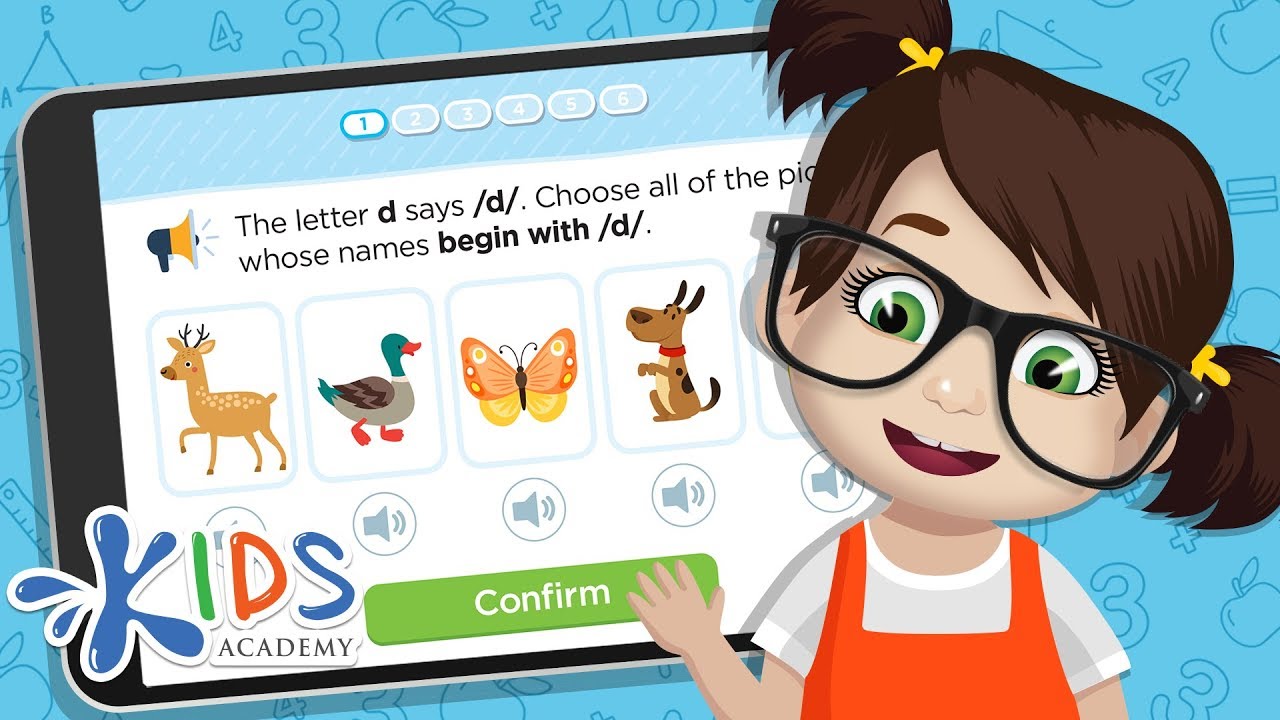
Tests and quizzes for kids are two ways for teacher’s and home school parents to evaluate a student’s progress and understanding of a topic, skill, or education standard. Being a good quiz and test taker is a skill that is practiced and learned. For some students, doing an assessment is easy. For others, test taking causes anxiety, is difficult, and scores might not reflect the student’s actual level of understanding and achievement. Despite preparing for a quiz or test, some students still perform poorly. Prepare your students for taking quizzes and tests with fun and engaging test options.
Kids Academy offers fun quizzes for kids in a variety of subjects including English Language Arts, Math, and Science. Kids Academy ELA quizzes for children in the preschool and primary levels offer bright and engaging graphics and interesting questions. Quizzes for Kindergarten and quizzes for 1st grade assess skills such as identifying letters and sounds, complex phonics skills and reading comprehension. Math quizzes for young kids include testing about numbers, counting, graphing, and simple computations, while math quizzes for 2nd grade and quizzes for 3rd grade include more complex computations and operations. Numerous science quizzes for kids covering a range of topics are available too! All quizzes are age appropriate and engaging.
The quizzes are easy to access by subject, skill and grade level. Children complete the quizzes in the Kids Academy platform in different ways. Drag and drop, typing the answers, and clicking on the correct answer choice are ways children complete the quizzes. Children receive immediate answer feedback and positive reinforcement and a reward for a job well done.
Kids Academy offers quizzes for preschool to grade 3 level students. These resources integrate will into existing curriculum and provide students with quiz and test practice and also assessment options in the school or home classroom.
*****
Connect with us on :
Facebook: https://www.facebook.com/KidsAcademyCompany
Twitter: https://twitter.com/KidsAcademyCo
Install for free our Kids Academy Talented and Gifted Program for kids aged 2-10:
App Store: https://smart.link/59833db06a6b8
Google Play: https://smart.link/5a1bea3272481
Our website: https://www.kidsacademy.mobi/

Educational video for children to learn interesting facts and characteristics about jellyfish. Jellyfish are invertebrate and carnivorous animals, they feed on plankton, crustaceans, eggs and fish larvae. Jellyfish come in many sizes, the largest can weigh up to 7 ounces and measure up to 120 feet.
This is a very useful and interesting video resource for children to learn interesting facts about jellyfish, including where they live and what they eat. It is an excellent video for early childhood education.
Thanks for visiting us! If you want your children to smile and learn, subscribe! :D
If you like our videos, download Smile and Learn now. You’ll discover thousands of activities for children aged 3 to 12 years, all designed by educators. We have hundreds of games, interactive stories and videos in five languages: English, Spanish, Portuguese, Italian, Turkish and French. Try a month for free and start the adventure!
www.smileandlearn.com

Educational video for children to learn technology vocabulary. Thanks to this video, they will discover technology words like computer, laptop, monitor, mouse, speakers, webcam, keyboard, microphone, printer, scanner and flash drive. At then of the video, the little ones will recap everything they learned. Excellent resource for preschool education.
Thanks for visiting us! If you want your children to smile and learn, subscribe! :D
We only upload our own content, designed by educators so that children smile and learn while watching a video.
All of our content reinforces educational values, encouraging the use of multiple intelligences and language learning.
If you like our videos, download Smile and Learn now. You’ll discover more than 5.000 activities for children aged 3 to 12 yeards, all designed by educators. We have 250 games and interactive stories and over 280 videos in five languages: English, Spanish, Portuguese, Italian and French. Try a month for free and start the adventure!

You're already learning on YouTube — why not get college credit for it? https://link.gostudyhall.com/my1
In this episode of Crash Course: How to College, Erica helps us think about how to best choose the right school for us. There's a lot to think about, like: what kind of learner you are, what kind of environment you like, how to know if your school is looking out for your success, what kinds of support do different schools offer, and of course what do you want to study?
Crash Course: How to College is part of Study Hall, a partnership between ASU and Crash Course. Head over to our new Study Hall channel to check out our Fast Guide series which break down different college majors.
***
Now you can take top-tier college courses with Study Hall! Study Hall videos are available to watch at no cost, and first-year courses are $25 to sign-up and begin coursework. Once you're satisfied with your grade, receive credit for only $400. Sign up at https://link.gostudyhall.com/my1
Follow Study Hall on socials!
Twitter: https://twitter.com/gostudyhall
Instagram: https://Instagram.com/GoStudyHall
Facebook: https://www.facebook.com/GoStudyHall
__________________________________________________________________________
Chapters:
0:00 - Introduction
1:00 - How to find the right fit
4:10 - Types of colleges to choose from
5:57 - How to choose
6:21 - Modalities
7:09 - Conclusion
__________________
Watch our videos and review your learning with the Crash Course App!
Download here for Apple Devices: https://apple.co/3d4eyZo
Download here for Android Devices: https://bit.ly/2SrDulJ
Crash Course is on Patreon! You can support us directly by signing up at http://www.patreon.com/crashcourse
Thanks to the following patrons for their generous monthly contributions that help keep Crash Course free for everyone forever:
Dave Freeman, Hasan Jamal, DL Singfield, Lisa Owen, Jeremy Mysliwiec, Amelia Ryczek, Ken Davidian, Stephen Akuffo, Toni Miles, Erin Switzer, Steve Segreto, Michael M. Varughese, Kyle & Katherine Callahan, Laurel Stevens, Vincent, Michael Wang, Stacey Gillespie (Stacey J), Alexis B, Burt Humburg, Aziz Y, Shanta, DAVID MORTON HUDSON, Perry Joyce, Scott Harrison, Mark & Susan Billian, Junrong Eric Zhu, Rachel Creager, Breanna Bosso, Matt Curls, Tim Kwist, Jonathan Zbikowski, Jennifer Killen, Sarah & Nathan Catchings, team dorsey, Trevin Beattie, Divonne Holmes à Court, Eric Koslow, Jennifer, Dineen, Indika Siriwardena, Khaled El Shalakany, Jason Rostoker, Shawn Arnold, Siobhán, Ken Penttinen, Nathan Taylor, Les Aker, ClareG, Rizwan Kassim, Alex Hackman, Jirat, Katie Dean, Avi Yashchin, NileMatotle, Wai Jack Sin, Ian Dundore, Justin, Mark, Caleb Weeks
__
Want to find Crash Course elsewhere on the internet?
Facebook - http://www.facebook.com/YouTubeCrashC...
Twitter - http://www.twitter.com/TheCrashCourse
Tumblr - http://thecrashcourse.tumblr.com
Support Crash Course on Patreon: http://patreon.com/crashcourse
CC Kids: http://www.youtube.com/crashcoursekids"
#CrashCourse #HowtoCollege #StudyHall
***
Watch our videos and review your learning with the Crash Course App!
Download here for Apple Devices: https://apple.co/3d4eyZo
Download here for Android Devices: https://bit.ly/2SrDulJ
Crash Course is on Patreon! You can support us directly by signing up at http://www.patreon.com/crashcourse
Thanks to the following patrons for their generous monthly contributions that help keep Crash Course free for everyone forever:
Dave Freeman, Hasan Jamal, DL Singfield, Lisa Owen, Jeremy Mysliwiec, Amelia Ryczek, Ken Davidian, Stephen Akuffo, Toni Miles, Erin Switzer, Steve Segreto, Michael M. Varughese, Kyle & Katherine Callahan, Laurel Stevens, Vincent, Michael Wang, Stacey Gillespie (Stacey J), Alexis B, Burt Humburg, Aziz Y, Shanta, DAVID MORTON HUDSON, Perry Joyce, Scott Harrison, Mark & Susan Billian, Junrong Eric Zhu, Rachel Creager, Breanna Bosso, Matt Curls, Tim Kwist, Jonathan Zbikowski, Jennifer Killen, Sarah & Nathan Catchings, team dorsey, Trevin Beattie, Divonne Holmes à Court, Eric Koslow, Jennifer, Dineen, Indika Siriwardena, Khaled El Shalakany, Jason Rostoker, Shawn Arnold, Siobhán, Ken Penttinen, Nathan Taylor, Les Aker, ClareG, Rizwan Kassim, Alex Hackman, Jirat, Katie Dean, Avi Yashchin, NileMatotle, Wai Jack Sin, Ian Dundore, Justin, Mark, Caleb Weeks
__
Want to find Crash Course elsewhere on the internet?
Facebook - http://www.facebook.com/YouTubeCrashCourse
Twitter - http://www.twitter.com/TheCrashCourse
Tumblr - http://thecrashcourse.tumblr.com
Support Crash Course on Patreon: http://patreon.com/crashcourse
CC Kids: http://www.youtube.com/crashcoursekids

This chemistry video tutorial explains how to solve practice problems associated with boyle's law. it provides an example that illustrates the concept of boyle's law as well as the PV graph that goes with it. As the volume increases, the pressure decreases in an inverse relationship.
Pressure & Boiling Point:
https://www.youtube.com/watch?v=6t50Gmo8tq0
Gas Pressure Unit Conversion:
https://www.youtube.com/watch?v=JNOg1OsxMUw
Manometers & Barometers:
https://www.youtube.com/watch?v=8P5NlpxGT7Y
Water Height & Mercury Column:
https://www.youtube.com/watch?v=C6iFuluQvJk
Boyle's Law Practice Problems:
https://www.youtube.com/watch?v=v8r_AU_TlPg
_________________________________
How Does a Bike Pump Work?
https://www.youtube.com/watch?v=I0b_i6-HLBA
Charles Law:
https://www.youtube.com/watch?v=uZ2d79NFx2w
Gay Lussac's Law:
https://www.youtube.com/watch?v=RszgzH_2A9k
Avogadro's Law:
https://www.youtube.com/watch?v=Czo2rIai5u0
Ideal Gas Law Problems:
https://www.youtube.com/watch?v=iaZ96KaQ44c
Combined Gas Law Problems:
https://www.youtube.com/watch?v=pFaYMR2UAGE
_______________________________
Gas Stoichiometry Problems:
https://www.youtube.com/watch?v=hPY7d6GUEV0
Molar Mass of a Gas at STP:
https://www.youtube.com/watch?v=XTiR7F6FzNc
Gas Density at STP:
https://www.youtube.com/watch?v=p8Mqx6CrDis
Dalton's Law of Partial Pressure:
https://www.youtube.com/watch?v=J7YRwU7IV8Q
Collecting Gas Over Water:
https://www.youtube.com/watch?v=1obOU5CxoQ4
_______________________________
Gas Density of Mixtures:
https://www.youtube.com/watch?v=OOD4Wg_TwX4
Average Kinetic Energy of a Gas:
https://www.youtube.com/watch?v=drZe2cCu-mc
Graham's Law of Effusion:
https://www.youtube.com/watch?v=urJI2RHZ42k
Kinetic Molecular Theory of Gases:
https://www.youtube.com/watch?v=iAsP-9m2aH0
Gas Law Problems Review:
https://www.youtube.com/watch?v=2ZtLDXF1V6w
_________________________________
Final Exams and Video Playlists:
https://www.video-tutor.net/
Full-Length Videos and Worksheets:
https://www.patreon.com/MathSc....ienceTutor/collectio

Dihydrogen monoxide (better known as water) is the key to nearly everything. It falls from the sky, makes up 60% of our bodies, and just about every chemical process related to life takes place with it or in it. Without it, none of the chemical reactions that keep us alive would happen - none of the reactions that sustain any life form on earth would happen - and the majority of inorganic chemical reactions that shape the surface of the earth would not happen either. Every one of us uses water for all kinds of chemistry every day - our body chemistry, our food chemistry, and our laundry chemistry all take place in water.
In today's Crash Course Chemistry, we use Hank's actual dirty laundry (ew) to learn about some of the properties of water that make it so special - its polarity and dielectric property; how electrolytes can be used to classify solutions; and we discover how to calculate a solution's molarity as well as how to dilute a solution using the dilution equation.
Pssst... we made flashcards to help you review the content in this episode! Find them on the free Crash Course App!
Download it here for Apple Devices: https://apple.co/3d4eyZo
Download it here for Android Devices: https://bit.ly/2SrDulJ
Table of Contents
Polarity 02:40
Dielectric Property 04:13
Electrolytes 04:29
Molarity 08:46
Dilution 10:56
Crash Course is on Patreon! You can support us directly by signing up at http://www.patreon.com/crashcourse
Want to find Crash Course elsewhere on the internet?
Facebook - http://www.facebook.com/YouTubeCrashCourse
Twitter - http://www.twitter.com/TheCrashCourse
Instagram - https://www.instagram.com/thecrashcourse/
CC Kids: http://www.youtube.com/crashcoursekids

In which Stan Muller talks about some of the problems in Intellectual Property law as it exists today. He'll also teach you a little about how IP law applies to everyone's favorite media platform, YouTube. Lastly, he'll do a little prognosticating, and try to predict how IP law might change in the future.
Destin's Freebooting Video: https://www.youtube.com/watch?v=L6A1Lt0kvMA
Crash Course is now on Patreon! You can support us directly by signing up at http://www.patreon.com/crashcourse
Thanks to the following Patrons for their generous monthly contributions that help keep Crash Course free for everyone forever:
Joseph G. O'Connor III, Damian Shaw, Kenzo Yasuda, Brendan M. Sullivan, Nick Glorioso, Stephen DeCubellis, Vanessa Benavent, SHS Physics, Scott Nedrow, Matthew Palka (Errrbody Palka!) :D
TO: Everyone
FROM: Me
You CAN'T be 'Based off' of anything! BASED ON!
FROM: denial
Nou Ani Anquietas. Hic Qua Videum.
Want to find Crash Course elsewhere on the internet?
Facebook - http://www.facebook.com/YouTubeCrashCourse
Twitter - http://www.twitter.com/TheCrashCourse
Tumblr - http://thecrashcourse.tumblr.com
Support Crash Course on Patreon: http://patreon.com/crashcourse
CC Kids: http://www.youtube.com/crashcoursekids

GeoGebra löser ekvationerna snabbt till dig.
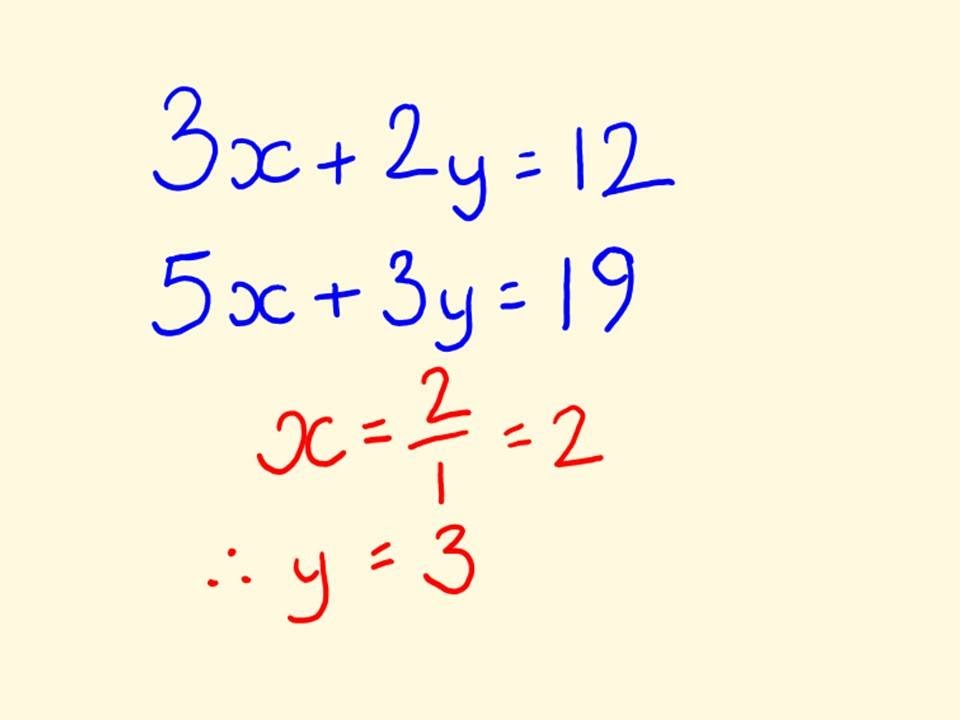
This trick solves simultaneous equations fast, without all the multiplying of equations usually used.
To donate to the tecmath channel:https://paypal.me/tecmath
To support tecmath on Patreon: https://www.patreon.com/tecmath
To buy tecmath mechandise: https://teespring.com/stores/tecmath-store
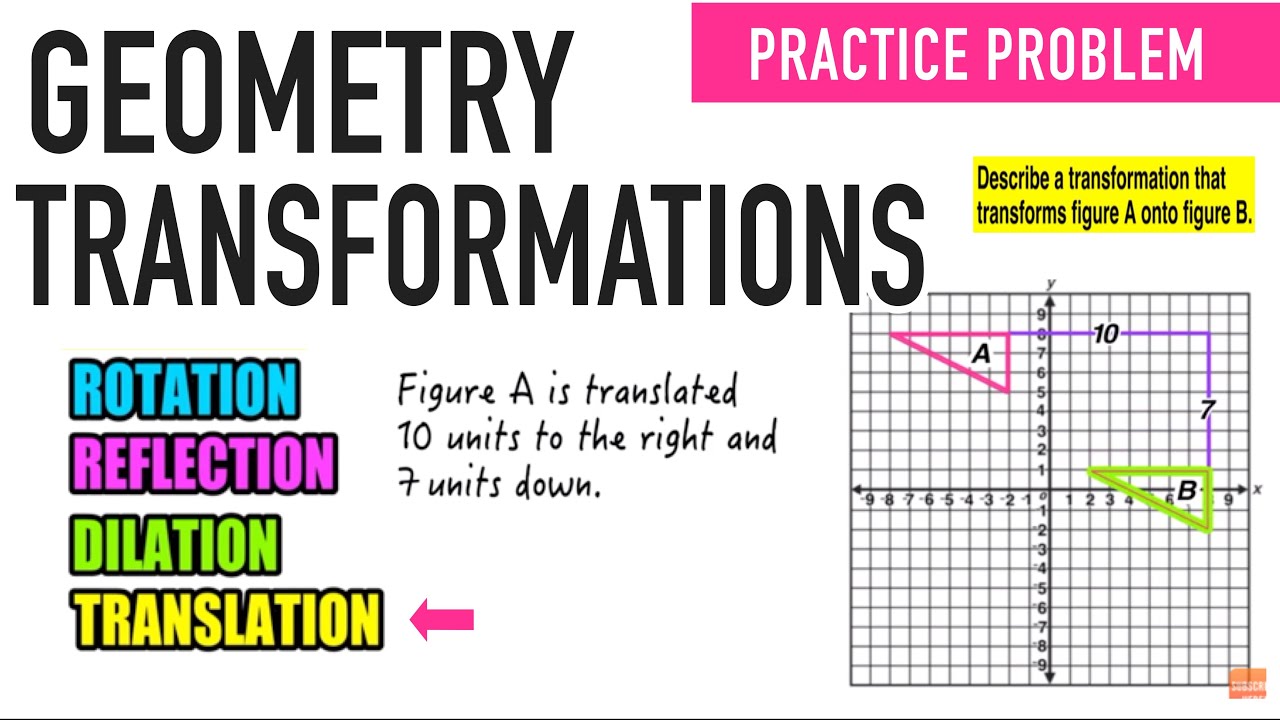
Join us on this geometry translations practice problem where you have to describe a transformation.
Join us on this flipped math lesson for CCLS 8.G.A.2 where we work through a problem that was inspired by a released common core exam item where we explore how to describe a sequence of transformations between two congruent triangles on the coordinate plane.
This lesson answers the question: What is a translation? How do I translate a figure? What is the difference between a rotation and a reflection? What is a dilation? What is a sequence of transformations? How do I describe a transformation?
Our lessons are perfect for flipped classroom math teachers and students and for warm-up and exit ticket activities . This lesson is aligned with the 8th grade common core math learning standards for math and the SAT math curriculum as well.
Be sure to join our mailing list at http://www.mashupmath.com

Join us on this special lesson where you will learn how to calculate slugging percentage, how to calculate batting average, and how to calculate on base percentage featuring Chipper Jones.
Be sure to tweet this lesson to Chipper @RealCJ10 !!!
This lesson answers the questions: How do I find on base percentage? How do I find batting average? How do I find slugging percentage? How do I find total bases? Why is Chipper Jones the man!? How do I find OBP? How do I find AVG? How do I find SLG? How is slugging percentage calculated? How is on base percentage calculated?
Be sure to join our mailing list at http://www.mashupmath.com

In this lesson, we will work through two measurement unit conversion practice problems: how to convert centimeters to meters (CM to M) and how to convert cups to quarts.
★ Want more FREE weekly math videos? Subscribe Now: http://bit.ly/1OVJnyh
★★ Why Math? Download YOUR Free eBook and sign-up for our FREE weekly newsletter: http://www.mashupmath.com/resources

¡Bienvenidos a un nuevo video de nuestro canal para aprender español! Hoy exploraremos cómo usar preposiciones y estructuras esenciales en español para comunicar ideas de manera más completa y precisa.
00:02 1️⃣ Preposiciones Comunes y su Uso
Las preposiciones son palabras clave para conectar ideas y expresar relaciones en español. En esta sección, aprenderemos a utilizar preposiciones de lugar, tiempo y medio. Observa los ejemplos prácticos que te ayudarán a usarlas en tus conversaciones.
Ejemplos:
¿Cómo vas al trabajo?
"🚲 Voy en bici."
"🚇 Él va en metro."
¿De quién es esta carta?
"📬 La carta es de mi amigo."
"👵👴 La carta es de mis abuelos."
Consejo: Practica con preposiciones como en, de, con, por, ante y frente a para expresar relaciones de lugar y pertenencia.
01:04 2️⃣ Verbos con Complemento Indirecto
En español, algunos verbos necesitan un complemento indirecto (me, te, le, nos, os, les) para indicar a quién va dirigida la acción. Esto es fundamental para expresar quién recibe o se beneficia de la acción en la oración.
Ejemplos:
"❓ ¿Me puedes explicar cómo funciona esto?"
"🎉 Te felicito por tu nuevo trabajo."
Consejo: Recuerda que estos complementos indirectos se usan para señalar la persona que recibe o beneficia de la acción.
01:54 3️⃣ Verbos con Dos Objetos (Directo e Indirecto)
Algunos verbos requieren tanto un objeto directo como un objeto indirecto. En estos casos, el complemento indirecto suele colocarse primero. Es una estructura útil para indicar qué persona recibe el objeto directo de la acción.
Ejemplos:
"📲 Te envié un mensaje" → mensaje = objeto directo, te = objeto indirecto
"📚 Dame el libro" → libro = objeto directo, me = objeto indirecto
Consejo: En español, usa me, te, le, nos, os, les como complementos indirectos para clarificar quién recibe la acción en frases con dos objetos.
03:43 4️⃣ Preguntas de “¿Dónde?” y Preposiciones de Lugar
Las preposiciones de lugar son esenciales para describir ubicaciones y responder a preguntas sobre el lugar. Aprender estas estructuras te ayudará a hablar de ubicaciones en español.
Ejemplos:
"¿Dónde está el perro? 🐶"
"Duerme 🛏️ debajo de la mesa."
"Está de pie frente a la 🔥 chimenea."
Consejo: Practica preposiciones de lugar como debajo de, frente a, al lado de para ubicar objetos o personas.
03:45 5️⃣ Preguntas de “¿Cuándo?” y Expresiones de Tiempo
Las expresiones de tiempo son importantes para indicar cuándo ocurren las acciones. Responder a preguntas de “¿cuándo?” es crucial para organizar eventos y rutinas.
Ejemplos:
"⏰ ¿Cuándo vuelves a casa?"
"Estaré allí en una hora."
"El 🚌 bus sale en 15 minutos."
Otros ejemplos:
"🏃♂️ Antes del desayuno, siempre salgo a correr."
"🎿 En invierno, voy a esquiar."
Consejo: Utiliza en, antes de, después de y días de la semana para hablar de momentos específicos.
04:35 🔄 Resumen
Hoy hemos repasado:
📍 Preposiciones comunes para expresar lugar y pertenencia.
👤 Complementos indirectos en verbos.
🗺️ Preposiciones de lugar para responder preguntas de “¿dónde?”.
🕒 Expresiones de tiempo para responder preguntas de “¿cuándo?”.
Practicad estas estructuras para mejorar vuestro español y construir frases más complejas y precisas.
¡No olvides suscribirte y activar la campanita 🔔 para no perderte nuevos videos!