Top videos

🎉 NEW Videos: https://www.youtube.com/playli....st?list=PLLF_mZmNqOn
🕵️♀️ Amazing Things for Kids: https://www.youtube.com/playli....st?list=PLLF_mZmNqOn
Why does a stone sink in water while a metal ship can float? ⚖️ 🌊 The answer lies in density and buoyancy.
In this educational video from Happy Learning, you'll learn in a simple way how density works and why some objects float while others sink. Even submarines have their own trick to float and dive!
🚀 Join us on this scientific adventure and discover how density affects everything around us.
Subscribe to Happy Learning: https://my.happylearning.tv/
Curiosities for kids:https://www.youtube.com/playli....st?list=PLLF_mZmNqOn
Discover hundreds of never-before-seen resources! Create your free account at https://my.happylearning.tv/ and start learning in the most entertaining way.

Subscribe to Happy Learning: https://my.happylearning.tv/
More related videos: https://www.youtube.com/playli....st?list=PLLF_mZmNqOn
Curiosities for kids:https://www.youtube.com/playli....st?list=PLLF_mZmNqOn
🌍 Earth's Movements and Seasons | Learn Geography While Having Fun
🌟 Did you know that the Earth is constantly moving? In this educational video, you’ll learn about the two main movements of our planet: rotation and revolution. Discover how these movements create day and night and the four seasons: spring, summer, autumn, and winter.
👨🏫 What will you find in this video?
🌎 Rotation movement: Why do we have days and nights?
☀️ Revolution movement: What causes the seasons?
📚 Fun facts about time, weather, and how the year is measured.
This video is perfect for primary school kids who want to learn geography in a fun and easy way. Remember to care for our planet while learning about it!
👉 Subscribe to Happy Learning to explore more educational videos full of fun and curiosity.
Discover hundreds of never-before-seen resources! Create your free account at https://my.happylearning.tv/ and start learning in the most entertaining way.

Subscribe to Happy Learning: https://my.happylearning.tv/
More related videos: https://www.youtube.com/playli....st?list=PLLF_mZmNqOn
Curiosities for kids:https://www.youtube.com/playli....st?list=PLLF_mZmNqOn
🌱 PHOTOSYNTHESIS: How Plants Make Their Food | Fun Science for Kids 🌞
🌟 What is photosynthesis? Discover the amazing process plants use to create their own food and how it helps our planet! This fun and educational video is perfect for kids who want to learn about science in an exciting way.
🌿 What will you learn?
- How plants use sunlight, water, and carbon dioxide to make food.
- Why photosynthesis is essential for all living things.
- Fun facts about how plants give us oxygen to breathe!
📚 Join us on this journey to explore the magic of photosynthesis and its role in nature. Don’t forget to subscribe to Happy Learning for more science videos for kids! 🌍
Discover hundreds of never-before-seen resources! Create your free account at https://my.happylearning.tv/ and start learning in the most entertaining way.

Discover hundreds of never-before-seen resources! Create your free account at https://my.happylearning.tv/ and start learning in the most entertaining way.
What are you waiting for? MATHS IS EASY PEASY with Happy Learning
💭Join us on the times tables song!!!🎵🎶
👉SUBSCRIBE TO HAPPY LEARNING! http://bit.ly/HappyLearningTV
👉Web site: https://happylearning.tv/en/
👉Follow us on Facebook: https://www.facebook.com/HappyLearningTv
Recommended Video: 7 Times Table Song: Easy Peasy Maths
https://youtu.be/lYf5y2Qvem4
--------------
Hello Happy Friends, Welcome to a new Happy Learning Video!
Today, we're going to learn the 8 times table!
1 X 8 = 8
2 X 8 = 16
3 X 8 = 24
4 X 8 = 32
5 X 8 = 40
6 X 8 = 48
7 X 8 = 56
8 X 8 = 64
9 X 8 = 72
10 X 8 = 80
One more time!

🐙🦋 Welcome to Happy Learning’s live session on invertebrates and insects! In this exciting educational livestream, children will discover what invertebrates are, how they are classified, the role insects play in this group, and why they are essential for the balance of nature.
Natural Sciences in Primary School aim to help children understand the world around them by developing their curiosity and critical thinking through observation and experimentation. They learn about nature, living beings, the human body, energy and the environment, while also understanding the importance of caring for the planet.
📖 SUBJECT PLAYLISTS
🦖⛰️🐅 NATURAL SCIENCES for Primary School: https://www.youtube.com/playli....st?list=PLLF_mZmNqOn
👨🏫 SOCIAL SCIENCES for Primary School: https://www.youtube.com/playli....st?list=PLLF_mZmNqOn
➕✖️ MATH for Primary School Children: https://www.youtube.com/playli....st?list=PLLF_mZmNqOn
🤴🏰 HISTORY for Primary School Children: https://www.youtube.com/playli....st?list=PLLF_mZmNqOn
🌍⛰️ GEOGRAPHY for Primary School Children: https://www.youtube.com/playli....st?list=PLLF_mZmNqOn
🤝😊 Values and Emotions for Primary School Children: https://www.youtube.com/playli....st?list=PLLF_mZmNqOn v=KkCIIQyevjo&list=PL_Y3qbepMRoY7gwuwniiq11oMo6Ofe724
🌍 THE HAPPY LEARNING UNIVERSE
✅ Learn more about Happy Learning and our educational platform: https://happylearning.tv/en/
✅ Discover our social mission: https://happylearning.tv/en/nemesio-diez-foundation/
✅ Download the Happy Learning App:
- iOS: https://apps.apple.com/es/app/....happy-learning-tv/id
- Android: https://play.google.com/store/apps/details?id=tv.happylearning.canal&pli=1
🎓 ABOUT HAPPY LEARNING
Happy Learning is a social enterprise created by the Nemesio Diez Foundation, working to improve people's quality of life through education, health, sports and culture.
As a social company, our mission is to educate all children in the world in values and knowledge, to promote their holistic development and their commitment to society and the planet.
We offer educational resources to families, schools, hospitals and NGOs to ensure that children everywhere have access to a high-quality, comprehensive education.
At Happy Learning, we turn learning into an exciting adventure for primary school children. 🚀
We offer over 2,000 educational resources that combine fun and learning through animated videos, reading materials, interactive games and real-world activities.
📺 HAPPY LEARNING YOUTUBE CHANNEL
Welcome to Happy Learning! 🚀📚
The educational channel where learning is an adventure. Our goal is to spark curiosity and a love for knowledge in primary school children through fun and dynamic educational videos.
Discover the fascinating world of science with videos on Dinosaurs, the Solar System, Invertebrate Animals, Arachnids and much more. Travel back in time with history videos covering Prehistory, the Discovery of America or Ancient Egypt. Learn geography with content about The Earth and Its Movements, the Water Cycle and Parts of the Earth. Strengthen math skills with videos on Multiplication, Subtraction and Matter and Its Properties, and improve Spanish language understanding with lessons on Nouns, Sentences and Subject and Predicate.
Happy Learning transforms education into an exciting experience through animated videos, clear explanations and interactive activities. Perfect for children, parents and teachers seeking high-quality educational content.
🌟 Join our community of explorers!

NEW VIDEOS https://www.youtube.com/playli....st?list=PLLF_mZmNqOn
ENVIRONMENTAL EDUCATION https://www.youtube.com/playli....st?list=PLLF_mZmNqOn
🌊🚯 Did you know that millions of tons of trash end up in the oceans every year? In this educational video for kids, you'll learn why it’s so important to protect the oceans from pollution, how marine life is affected, and what we can do every day to help the planet. 🐢🧼
Environmental education is key to helping children understand the importance of protecting the planet. Through our educational natural science videos, young learners explore topics like climate change, biodiversity, recycling, and ecosystem conservation.
📖 SUBJECT PLAYLISTS
🦖⛰️🐅 NATURAL SCIENCES for Primary School: https://www.youtube.com/playli....st?list=PLLF_mZmNqOn
👨🏫 SOCIAL SCIENCES for Primary School: https://www.youtube.com/playli....st?list=PLLF_mZmNqOn
➕✖️ MATH for Primary School Children: https://www.youtube.com/playli....st?list=PLLF_mZmNqOn
🤴🏰 HISTORY for Primary School Children: https://www.youtube.com/playli....st?list=PLLF_mZmNqOn
🌍⛰️ GEOGRAPHY for Primary School Children: https://www.youtube.com/playli....st?list=PLLF_mZmNqOn
🤝😊 Values and Emotions for Primary School Children: https://www.youtube.com/playli....st?list=PLLF_mZmNqOn v=KkCIIQyevjo&list=PL_Y3qbepMRoY7gwuwniiq11oMo6Ofe724
🌍 THE HAPPY LEARNING UNIVERSE
✅ Learn more about Happy Learning and our educational platform: https://happylearning.tv/en/
✅ Discover our social mission: https://happylearning.tv/en/nemesio-diez-foundation/
✅ Download the Happy Learning App:
- iOS: https://apps.apple.com/es/app/....happy-learning-tv/id
- Android: https://play.google.com/store/apps/details?id=tv.happylearning.canal&pli=1
🎓 ABOUT HAPPY LEARNING
Happy Learning is a social enterprise created by the Nemesio Diez Foundation, working to improve people's quality of life through education, health, sports and culture.
As a social company, our mission is to educate all children in the world in values and knowledge, to promote their holistic development and their commitment to society and the planet.
We offer educational resources to families, schools, hospitals and NGOs to ensure that children everywhere have access to a high-quality, comprehensive education.
At Happy Learning, we turn learning into an exciting adventure for primary school children. 🚀
We offer over 2,000 educational resources that combine fun and learning through animated videos, reading materials, interactive games and real-world activities.
📺 HAPPY LEARNING YOUTUBE CHANNEL
Welcome to Happy Learning! 🚀📚
The educational channel where learning is an adventure. Our goal is to spark curiosity and a love for knowledge in primary school children through fun and dynamic educational videos.
Discover the fascinating world of science with videos on Dinosaurs, the Solar System, Invertebrate Animals, Arachnids and much more. Travel back in time with history videos covering Prehistory, the Discovery of America or Ancient Egypt. Learn geography with content about The Earth and Its Movements, the Water Cycle and Parts of the Earth. Strengthen math skills with videos on Multiplication, Subtraction and Matter and Its Properties, and improve Spanish language understanding with lessons on Nouns, Sentences and Subject and Predicate.
Happy Learning transforms education into an exciting experience through animated videos, clear explanations and interactive activities. Perfect for children, parents and teachers seeking high-quality educational content.
🌟 Join our community of explorers!

Do you know how harmful palm oil is for the planet? Discover with us the consequences it causes and how it affects the Earth.

Subscribe to Happy Learning: https://my.happylearning.tv/
More related videos: https://www.youtube.com/playli....st?list=PLLF_mZmNqOn
Curiosities for kids:https://www.youtube.com/playli....st?list=PLLF_mZmNqOn
Discover hundreds of never-before-seen resources! Create your free account at https://my.happylearning.tv/ and start learning in the most entertaining way.
THE CIRCULATORY SYSTEM | Educational Videos for Children
In this Happy Learning video, we are going to learn about one of the most important systems in our body: the circulatory system! 💓🩸 This system is responsible for carrying blood throughout our body, like a big highway full of life. 🚗🛣️ Did you know that blood transports the oxygen we need to breathe and the nutrients that give us energy? It's like a super delivery service that never stops! 📦🚚 All of this is possible thanks to the heart, which acts as a powerful pump. Every time it beats, it pushes blood through the blood vessels, making sure oxygen reaches every corner of our body. It’s amazing!
In this video, we will learn how the heart, arteries, veins, and capillaries work together to keep us healthy and strong. 💪❤️ You will also discover what happens when we exercise: our heart beats faster to deliver more oxygen to the muscles. It’s a fascinating system that never rests! 🌟 So get ready to explore in a fun way how this magical network works through our body. Your heart and circulatory system are true silent heroes that work day and night for you!
Discover hundreds of unseen resources! Create your free account at https://my.happylearning.tv/ and learn in the most fun way.
#happylearning
#learning
#happy

Discover hundreds of never-before-seen resources! Create your free account at https://my.happylearning.tv/ and start learning in the most entertaining way.
What are you waiting for? We are all composed of these tiny microscopic things called... CELLS! let’s get to know them a little more through a fun q&a game!!!
💭How many did you get right?
👇Let me know in the comments bellow!
-
Learning with Sarah, you'll find this out and much more by learning with Sarah...
IT'S EASY PEASY 😉
-
👉SUBSCRIBE TO HAPPY LEARNING! http://bit.ly/HappyLearningTV
👉Web site: https://happylearning.tv/en/
👉Follow us on Facebook: https://www.facebook.com/HappyLearningTv
Recommended video: WHAT ARE BLACK HOLES?
https://youtu.be/iubWQ7J6U3AY
——
Hello Happy Friends, Are you ready to Learn? I’m Sarah
Today, we’re going to go over everything we know about… cells! With a Q&A game!
Let’s start!
Which one of these living things is composed by cells?
Aniamals and plants
Placton or
All living things
Of course! All living things!
Let’s get to know a little more...
Cells are the smallest parts in living things, and we are all composed... by cells. Some, only have a single cell and we call them unicellular, for example, some bacteria. Others have many cells and we call them multicellular, like animals… or plants. By the way.. Did you know that human beings have hundreds of billions of cells?
Wow! Interesting!
Yes, we do have cells, indeed.
Let’s head to the next question. This one is a little bit tougher.
Which is the most important part of a cell?
Membrane
Nucleus
Or cytoplasm
Oh look! The most important part is the nucleus, but there are other parts which are also very important.
Let’s get to know a little more about them.
In these images, you can see a cell and its most important parts. But you need to know that the nucleus is the most important organelle of all and that’s why we make it stand out from the rest. The nucleus is like the brain in a cell and it controls its functions. Within it, there are genes, which transmit the hereditary characteristics from parent to offspring. These crocodile babies look very similar to their parents, because of genes.
The truth is that when they’re small, they’re so cute, but when they grow up… not so much.
Have you been paying attention to the explanation and observed the cell diagram properly? Yes? Well then you’re going to find the next question very easy.
What can we find in the cytoplasm?
The membrane
The cell wall
The organelle
Or bacterias
Of course! The organelle! Let’s look at the diagram again to learn a little more
The cytoplasm, what a werid word! Is a liquid substance which is found between the membrane… and the nucleus, and here, in the cytoplasm, we can find… the organelle. The organelle are different between themselves and each one has a distinct function. Some, for example, some are in charge of digesting food and others of eliminating waste.
That’s so cool! I love learning so many new things. As always, I’ll tell you that the most important thing is not having answered all the questions correctly, but rather having learnt and always wanting to learn more.
Goodbye Happy Friends, See you next time!
I hope you’re always ready to learn!
Goodbyee!
Oh! And don’t forget to subscribe to Happy Learning TV
PREMIERES! 👉 https://www.youtube.com/playli....st?list=PLLF_mZmNqOn
Discover hundreds of never-before-seen resources! Create your free account at https://my.happylearning.tv/ and start learning in the most entertaining way.
What are you waiting for? Hello friends, and welcome to a new Happy learning video.
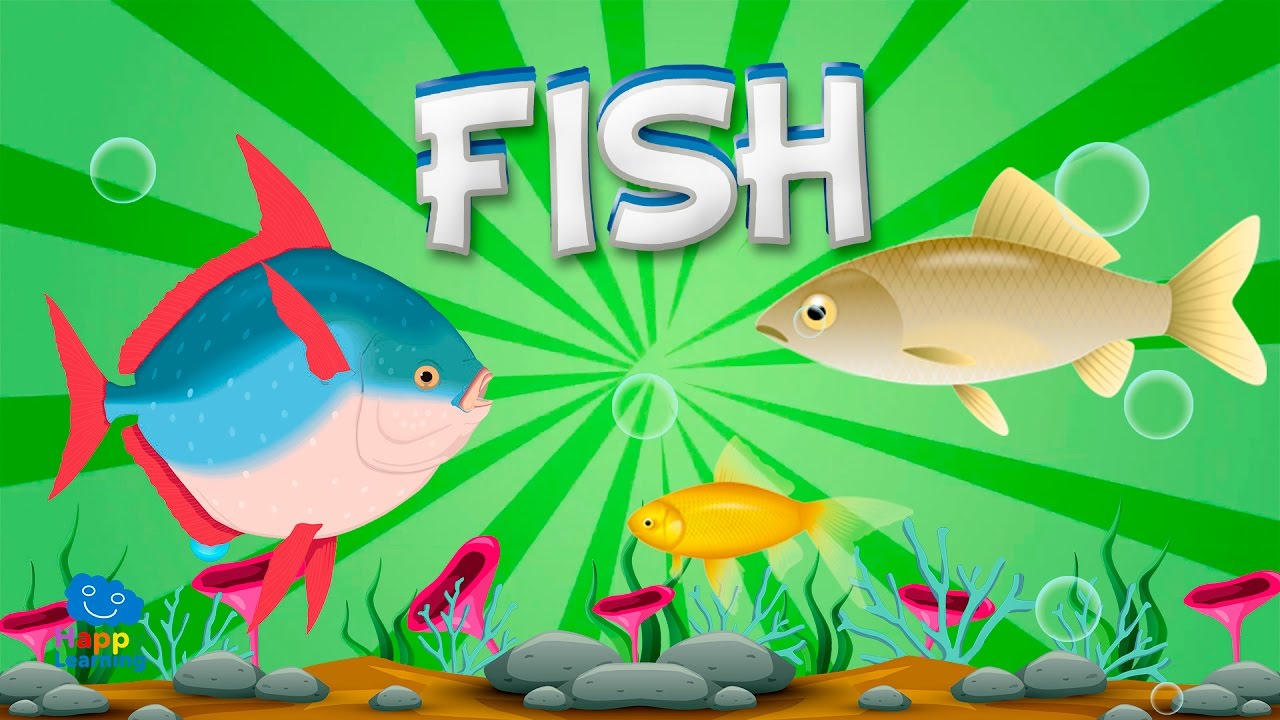
Today we are going to learn about the wettest animals on the planet...presenting the fish.
In almost all the places where you can find water, be it either salt water or fresh water, you can also find fish. There are fish of all sorts of sizes, colors and shapes, and yet they all have common characteristics which we should know.
Fish are vertebrates, their skeleton is made up of bones or cartilage. They are also cold blooded, their body temperature is not constant, meaning it depends on the water temperature.
This fish appears to be really cold!
All fish have extremities in the form of fins, as you can see in this image, dorsal fins, caudal fin which is the tail, pectoral fin, pelvic fin and anal fin. Another really important fact that one must remember is that almost all fish are covered in scales.
The gills are the fish´s respiratory organ. The respiration process is very interesting; water enters through the mouth and goes to the gills; the gills then get the oxygen and distributes it to the rest of the body through the blood vessels , then the water is expelled through an opening which can be found in the majority of fish behind their head, which is called the gill flap.
Fish reproduce by laying eggs, therefore they are oviparous, and their fertilization can be either external or internal. Some fish are excellent fathers, like this one who protects his babies inside his mouth. It looks as if he is going to eat them but he is actually protecting them. Look at that! it´s amazing isn't it?
Almost all fish are carnivores, eating other fish smaller than themselves and therefore they each have different ways of defending themselves. The most common action to take when feeling threatened is to escape as fast as possible, as in to swim away rapidly. But there are other ways of defending oneself which are much more original. For example, this Clown fish hides itself among these venomous anemones, others imitate or camouflage themselves with their background, by obtaining the color and shape of the plants and rocks around them...Can you see a fish in this image? Wow, well there was indeed a fish and a very hungry one!
Look, this is the largest fish in the world, the Whale shark. Even though it is called a whale shark you must remember it is a shark and not a whale. Whales are not fish, they are aquatic mammals, like theses friendly dolphins. So never forget, whales and dolphins are not fish but mammals.
Now I have a very important fact you must always remember, its extremely important. As you already know fish as well as many other animals, live in water...water is essential for life, and for this reason we must look after it, we must protect it. There are people who dirty nature by throwing rubbish into the rivers and oceans, without thinking about the terrible consequences they are causing. The plastics and substances which contaminate the water, kill a huge amount of animals. Fish, turtles, dolphins, whales, sharks and many more die every day because of contamination. Water is a source of life. We must take care of it and protect it. So now you know, look after nature so that all living creatures can live happily.
Good bye friends, until the next Happy learning video.
Discover hundreds of never-before-seen resources! Create your free account at https://my.happylearning.tv/ and start learning in the most entertaining way.
What are you waiting for? The ecosystem
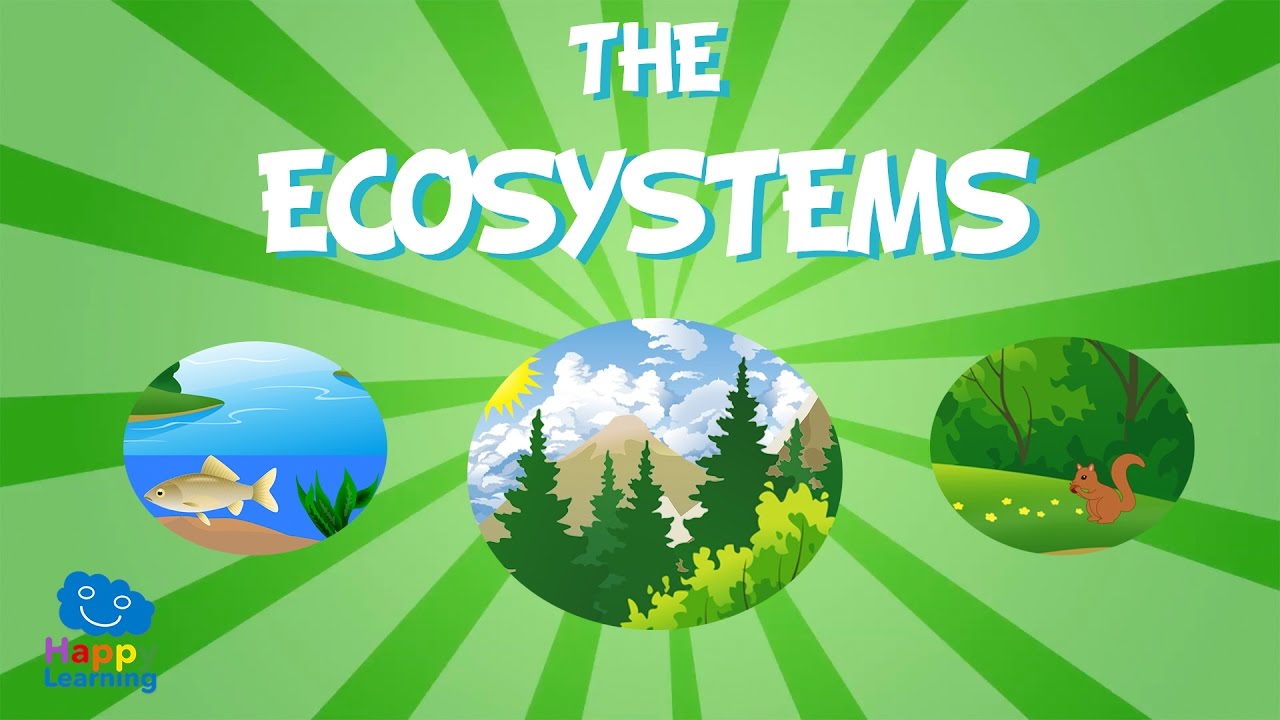
Hello friends and welcome to a new Happy Learning video. Today we are going to learn about the ecosystems.
But…do you know what an ecosystem is? An ecosystem is a community of living things in a given area. For example, this river is an ecosystem and is made up of water, the river bed, the river banks and all the living creatures which live in it, such as this frog, these lily pads or this shy duck which hides as soon as it sees us.
An ecosystem can be very small, such as this puddle, or very big such as this enormous desert…
The ecosystems are made up of two components: the Abiotic and the Biotic components.
The Abiotic components include the non-living things like the ground, the climate, or the water and it determines which living things can survive in an ecosystem. For example a desert is a very dry place and so only animals and plants which can survive without much water can live there, like this slippery lizard or these humped back camels.
On our planet there are loads of ecosystems, and they are divided into aquatic and terrestrial. (And these can be either aquatic or terrestrial)
There are two types of aquatic ecosystems: freshwater and Marine.
The freshwater ones are those which have freshwater such as rivers or lakes where Lily pads, otters, or frogs live…Whoops, and here are our friendly ducks again…
The marine ecosystems are those found in the sea such as this beautiful colorful reef so full of life, fish, corals, octopuses and many more fascinating creatures.
When talking about the terrestrial ecosystems we imagine prairies… large plains in the savanna were zebras or antelope like to graze…jungles where trees are extremely high and are the homes for these monkeys called orangutans…or even mountain ecosystems where there tends to be plenty of snow.
Well now we know a bit more about ecosystems and as always, on behalf of Happy Learning we ask you to please look after them… they are so beautiful, we mustn’t destroy them. (We must preserve them)
Goodbye friends and don’t forget to subscribe to Happy Learning

🎉 NEW Videos: https://www.youtube.com/playli....st?list=PLLF_mZmNqOn
🕵️♀️ Amazing Things for Kids: https://www.youtube.com/playli....st?list=PLLF_mZmNqOn
What is Air? | Educational Videos for Primary School Kids | @HappyLearningENG
Did you know that air is full of things we can’t see? In this video, we teach you all the secrets of air: what it’s made of, how it changes with temperature, and why it’s so important for life on Earth. Discover how air allows plants to perform photosynthesis, how a hot air balloon flies, and much more! You’ll also learn how air is essential for fire, sound, and the flight of birds. Don’t miss this adventure through air and its amazing characteristics!
Subscribe to Happy Learning: https://my.happylearning.tv/
Curiosities for kids:https://www.youtube.com/playli....st?list=PLLF_mZmNqOn
Discover hundreds of never-before-seen resources! Create your free account at https://my.happylearning.tv/ and start learning in the most entertaining way.

Discover hundreds of never-before-seen resources! Create your free account at https://my.happylearning.tv/ and start learning in the most entertaining way.
What are you waiting for? In this video we are going to learn the farm animals in spanish. Spanish vocabulary for children. vaca (cow), perro (dog), gato (cat), oveja (sheep), gallo (cock), cerdo (pig), caballo (horse), pato (duck), burro (donkey), gallina (chicken)
▶SUBSCRIBE TO HAPPY LEARNING! http://bit.ly/HappyLearningTV
▶Follow us on Twitter: https://twitter.com/HappyLearningTv
▶Follow us on Facebook: https://www.facebook.com/HappyLearningTv

Discover hundreds of never-before-seen resources! Create your free account at https://my.happylearning.tv/ and start learning in the most entertaining way.
What are you waiting for? Do you know what the difference is between seas and oceans? Did you know that at the bottom of the sea, there are volcanoes, and large plains?...
💭What is the most interesting fact you learnt today?
💭 Did you know any of these already?
👉SUBSCRIBE TO HAPPY LEARNING! http://bit.ly/HappyLearningTV
👉Web site: https://happylearning.tv/en/
👉Follow us on Facebook: https://www.facebook.com/HappyLearningTv
Recommended video: 5 things you didn’t know about eyes
https://www.youtube.com/watch?v=KsdYjtdpZtE&t=5s
-----------
1 - Do you know what the difference is between seas and oceans?
The most important difference between seas and oceans is that seas are a loot smaller. and they belong, to the oceans. actually, they are a part of them; the seas, are the part of the oceans, which are closest to land. We all know that on our planet we have, 5 oceans: Atlantic, Pacific, Indian, Arctic and Antarctic. But… do you know how many seas there are? Well there are 57. and the largest are the Arabian Sea, the South China Sea, Caribean Sea, Mediterranean Sea and the Bering Sea.
2- Did you know that at the bottom of the sea, there are volcanoes, and large plains?
Although a lot of people think that the bottom of the sea is flat, it’s not true. Actually, the bottom of the Sea is like land, it has mountains, volcanoes, caves, great planes and even waterfalls!!. It’s so deep and big, that although it may seem incredible, there are many places where humans have not reached yet. Actually, 95% of the sea, remains unexplored. There’s so much to discover!
3- Do you know that the Everest isn’t the largest mountain in the world?
Well no! The largest mountain on Earth is in the sea and it’s called Mauna Kea. This inactive volcano, located in a Hawaiian island, measures from the sea surface to its tip, 4207 meters. But if we measure it from its base, which is at the bottom of the ocean, it measures ten thousand meters high, and if we compare this to the 8 thousand 848 meters of the Everest, they turn the Mauna Kea into the largest mountain in the world. What is true, is that the Everest, is the highest point on Earth.
4- What do you think we know more about? Planet mars or the oceans?
Well, although it may seem incredible, we know Mars’ surface more and better than the bottom of the sea. Human beings know very little about species which habitat the oceans, and there are still many to be discovered. It’s probable that most of these species are very small organisms but scientists believe there are still fish, and mammals which have not been discovered yet. Each year we discover a mean of 2000 new species.
5- Did you know that the sea is the biggest rubbish dump in the universe?
Yes, sadly, the sea has been used for a long time, as a dump, without realising oceans are the lungs of our planet. More than 50% of the air we breathe is produced at sea. The Mediterranean Sea,, is the most contaminated in the world, but sadly, most oceans are at an alarming stage. Plastics, pesticides , chemical substances, oil… all affect the sea’s health and living things within it. More than 100 thousand marine animals like penguins, whales, dolphins, turtles, fish and birds... die every year, only because of the plastic in the sea…
Please respect and take care of nature, don’t throw rubbish to the sea or rivers and always recycle. If we take care of the water, if we take care of the sea, we will make all living things live in a better world, cleaner and happier.

Discover hundreds of never-before-seen resources! Create your free account at https://my.happylearning.tv/ and start learning in the most entertaining way.
What are you waiting for? Hello friends, we're very happy to present the second episode of our series "Children can make a WORLD of difference" in which our planet Earth will tell us some worrying things about the trees and how our everyday actions can help her alleviate this situation.

Discover hundreds of never-before-seen resources! Create your free account at https://my.happylearning.tv/ and start learning in the most entertaining way.

Students are challenged to design their own small-sized prototype light sculptures to light up a hypothetical courtyard. To accomplish this, they use Arduino microcontrollers as the “brains” of the projects and control light displays composed of numerous (3+) light-emitting diodes (LEDs). With this challenge, students further their learning of Arduino fundamentals by exploring one important microcontroller capability—the control of external circuits. The Arduino microcontroller is a powerful yet easy-to-learn platform for learning computer programing and electronics. LEDs provide immediate visual success/failure feedback, and the unlimited variety of possible results are dazzling!
View the full activity on TeachEngineering: https://www.teachengineering.o....rg/makerchallenges/v
TeachEngineering has over 1,500 FREE lessons and activities. Visit https://www.teachengineering.org/ for more!
Music: New Tires - Silent Partner

Through multi-trial experiments, students are able to see and measure something that is otherwise invisible to them—seeing plants breathe. Student groups are given two small plants of native species and materials to enclose them after watering with colored water. After being enclosed for 10, 20 and 30 minutes, teams collect and measure the condensed water from the plants' "breathing," and then calculate the rates at which the plants breathe. A plant's breath is known as transpiration, which is the flow of water from the ground where it is taken up by roots (plant uptake) and then lost through the leaves. Students plot volume/time data for three different native plant species, determine and compare their transpiration rates to see which had the highest reaction rate and consider how a plant's unique characteristics (leaf surface area, transpiration rate) might figure into engineers' designs for neighborhood stormwater management plans.
View the full activity at TeachEngineering:
https://www.teachengineering.o....rg/activities/view/u
TeachEngineering has over 1,500 FREE lessons and activities. Visit http://www.TeachEngineering.org for more!
Music: Valerie Plain - Rondo Brothers
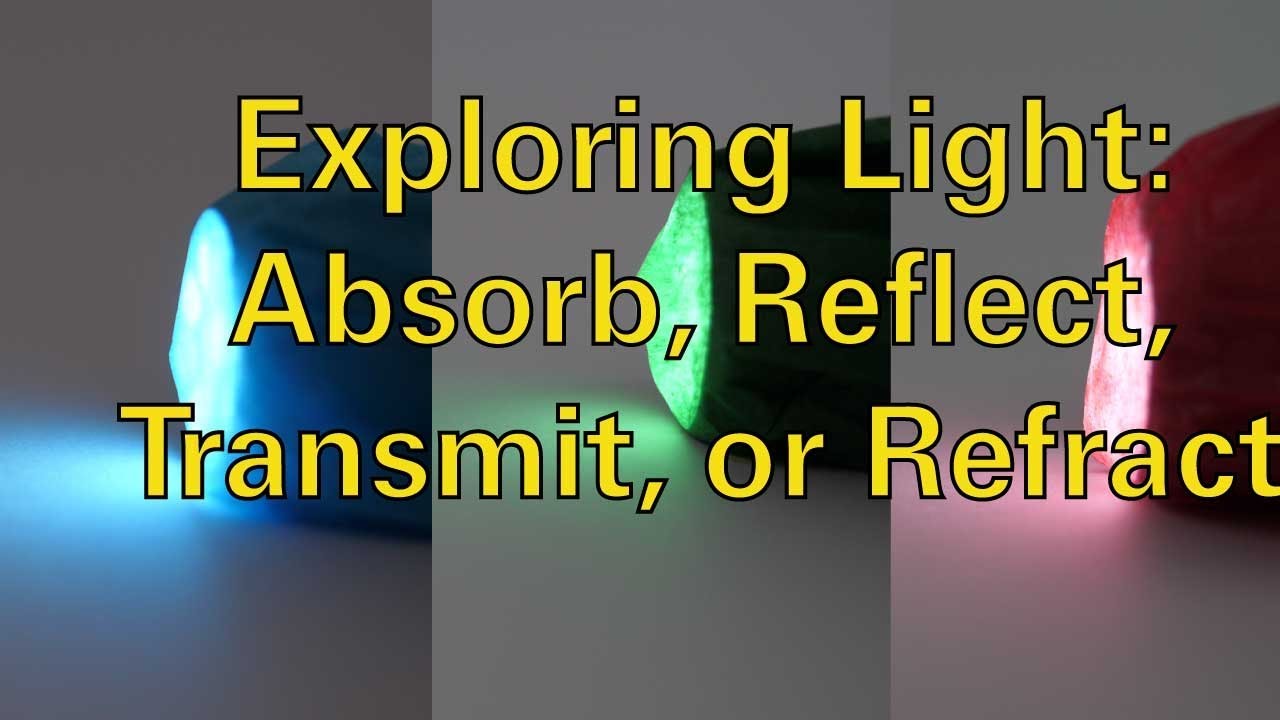
In a hands-on way, students explore light's properties of absorption, reflection, transmission and refraction through various experimental stations within the classroom. To understand absorption, reflection and transmission, they shine flashlights on a number of provided objects. To understand refraction, students create indoor rainbows. An understanding of the fundamental properties of light is essential to designing an invisible laser security system, the ongoing objective in this unit.
View the full activity at TeachEngineering:
https://www.teachengineering.o....rg/activities/view/v
TeachEngineering has over 1,500 FREE lessons and activities. Visit https://www.teachengineering.org/ for more!
Music: New Land - ALBIS

Students use water balloons and a length of string to understand how the force of gravity between two objects and the velocity of a spacecraft can balance to form an orbit. They see that when the velocity becomes too great for gravity to hold the spacecraft in orbit, the object escapes the orbit and travels further away from the planet.
View the full activity on TeachEngineering:
https://www.teachengineering.o....rg/activities/view/c
TeachEngineering has over 1,500 FREE lessons and activities. Visit https://www.teachengineering.org/ for more!
Music: Above and Beyond - Silent Partner

To understand the challenges of satellite construction, student teams design and create model spacecraft to protect vital components from the harsh conditions found on Mercury and Venus. They use slices of butter in plastic eggs to represent the internal data collection components of the spacecraft. To discover the strengths and weaknesses of their designs, they test their unique thermal protection systems in a planet simulation test box that provides higher temperature and pressure conditions.
This engineering curriculum aligns to Next Generation Science Standards (NGSS).
View the full activity on TeachEngineering:
https://www.teachengineering.o....rg/activities/view/c
TeachEngineering has over 1,500 FREE lessons and activities. Visit https://www.teachengineering.org/ for more
Music: EDM Detection Mode

To further their understanding of sound energy, students identify the different pitches and frequencies created by a vibrating ruler and a straw kazoo. They create high- and low-pitch sound waves.
This engineering curriculum aligns to Next Generation Science Standards (NGSS).
View the full activity on TeachEngineering:
https://www.teachengineering.o....rg/activities/view/c
TeachEngineering has over 1,500 FREE lessons and activities. Visit https://www.teachengineering.org/ for more
Music: Tyler Kimbell

Students act as structural engineers and learn about forces and load distributions as they follow the steps of the engineering design process to design and build small-scale bridges using wooden tongue depressors and glue. Teams brainstorm ideas that meet the size and material design constraints and create prototype bridges of the most promising solutions. They test their bridges to see how much weight they can hold until they break and then determine which have the highest strength-to-weight ratios. They examine the prototype failures to identify future improvements. This activity is part of a unit in which multiple activities are brought together for an all-day school/multi-school concluding “engineering field day” competition.
View the full activity on TeachEngineering: https://www.teachengineering.o....rg/activities/view/u
TeachEngineering has over 1,500 FREE lessons and activities. Visit https://www.teachengineering.org/ for more!
Music: Undeniable - Text Me Records / Bobby Renz

In this hands-on activity, students explore the electrical force that takes place between two objects. Each student builds an electroscope and uses the device to draw conclusions about objects' charge intensity. Students also determine what factors influence electric force.
View the full activity on TeachEngineering:
https://www.teachengineering.o....rg/activities/view/c
TeachEngineering has over 1,500 FREE lessons and activities. Visit https://www.teachengineering.org/ for more!
Music: Weekend In The City - Silent Partner

Students practice the initial steps involved in an engineering design challenge. They begin by reviewing the steps of the engineering design loop and discussing the client need for the project. Next, they identify a relevant context, define the problem within their design teams, and examine the project's requirements and constraints. (Note: Conduct this activity in the context of a design project that students are working on, which could be a challenge determined by the teacher, brainstormed with the class, or the example project challenge provided [to design a prosthetic arm that can perform a mechanical function].)
View the full activity on TeachEngineering:
https://www.teachengineering.o....rg/activities/view/c
TeachEngineering has over 1,500 FREE lessons and activities. Visit https://www.teachengineering.org/ for more
music - Dream of A Day