Top videos
How does our knowledge grow? It turns out there are some different ideas about that. Schemas, Four-Stage Theory of Cognitive Development, and Vygotsky's Theory of Scaffolding all play different roles but the basic idea is that children think about things very differently than adults. Hank explains in today's episode of Crash Course Psychology.
Want more videos about psychology? Check out our sister channel SciShow Psych at https://www.youtube.com/scishowpsych!
--
Chapters:
Introduction: Cognitive Development 00:00
Maturation 1:23
Jean Piaget's Theory of Cognitive Development 1:45
Schemas 2:39
Assimilation & Accommodation 3:03
Sensorimotor Stage of Cognitive Development 3:37
Preoperational Stage of Cognitive Development 4:37
Concrete Operational Stage of Cognitive Development 6:40
Formal Operational Stage of Cognitive Development 7:06
Reception of Piaget's Four-Step Model 7:20
Vygotsky's Theory of Scaffolding 7:48
Review & Credits 8:58
--
Crash Course is on Patreon! You can support us directly by signing up at http://www.patreon.com/crashcourse
Want to find Crash Course elsewhere on the internet?
Facebook - http://www.facebook.com/YouTubeCrashCourse
Twitter - http://www.twitter.com/TheCrashCourse
Instagram - https://www.instagram.com/thecrashcourse/
CC Kids: http://www.youtube.com/crashcoursekids

Interactions between species are what define ecological communities, and community ecology studies these interactions anywhere they take place. Although interspecies interactions are mostly competitive, competition is pretty dangerous, so a lot of interactions are actually about side-stepping direct competition and instead finding ways to divvy up resources to let species get along. Feel the love?
Table of Contents
1) Competitive Exclusion Principle 2:02
2) Fundamental vs. Realized Niche 3:48
3) Eco-lography / Resource Partitioning 5:25
4) Character Displacement 7:29
5) Mutualism 9:15
6) Commensalism 9:55
References
http://www.sciencedaily.com/ar....ticles/c/competitive
http://www.youtube.com/watch?v=GbRPDGikcnc
http://www.instruction.greenri....ver.edu/mcvay/ES204%
http://www.sciencedaily.com/ar....ticles/e/ecological_
http://www.stanford.edu/group/stanfordbirds/text/essays/MacArthur's_Warblers.html
http://uts.cc.utexas.edu/~varanus/MacArthur.html
http://www.jstor.org/discover/10.2307/1383283?uid=3739960&uid=2129&uid=2&uid=70&uid=4&uid=3739256&sid=21101174112437
http://www.cals.ncsu.edu/cours....e/ent591k/symbiosis.
http://www.eoearth.org/article/Community_ecology
http://livingseas.org/2011/01/....22/killer-whales-sta
http://www.ecy.wa.gov/programs..../sea/pugetsound/beac
http://www.visitolympicpeninsu....la.org/tidepools.htm
http://www.annualreviews.org/d....oi/abs/10.1146/annur
http://eol.org/pages/484359/overview
http://www.geog.ubc.ca/biodive....rsity/efauna/Introdu
http://www.daviddarling.info/e....ncyclopedia/S/symbio
http://blogs.discovermagazine.....com/discoblog/2012/0
http://sites.sinauer.com/ecology2e/webext11.1.html
http://www.stanford.edu/group/stanfordbirds/text/essays/MacArthur's_Warblers.html
http://www.annualreviews.org/d....oi/pdf/10.1146/annur
Crash Course is on Patreon! You can support us directly by signing up at http://www.patreon.com/crashcourse
Want to find Crash Course elsewhere on the internet?
Facebook - http://www.facebook.com/YouTubeCrashCourse
Twitter - http://www.twitter.com/TheCrashCourse
Instagram - https://www.instagram.com/thecrashcourse/
CC Kids: http://www.youtube.com/crashcoursekids
Today we conclude our unit on Philosophy of Religion and Hank gets a little help from Indiana Jones to explain religious pragmatism and Pascal’s Wager, fideism, and Kierkegaard’s leap to faith.
--
“Indiana Jones” © Copyright Walt Disney Studios
All other images and video via VideoBlocks or Wikimedia Commons, licensed under Creative Commons BY 4.0: https://creativecommons.org/licenses/by/4.0/
--
Produced in collaboration with PBS Digital Studios: http://youtube.com/pbsdigitalstudios
Crash Course Philosophy is sponsored by Squarespace.
http://www.squarespace.com/crashcourse
--
Want to find Crash Course elsewhere on the internet?
Facebook - http://www.facebook.com/YouTubeCrashC...
Twitter - http://www.twitter.com/TheCrashCourse
Tumblr - http://thecrashcourse.tumblr.com
Support CrashCourse on Patreon: http://www.patreon.com/crashcourse
CC Kids: http://www.youtube.com/crashcoursekids
In the penultimate episode of Crash Course Anatomy & Physiology, Hank explains your adaptive immune system. The adaptive immune system's humoral response guards extracellular terrain against pathogens. Hank also explains B cells, antibodies, and how vaccines work.
Pssst... we made flashcards to help you review the content in this episode! Find them on the free Crash Course App!
Download it here for Apple Devices: https://apple.co/3d4eyZo
Download it here for Android Devices: https://bit.ly/2SrDulJ
Chapters:
Introduction: Adaptive Immune Responses 00:00
How B Cells Identify Antigens 2:14
B Cells Become Effector Cells & Memory Cells 4:05
How Antibodies Fight Antigens 5:22
Active and Passive Humoral Immunity 6:03
How Vaccines Work 6:27
Review 8:30
***
Crash Course is on Patreon! You can support us directly by signing up at http://www.patreon.com/crashcourse
Thanks to the following Patrons for their generous monthly contributions that help keep Crash Course free for everyone forever:
Mark, Eric Kitchen, Jessica Wode, Jeffrey Thompson, Steve Marshall, Moritz Schmidt, Robert Kunz, Tim Curwick, Jason A Saslow, SR Foxley, Elliot Beter, Jacob Ash, Christian, Jan Schmid, Jirat, Christy Huddleston, Daniel Baulig, Chris Peters, Anna-Ester Volozh, Ian Dundore, Caleb Weeks
--
Want to find Crash Course elsewhere on the internet?
Facebook - http://www.facebook.com/YouTubeCrashCourse
Twitter - http://www.twitter.com/TheCrashCourse
Tumblr - http://thecrashcourse.tumblr.com
Support Crash Course on Patreon: http://patreon.com/crashcourse
CC Kids: http://www.youtube.com/crashcoursekids
Today we are introducing a new area of philosophy – philosophy of religion. We are starting this unit off with Anselm’s argument for God’s existence, while also considering objections to that argument.
--
“That’s a Neigh” David Goehring https://www.flickr.com/photos/carbonnyc/8757020626
All other images via Wikimedia Commons, licensed under Creative Commons by 4.0: https://creativecommons.org/licenses/by/4.0/
--
Produced in collaboration with PBS Digital Studios: http://youtube.com/pbsdigitalstudios
Crash Course Philosophy is sponsored by Squarespace.
http://www.squarespace.com/crashcourse
--
Want to find Crash Course elsewhere on the internet?
Facebook - http://www.facebook.com/YouTubeCrashC...
Twitter - http://www.twitter.com/TheCrashCourse
Tumblr - http://thecrashcourse.tumblr.com
Support CrashCourse on Patreon: http://www.patreon.com/crashcourse
CC Kids: http://www.youtube.com/crashcoursekids
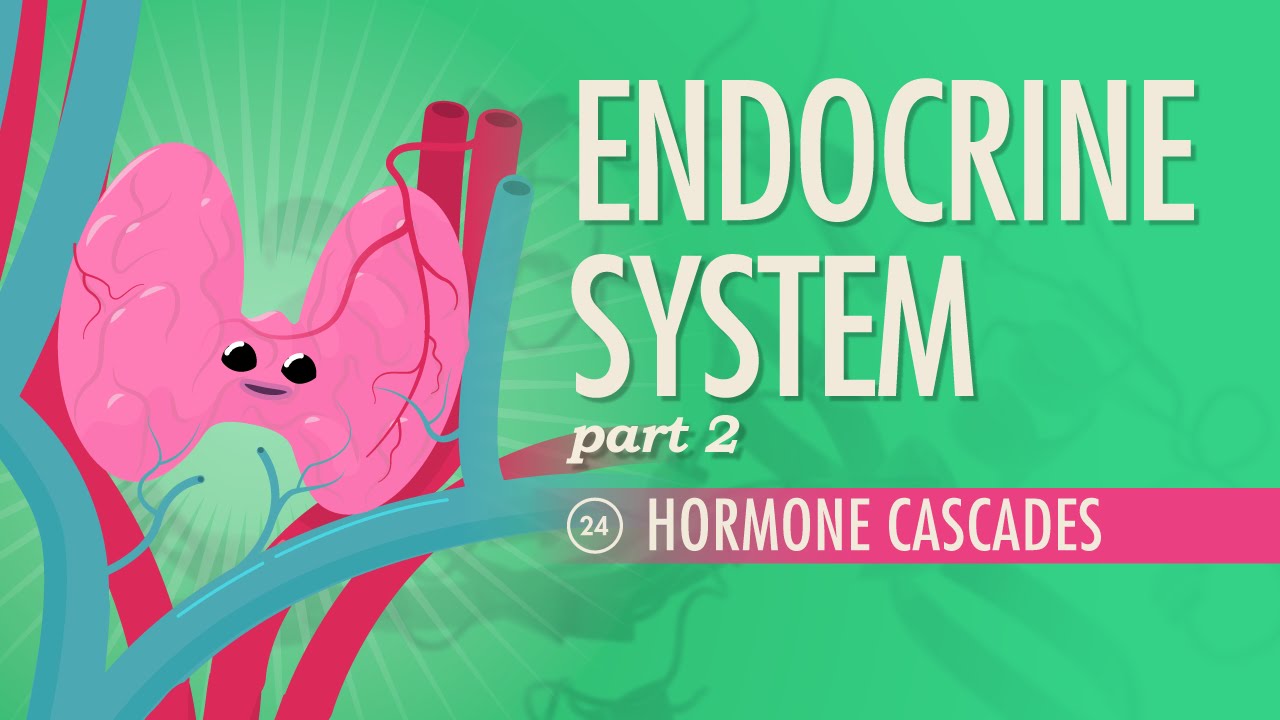
In the second half of our look at the endocrine system, Hank discusses chemical homeostasis and hormone cascades. Specifically, he looks at the hypothalamus-pituitary-thyroid axis, or HPT axis, and all the ways your body can suffer when that system, or your hormones in general, get out of whack.
Pssst... we made flashcards to help you review the content in this episode! Find them on the free Crash Course App!
Download it here for Apple Devices: https://apple.co/3d4eyZo
Download it here for Android Devices: https://bit.ly/2SrDulJ
Chapters:
Introduction: Graves Disease & Hyperthyroidism 00:00
Hormone Cascades 2:35
Hypothalamus-Pituitary-Thyroid (HPT) Axis 3:25
Thyroid Disorders & Autoimmune Dysfunction 6:37
Review 8:21
Credits 8:57
***
Crash Course is now on Patreon! You can support us directly by signing up at http://www.patreon.com/crashcourse
Thanks to the following Patrons for their generous monthly contributions that help keep Crash Course free for everyone forever:
Mark Brouwer, Jan Schmid, Steve Marshall, Anna-Ester Volozh, Sandra Aft, Brad Wardell, Christian Ludvigsen, Robert Kunz, Jason, A Saslow, Jacob Ash, Jeffrey Thompson, Jessica Simmons, James Craver, Simun Niclasen, SR Foxley, Roger C. Rocha, Nevin, Spoljaric, Eric Knight, Elliot Beter, Jessica Wode
***SUBBABLE MESSAGES***
TO: Rachel
FROM: Alex
I Love You!
--
TO: Crash Course
FROM: James Earle
I loved Subbable. I'll see you on Patreon.
***SUPPORTER THANK YOU!***
Thank you so much to all of our awesome supporters for their contributions to help make Crash Course possible and freely available for everyone forever:
Megan McChristy, Matthew Feickert, Tara D. Kane, Gage Ledbetter, Benjamin Perea, Chad Walter, Janel Christensen, Alura Embrey, Ken Johnson, Harland Wirth
--
Want to find Crash Course elsewhere on the internet?
Facebook - http://www.facebook.com/YouTubeCrashCourse
Twitter - http://www.twitter.com/TheCrashCourse
Tumblr - http://thecrashcourse.tumblr.com
Support Crash Course on Patreon: http://patreon.com/crashcourse
CC Kids: http://www.youtube.com/crashcoursekids

In the 1920s, there was a blossoming of all kinds of art made by African Americans in the New York neighborhood Harlem. Let's call it a renaissance. While all the arts were having a great run, some extremely interesting things were happening in the theater. Writers like Langston Hughes and Zora Neale Hurston were writing plays, and black theater companies were drawing larger audiences than ever before.
Crash Course is on Patreon! You can support us directly by signing up at http://www.patreon.com/crashcourse
Thanks to the following Patrons for their generous monthly contributions that help keep Crash Course free for everyone forever:
Sam Buck, Mark Brouwer, Jennifer French Lee, Brandon Westmoreland, dorsey, Indika Siriwardena, James Hughes, Kenneth F Penttinen, Trevin Beattie, Satya Ridhima Parvathaneni, Erika & Alexa Saur, Glenn Elliott, Justin Zingsheim, Jessica Wode, Eric Prestemon, Kathrin Benoit, Tom Trval, Jason Saslow, Nathan Taylor, Brian Thomas Gossett, Khaled El Shalakany, SR Foxley, Sam Ferguson, Yasenia Cruz, Eric Koslow, Caleb Weeks, Tim Curwick, D.A. Noe, Shawn Arnold, Malcolm Callis, Advait Shinde, William McGraw, Andrei Krishkevich, Rachel Bright, Kathy & Tim Philip, Jirat, Ian Dundore
--
Want to find Crash Course elsewhere on the internet?
Facebook - http://www.facebook.com/YouTubeCrashCourse
Twitter - http://www.twitter.com/TheCrashCourse
Tumblr - http://thecrashcourse.tumblr.com
Support Crash Course on Patreon: http://patreon.com/crashcourse
CC Kids: http://www.youtube.com/crashcoursekids

A unit is a frequently arbitrary designation we have given to something to convey a definite magnitude of a physical quantity and every quantity can be expressed in terms of the seven base units that are contained in the international system of units. Hank thinks this is a thrilling subject, and while you may not agree, it is a subject that is very important if you want to be a scientist and communicate with accuracy and precision with other scientists. So listen up and learn something or Hank might have to kill you! (NOT REALLY!)
Watch this video in Spanish on our new Crash Course en Español channel! https://youtu.be/aMrxhohbkVA
Pssst... we made flashcards to help you review the content in this episode! Find them on the free Crash Course App!
Download it here for Apple Devices: https://apple.co/3d4eyZo
Download it here for Android Devices: https://bit.ly/2SrDulJ
Table of Contents
Unit Conversion 02:27
Scientific Notation 03:26
Sig Figs 07:40
Crash Course is on Patreon! You can support us directly by signing up at http://www.patreon.com/crashcourse
Want to find Crash Course elsewhere on the internet?
Facebook - http://www.facebook.com/YouTubeCrashCourse
Twitter - http://www.twitter.com/TheCrashCourse
Instagram - https://www.instagram.com/thecrashcourse/
CC Kids: http://www.youtube.com/crashcoursekids
This week Craig Benzine explores the leadership structure of congress. We’ll break out the clone machine to examine the responsibilities of the speaker of the house, the majority and minority leaders, and the majority and minority whips in both the Senate and the House. As the leadership heavily influences assignments to committees and acts as the primary point of contact with the media, they wield significant power in influencing public dialog.
Produced in collaboration with PBS Digital Studios: http://youtube.com/pbsdigitalstudios
Support is provided by Voqal: http://www.voqal.org
Chapters:
Introduction: Leadership Structure of Congress 00:00
Leadership in Congress 0:22
Speaker of the House 0:50
Majority & Minority Whips & Leaders 1:20
Senate leadership 2:05
How congressional leaders exercise power 3:03
Who controls the congressional agenda? 3:28
Access to press 4:13
Fundraising 4:43
Why political parties matter in Congress 5:26
Understanding congressional leadership 6:54
Credits 7:39
Crash Course is on Patreon! You can support us directly by signing up at http://www.patreon.com/crashcourse
Want to find Crash Course elsewhere on the internet?
Facebook - http://www.facebook.com/YouTubeCrashCourse
Twitter - http://www.twitter.com/TheCrashCourse
Instagram - https://www.instagram.com/thecrashcourse/
CC Kids: http://www.youtube.com/crashcoursekids
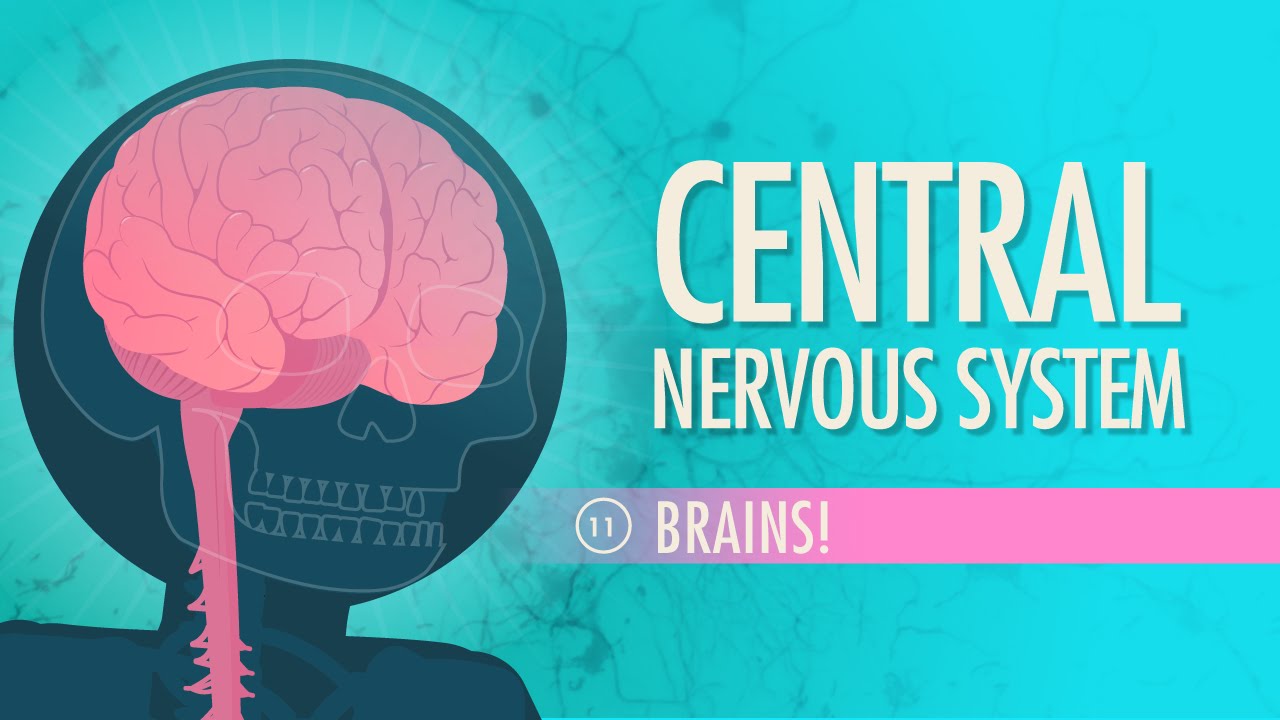
Today Hank talks about your central nervous system. In this episode, we'll explore how your brain develops and how important location is for each of your brain's many functions.
Pssst... we made flashcards to help you review the content in this episode! Find them on the free Crash Course App!
Download it here for Apple Devices: https://apple.co/3d4eyZo
Download it here for Android Devices: https://bit.ly/2SrDulJ
Chapters:
Introduction: Broca's Aphasia 00:00
Central Nervous System Structure & Function 1:48
Brain Development: Neural Tube 3:27
Brain Development: 3 Primary Vesicles 3:47
Brain Development: 5 Secondary Vesicles 4:04
Brain Development: Major Adult Brain Regions 4:18
Brain Development: Cerebellum & Brain Stem 4:42
Brain Development: Reptilian Brain 5:45
Brain Development: Cerebral Hemispheres 6:35
The Brain's Lobes 7:35
Review 9:14
Credits 9:48
***
Crash Course is on Patreon! You can support us directly by signing up at http://www.patreon.com/crashcourse
Want to find Crash Course elsewhere on the internet?
Facebook - http://www.facebook.com/YouTubeCrashCourse
Twitter - http://www.twitter.com/TheCrashCourse
Instagram - https://www.instagram.com/thecrashcourse/
CC Kids: http://www.youtube.com/crashcoursekids
***
Thank you so much to all of our awesome supporters for their contributions to help make Crash Course possible and freely available for everyone forever:
Creatrix Tiara
Dr. Sarah Hinzman
Caroline Haas
Mason R Norris
Alton Toth of Sechelt
Rodrigo Groppa
Sönke
Rebecca Karger
Gregle
Ariana Flewelling (@EdTechAri)
What is social deviance? Who defines what is deviant and how to people come to behave that way? Today we’re going to explore biological and psychological approaches to explaining deviance, including what each perspective can bring to the table, and their inherent limitations. From there, we’ll explain the sociological perspective and the social foundations of deviance.
Crash Course is made with Adobe Creative Cloud. Get a free trial here: https://www.adobe.com/creativecloud.html
***
Sunflower student movement in Taiwan by Artemas Liu https://www.flickr.com/photos/....48144725@N02/1376431 (CC BY 2.0)
***
Crash Course is on Patreon! You can support us directly by signing up at http://www.patreon.com/crashcourse
Thanks to the following Patrons for their generous monthly contributions that help keep Crash Course free for everyone forever:
Mark, Les Aker, Bob Kunz, mark austin, William McGraw, Jeffrey Thompson, Ruth Perez, Jason A Saslow, Shawn Arnold, Eric Prestemon, Malcolm Callis, Steve Marshall, Advait Shinde, Rachel Bright, Khaled El Shalakany, Ian Dundore, The Great Dionysus, Tim Curwick, Ken Penttinen, Dominic Dos Santos, Caleb Weeks, Kathrin Janßen, Nathan Taylor, Yana Leonor, Andrei Krishkevich, Brian Thomas Gossett, Chris Peters, Kathy & Tim Philip, Mayumi Maeda, Eric Kitchen, SR Foxley, Tom Trval, Andrea Bareis, Moritz Schmidt, Gianna Phelps, Jessica Wode, Daniel Baulig, Jirat
--
Want to find Crash Course elsewhere on the internet?
Facebook - http://www.facebook.com/YouTubeCrashCourse
Twitter - http://www.twitter.com/TheCrashCourse
Tumblr - http://thecrashcourse.tumblr.com
Support Crash Course on Patreon: http://patreon.com/crashcourse
CC Kids: http://www.youtube.com/crashcoursekids
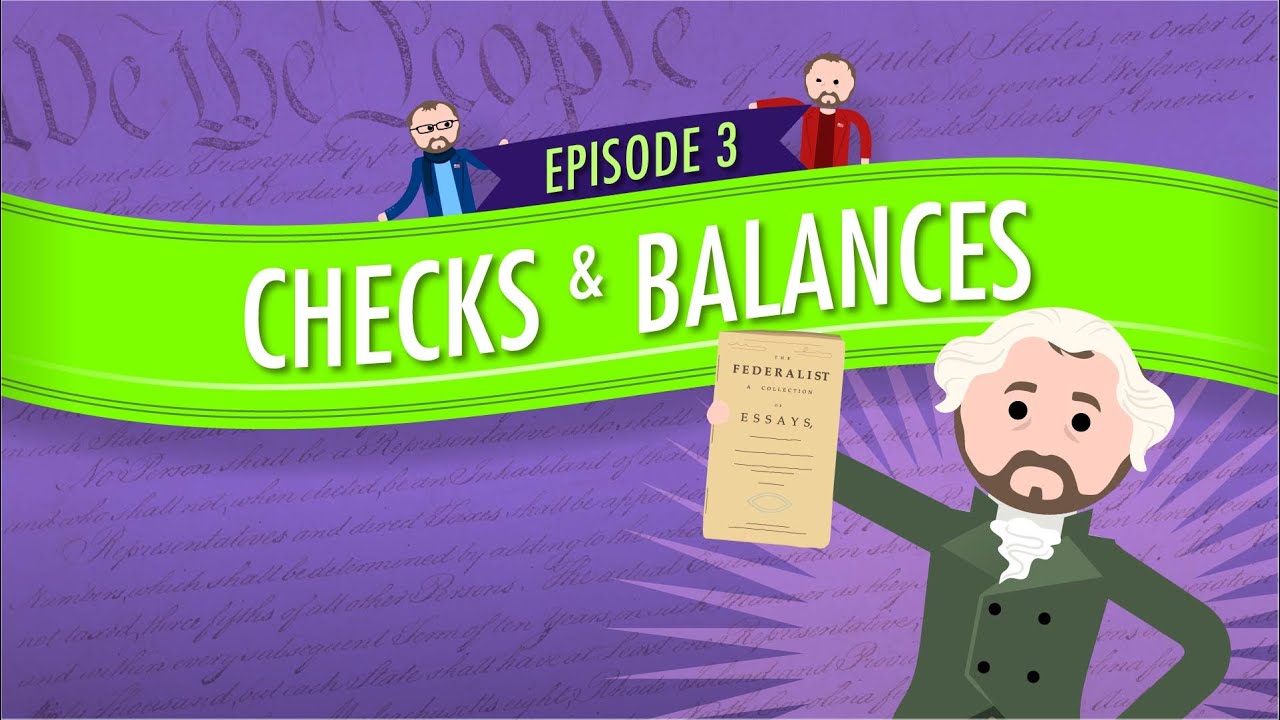
In which Craig Benzine teaches you about the US Governments Separation of powers and the system of checks and balances. In theory, the Legislative Branch, the Executive Branch, and the Judicial Brach are designed to keep each other in check and to keep any branch from becoming too powerful. In reality, the system was designed to keep the President from becoming some kind of autocrat. For the most part, it has worked. Craig will call in the clones to explain which powers belong to which branches and to reveal some secret perks that the Supreme Court justices enjoy.
Produced in collaboration with PBS Digital Studios: http://youtube.com/pbsdigitalstudios
Support is provided by Voqal: http://www.voqal.org
Chapters:
Introduction 00:00
Separation of Powers 0:25
Checks & Balances 2:28
Legislative Branch powers over the Executive Branch 2:58
Legislative Branch powers over the Judiciary Branch 3:39
Executive Branch powers over the Legislative Branch 4:37
Executive Branch powers over the Judiciary Branch 4:59
Judiciary Branch powers over the Legislative & Executive Branches 5:20
Why do we have checks & balances? 6:22
Credits 7:58
Crash Course is on Patreon! You can support us directly by signing up at http://www.patreon.com/crashcourse
Want to find Crash Course elsewhere on the internet?
Facebook - http://www.facebook.com/YouTubeCrashCourse
Twitter - http://www.twitter.com/TheCrashCourse
Instagram - https://www.instagram.com/thecrashcourse/
CC Kids: http://www.youtube.com/crashcoursekids

In order to understand the history of media literacy we have to go all the way back to straight up literacy. In the first half of our look at the history of media literacy, Jay takes us all the way back to Ancient Greece and forward through the printing press, newspapers, and Yellow Journalism.
***
Resources & References:
The Impact of the Printing Press http://courses.educ.ubc.ca/ete....c540/Sept04/arthurp/
Grandparents of Media Literacy https://www.grandparentsofmedi....aliteracy.com/grandp
Maine Explosion Caused by Bomb or Torpedo? https://digitalcollections.nyp....l.org/items/84ea964f
***
Crash Course is on Patreon! You can support us directly by signing up at http://www.patreon.com/crashcourse
Thanks to the following Patrons for their generous monthly contributions that help keep Crash Course free for everyone forever:
Mark Brouwer, Justin Zingsheim, Nickie Miskell Jr., Jessica Wode, Eric Prestemon, Kathrin Benoit, Tom Trval, Jason Saslow, Nathan Taylor, Divonne Holmes à Court, Brian Thomas Gossett, Khaled El Shalakany, Indika Siriwardena, Robert Kunz, SR Foxley, Sam Ferguson, Yasenia Cruz, Daniel Baulig, Eric Koslow, Caleb Weeks, Tim Curwick, Evren Türkmenoğlu, Alexander Tamas, D.A. Noe, Shawn Arnold, mark austin, Ruth Perez, Malcolm Callis, Ken Penttinen, Advait Shinde, Cody Carpenter, Annamaria Herrera, William McGraw, Bader AlGhamdi, Vaso, Melissa Briski, Joey Quek, Andrei Krishkevich, Rachel Bright, Alex S, Mayumi Maeda, Kathy & Tim Philip, Montather, Jirat, Eric Kitchen, Moritz Schmidt, Ian Dundore, Chris Peters,, Sandra Aft, Steve Marshall
--
Want to find Crash Course elsewhere on the internet?
Facebook - http://www.facebook.com/YouTubeCrashCourse
Twitter - http://www.twitter.com/TheCrashCourse
Tumblr - http://thecrashcourse.tumblr.com
Support Crash Course on Patreon: http://patreon.com/crashcourse
CC Kids: http://www.youtube.com/crashcoursekids

Did you know that centrifugal force isn't really a thing? I mean, it's a thing, it's just not real. In fact, physicists call it a "fictitious force." Mind blown yet? To explore this idea further, this week Shini sits down with us to discuss centripetal force, centrifugal force, and a few other bits of physics to help us understand uniform circular motion.
***
Produced in collaboration with PBS Digital Studios: http://youtube.com/pbsdigitalstudios
Crash Course is on Patreon! You can support us directly by signing up at http://www.patreon.com/crashcourse
Thanks to the following Patrons for their generous monthly contributions that help keep Crash Course free for everyone forever:
Mark, Eric Kitchen, Jessica Wode, Jeffrey Thompson, Steve Marshall, Moritz Schmidt, Robert Kunz, Tim Curwick, Jason A Saslow, SR Foxley, Elliot Beter, Jacob Ash, Christian, Jan Schmid, Jirat, Christy Huddleston, Daniel Baulig, Chris Peters, Anna-Ester Volozh, Ian Dundore, Caleb Weeks
--
Want to find Crash Course elsewhere on the internet?
Facebook - http://www.facebook.com/YouTubeCrashC...
Twitter - http://www.twitter.com/TheCrashCourse
Tumblr - http://thecrashcourse.tumblr.com
Support CrashCourse on Patreon: http://www.patreon.com/crashcourse
CC Kids: http://www.youtube.com/crashcoursekids

Gases are everywhere, and this is good news and bad news for chemists. The good news: when they are behaving themselves, it's extremely easy to describe their behavior theoretically, experimentally, and mathematically. The bad news is they almost never behave themselves.
In this episode of Crash Course Chemistry, Hank tells how the work of some amazing thinkers combined to produce the Ideal Gas Law, how none of those people were Robert Boyle, and how the ideal gas equation allows you to find out pressure, volume, temperature, or number of moles. You'll also get a quick introduction to a few jargon-y phrases to help you sound like you know what you're talking about.
Pssst... we made flashcards to help you review the content in this episode! Find them on the free Crash Course App!
Download it here for Apple Devices: https://apple.co/3d4eyZo
Download it here for Android Devices: https://bit.ly/2SrDulJ
Table of Contents
Ideal Gas Law Equation 0:50
Everyone But Robert Boyle 1:35
Ideal Gas Law to Figure Out Things 6:16
Jargon Fun Time 7:46
Crash Course is on Patreon! You can support us directly by signing up at http://www.patreon.com/crashcourse
Want to find Crash Course elsewhere on the internet?
Facebook - http://www.facebook.com/YouTubeCrashCourse
Twitter - http://www.twitter.com/TheCrashCourse
Instagram - https://www.instagram.com/thecrashcourse/
CC Kids: http://www.youtube.com/crashcoursekids

Today Hank wraps up our look at connective tissues with a discussion of their various types. Also chicken.
Pssst... we made flashcards to help you review the content in this episode! Find them on the free Crash Course App!
Download it here for Apple Devices: https://apple.co/3d4eyZo
Download it here for Android Devices: https://bit.ly/2SrDulJ
Chapters:
Introduction: We're All Just Meat 00:00
Loose vs. Dense Connective Tissue Proper 2:10
Types of Loose Tissue Proper: Areolar, Adipose, and Reticular 2:56
Types of Dense Tissue Proper: Regular, Irregular, and Elastic 4:04
Types of Cartilage: Hyaline, Elastic, and Fibro 5:24
Types of Osseous (Bone) Tissue: Spongy and Compact 6:33
Blood is a Connective Tissue 7:14
Review 8:51
Credits 9:47
Crash Course is on Patreon! You can support us directly by signing up at http://www.patreon.com/crashcourse
Want to find Crash Course elsewhere on the internet?
Facebook - http://www.facebook.com/YouTubeCrashCourse
Twitter - http://www.twitter.com/TheCrashCourse
Instagram - https://www.instagram.com/thecrashcourse/
CC Kids: http://www.youtube.com/crashcoursekids

This episode is sponsored by Audible. Try Audible: http://audible.com/crashcourse
Why is it hard to move a heavy bookcase across a carpeted floor? And why is it easier to keep it moving than it was to get it started moving? You might think it's all about weight, but actually it's about friction. Two kinds of friction! In today's episode of Crash Course Physics, Shini Somara tells us about Static and Kinetic friction; how they work and how they're different.
***
Produced in collaboration with PBS Digital Studios: http://youtube.com/pbsdigitalstudios
Crash Course is on Patreon! You can support us directly by signing up at http://www.patreon.com/crashcourse
Thanks to the following Patrons for their generous monthly contributions that help keep Crash Course free for everyone forever:
Mark, Eric Kitchen, Jessica Wode, Jeffrey Thompson, Steve Marshall, Moritz Schmidt, Robert Kunz, Tim Curwick, Jason A Saslow, SR Foxley, Elliot Beter, Jacob Ash, Christian, Jan Schmid, Jirat, Christy Huddleston, Daniel Baulig, Chris Peters, Anna-Ester Volozh, Ian Dundore, Caleb Weeks
--
Want to find Crash Course elsewhere on the internet?
Facebook - http://www.facebook.com/YouTubeCrashC...
Twitter - http://www.twitter.com/TheCrashCourse
Tumblr - http://thecrashcourse.tumblr.com
Support CrashCourse on Patreon: http://www.patreon.com/crashcourse
CC Kids: http://www.youtube.com/crashcoursekids

This week Craig Benzine talks about what happens when a case makes it to the Supreme Court of the United States (or the SCOTUS). We're going to focus on court procedure today. We talk about how to petition to get your case heard, how written arguments, or briefs, are made, what actually happens on the courtroom floor, and of course the variety of ways the SCOTUS issues opinions on cases.
Produced in collaboration with PBS Digital Studios: http://youtube.com/pbsdigitalstudios
Support is provided by Voqal: http://www.voqal.org
All Flickr.com images are licensed under Creative Commons by Attribution 2.0
https://creativecommons.org/li....censes/by/2.0/legalc
Want to find Crash Course elsewhere on the internet?
Facebook - http://www.facebook.com/YouTubeCrashCourse
Twitter - http://www.twitter.com/TheCrashCourse
Tumblr - http://thecrashcourse.tumblr.com
Support Crash Course on Patreon: http://patreon.com/crashcourse
CC Kids: http://www.youtube.com/crashcoursekids

Slave codes were a method of protecting the investment of white enslavers in the Colonies by restricting the lives of enslaved people in almost every imaginable way. The codes restricted enslaved people’s ability to move around, or engage in commerce that could make them financially independent - they restricted the opportunities that would allow them to live with even relative freedom. Today, we'll learn how Colonies put laws in place to restrict the movement and freedoms of enslaved people and free Black people.
VIDEO SOURCES
Ira Berlin, Many Thousands Gone: The First Two Centuries of Slavery in North America (Cambridge: Harvard University Press, 1998).
John Hope Franklin, From Slavery to Freedom: A History of Negro Americans (New York: Knopf, 1967).
Claude M. Steele, Whistling Vivaldi: How Stereotypes Affect Us and What We Can Do (Reprint Edition ed. 2011).
Black Codes and Slave Codes, Colonial, , Oxford African American Studies Center , http://oxfordaasc.com/view/10.....1093/acref/978019530
Peter H. Wood, Black Majority: Negroes in Colonial South Carolina from 1670 through the Stono Rebellion (New York: W.W. Norton, 1974).
Jennifer L. Morgan, Partus sequitur ventrem: Law, Race, and Reproduction in Colonial Slavery, 22 Small Axe: A Caribbean Journal of Criticism 1–17 (2018).
Watch our videos and review your learning with the Crash Course App!
Download here for Apple Devices: https://apple.co/3d4eyZo
Download here for Android Devices: https://bit.ly/2SrDulJ
Crash Course is on Patreon! You can support us directly by signing up at http://www.patreon.com/crashcourse
Check out Clint's book: https://bookshop.org/books/how....-the-word-is-passed-
Thanks to the following patrons for their generous monthly contributions that help keep Crash Course free for everyone forever:
Alexis B, Rene Duedam, Burt Humburg, Aziz, Nick, DAVID MORTON HUDSON, Perry Joyce, Scott Harrison, Mark & Susan Billian, Junrong Eric Zhu, Alan Bridgeman, Jennifer Smith, Matt Curls, Tim Kwist, Jonathan Zbikowski, Jennifer Killen, Sarah & Nathan Catchings, Brandon Westmoreland, team dorsey, Trevin Beattie, Eric Koslow, Indika Siriwardena, Khaled El Shalakany, Shawn Arnold, Siobhán, Ken Penttinen, Nathan Taylor, William McGraw, Laura Damon, Andrei Krishkevich, Sam Ferguson, Eric Prestemon, Jirat, Brian Thomas Gossett, Wai Jack Sin, Ian Dundore, Jason A Saslow, Justin, Jessica Wode, Mark, Caleb Weeks
__
VIDEO SOURCES
-Ira Berlin, Many Thousands Gone: The First Two Centuries of Slavery in North America (Cambridge: Harvard University Press, 1998).
-John Hope Franklin, From Slavery to Freedom: A History of Negro Americans (New York: Knopf, 1967).
-Claude M. Steele, Whistling Vivaldi: How Stereotypes Affect Us and What We Can Do (Reprint Edition ed. 2011).
-Black Codes and Slave Codes, Colonial, , Oxford African American Studies Center , http://oxfordaasc.com/view/10.....1093/acref/978019530
-Peter H. Wood, Black Majority: Negroes in Colonial South Carolina from 1670 through the Stono Rebellion (New York: W.W. Norton, 1974).
-Jennifer L. Morgan, Partus sequitur ventrem: Law, Race, and Reproduction in Colonial Slavery, 22 Small Axe: A Caribbean Journal of Criticism 1–17 (2018).
Want to find Crash Course elsewhere on the internet?
Facebook - http://www.facebook.com/YouTubeCrashCourse
Twitter - http://www.twitter.com/TheCrashCourse
Tumblr - http://thecrashcourse.tumblr.com
Support Crash Course on Patreon: http://patreon.com/crashcourse
CC Kids: http://www.youtube.com/crashcoursekids
#crashcourse #history #slavery
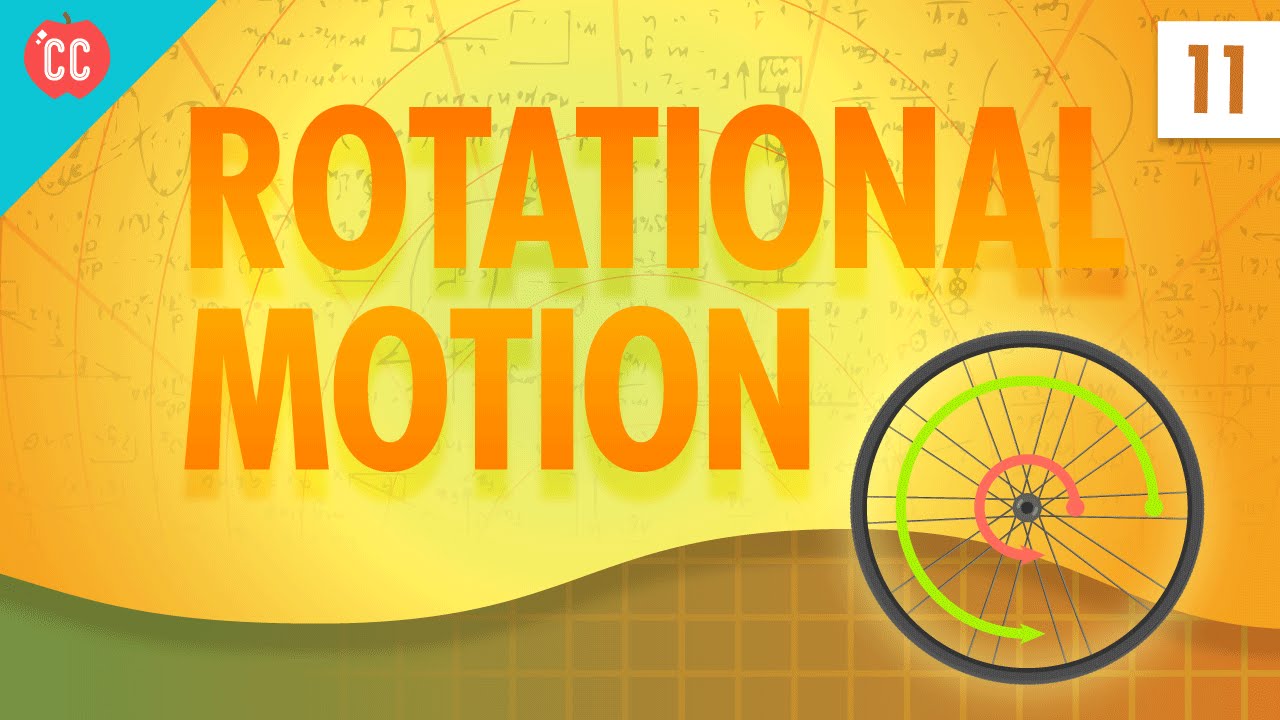
Did you know that at a certain point on a moving wheel... there's no motion? I mean, kinda... it's all relative, right? Prepare to have your mind blown in this episode of Crash Course Physics where Shini delves into the world of rotational motion!
--
Produced in collaboration with PBS Digital Studios: http://youtube.com/pbsdigitalstudios
--
Want to find Crash Course elsewhere on the internet?
Facebook - http://www.facebook.com/YouTubeCrashC...
Twitter - http://www.twitter.com/TheCrashCourse
Tumblr - http://thecrashcourse.tumblr.com
Support CrashCourse on Patreon: http://www.patreon.com/crashcourse
CC Kids: http://www.youtube.com/crashcoursekids

This week Craig breaks out the crystal ball to try and figure out why our congresspeople do the things that they do. We’ll talk about the three motivating factors of congressional decisions - constituency, interest groups, and political parties - and we’ll break down how each of these factors motivates certain actions like casework, public opinion polls, and logrolling. Craig will even weigh in on which of these factors probably contributes most significantly to the actions and decisions of our congresspersons and he'll do it without even a touch of cynicism!
Support is provided by Voqal: http://www.voqal.org
This episode is sponsored by Squarespace: http://www.squarespace.com/crashcourse
Chapters:
Introduction 00:00
How constituents & public opinion influence lawmakers 0:38
How interest groups influence lawmakers 2:01
How political parties influence lawmakers 3:07
Presidential power & political parties 4:20
Other influences on congressional decisions 5:20
Credits 6:05
Crash Course is on Patreon! You can support us directly by signing up at http://www.patreon.com/crashcourse
Want to find Crash Course elsewhere on the internet?
Facebook - http://www.facebook.com/YouTubeCrashCourse
Twitter - http://www.twitter.com/TheCrashCourse
Instagram - https://www.instagram.com/thecrashcourse/
CC Kids: http://www.youtube.com/crashcoursekids

In which Craig Benzine talks about the structure of the U.S. court system and how exactly it manages to keep things moving smoothly. You'll learn about trial courts, district courts, appeals courts, circuit courts, state supreme courts, and of course the one at the top - the U.S. Supreme Court. It’s all quite a bit to manage with jurisdictions and such, but it's important to remember that the vast majority of cases never even make it to court! Most are settled out of court, but also terms like mootness and ripeness are used to throw cases out altogether. Today, we're going to focus on how cases make it to the top, and next week we’ll talk about what happens when they get there.
Produced in collaboration with PBS Digital Studios: http://youtube.com/pbsdigitalstudios
Support is provided by Voqal: http://www.voqal.org
All Flickr.com images are licensed under Creative Commons by Attribution 2.0
https://creativecommons.org/li....censes/by/2.0/legalc
Crash Course is on Patreon! You can support us directly by signing up at http://www.patreon.com/crashcourse
Want to find Crash Course elsewhere on the internet?
Facebook - http://www.facebook.com/YouTubeCrashCourse
Twitter - http://www.twitter.com/TheCrashCourse
Instagram - https://www.instagram.com/thecrashcourse/
CC Kids: http://www.youtube.com/crashcoursekids

In which Craig Benzine teaches you about delegation and informal powers. What are all these federal agencies about? Well, the President has a lot of stuff to do as the chief executive, and as much as Americans like to talk about personal responsibility, the President can't really do all this stuff alone. Because it's a huge job! Same deal with Congress. So, they delegate authority. This is where all the government agencies and stuff come from. Congress creates them to actually get around to enforcing laws. You'll learn about stuff like OSHA, the FDA, and maybe even the FCC. Although you hear an occasional complaint about bureaucracies and such, the business of government wouldn't get done without agencies and delegation.
Support is provided by Voqal: http://www.voqal.org
This episode is sponsored by Squarespace: http://www.squarespace.com/crashcourse
Chapters:
Introduction: Delegation 00:00
What is delegation? 0:39
How Congress limits an agency's discretion 1:37
Why Congress delegates power 2:45
Congressionally delegated powers: key takeaways 4:37
Credits 5:44
Crash Course is on Patreon! You can support us directly by signing up at http://www.patreon.com/crashcourse
Want to find Crash Course elsewhere on the internet?
Facebook - http://www.facebook.com/YouTubeCrashCourse
Twitter - http://www.twitter.com/TheCrashCourse
Instagram - https://www.instagram.com/thecrashcourse/
CC Kids: http://www.youtube.com/crashcoursekids

Smile and Learn helps your kids to learn new vocabulary. This time, they'll learn about fruits. Always with an easy example for kids to identify each word with the correct fruit.
This video belongs to a collection of videos where kids will learn new words about several topics always in a fun and easy way with helpful examples that will boost them forward.
Thanks for visiting us! If you want your children to smile and learn, subscribe! :D
We only upload our own content, designed by educators so that children smile and learn while watching a video.
All of our content reinforces educational values, encouraging the use of multiple intelligences and language learning.
If you like our videos, download “The Smart Library” now. You’ll discover more than 70 interactive games and stories for children designed by educators. The stories are based on VALUES like friendship, respect, and generosity, and our games cover all of the MULTIPLE INTELLIGENCES. All our content is in SPANISH, ENGLISH, FRENCH, ITALIAN and PORTUGUESE.
The perfect tool to use in and out of school.
Download it today!
-Apple Store: https://itunes.apple.com/us/ap....p/smart-edutainment-
-Google Play: https://play.google.com/store/....apps/details?id=net.
www.smileandlearn.com
Thank you for trusting us with your children's education!

Educational video for children to learn about the human ear and understand how it works. They will also look at the parts of the ear. These are: the outer ear, the middle ear and the inner ear. Children will learn new words like auricle, auditory canal, eardrum, hammer, incus, stirrup, cochlea, and Eustachian tubes. Finally, they will learn how sound travels to enter the outer ear and how they can look after their ears with helpful hearing health tips. This video belongs to a collection of Science videos for children and is an excellent resource for elementary school.
Thanks for visiting us! If you want your children to smile and learn, subscribe! :D
We only upload our own content, designed by educators so that children smile and learn while watching a video.
All of our content reinforces educational values, encouraging the use of multiple intelligences and language learning.
If you like our videos, download Smile and Learn now. You’ll discover more than 5.000 activities for children aged 3 to 12 yeards, all designed by educators. We have 250 games and interactive stories and over 280 videos in five languages: English, Spanish, Portuguese, Italian and French. Try a month for free and start the adventure!