Top videos

In 2018 the kg will be defined by Planck's constant, not a hunk of metal.
Try a free book from Audible for 30 days http://ve42.co/audible
Special thanks to the staff at NIST who made this possible: Darine Haddad, Jon Pratt, Stephan Schlamminger, and Ben Stein.
Additional footage and animations by Sean Kelley, Jennifer Lauren Lee, and Frank Seifert.
I have been obsessed with measurement for a long time and I'm not sure quite how it happened. The world's roundest object played a role in this. I guess I'm just fascinated by how difficult it is to pin down a quantity like a kilogram. A physical object seemed like a good idea until the mass of the international prototype kilogram wasn't as constant as expected. These methods of the Kibble balance and silicon sphere have shown better precision than 20 parts per billion, making them superior to the old method. The agreement between Avogadro approaches
Special thanks to Patreon Supporters:
Tony Fadell, Donal Botkin, Jeff Straathof, Zach Mueller, Ron Neal, Nathan Hansen
Support Veritasium on Patreon: http://ve42.co/patreon
Interferometer video by TSG Physics: https://www.youtube.com/watch?v=j-u3IEgcTiQ
Music from http://epidemicsound.com "ExperiMental1" by Gunnar Johnsén
Studio filming by Raquel Nuno

Built for educators, trusted by students. Accurately detect AI-written content with GPTZero: https://gptzero.me/jubilee — Use code JUBILEE for 30% off any plan, for life.
Hey you 👈 Wanna be in a Jubilee video? https://bit.ly/be-in-a-video
LET’S BE FRIENDS
Instagram: https://www.instagram.com/jubileemedia/
TikTok: https://www.tiktok.com/@jubilee?lang=en
Website: https://www.jubileemedia.com
OUR LOVE + DATING CHANNEL 🍑
YouTube: https://www.youtube.com/@nectarcrush
Instagram: https://www.instagram.com/lovecommanectar
Nectar app: https://lovecommanectar.co/m/download-nectar
ARE YOU A BRAND? WANNA WORK WITH US?
Email partnerships@jubileemedia.com
LIKE EDITING VIDEOS?
Explore how our official partner OpusClip and OpusSearch can streamline your short-form post-production process today!
https://bit.ly/4iTscB7
FEATURING
Raymond: https://www.youtube.com/@Doctorrayk
Lily: https://www.instagram.com/lilyjiaang
Cristian:
https://www.youtube.com/@Cristianjulianchigbolu
https://www.instagram.com/st.laurentcristian
Kumari: https://www.instagram.com/kumieoomie
Michael: https://www.instagram.com/michaelamatoo
TIMECODES
00:00 Intro
00:43 College is no longer worth the cost of tuition
08:53 AI or Not? Text - 1
10:27 AI or Not? Text - 2
12:20 AI or Not? Text - 3
14:22 AI tools, like ChatGPT, are destroying students' abilities to think for themselves
26:04 College students today are lazier than past generations
34:16 The current education system prepares students for the future
43:13 Colleges don't care about student mental health

Sources & further reading: https://sites.google.com/view/sources-biorisk
This video was made possible through a grant by Open Philanthropy.
Check out the biorisk career guide from 80,000 hours:
https://80000hours.org/kurz-bio
Find the Map of Evolution and other fascinating infographic posters on the kurzgesagt shop here: kgs.link/shop-179
A breathtaking scientific revolution is taking place – biotechnology has been progressing at stunning speed, giving us the tools to eventually gain control over biology. On the one hand solving the deadliest diseases while also creating viruses more dangerous than nuclear bombs, able to devastate humanity.
What is going on?
OUR CHANNELS
▀▀▀▀▀▀▀▀▀▀▀▀▀▀▀▀▀▀▀▀▀▀▀▀▀▀
German: https://kgs.link/youtubeDE
Spanish: https://kgs.link/youtubeES
French: https://kgs.link/youtubeFR
Portuguese: https://kgs.link/youtubePT
Arabic: https://kgs.link/youtubeAR
Hindi: https://kgs.link/youtubeHI
Japanese: https://kgs.link/youtubeJA
Korean: https://kgs.link/youtubeKO
HOW CAN YOU SUPPORT US?
▀▀▀▀▀▀▀▀▀▀▀▀▀▀▀▀▀▀▀▀▀▀▀▀▀▀
This is how we make our living and it would be a pleasure if you support us!
Get Products designed with ❤ https://shop-us.kurzgesagt.org
Join the Patreon Bird Army 🐧 https://kgs.link/patreon
DISCUSSIONS & SOCIAL MEDIA
▀▀▀▀▀▀▀▀▀▀▀▀▀▀▀▀▀▀▀▀▀▀▀▀▀▀
TikTok: https://kgs.link/tiktok
Reddit: https://kgs.link/reddit
Instagram: https://kgs.link/instagram
Twitter: https://kgs.link/twitter
Facebook: https://kgs.link/facebook
Discord: https://kgs.link/discord
Newsletter: https://kgs.link/newsletter
OUR VOICE
▀▀▀▀▀▀▀▀▀▀▀▀▀▀▀▀▀▀▀▀▀▀▀▀▀▀
The Kurzgesagt voice is from
Steve Taylor: https://kgs.link/youtube-voice
OUR MUSIC ♬♪
▀▀▀▀▀▀▀▀▀▀▀▀▀▀▀▀▀▀▀▀▀▀▀▀▀▀
700+ minutes of Kurzgesagt Soundtracks by Epic Mountain:
Spotify: https://kgs.link/music-spotify
Soundcloud: https://kgs.link/music-soundcloud
Bandcamp: https://kgs.link/music-bandcamp
Youtube: https://kgs.link/music-youtube
Facebook: https://kgs.link/music-facebook
The Soundtrack of this video:
Soundcloud: https://bit.ly/3JDiwe8
Bandcamp: https://bit.ly/44bScjO
If you want to help us caption this video, please send subtitles to subtitle@kurzgesagt.org
You can find info on what subtitle files work on YouTube here:
https://support.google.com/youtube/answer/2734698?hl=en-GB&ref_topic=7296214
Thank you!
🐦🐧🐤 PATREON BIRD ARMY 🐤🐧🐦
▀▀▀▀▀▀▀▀▀▀▀▀▀▀▀▀▀▀▀▀▀▀▀▀▀▀
Many Thanks to our wonderful Patreons (from http://kgs.link/patreon) who support us every month and made this video possible:
Roi Chen, Luna, Enes Disli, Xavier O'Donoghue, Gordon Rutherford, Byron Arriola, Shahab Mosharraf, Oo Oo, Mateo, Johnathan Young, The Marshal Star, NikoFwuffyWolfderg, Zack, Sarah Kaiser, Blackilykat, Balázs Németh, Bladen Peters, Oliver, Kouroth, Daniel Lau, Annamaria Jauregui, Romain, Rues World, ouriel karmeli, Distant Monarch Spotify, Christopher Jones, dbchelpa, gummibeil, Philipp, 세환 박, Sebastian Colantoni, Jordan Williams, David Scott, Sven Bette, Patrick_NSK, Isaac Futures, Carlos Echenique, Florian Terber, Diogo, Nicolas Cassis, Tosnic, Jonathan VC, Jarod Appel, Djebz
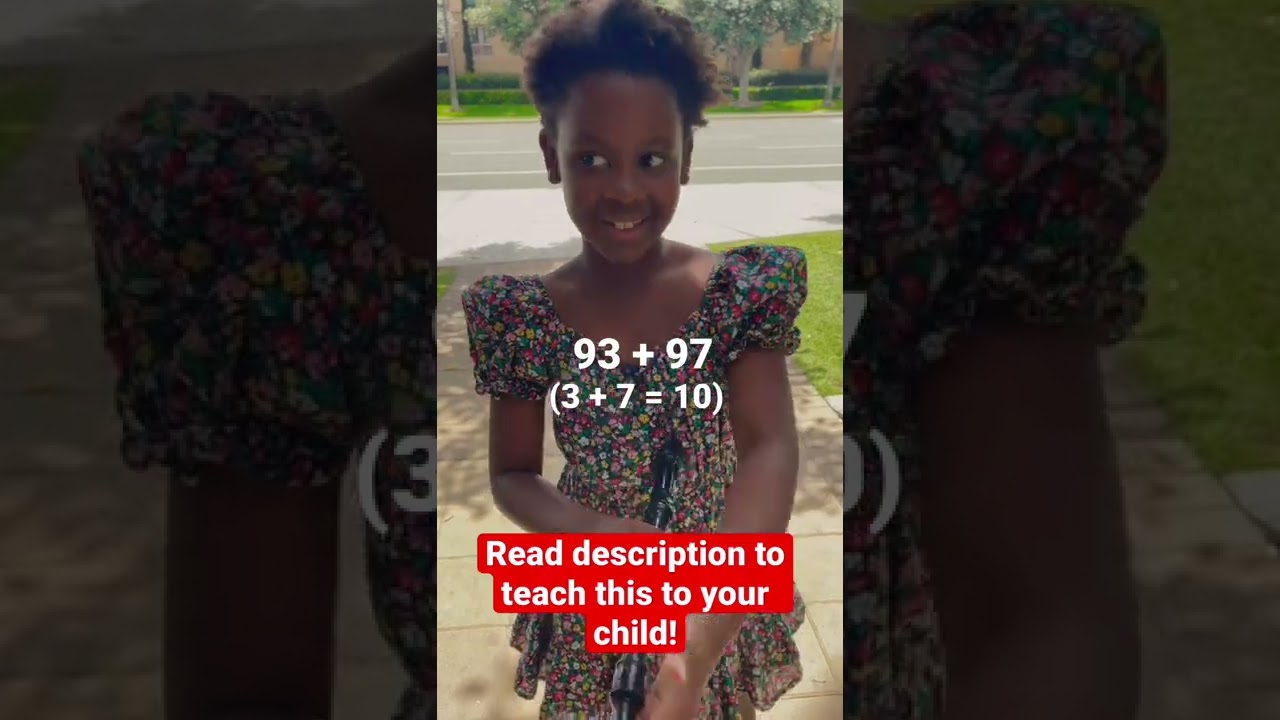
This was a trend on IG/TikTok, people would write out how they solved this problem. It shows that there are many ways to solve a math problem, but let me show you a faster way than stacking and adding.
This is an easy problem to teach children to group numbers to add faster.
You will start writing this out, and after practicing for a few days or weeks the child will be able to do it in their head. The top kids in the top countries for math can do this in a fraction of a second! It's always my goal to have our kids be competitive on a global scale while also having fun while learning.
Age level: any age
Prior Knowledge: The child should know common ways to make 10 ( 0+10, 1+9, 2+8, 3+7, 4+6). The child should know how to add multiples of 10 (For example 40 + 20 or 80 + 50).
93 + 97 = 190
Tell the child:
-- Is it easier to add 17 + 24 or 10 + 20? Why?
-- That's right, it's easy to add numbers that end with 0!
-- So we're always going to try to group numbers that make a 10.
-- Do you see any ways to make 10 in our problem?
-- 7 + 3 = 10
-- So now, let's rewrite our problem to make it easier to solve
-- I'm writing 90 + 90 + 10 [Write]
-- We took out the 7 and 3, and made a ten. [Point to the numbers as you say this]
-- Now, do you see any ways to make 100? [You may remind students that 100 is also "a ten"]
- That's right! We can add the 90 + 10 first, because we know that equals 100.
[Note: It's ok if the child wants to add 90 + 90 first! Whatever method is fastest for them]
- Now let's rewrite our problem again to make it easier to solve
- I'm writing 90 + 100
- Wow, it's so easy to add a number to 100! What's the answer?
- 190
Here are some other problems that you can practice with. Remember, it will be slow at first, and it's okay to use physical models.
12 + 48
33 + 67
55 + 15
81 + 49
Yes there's a lot of prior knowledge that goes into this! If this hits 2000 likes I'll make videos on those mini lessons.

For decades going to university was a sure step to a nice life, but today graduates are struggling. Are degrees still worth it, and which are the best subjects to study in the age of AI?
Video supported by @mishcondereya
00:00 - Is it still worth going to university?
00:20 - Are you more likely to be employed if you’re a graduate?
02:07 - Are people still applying to university?
03:05 - How will AI impact jobs?
04:06 - What should you study in the age of AI?
05:15 - The importance of work experience
Why today’s graduates are screwed: https://econ.st/4om6toq
Is your master’s degree useless?: https://econ.st/43bjYOF
Britain should let university tuition fees rise: https://econ.st/4q6IIBF
Does more education lead to less sex?: https://econ.st/4nOg5aE
Can AI replace junior workers?: https://econ.st/4h73H34
How AI is changing the office: https://econ.st/4n40eDR
Will AI make you stupid?: https://econ.st/4omz6B7
Why AI hasn’t taken your job: https://econ.st/4n6He7M
Listen: We don’t need no (AI) education: https://econ.st/47libZL
Sign up to our weekly newsletter: https://econ.st/3J0xzBr

#colour #interesting #quick #fast #games #play
💛👉🏻@learnfast101
-----------------------------------------------------------------------------------
💛Please SUBSCRIBE to our channel, LIKE, and SHARE to encourage us to share more useful and interesting knowledge.
💛歡迎訂閱我們的頻道、點讚、分享,鼓勵我們分享更多有用又有趣的知識。
-----------------------------------------------------------------------------------
Welcome to watch our videos 歡迎觀看我們所創作的其他影片
👉🏻1) Basic Conversation 會話 https://www.youtube.com/playli....st?list=PLPoPxSDq_eP
👉🏻2) Grammar 語法 https://www.youtube.com/playli....st?list=PLPoPxSDq_eP
👉🏻3)English Speaking https://www.youtube.com/playli....st?list=PLPoPxSDq_eP
👉🏻4)Funny Jokes 笑話 https://www.youtube.com/playli....st?list=PLPoPxSDq_eP
👉🏻5)Vocabulary 詞彙 https://www.youtube.com/playli....st?list=PLPoPxSDq_eP
👉🏻6)English Idioms 英語成語 https://www.youtube.com/playli....st?list=PLPoPxSDq_eP
👉🏻7)Revision Exercise 重温練習 https://www.youtube.com/playli....st?list=PLPoPxSDq_eP
👉🏻8)Fun Games 趣遊戲味 https://www.youtube.com/playli....st?list=PLPoPxSDq_eP
👉🏻9) Tongue Twister 繞口令 https://www.youtube.com/playli....st?list=PLPoPxSDq_eP
👉🏻10)Writing a composition 作文 https://www.youtube.com/playli....st?list=PLPoPxSDq_eP

#1minutevideo #englishfun #englishlearning #question #温習 #revision #學英文 #英語語法 #英語初學者 #刻意練習 #english
今天的短片,有5條關於食物的有趣問題,你答對了幾多題?
-----------------------------------------------------------------------------------
💛Please SUBSCRIBE to our channel, LIKE, and SHARE: @learnfast101
💛歡迎訂閱我們的頻道、點讚、分享: @learnfast101
-----------------------------------------------------------------------------------
Welcome to watch our videos 歡迎觀看我們所創作的其他影片
👉🏻1) Basic Conversation 會話 https://www.youtube.com/playli....st?list=PLPoPxSDq_eP
👉🏻2) Grammar 語法 https://www.youtube.com/playli....st?list=PLPoPxSDq_eP
👉🏻3)English Speaking https://www.youtube.com/playli....st?list=PLPoPxSDq_eP
👉🏻4)Funny Jokes 笑話 https://www.youtube.com/playli....st?list=PLPoPxSDq_eP
👉🏻5)Vocabulary 詞彙 https://www.youtube.com/playli....st?list=PLPoPxSDq_eP
👉🏻6)English Idioms 英語成語 https://www.youtube.com/playli....st?list=PLPoPxSDq_eP
👉🏻7)Revision Exercise 重温練習 https://www.youtube.com/playli....st?list=PLPoPxSDq_eP
👉🏻8)Fun Games 趣遊戲味 https://www.youtube.com/playli....st?list=PLPoPxSDq_eP
👉🏻9) Tongue Twister 繞口令 https://www.youtube.com/playli....st?list=PLPoPxSDq_eP
👉🏻10)Writing a composition 作文 https://www.youtube.com/playli....st?list=PLPoPxSDq_eP

-----------------------------------------------------------------------------------
Please SUBSCRIBE to our channel, LIKE, and SHARE to encourage us to share more useful and interesting knowledge.
請訂閱我們的頻道、點讚、分享,鼓勵我們分享更多有用又有趣的知識。
-----------------------------------------------------------------------------------
📍📍Welcome to watch our videos📍📍
歡迎觀看我們所創作的的其他影片
1)Basic Conversation 會話
https://www.youtube.com/playli....st?list=PLPoPxSDq_eP
2) Grammar 語法
https://www.youtube.com/playli....st?list=PLPoPxSDq_eP
3)English Speaking
https://www.youtube.com/playli....st?list=PLPoPxSDq_eP
4)Funny Jokes 笑話
https://www.youtube.com/playli....st?list=PLPoPxSDq_eP
5)Vocabulary 詞彙
https://www.youtube.com/playli....st?list=PLPoPxSDq_eP
6)English Idioms 英語成語
https://www.youtube.com/playli....st?list=PLPoPxSDq_eP
7)Revision Exercise 重温練習
https://www.youtube.com/playli....st?list=PLPoPxSDq_eP
8)Fun Games 趣遊戲味
https://www.youtube.com/playli....st?list=PLPoPxSDq_eP
9) Tongue Twister 繞口令
https://www.youtube.com/playli....st?list=PLPoPxSDq_eP
10)Writing a composition 作文
https://www.youtube.com/playli....st?list=PLPoPxSDq_eP

Class 11th math + IIT - JEE के कोर्स से संबंधित अधिक जानकारी के लिए 8059832705 पर Whatsapp करे.
Our Website :
https://www.mathkeeda.in/
Our App :
https://play.google.com/store/....apps/details?id=com.
Instagram :
https://www.instagram.com/mathkeeda/
Facebook page
https://www.facebook.com/mathkeeda
Email id
rohitmaths212@gmail.com
#Mathkeeda #Rohitsirmaths -----------------------------------------------------------------------------------
👉 Follow us on Instgram :
https://www.instagram.com/mathkeeda/
👉 Follow our Facebook Page :
https://www.facebook.com/mathkeeda.in

\ 免費下載 /
🔥《AI × 個人品牌變現藍圖》下載地址:https://aiteacherkong.kit.com/06a13a865c
\ 限時免費1對1咨詢 /
如果你對AI工具、AI提示詞、AI賦能自媒體賽道感興趣的話,可以預約一次和我的1對1電話咨詢,我會一次性解答你所有的疑問!
https://calendly.com/hey-teach....erkong123/meet-with-
本期涉及的提示詞:
https://www.notion.so/Notebook....lm-2ff417dc2c598069a
视频内容:
==================================
00:00 引言
01:32 Notebooklm基本操作
03:41 來源篩選
05:14 自定義設定筆記本
05:55 數據表格功能
07:14 視覺化圖表
08:06 動漫角色講解知識
10:43 生成簡報
11:44 生成測驗題
12:21 上傳大檔案
12:44 生成網站
14:01Gems調用Notebooklm
14:40 總結

Host Sarah Urist Green shares 40 reflections about art, gathered in the course of a career in art, art history, curating, and making videos about all of the above. And don't forget to check out Sound Field!: http://youtube.com/soundfieldpbs.
#art #arthistory #contemporaryart
Thanks to our Grandmasters of the Arts Vincent Apa, Josh Thomas, and Ernest Wolfe, and all of our patrons, especially Rich Clarey, Iain Eudaily, Frame Monster Design Laboratory, Patrick Hanna, Nichole Hicks, Andrew Huynh, Eve Leonard, David Moore, Gabriel Civita Ramirez, Constance Urist, Nicholas Xu, and Roberta Zaphiriou. To support our channel, visit: http://www.patreon.com/artassignment.
Subscribe for new episodes of The Art Assignment every other Thursday, and follow us elsewhere for the full Art Assignment experience:
Twitter: http://twitter.com/artassignment
Instagram: http://instagram.com/theartassignment/
Facebook group: https://www.facebook.com/group....s/artassignmentextra

In this video we will learn fraction based simplification . Here we will learn how to take lcm as well as convert mixed fraction into fraction also we learn addition of fraction.
Simplification Tricks | Fraction Based Simplification | Simplify Mixed Fraction | Simplifying
#simplify #simplifying #simplification
Please Follow Our Page 🙏
https://www.facebook.com/profile.php?id=100094580931485&mibextid=9R9pXO
Subscribe Our New Math Channel 👇👇👇
https://youtube.com/@mathmantr....a1?si=vbeiqOgSC-DVxz
Do not Forget to subscribe 👇👇👇
https://youtube.com/@mindyourc....hoices?si=mfePSALy4y
Some Important Videos Playlist🙂😀
Basic Maths for everyone
https://youtube.com/playlist?l....ist=PLGVkVrQm9bvYvgl
Trigonometry ( for class 10/11 )
https://youtube.com/playlist?l....ist=PLGVkVrQm9bvbmr9
Class 10 Optional Maths👇
https://www.youtube.com/playli....st?list=PLGVkVrQm9bv
Maths Formula Chapter wise👇
https://youtube.com/playlist?l....ist=PLGVkVrQm9bvalLp
Class 8 maths 👇
https://youtube.com/playlist?l....ist=PLGVkVrQm9bva2n6
Maths Puzzles || Math Reasoning 👇
https://youtube.com/playlist?l....ist=PLGVkVrQm9bvbkhC
Maths For all government exam 👇
https://youtube.com/playlist?l....ist=PLGVkVrQm9bvYvgl
त्रिकोणमिति से बनने वाले सभी सूत्र
https://youtu.be/qUrj09BEpt0
Trigonometry Table याद करने का सबसे आसान तरीका
https://youtu.be/iYdJJOHdZf4
Simple Interest Formula ( साधारण ब्याज )
https://youtu.be/-0GA7jTrpTo
Simplification ( सरलीकरण )
https://youtu.be/YNhbsNZ2PKc
https://youtu.be/N-0PW877yi4
https://youtu.be/HlJLBnP8vlg
https://youtu.be/pltDkukLyNs
This video is related with these topics 👇
simplify
simplifying
simplification
simplification tricks
basic simplification
bodmas
bodmas rules
bodmas rules in hindi
fraction
fraction based simplification
simplify mixed fraction
mindyourchoices
simplify
simplifying
simplification tricks
fraction tricks
fraction based simplification
fraction based simplify
mixed fraction
mixed fraction simplify
fraction simplification
based simplification tricks
fraction
simplifying mixed fraction
simplify fraction
simplify fractions
simplify mixed fraction
simplification for SSC CGL
simplification for competitive exams
how to simplify fraction
maths tricks

Thousands of parents and educators are turning to the kids’ learning app that makes real learning truly fun. Try Kids Academy with
3-day FREE TRIAL! https://bit.ly/2GuGyL2
US Local Government Departments | Water, Fire, Police, Sanitation Recreation & Transportation
If your kid is at that stage of his life when he should start learning about the government, what it does and what do the sectors in the government do then it is an undeniable fact that you first need to teach them about the different departments of the local government of the US.
For starters, the local government is divided into sectors and each sector is assigned a particular duty. For example, when we talk about the state and city governments, they are divided into different departments like the department of water, the department of fire, police, sanitation, recreation, and transportation.
Long story short, these departments take care of the basis on which a state or country runs.
Water Department: The water department is responsible for providing safe and clean water to drink, make food and bathe. Not only this, in fact, this department is also responsible to provide resources of water for emergency purposes like when there’s a fire somewhere.
Fire Department: The fire department is of course there to save people from fires and the destruction caused by it. For example, if a building is on fire, this department will be on alert.
Police: For controlling crime in a state and punishing thieves and looters etc, the police department is there to make sure that people are following the law.
Sanitation: This department is responsible for providing a healthy atmosphere for people. Keeping the roads clean, getting rid of all the debris and making sure that there’s little to no pollution around falls in their department.
Recreation Department: They take care of entertainment places like parks, beaches, and playgrounds, etc.
Transportation Department: They are the ones who look after the transportation systems of a state.
These are some of the major operating departments out there so make sure to teach your little one about all of these local government departments so that he knows how a state runs.
Subscribe to our channel: https://goo.gl/iG2Bdr
#TalentedAndGifted #LearnWithKidsAcademy
Kids Academy Talented and Gifted Program for kids aged 2-10:
*****
Connect with us on :
App Store: https://smart.link/59833db06a6b8
Google Play: https://smart.link/597210af6eb83
Our website: http://www.kidsacademy.mobi
Facebook: https://www.facebook.com/KidsAcademyC...
Twitter: https://twitter.com/KidsAcademyCo

In this video I'll show to you how to divide simple fractions and mixed fractions step by step.
#dividingfractions #TeacherTes #FilKoreanTV #Mathtutorials
Please watch also the other videos below.
Divisibility rules for 2,5 and 10
https://youtu.be/VRrvDasqIEo
Divisibility rules for 3, 6 and 9
https://youtu.be/Cj4VLhZ7584
Divisibility rules for 4, 8, 11 and 12
https://youtu.be/JiDdtnQxI1U
Divisibility Rule for 7
https://youtu.be/wAreAjCSqow
How to Solve Equations Involving Different Operations
https://youtu.be/jxgPerdbMaM
How to Find the Greatest Common Factor
https://youtu.be/aJD6I71vJcU
HOW TO ADD DECIMAL NUMBERS
https://youtu.be/RGGi7VVRb6I
HOW TO DIVIDE FRACTIONS
https://youtu.be/xi9-42YB8KQ
HOW TO MULTIPLY MIXED NUMBERS
https://youtu.be/lL8Rqmwt0kg
HOW TO ROUND OFF DECIMAL NUMBERS
https://youtu.be/7N9t4Q9takw
HOW TO READ AND WRITE DECIMAL NUMBERS
https://youtu.be/sKFlbr4-Z4o
How to Identify the Place value of decimal numbers
https://youtu.be/Hk_9MEI6V9M
How to Multiply Fractions
https://youtu.be/XcBK4kz5V50
How to change improper fractions to mixed numbers and mixed numbers to improper fractions
https://youtu.be/YiVFKEBkit4
Thank you so much for watching. Please subscribe to our channel.
God bless!
division of fractions and mixed numbers
division of fractions and mixed fractions
division of whole numbers and fractions
How to divide fractions
How to divide fractions step by step
How to find the quotient of fractions
How to get the quotient of fractions
What are the process in dividing fractions
What are the steps in dividing fractions
What are the step by step process in dividing fractions
how to divide whole numbers and fractions
how to divide whole numbers and mixed numbers
how to divide whole number by a fraction
how to divide mixed numbers and whole numbers
how to divide mixed number by a whole number
how to divide mixed numbers and fractions
how to divide mixed number by a fraction
how to divide mixed numbers
how to divide mixed number by a mixed number
how to divide fractions with whole numbers
how to divide mixed fractions
how to divide mixed fractions with whole numbers
how to divide mixed fractions by fractions
how to divide mixed
how to divide mixed fractions with same denominators
how to divide mixed numbers with unlike denominators
how to divide mixed numbers with proper fractions
how to divide mixed numbers with different denominators
how to divide mixed numbers by whole numbers
how to divide whole numbers by fractions
how to divide whole numbers by mixed numbers
how to divide whole numbers by mixed fractions
how to divide whole numbers into fractions
how to divide whole numbers by improper fractions
how to divide whole numbers by unit fractions
dividing simple fractions and mixed numbers tagalog
dividing simple fractions and mixed fractions tagalog
dividing simple fractions and mixed numbers tagalog version
dividing simple fractions and mixed numbers tagalog grade 6 module 5
dividing simple fractions and mixed numbers grade 6
dividing simple fractions and mixed fractions grade 6
dividing simple fractions and mixed fractions
dividing simple fraction and mixed number
dividing simple fractions by another simple fractions
how to divide fractions with mixed numbers
how to divide fractions with whole numbers
how to divide fractions then simplify
how to divide fractions to lowest terms
dividing simple fractions
dividing simple and mixed numbers
dividing simple fractions and whole numbers
dividing simple fraction whole number by fraction and vice versa
dividing simple fractions tagalog
paano magdivide ng fraction
paano magdivide ng fraction tagalog
dividing rational numbers
how to divide rational numbers
rational numbers
Thousands of parents and educators are turning to the kids’ learning app that makes real learning truly fun. Try Kids Academy with
3-day FREE TRIAL! https://bit.ly/2GuGyL2
Verb or Noun - Basic English Grammar
Is it a verb or a noun? Knowing the parts of speech is important for constructing meaningful and articulate sentences. Help your child understand two of the most important and common parts of speech with the guidance of an enlightening educator with this quick video tutorial!
Watching this video offers your child:
• Guided practice as a teacher walks your child through each sentence
• Engaging explanation of verbs and nouns
Watch as your child builds confidence working through sentences to identify the parts of speech! Your little learner will understand and apply his or her new knowledge of verbs and nouns in no time with their own personal “guide on the side” using this short and engaging video from Kids Academy!
#TalentedAndGifted #LearnWithKidsAcademy
Kids Academy Talented and Gifted Program for kids aged 2-10:
App Store: https://smart.link/59833db06a6b8
Google Play: https://smart.link/597210af6eb83
*****
Subscribe to our channel: https://goo.gl/iG2Bdr
Connect with us on :
Our site: https://www.kidsacademy.mobi/
Facebook: https://www.facebook.com/KidsAcademyCompany
Twitter: https://twitter.com/KidsAcademyCo

PBS Member Stations rely on viewers like you. To support your local station, go to: http://to.pbs.org/DonateOKAY
↓ More info and sources below ↓
I HAVE A PATREON NOW!! Join the community ►► https://www.patreon.com/itsokaytobesmart
SUBSCRIBE so you don’t miss a video! ►► http://bit.ly/iotbs_sub
It sounds like such an incredible fact. “Our own cells are outnumbered by our microbes 10 to 1!” I don’t remember where I first heard it. But I read it in science papers and articles by journalists, so I believed it without question. I even made one of my first videos based on this fact. Problem is, this fact is not true. So how did it remain firmly planted in our common knowledge for almost four decades without any scientific scrutiny? And how can you prepare yourself to not be fooled by other scientific urban legends? I look at a few of the most famous incorrect factoids in science, and give a few suggestions for how to make our common knowledge more correct.
References: https://sites.google.com/view/....7-scientific-urban-l
Please do not watch this old video, it is wrong and my hair is awful: https://www.youtube.com/watch?v=4BZME8H7-KU
-----------
Join us on Patreon!
URL
Twitter
http://www.twitter.com/DrJoeHanson
http://www.twitter.com/okaytobesmart
Instagram
http://www.instagram.com/DrJoeHanson
http://www.instagram.com/okaytobesmart
Merch
https://store.dftba.com/collec....tions/its-okay-to-be
Facebook
https://www.facebook.com/itsokaytobesmart
Books from our episodes:
http://smart-books.tumblr.com/

This organic chemistry video tutorial provides a basic introduction into naming organic compounds. It explains how to write the IUPAC nomenclature of alkanes. It covers the basic iupac rules such as numbering and writing the substituents in alphabetical order. It explains the importance of identifying the parent chain or the longest carbon chain as well as identifying the parent chain with highest number of substituents.
Access The Full 42 Minute Video:
https://www.patreon.com/MathScienceTutor
Direct Link to The Full Video:
https://bit.ly/3GURyOl
Organic Chemistry PDF Worksheets:
https://www.video-tutor.net/orgo-chem.html
_______________________________________
Join The YouTube Membership Program:
https://bit.ly/46xaQTR
Full 42 Minute Video on YouTube:
https://www.youtube.com/watch?v=tqn1drpHh4c

Thank you to Bill and Melinda Gates for supporting PBS Digital Studios. If you’d like to take a look at the 2018 Annual Letter, you can check it out here http://b-gat.es/2Cfph0j
↓↓↓ More info and sources below ↓↓↓
Don’t miss our next video! SUBSCRIBE! ►► http://bit.ly/iotbs_sub
Is overpopulation real? Is Earth filling up with too many humans? How many people can Earth hold, anyway? As our species approaches 8 billion, human overpopulation is a major concern for many people. How can we reduce poverty and our impact on the environment? Do we need a forced one-child policy or something? Maybe not, because when we look at the science and history, populations seem to control themselves. This week we look at all these questions and more.
READ MORE:
https://ourworldindata.org
https://www.sciencemag.org/sit....e/special/population
http://science.sciencemag.org/content/346/6206/234
https://www.scientificamerican.....com/article/are-mal
-----------
FOLLOW US:
Merch: https://store.dftba.com/collec....tions/its-okay-to-be
Facebook: http://www.facebook.com/itsokaytobesmart
Twitter:@DrJoeHanson @okaytobesmart
Tumblr: http://www.itsokaytobesmart.com
Instagram: @DrJoeHanson
-----------
It’s Okay To Be Smart is hosted by Joe Hanson, Ph.D.
Director: Joe Nicolosi
Writer: Joe Hanson, Ph.D.
Creative Director: David Schulte
Editor/animator: Karl Boettcher
Producer: Stephanie Noone and Amanda Fox
Produced by PBS Digital Studios
Music via APM
Stock images from Shutterstock http://www.shutterstock.com

Educational video for children to learn how the human eye works and its parts: the lacrimal gland, the eyelid, the eyelashes, the eyebrows, the cornea, the iris, the retina, the lens and the optical nerve. Children will learn a lot of new vocabulary and will understand how our eyes collect information from the world around us and send it to the brain which interprets it. Let's learn how senses work!
Thanks for visiting us! If you want your children to smile and learn, subscribe! :D
We only upload our own content, designed by educators so that children smile and learn while watching a video.
All of our content reinforces educational values, encouraging the use of multiple intelligences and language learning.
If you like our videos, download Smile and Learn now. You’ll discover more than 5.000 activities for children aged 3 to 12 years, all designed by educators. We have 250 games and interactive stories and over 280 videos in five languages: English, Spanish, Portuguese, Italian and French. Try a month for free and start the adventure!

Welcome to Dividing Mixed Numbers with Mr. J! Need help with how to divide mixed numbers? You're in the right place!
Whether you're just starting out, or need a quick refresher, this is the video for you if you're looking for how to divide mixed numbers. Mr. J will go through dividing mixed numbers examples and explain the dividing mixed numbers steps.
About Math with Mr. J: This channel offers instructional videos that are directly aligned with math standards. Teachers, parents/guardians, and students from around the world have used this channel to help with math content in many different ways. All material is absolutely free.
Click Here to Subscribe to the Greatest Math Channel On Earth: https://goo.gl/XHTrfY
Follow Mr. J on Twitter: @MrJMath5
Email: math5.mrj@gmail.com
Music: https://www.bensound.com/royalty-free-music
Hopefully this video is what you're looking for when it comes to dividing mixed numbers.
Have a great rest of your day and thanks again for watching!