سرفہرست ویڈیوز
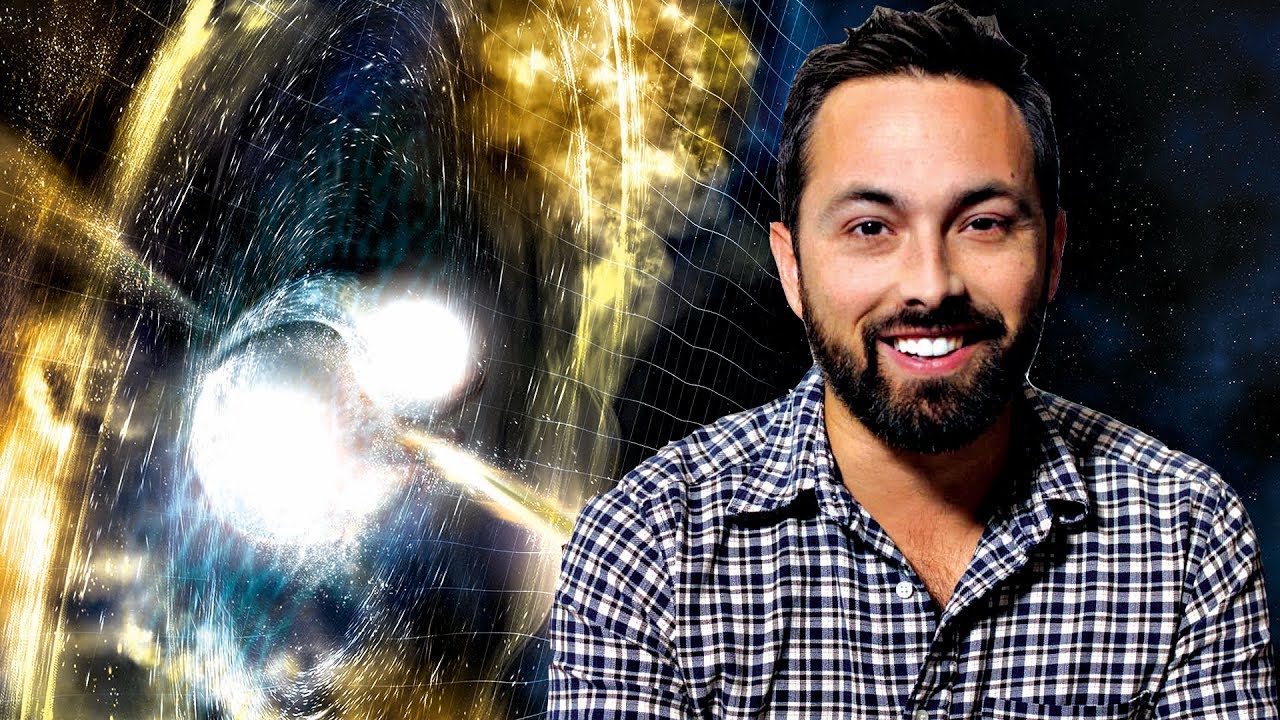
The merging of two neutron stars was detected by gravitational waves and then by telescopes in all parts of the electromagnetic spectrum. This is a historic detection as it demonstrates:
- the first gravitational waves detected from inspiraling neutron stars
- the first joint observation by gravitational wave and electromagnetic wave astronomy
- identification of a gamma ray burst in conjunction with merging neutron stars
- how gravitational waves and gamma rays can be used together to locate their source
All evidence so far indicates that the data support General Relativity.
Special thanks to Patreon supporters:
Tony Fadell, Donal Botkin, Curational, Jeff Straathof, Zach Mueller, Ron Neal, Nathan Hansen, Corvi
Support Veritasium on Patreon: http://ve42.co/patreon
Graphics from:
Jets and Debris from a Neutron Star Collision
This animation captures phenomena observed over the course of nine days following the neutron star merger known as GW170817. They include gravitational waves (pale arcs); a near-light-speed jet that produced gamma rays (magenta); expanding debris from a "kilonova" that produced ultraviolet (violet), optical and infrared (blue-white to red) emission; and, once the jet directed toward us expanded into our view from Earth, X-rays (blue).
Credit: NASA's Goddard Space Flight Center/CI Lab
Virgo Helps Localize Gravitational-Wave Signals
Sky localizations of gravitational-wave signals detected by LIGO beginning in 2015 (GW150914, LVT151012, GW151226, GW170104), and, more recently, by the LIGO-Virgo network (GW170814, GW170817). After Virgo came online in August 2017, scientists were better able to localize the gravitational-wave signals. The background is an optical image of the Milky Way. The localizations of GW150914, LVT151012, and GW170104 wrap around the celestial sphere, so the sky map is shown with a translucent dome.
Credit: LIGO/Virgo/NASA/Leo Singer (Milky Way image: Axel Mellinger)
Variety of Gravitational Waves and a Chirp
The signal measured by LIGO and Virgo from the neutron star merger GW170817 is compared here to previously detected binary black hole mergers. All signals are shown starting at 30 Hertz, and the progression of GW170817 is shown in real time, accompanied by its conversion to audio heard at the end of the movie. GW170817 was observable for more than 30 times longer than any previous gravitational-wave signal.
Credit: LIGO/University of Oregon/Ben Farr
LIGO is funded by the NSF, and operated by Caltech and MIT, which conceived of LIGO and led the Initial and Advanced LIGO projects. Financial support for the Advanced LIGO project was led by the NSF with Germany (Max Planck Society), the U.K. (Science and Technology Facilities Council) and Australia (Australian Research Council) making significant commitments and contributions to the project.
More than 1,200 scientists and some 100 institutions from around the world participate in the effort through the LIGO Scientific Collaboration, which includes the GEO Collaboration and the Australian collaboration OzGrav. Additional partners are listed at http://ligo.org/partners.php
The Virgo collaboration consists of more than 280 physicists and engineers belonging to 20 different European research groups: six from Centre National de la Recherche Scientifique (CNRS) in France; eight from the Istituto Nazionale di Fisica Nucleare (INFN) in Italy; two in the Netherlands with Nikhef; the MTA Wigner RCP in Hungary; the POLGRAW group in Poland; Spain with the University of Valencia; and the European Gravitational Observatory, EGO, the laboratory hosting the Virgo detector near Pisa in Italy, funded by CNRS, INFN, and Nikhef.

This video is sponsored by Brilliant. The first 200 people to sign up via https://brilliant.org/veritasium get 20% off a yearly subscription.
Special thanks to:
Bruce Sherwood, Ruth Chabay, Aaron Titus, and Steve Spicklemore
https://matterandinteractions.org
VPython simulation: http://tinyurl.com/SurfaceCharge
Thanks to Ansys for help with the simulations: https://www.ansys.com/products..../electronics/ansys-h
Huge thanks to Richard Abbott from Caltech for all his modeling
Electrical Engineering YouTubers:
Electroboom: https://www.youtube.com/c/Electroboom
Alpha Phoenix: https://www.youtube.com/c/AlphaPhoenixChannel
eevblog: https://www.youtube.com/c/EevblogDave
Ben Watson: https://www.youtube.com/channe....l/UCgZUVIEtBnnBpFWJu
Big Clive: https://www.youtube.com/c/Bigclive
Z Y: https://www.youtube.com/user/ZongyiYang
NYU Quantum Technology Lab
https://www.youtube.com/channe....l/UCk7io8SN3ZwKvkpnM
Dr. Ben Miles
https://www.youtube.com/channe....l/UCUeZBocfxALSUdOgN
Further analysis of the large circuit is available here: https://ve42.co/bigcircuit
Special thanks to Dr Geraint Lewis for bringing up this question in the first place and discussing it with us. Check out his and Dr Chris Ferrie’s new book here: https://ve42.co/Universe2021
▀▀▀
References:
A great video about the Poynting vector by the Science Asylum: https://youtu.be/C7tQJ42nGno
Sefton, I. M. (2002). Understanding electricity and circuits: What the text books don’t tell you. In Science Teachers’ Workshop. -- https://ve42.co/Sefton
Feynman, R. P., Leighton, R. B., & Sands, M. (1965). The feynman lectures on physics; vol. Ii, chapter 27. American Journal of Physics, 33(9), 750-752. -- https://ve42.co/Feynman27
Hunt, B. J. (2005). The Maxwellians. Cornell University Press.
Müller, R. (2012). A semiquantitative treatment of surface charges in DC circuits. American Journal of Physics, 80(9), 782-788. -- https://ve42.co/Muller2012
Galili, I., & Goihbarg, E. (2005). Energy transfer in electrical circuits: A qualitative account. American journal of physics, 73(2), 141-144. -- https://ve42.co/Galili2004
Deno, D. W. (1976). Transmission line fields. IEEE Transactions on Power Apparatus and Systems, 95(5), 1600-1611. -- https://ve42.co/Deno76
▀▀▀
Special thanks to Patreon supporters: Inconcision, Kelly Snook, TTST, Ross McCawley, Balkrishna Heroor, Chris LaClair, Avi Yashchin, John H. Austin, Jr., OnlineBookClub.org, Dmitry Kuzmichev, Matthew Gonzalez, Eric Sexton, john kiehl, Anton Ragin, Diffbot, Micah Mangione, MJP, Gnare, Dave Kircher, Burt Humburg, Blake Byers, Dumky, Evgeny Skvortsov, Meekay, Bill Linder, Paul Peijzel, Josh Hibschman, Mac Malkawi, Michael Schneider, jim buckmaster, Juan Benet, Ruslan Khroma, Robert Blum, Richard Sundvall, Lee Redden, Vincent, Stephen Wilcox, Marinus Kuivenhoven, Clayton Greenwell, Michael Krugman, Cy 'kkm' K'Nelson, Sam Lutfi, Ron Neal
▀▀▀
Written by Derek Muller
Edited by Derek Muller
Filmed by Trenton Oliver and Petr Lebedev
Animation by Mike Radjabov and Ivy Tello
Additional video/photos supplied by Getty Images
Music from Epidemic Sound and Jonny Hyman
Thumbnail by Ignat Berbeci
Produced by Derek Muller, Petr Lebedev, and Emily Zhang

Have your voice heard at the UN Climate Summit in NYC, September 23: http://bit.ly/WhyNotVe
Interview filming by Chris Cassella: http://bit.ly/ScienceAlertVe

A planet has been predicted to orbit the sun with a period of 10,000 years, a mass 5x that of Earth on a highly elliptical and inclined orbit. What evidence supports the existence of such a strange object at the edge of our solar system?
Huge thanks to:
Prof. Konstantin Batygin, Caltech
Prof. David Jewitt, UCLA
I had heard about Planet 9 for a long time but I wondered what sort of evidence could support the bold claim: a planet at the very limits of our ability to detect one, so far out that its period is over 60 times that of Neptune. The planet 9 hypothesis helps explain clustering of orbits of distant Kuiper belt objects. It also explains how some of these objects have highly inclined orbits - up to 90 degrees relative to the plane of the solar system. Some are orbiting in reverse. Plus their orbits are removed from the orbit of Neptune, the logical option for a body that could have ejected them out so far. The fact that the perihelion is so far out suggests another source of gravity was essential for their peculiar orbits.
Special Thanks to Patreon Supporters:
Alfred Wallace, Arjun Chakroborty, Bryan Baker, Chris Vargas, Chuck Lauer Vose, DALE HORNE, Donal Botkin, Eric Velazquez, halyoav, James Knight, Jasper Xin, Joar Wandborg, Kevin Beavers, kkm, Leah Howard, Lyvann Ferrusca, Michael Krugman, Mohammed Al Sahaf, Noel Braganza, Pindex, Ron Neal, Sam Lutfi, Stan Presolski, Tige Thorman
Music from http://epidemicsound.com "Observations - From Now On" "Magnified XY"

How were the first computers made? Head to https://brilliant.org/veritasium to start your free 30-day trial, and the first 200 people get 20% off an annual premium subscription.
A huge thanks to David Lovett for showing me his awesome relay and vacuum tube based computers. Check out his YouTube channel @UsagiElectric
▀▀▀
References:
Herring, C., & Nichols, M. H. (1949). Thermionic emission. Reviews of modern physics, 21(2), 185. – https://ve42.co/Herring1949
Goldstine, H. H., & Goldstine, A. (1946). The electronic numerical integrator and computer (eniac). Mathematical Tables and Other Aids to Computation, 2(15), 97-110. – https://ve42.co/ENIAC
Shannon, C. E. (1938). A symbolic analysis of relay and switching circuits. Electrical Engineering, 57(12), 713-723. – https://ve42.co/Shannon38
Boole, G. (1847). The mathematical analysis of logic. Philosophical Library. – https://ve42.co/Boole1847
The world’s first general purpose computer turns 75 – https://ve42.co/ENIAC2
Dylla, H. F., & Corneliussen, S. T. (2005). John Ambrose Fleming and the beginning of electronics. Journal of Vacuum Science & Technology A: Vacuum, Surfaces, and Films, 23(4), 1244-1251. – https://ve42.co/Dylla2005
Stibitz, G. R. (1980). Early computers. In A History of Computing in the Twentieth Century (pp. 479-483). Academic Press.
ENIAC’s Hydrogen Bomb Calculations – https://ve42.co/ENIAC3
▀▀▀
Special thanks to our Patreon supporters:
Emil Abu Milad, Tj Steyn, meg noah, Bernard McGee, KeyWestr, Amadeo Bee, TTST, Balkrishna Heroor, John H. Austin, Jr., john kiehl, Anton Ragin, Benedikt Heinen, Diffbot, Gnare, Dave Kircher, Burt Humburg, Blake Byers, Evgeny Skvortsov, Meekay, Bill Linder, Paul Peijzel, Josh Hibschman, Mac Malkawi, Juan Benet, Ubiquity Ventures, Richard Sundvall, Lee Redden, Stephen Wilcox, Marinus Kuivenhoven, Michael Krugman, Cy ‘kkm’ K’Nelson, Sam Lutfi.
▀▀▀
Written by Petr Lebedev, Derek Muller and Kovi Rose
Edited by Trenton Oliver
Animated by Mike Radjabov, Ivy Tello and Fabio Albertelli
Filmed by Derek Muller & Raquel Nuno
Additional video/photos supplied by Getty Images & Pond5
Music from Epidemic Sound
Produced by Derek Muller, Petr Lebedev, & Emily Zhang
Thumbnail by Ignat Berbeci

Force is a central concept in physics. By analysing the forces on an object, its resulting motion can be determined. But what exactly is a force? The word force is used in everyday language in a variety of contexts, only some of which reflect the scientific definition of force. In this video, people at Victoria Park in Sydney are interviewed on their ideas of force and the forces that act on them.

Panem finds power in the radiance of the sun, and the water which rains down upon us! District 5’s Chief Energy Researcher Derek Muller takes CapitolTV on a tour of our nation's cutting edge renewable technologies, and demonstrates one of the largest ‘Kelvin’s Thunderstorm’ experiments ever built to date… all for a brighter and more efficient Panem.
Sanctioned by the Capitol Ministry of Information, DISTRICT VOICES was made with friends from Google - http://artcopycode.com/campaign/lionsgate
For more of Panem’s finest programming, and to register for updates, visit http://CapitolTV.pn
#CapitolTV - #DistrictVoices
The Hunger Games: Mockingjay Part 1 – In theaters November 21
http://TheHungerGamesExplorer.com
#Mockingjay
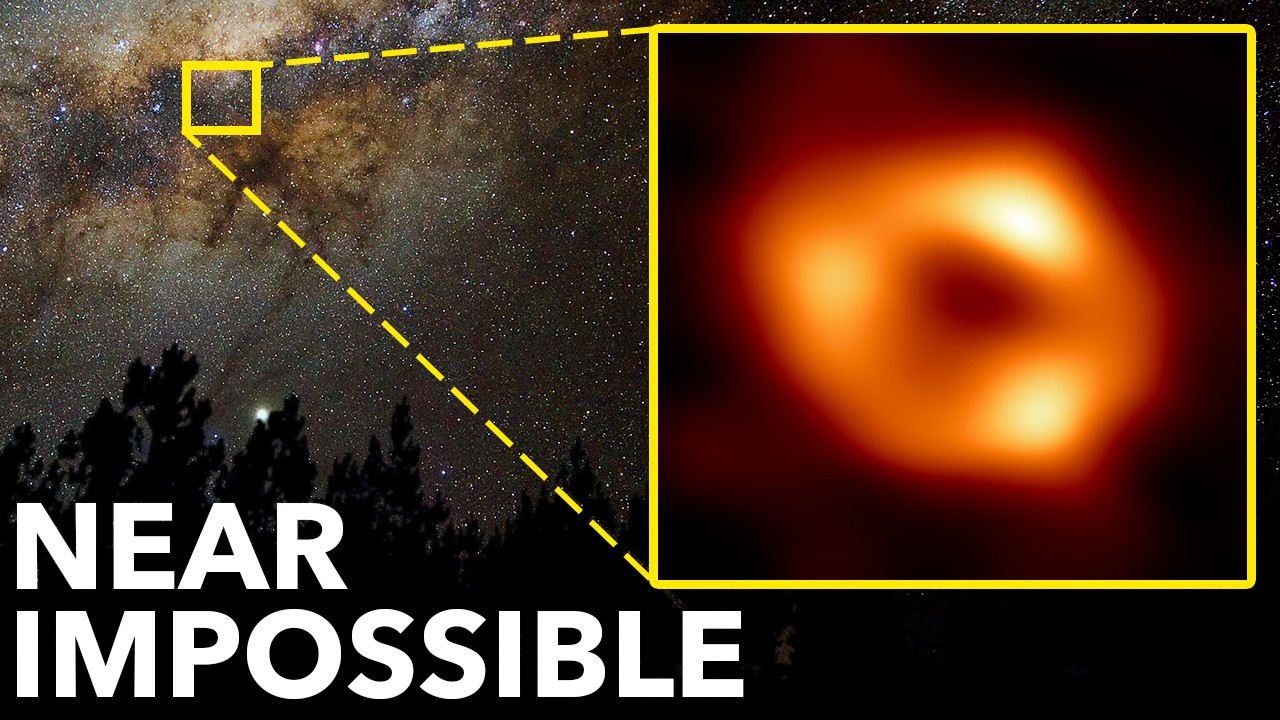
This is an image of the supermassive black hole, Sagittarius A*, at the center of our Milky Way galaxy.
Visit https://www.kiwico.com/veritasium30 to get 30% off your first month of any crate!
▀▀▀
Image of Sgr A* from EHT collaboration
Event Horizon Telescope collaboration: https://ve42.co/EHT
Animations from The Relativistic Astrophysics group, Institute for Theoretical Physics, Goethe-Universität Frankfurt. Massive thanks to Prof. Luciano Rezzolla, Dr Christian Fromm and Dr Alejandro Cruz-Osorio.
A huge thanks to Prof. Peter Tuthill and Dr Manisha Caleb for feedback on earlier versions of this video and helping explain VLBI.
Great video by Thatcher Chamberlin about VLBI here – https://youtu.be/Y8rAHTvpJbk
Animations and simulations with English text:
L. R. Weih & L. Rezzolla (Goethe University Frankfurt)
https://youtu.be/jvftAadCFRI
Video of stars going around Sgr A* from European Southern Observatory
https://www.eso.org/public/videos/eso1825e/
Video zooming into the center of our galaxy from European Southern Observatory
https://www.youtube.com/watch?v=dXAU0gzsPOw
Video of observation of M87 courtesy of:
C. M. Fromm, Y. Mizuno & L. Rezzolla (Goethe University Frankfurt)
https://youtu.be/meOKmzhTcIY
Video of observation of SgrA* courtesy of
C. M. Fromm, Y. Mizuno & L. Rezzolla (Goethe University Frankfurt)
Z. Younsi (University College London)
https://youtu.be/VnsZj9RvhFU
Video of telescopes in the array 2017:
C. M. Fromm & L. Rezzolla (Goethe University Frankfurt)
https://youtu.be/Ame7fzBuFnk
Animations and simulations (no text):
L. R. Weih & L. Rezzolla (Goethe University Frankfurt)
https://youtu.be/XmvpKFSvB7A
▀▀▀
Special thanks to Patreon supporters: Inconcision, Kelly Snook, TTST, Ross McCawley, Balkrishna Heroor, Chris LaClair, Avi Yashchin, John H. Austin, Jr., OnlineBookClub.org, Dmitry Kuzmichev, Matthew Gonzalez, Eric Sexton, john kiehl, Anton Ragin, Diffbot, Micah Mangione, MJP, Gnare, Dave Kircher, Burt Humburg, Blake Byers, Dumky, Evgeny Skvortsov, Meekay, Bill Linder, Paul Peijzel, Josh Hibschman, Mac Malkawi, Michael Schneider, jim buckmaster, Juan Benet, Ruslan Khroma, Robert Blum, Richard Sundvall, Lee Redden, Vincent, Stephen Wilcox, Marinus Kuivenhoven, Clayton Greenwell, Michael Krugman, Cy 'kkm' K'Nelson, Sam Lutfi, Ron Neal
▀▀▀
Written by Derek Muller
Animation by Ivy Tello, Mike Radjabov, Maria Raykova
Thumbnail by Ignat Berbeci
Filmed by Petr Lebedev

How a helicopter built of phone parts survived Mars for 3 years. Use code veritasium at https://incogni.com/veritasium to get an exclusive 60% off an annual Incogni plan.
Try Snatoms! A molecular modelling kit I invented where the atoms snap together.
https://ve42.co/SnatomsV
Correction:
0:12, we say that ingenuity is 680g which is its weight on Mars. On Earth however, it weighs around 1800g.
Clarifications:
- A Patreon supporter named Zeus pointed out that we were wrong about Perseverance's/Ingenuity's position on Mars. It is in the Northern Hemisphere and hence Mars would be getting closer to the Sun as it goes into winter.
- Ingenuity was on Mars for 1004 Earth days.
Sign up to the Veritasium newsletter for weekly science updates - https://ve42.co/Newsletter
▀▀▀
A massive thank you to the team at JPL and especially Teddy Tzanetos, Travis Brown, Håvard Grip and DC Agle
Check out Astrum's video on Mars - https://www.youtube.com/watch?v=b7mjp7MDx_w
▀▀▀
0:00 How Did Ingenuity Get To Mars?
3:23 Better Results, Bigger Expectations
6:15 Wobblecopter
7:48 Dust On Mars
9:41 What Is The Temperature On Mars?
11:54 Wake-Up Call
13:41 Android To The Rescue
16:22 Cosmic Rays
20:53 Dune and The Crash
25:26 The Next Generation
▀▀▀
References:
Ingenuity Mars Helicopter - NASA Science via science.nasa.gov - https://ve42.co/marsheli2
Ingenuity (helicopter) via Wikipedia - https://ve42.co/wikiheli
Mars Facts | NASA Mars Exploration via science.nasa.gov - https://ve42.co/marsfacts
Inside the Ingenuity Helicopter Teamwork on Mars via insideunmannedsystems.com - https://ve42.co/marscrew
Ingenuity Adapts for Mars Winter Operations via science.nasa.gov - https://ve42.co/marswinter
Ingenuity Is Doing Surprisingly Well via www.universetoday.com - https://ve42.co/marswell
Remember NASA's Little Mars Copter? It's Still Going Strong via www.sciencealert.com - https://ve42.co/marsstrong
How Far Away Is Mars? via www.space.com - https://ve42.co/marsdist
Mars Cameras via science.nasa.gov - https://ve42.co/marsorb
Mars Exploration Meeting Documentation via www.hou.usra.edu - https://ve42.co/marsmeet
Ingenuity Quick Facts via www.jpl.nasa.gov - https://ve42.co/marsquick
Flight 14 Delayed via science.nasa.gov - https://ve42.co/marsspin
Additional References - https://ve42.co/MarsAdRefs
Images & Video:
Images and video from Perseverance and Ingenuity missions supplied by the NASA Jet Propulsion Laboratory
Matthias (3 axis accelerometer, 3 axis gyroscope) https://youtu.be/yqFfmwVufMo?si=IoCj32PeVNZ4VJ-F
Veritasium. https://youtu.be/ty9QSiVC2g0?si=Gb48I-YjADPbPUsL
The Limiting Factor
https://youtu.be/4-1psMHSpKs?si=LF1jfLLNsBwRfwkB
NASA Jet Propulsion Laboratory. https://youtu.be/xsUtq8PwZpQ?si=xOC91fdoSHdJndgx
VideoFromSpace. https://youtu.be/Kb0Pc22N6w4?si=4uSUetsSUKFTStme
NASA Jet Propulsion Laboratory. https://youtu.be/qMbHE_VXI-8?si=TNePbTRpcN3oLEVJ
Veritasium. https://youtu.be/GhsZUZmJvaM?si=IIY0uuDrT-LzY5bI
Sighawke. https://youtu.be/OdKAW_0ENPU?si=18ZXXll3wSMj_Ex3
NASA Jet Propulsion Laboratory. https://youtu.be/thk4Rha-fTk?si=_elC6Iqm1uaSjEFX
NASA Jet Propulsion Laboratory. https://youtu.be/PFbzEM8PzHE?si=LmO71EVFqBAn6NEw
NASA Jet Propulsion Laboratory. https://youtu.be/ia6S1jZmwWc?si=aAFC-BEmGwHIIqH7
JPL Raw. https://youtu.be/uz4GaAE7OMQ?si=7084_GDkrGnSSVTy
NASA Jet Propulsion Laboratory. https://youtu.be/U7DFnNimSfw?si=JgwO2SNU9HXf3GIa
Apex Clips. https://youtu.be/NttUBB98zg4?si=j1OEQD1VBONTEEPI
Veritasium. https://youtu.be/AaZ_RSt0KP8?si=h7NKzMtJ87HRZ-bB
Cyber Chaos Crew. https://youtu.be/-KFH--_cdiI?si=S5rv8RjTtscu-S22
NBC News. https://youtu.be/lFiTjZDOekg?si=6a43qnPdveHaz6YA
Further image and video credits - https://docs.google.com/docume....nt/d/19fkGlnMj86GoIS
▀▀▀
Special thanks to our Patreon supporters:
Adam Foreman, Albert Wenger, Alex Porter, Alexander Tamas, Anton Ragin, Autodidactic Studios, Balkrishna Heroor, Bertrand Serlet, Blake Byers, Bruce, Dave Kircher, David Johnston, David Tseng, Evgeny Skvortsov, Garrett Mueller, Gnare, gpoly, Greg Scopel, HydrochloRick, Juan Benet, Keith England, KeyWestr, Kyi, Lee Redden, Marinus Kuivenhoven, Matthias Wrobel, Meekay, meg noah Michael Krugman, Orlando Bassotto, Paul Peijzel, Richard Sundvall, Sam Lutfi, TTST, Tj Steyn, Ubiquity Ventures, wolfee
▀▀▀
Directed by Henry van Dyck
Written by Henry van Dyck
Edited by Trenton Oliver
On-site Interviews by Jonny Hyman
Filming by Alex Gorosh
Produced by Rob Beasley Spence, Tori Brittain, Jonny Hyman, Henry van Dyck, Gabe Strong, Zoe Heron, and Derek Muller
Animated by Emma Wright and Mike Radjabov
Additional Research by Gabe Strong and Darius Garewal
Additional Editing by James Stuart
Thumbnail contributions by Ben Powell, Ren Hurley, Peter Sheppard, Gregor Čavlović and Henry van Dyck
Additional video/photos supplied by NASA JPL, Getty Images and Storyblocks
Music from Epidemic Sound
This is the first Veritasium science video. It addresses one of the most fundamental concepts in science: the idea that all things are made of atoms, tiny particles that are in perpetual motion. They attract each other when a little distance apart and repel when squeezed together.

An introduction to alpha, beta, and gamma radiation

What causes the phases of the moon? The common incorrect answer is the shadow of the Earth. The phases of the moon are actually just a result of our perception of the moon's half-illuminated surface. When the moon does pass through Earth's shadow the result is a lunar eclipse. This can be spectacular as the moon turns a deep shade of red.
Images courtesy of NASAimages.org and Geoff Wyatt, Senior Astronomy Educator Powerhouse Museum

This is a video about how Japanese samurai swords, aka katanas, are made – from the gathering of the iron sand, to the smelting of the steel, to the forging of the blade. Head over to https://hensonshaving.com/veritasium and enter code 'Veritasium' for 100 free blades with the purchase of a razor. Make sure to add both the razor and the blades to your cart for the code to take effect.
Special thanks to our Patreon supporters! Join this list to help us keep our videos free, forever:
https://ve42.co/PatreonDEB
If you’re looking for a molecular modeling kit, try Snatoms, a kit I invented where the atoms snap together magnetically - https://ve42.co/SnatomsV
CORRECTION: There's a typo at 18:20. The combination of Ferrite and Cementite is Pearlite, not Perlite. Thanks, @neophoys for pointing it out.
▀▀▀
A massive thank you to John McBride for making this entire project happen. This would not have been possible without John. Please check out his japan walking tours https://walkjapan.com/
Massive thanks to Craig Mod, Inoue-san, everyone in the Tanabe family, and Takanashi-san. Also a massive thank you to Kevin Cashen – https://cashenblades.com/
▀▀▀
References:
Tanii, H., Inazumi, T., & Terashima, K. (2014). Mineralogical study of iron sand with different metallurgical characteristic to smelting with use of Japanese classic iron-making furnace “Tatara”. ISIJ international, 54(5), 1044-1050.
Tate, M. (2005). History of Iron and Steel Making Technology in Japan Mainly on the smelting of iron sand by Tatara. Tetsu-to-Hagane, 91(1), 2-10.
Krauss, G. (1999). Martensite in steel: strength and structure. Materials science and engineering: A, 273, 40-57.
Krauss, G., & Marder, A. R. (1971). The morphology of martensite in iron alloys. Metallurgical Transactions, 2, 2343-2357.
Yalçın, Ü. (1999). Early iron metallurgy in Anatolia. Anatolian Studies, 49, 177-187.
Kapp, L., Kapp, H., & Yoshihara, Y. (1987). The craft of the Japanese sword. Kodansha International.
Matsumoto, C., Das, A. K., Ohba, T., Morito, S., Hayashi, T., & Takami, G. (2013). Characteristics of Japanese sword produced from tatara steel. Journal of Alloys and Compounds, 577, S673-S677.
Inoue, T. (2010). Tatara and the Japanese sword: the science and technology. Acta Mechanica, 214(1), 17-30.
Images & Video:
Great video from NHK – https://ve42.co/NHK
▀▀▀
Special thanks to our Patreon supporters:
Adam Foreman, Anton Ragin, Balkrishna Heroor, Bill Linder, Blake Byers, Burt Humburg, Chris Harper, Dave Kircher, David Johnston, Diffbot, Evgeny Skvortsov, Garrett Mueller, Gnare, I.H., John H. Austin, Jr. ,john kiehl, Josh Hibschman, Juan Benet, KeyWestr, Lee Redden, Marinus Kuivenhoven, Max Paladino, Meekay, meg noah, Michael Krugman, Orlando Bassotto, Paul Peijzel, Richard Sundvall, Sam Lutfi, Stephen Wilcox, Tj Steyn, TTST, Ubiquity Ventures
▀▀▀
Directed by Petr Lebedev
Written by Petr Lebedev and Derek Muller
Edited by Trenton Oliver and Jack Saxon
Animated by Fabio Albertelli, Jakub Misiek, David Szakaly
Filmed by Petr Lebedev and Lui Kimishima
Produced by Petr Lebedev, Derek Muller, Han Evans, Giovanna Utichi, Emily Taylor
Additional research by Gregor Čavlović
Thumbnail by Peter Sheppard
Additional video/photos supplied by Getty Images
Music from Epidemic Sound

The single principle that underpins all of physics. Head to https://brilliant.org/veritasium to start your free 30-day trial and get 20% off an annual premium subscription.
A massive thank you to Prof. Steven Strogatz for his expertise and enthusiasm. As an exclusive bonus for our Patreon members, we've posted a longer interview with Prof. Strogatz over there: https://www.patreon.com/posts/....principle-of-1160428
A huge thank you to Prof. Haithem Taha, Prof. Anthony Bloch, Dr. Carl-Fredrik Nyberg Brodda, Dr. Sarah Millholland, and Dr. Andrew Mitchell for all their help with finding the story and getting it right.
A special thanks to Dr. Aurèle Adam, Ron Haaksman, Marc Serra Peralta, and everyone at the Delft Makerspace for their help with preparing and performing experiments.
00:00 One rule that replaces all of physics
00:51 The problem of fastest descent
05:09 Fermat's principle
07:17 Bernoulli's solution
10:38 Maupertuis' principle
12:28 Maupertuis attacked and ridiculed
14:01 Euler & Lagrange to the rescue
17:22 The general approach to solving these problems
19:32 Writing the principle into its modern form
23:17 Why the principle works
27:08 Another way to do mechanics
30:19 A “spooky” breakthrough
▀▀▀
Join us on Patreon for early access videos and exclusive bonus content https://ve42.co/PatreonDE
Patrons: Adam Foreman, Anton Ragin, Balkrishna Heroor, Bertrand Serlet, Bill Linder, Blake Byers, Burt Humburg, Chris Harper, Dave Kircher, David Johnston, Evgeny Skvortsov, Garrett Mueller, Gnare, gpoly, I. H., John H. Austin, Jr., john kiehl, Josh Hibschman, Juan Benet, KeyWestr, Kyi, Lee Redden, Marinus Kuivenhoven, Martin, Matthias Wrobel, Max Paladino, Meekay, meg noah, Michael Krugman, Orlando Bassotto, Paul Peijzel, Richard Sundvall, Sam Lutfi, Stephen Wilcox, Tj Steyn, Toni , TTST, Ubiquity Ventures, wolfee
If you’re looking for a molecular modeling kit, try Snatoms, a kit I invented where the atoms snap together magnetically - https://ve42.co/SnatomsV
▀▀▀
Key references:
A fantastic book on the history of the Principle of Least Action: Rojo, A. and Bloch, A. The
Principle of Least Action: History and Physics. - https://ve42.co/Bloch2018
Coopersmith, J. (2017). The lazy universe: an introduction to the principle of least action. Oxford University Press. - https://ve42.co/LazyU
3Blue1Brown. The Brachistochrone, with Steven Strogatz via Youtube - https://ve42.co/Brach3B1B
Vsauce. The Brachistochrone via Youtube - https://ve42.co/BrachV
PBS Space Time. Is ACTION The Most Fundamental Property in Physics? via Youtube - https://ve42.co/PBSAction
Full list of references: https://ve42.co/LeastActionRefs
Images & Video:
Voltaire. (1753). Diatribe du Docteur Akakia. - https://ve42.co/DiatribeAkakia
Philosophical Transactions cover. via Wikimedia Commons - https://ve42.co/PhilTransImage
Kids Fun Science. (Jun 28, 2017). Refraction of Light with a arrow experiment via Youtube - https://ve42.co/RefractionFunSci
Physics with Simon Poliakoff. Refraction demonstration with water and laser via Youtube - https://ve42.co/SimonPoliakoff
Mercury Transit Across Sun. via Nasa.gov - https://ve42.co/MercTransit
▀▀▀
Directed by Casper Mebius
Written by Casper Mebius and Derek Muller
Edited by Trenton Oliver
Animated by Fabio Albertelli, Ivy Tello, Mike Radjabov, Gregor Čavlović, Emma Wright, James Finnemore and David Szakaly
Illustrated by Jakub Misiek, Emma Wright, and Maria Gusakovich
Filmed by Derek Muller and Casper Mebius
Additional research by Gabe Strong, Gregor Čavlović, and Geeta Thakur
Produced by Casper Mebius, Derek Muller, Rob Beasley Spence, Gabe Strong, Gregor Čavlović, and Tori Brittain
Thumbnail contributions by Jakub Misiek, Ren Hurley and Peter Sheppard
Additional video/photos supplied by Getty Images, Storyblocks, and NASA SVS
Music from Epidemic Sound

The Salton Sea is the largest body of water in California, home to the second most diverse group of birds in America and it exists by accident.
Another great video on the Salton Sea: https://youtu.be/otIU6Py4K_A
I used archive from this video.
Music by Kevin MacLeod, www.incompetech.com ‘Mirage’, ‘Hyperfun’, ‘Marty Gots a Plan’, ‘Past the Edge’
How an unlikely physics paradox controls these counterintuitive structures.
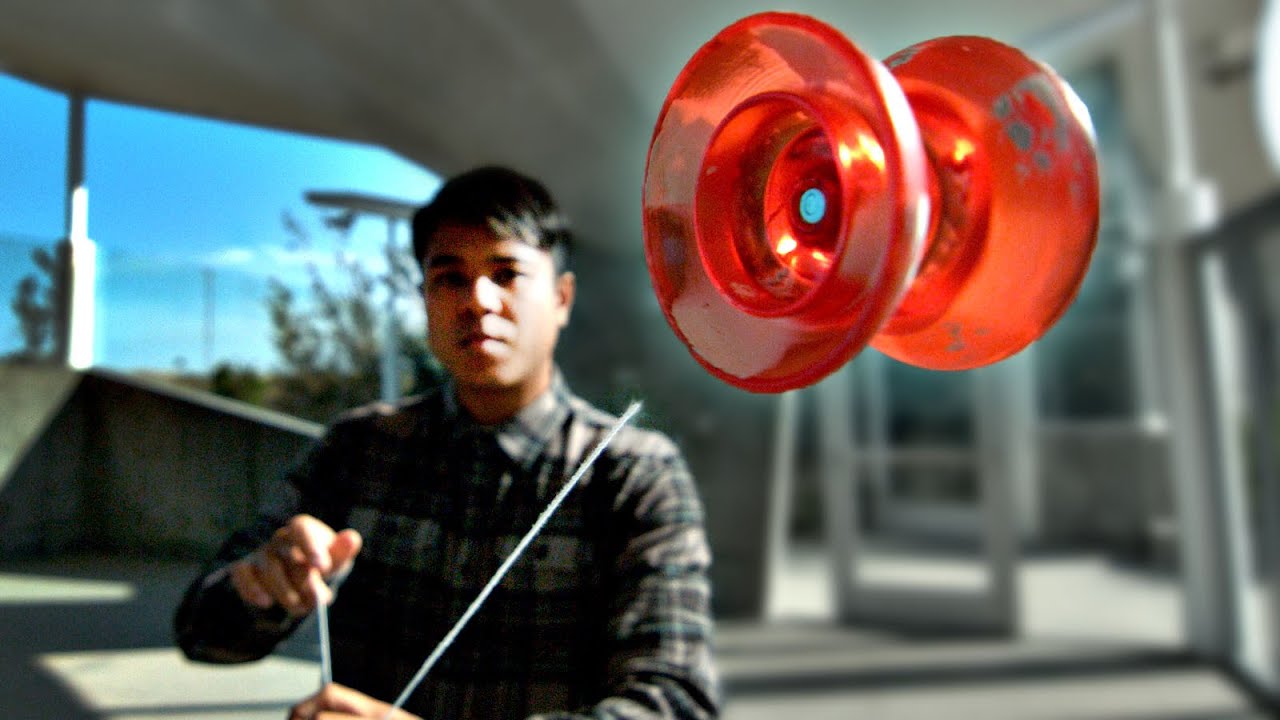
How can you Yo-Yo without the string attached?
Check out Audible: http://bit.ly/AudibleVe
For more Ben Conde: http://bit.ly/VeBenConde
For Beyond Slow Motion: http://bit.ly/VeBeyondSlowMo
For more on yo-yos check out: http://bit.ly/290wR3a
How to yo-yo without a string attached... So many crazy tricks and the science that makes it possible.
Edited and animated by Daniel Joseph Files
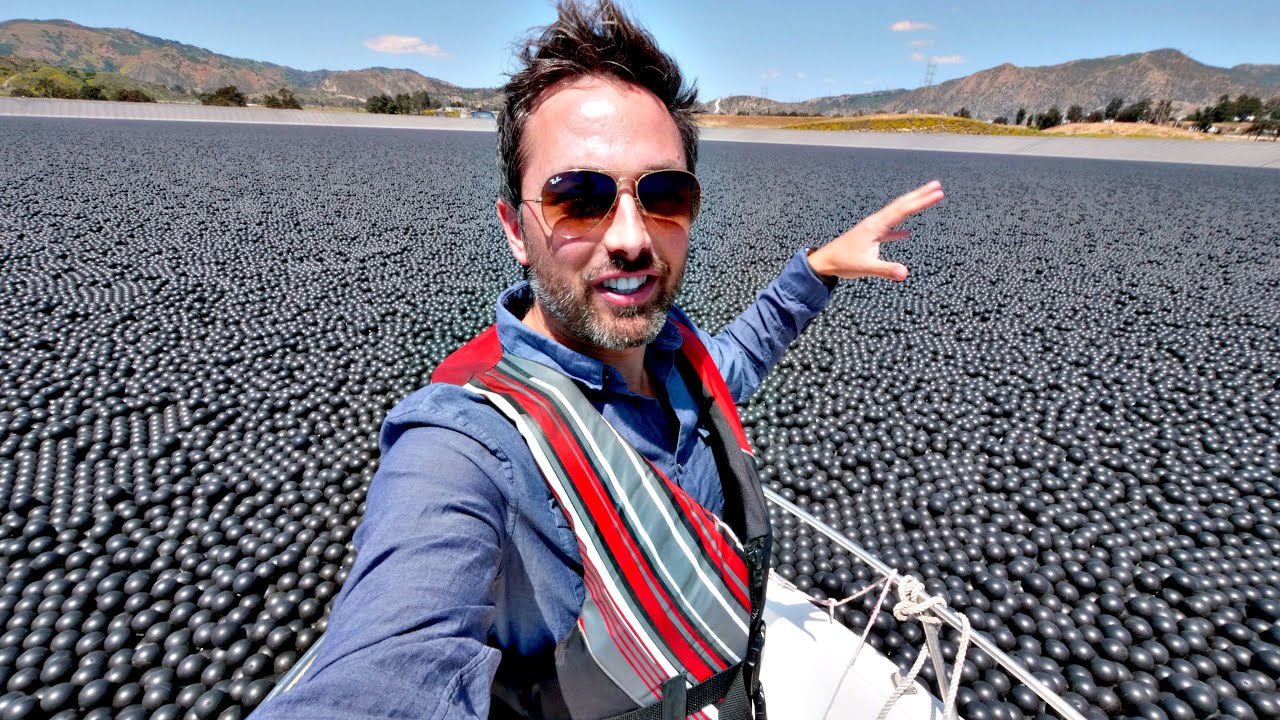
I took a boat through 96 million black plastic balls on the Los Angeles reservoir to find out why they're there. The first time I heard about shade balls the claim was they reduce evaporation. But it turns out this isn't the reason they were introduced.
Huge thanks to LADWP for arranging this special tour for me. Next time let's put the GoPro on the submersible!
The balls are made of high density polyethylene (HDPE) which is less dense than water so they float on the surface of the reservoir even if they break apart. They are 10cm (4 inches) in diameter and contain about 210ml of water. So the main reason they are on the reservoir is to block sunlight from entering the water and triggering a chemical reaction that turns harmless bromide into carcinogenic bromate. This effect occurs with prolonged exposure to bromate so regulators insist that levels be kept below 10 microgram per liter on average over a 12 month period.
Special thanks to our Patreon supporters! Join this community to help us keep our videos free, forever:
https://ve42.co/PatreonDEB
Thanks to:
Las Virgenes Reservoir for footage of initial shade ball dump
Euro-Matic for bird into jet-engine footage
Researched and Produced by Casey Rentz
Animations by Maria Raykova
Music from http://epidemicsound.com "Colorful Animation 4" "Seaweed"
And from Kevin MacLeod "Marty Gots a Plan"
This is an educational video about the science of water quality.
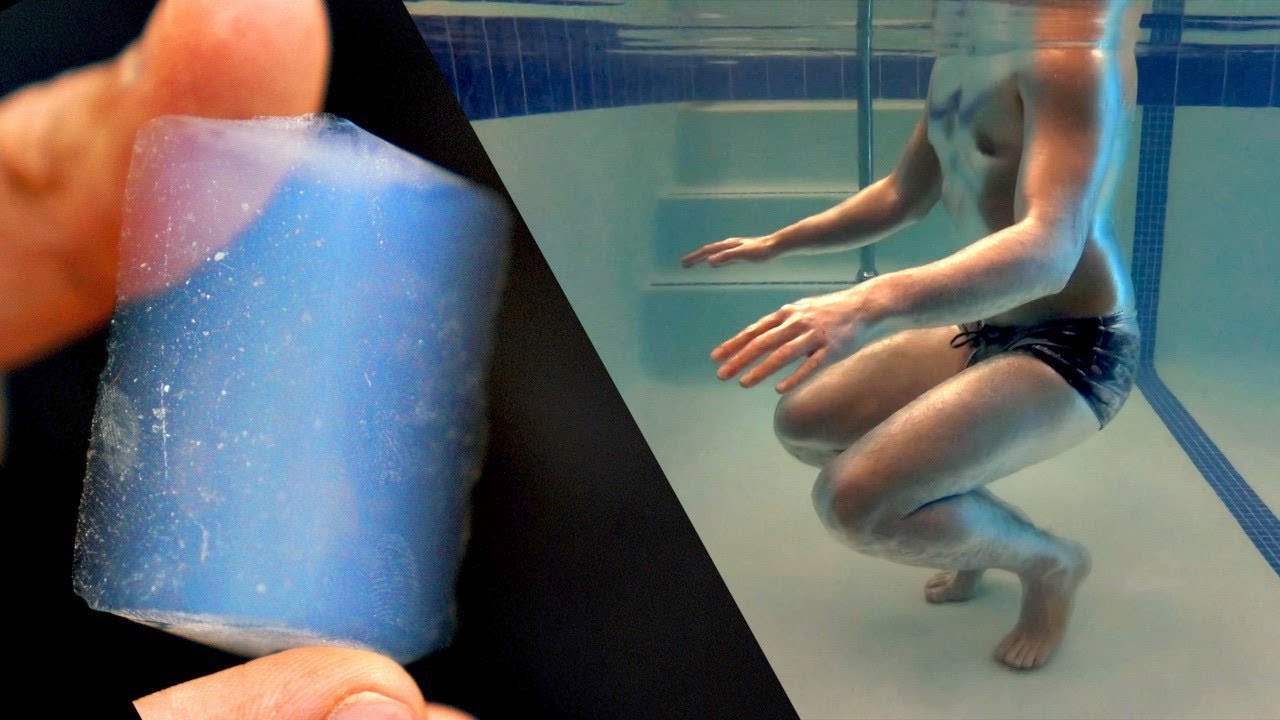
Aerogel has extraordinary properties but it can be tough to work with. This video looks at modifying aerogels to take advantage of their unique characteristics.
Subscribe to Veritasium: https://ve42.co/sub
Huge thanks to Dr. Stephen Steiner and the crew at Aerogel Technologies. To find out more or buy your own aerogel sample, check out: http://www.aerogeltechnologies.com/
Thanks to Dr. Steven Jones and Dr. Mihail Petkov at NASA's Jet Propulsion Laboratory
And thanks to FLIR for loaning us the awesome high definition thermal camera. The footage is amazing! https://www.flir.com
Aerogel’s extraordinary properties are due in large part to its structure. Aerogel is a solid but on the nanoscale it has a mesh or sponge-like structure. The struts of this structure are nanoscale, as are the pores at around 20nm across. This makes silica aerogel incredibly light (it was once the lightest solid but has now been superseded by graphene aerogel), transparent and adsorbent.
An ice-cube sized piece of aerogel has an internal surface area roughly equal to half a football field. Aerogel is used in high end museum cases to regulate humidity. Plus it helps maintain the vacuum on the Mars Insight seismometers - it adsorbs moisture and other outgassed volatiles that come from the spacecraft itself. Proposed uses include as a physical insecticide by ‘drying out insects’ reducing the need for chemical and toxic pesticides.
Special thanks to all my Patreon supporters especially those who contributed feedback to an earlier draft of this video:
a human, Albert Jachowicz-Brzeziński, Alfred Wallace, Arjun Chakroborty, Brent Stewart, Chris Vargas, Chuck Lauer Vose, Clip Tree, Coale Shifflett, Colin Bellmore, DALE HORNE, Eric Velazquez, Fedor Indutny, Fran Rodriguez, James Wong, Jasper Xin, Joar Wandborg, Johnny, Jorge Angel Sandoval, June Kang, Kevin Beavers, Kishore Tipirneni, Levan Ferr, Listen Money Matters, Manuel Zürcher, Mark Bevilacqua, Mathias Göransson, Michael Bradley Wirz, Michael Krugman, Mohammed Al Sahaf, Nicholas Hastings, OddJosh, Patrick Čalija, Peter Tajti, Philipp Volgger, Roberto Rezende, Robin DeBank, Ron Neal, Stan Presolski, Swante Scholz, Tiago Bruno, Tige Thorman, Warrior8252
Filmed by Paul Gramaglia
Thumbnail by Ignat Berbeci
Animations by Catherine Chooljian
Music from https://epidemicsound.com “Tonic Zone” “Betelgeuse” “Insidious Mice” “Seaweed” “It’s not that serious” “Platin00m - Sum It”
This is an educational, scientific video.

IQ is supposed to measure intelligence, but does it? Head to https://brilliant.org/veritasium to start your free 30-day trial, and the first 200 people get 20% off an annual premium subscription.
If you’re looking for a molecular modeling kit, try Snatoms – a kit I invented where the atoms snap together magnetically – https://ve42.co/SnatomsV
▀▀▀
A huge thank you to Emeritus Professor Cecil R. Reynolds and Dr. Stuart J. Ritchie for their expertise and time.
Also a massive thank you to Prof. Steven Piantadosi and Prof. Alan S. Kaufman for helping us understand this complicated topic. As well as to Jay Zagrosky from Boston University's Questrom School of Business for providing data from his study.
▀▀▀
References:
Kaufman, A. S. (2009). IQ testing 101. Springer Publishing Company.
Reynolds, C. R., & Livingston, R. A. (2021). Mastering modern psychological testing. Springer International Publishing.
Ritchie, S. (2015). Intelligence: All that matters. John Murray.
Spearman, C. (1961). " General Intelligence" Objectively Determined and Measured. - https://ve42.co/Spearman1904
Binet, A., & Simon, T. (1907). Le développement de l'intelligence chez les enfants. L'Année psychologique, 14(1), 1-94.. - https://ve42.co/Binet1907
Intelligence Quotient, Wikipedia - https://ve42.co/IQWiki
Radiolab Presents: G. - https://ve42.co/RadioLabG
McDaniel, M. A. (2005). Big-brained people are smarter: A meta-analysis of the relationship between in vivo brain volume and intelligence. Intelligence, 33(4), 337-346. - https://ve42.co/McDaniel2005
Deary, I. J., Strand, S., Smith, P., & Fernandes, C. (2007). Intelligence and educational achievement. Intelligence, 35(1), 13-21. - https://ve42.co/Deary2007
Lozano-Blasco, R., Quílez-Robres, A., Usán, P., Salavera, C., & Casanovas-López, R. (2022). Types of Intelligence and Academic Performance: A Systematic Review and Meta-Analysis. Journal of Intelligence, 10(4), 123. - https://ve42.co/Blasco2022
Kuncel, N. R., & Hezlett, S. A. (2010). Fact and fiction in cognitive ability testing for admissions and hiring decisions. Current Directions in Psychological Science, 19(6), 339-345. - https://ve42.co/Kuncel2010
Laurence, J. H., & Ramsberger, P. F. (1991). Low-aptitude men in the military: Who profits, who pays?. Praeger Publishers. - https://ve42.co/Laurence1991
Gregory, H. (2015). McNamara's Folly: The Use of Low-IQ Troops in the Vietnam War; Plus the Induction of Unfit Men, Criminals, and Misfits. Infinity Publishing.
Gottfredson, L. S., & Deary, I. J. (2004). Intelligence predicts health and longevity, but why?. Current Directions in Psychological Science, 13(1), 1-4. - https://ve42.co/Gottfredson2004
Sanchez-Izquierdo, M., Fernandez-Ballesteros, R., Valeriano-Lorenzo, E. L., & Botella, J. (2023). Intelligence and life expectancy in late adulthood: A meta-analysis. Intelligence, 98, 101738. - https://ve42.co/Izquierdo2023
Zagorsky, J. L. (2007). Do you have to be smart to be rich? The impact of IQ on wealth, income and financial distress. Intelligence, 35(5), 489-501. - https://ve42.co/Zagorsky2007
Strenze, T. (2007). Intelligence and socioeconomic success: A meta-analytic review of longitudinal research. Intelligence, 35(5), 401-426. - https://ve42.co/Strenze2007
Deary, I. J., Pattie, A., & Starr, J. M. (2013). The stability of intelligence from age 11 to age 90 years: the Lothian birth cohort of 1921. Psychological science, 24(12), 2361-2368. - https://ve42.co/Deary2013
Flynn, J. R. (1987). Massive IQ gains in 14 nations: What IQ tests really measure. Psychological bulletin, 101(2), 171. - https://ve42.co/Flynn1987
Why our IQ levels are higher than our grandparents' | James Flynn, TED via YouTube - https://www.youtube.com/watch?v=9vpqilhW9uI
Duckworth, A. L., Quinn, P. D., Lynam, D. R., Loeber, R., & Stouthamer-Loeber, M. (2011). Role of test motivation in intelligence testing. Proceedings of the National Academy of Sciences, 108(19), 7716-7720. - https://ve42.co/Duckworth2011
Kulik, J. A., Bangert-Drowns, R. L., & Kulik, C. L. C. (1984). Effectiveness of coaching for aptitude tests. Psychological Bulletin, 95(2), 179. - https://ve42.co/Kulik1984
▀▀▀
Special thanks to our Patreon supporters:
Adam Foreman, Amadeo Bee, Anton Ragin, Balkrishna Heroor, Benedikt Heinen, Bernard McGee, Bill Linder, Burt Humburg, Dave Kircher, Diffbot, Evgeny Skvortsov, Gnare, John H. Austin, Jr., john kiehl, Josh Hibschman, Juan Benet, KeyWestr, Lee Redden, Marinus Kuivenhoven, MaxPal, Meekay, meg noah, Michael Krugman, Orlando Bassotto, Paul Peijzel, Richard Sundvall, Sam Lutfi, Stephen Wilcox, Tj Steyn, TTST, Ubiquity Ventures
▀▀▀
Written by Derek Muller, Casper Mebius, & Petr Lebedev
Edited by Trenton Oliver
Filmed by Derek Muller, Han Evans, & Raquel Nuno
Animation by Fabio Albertelli & Ivy Tello
Additional video/photos supplied by Getty Images & Pond5
Music from Epidemic Sound
Produced by Derek Muller, Casper Mebius, & Han Evans

How a single phone call from a student helped uncover a flaw that nearly toppled Citicorp. Get an exclusive 15% discount on Saily data plans! Use code veritasium at checkout. Download Saily app or go to https://saily.com/veritasium
If you’re looking for a molecular modeling kit, try Snatoms, a kit I invented where the atoms snap together magnetically - https://ve42.co/SnatomsV
Correction: From construction images of Citicorp, sharp-eyed viewers might see that the mid-V columns are still there. Those columns help prevent buckling of the diagonal and the weight of people on the floor above, but do not take the majority of the gravity load. So we left them out of our diagram to clearly explain the load paths. See page 70 of this source for more details - https://drive.google.com/file/....d/1ODFo66-_V7Y9vKANb
Sign up to the Veritasium newsletter for weekly science updates - https://ve42.co/Newsletter
▀▀▀
0:00 Why is the citicorp building on stilts?
4:44 How wind load works
7:49 Tuned Mass Dampers
11:17 The Anonymous Student
14:00 Quartering Winds
18:38 What were the odds of collapse?
20:31 How was the citicorp building fixed?
25:40 Hurricane Ella
27:00 TMDs Take Over The World
28:36 Conspiracies and Cover Ups
▀▀▀
A big thank you for the incredible people without whom we couldn't have done this! 🖤
To Michael Greenburg, author of The Great Miscalculation, for his insights that really brought the story and its context to life. He gave us a pre-copy of his upcoming book, and it is fantastic: https://ve42.co/Miscalc
To Eric Hines for all his help with the technical details, fact-checking, and making sure we got the engineering right.
To Michael J. Vardaro for helping us uncover the details of the story and the resources he provided.
To Brock Hedegaard for helping us dive deep into the Citicorp structural analysis. Learn the fundamentals of structural analysis on his brilliant channel, @StructuresProfH, and see here for his analysis of the citicorp center; https://www.youtube.com/watch?v=lE_DspFE2ZM
To Michele Barbato from UC Davis for his inputs on the load calculations.
https://faculty.engineering.ucdavis.edu/barbato/
Matt from @mvvvc for talking us through his wind load analysis.
To Prof. Chris Letchford who helped us understand the impact of wind on Citicorp's structure.
To DongHun Yeo from NIST for discussing his research about wind effects on buildings similar to citicorp: https://ve42.co/WindLoad
Finally, to Team Columbia —who built the epic TMD and ran wind tunnel experiments that made this story come alive.
This includes the folks at the Mechanical Engineering Teaching Laboratory
(Follow all the cool stuff they’re doing: @mechcu, @columbiaengineering or visit https://teachinglab.me/)
Amanda Lombardo, Manager of Instructional Laboratories
Daniela Durón García, Assistant Manager of Instructional Laboratories
Jorge Casas, Machinist
And the amazing seniors from the Columbia Space Initiative:
(Support their awesome work here: columbiaspace.org/support-us/, Follow them: @columbiaspaceinitiative)
Michael Sheehan
Claudio Solano
Jessica Bolar
Kathryn Lampo
▀▀▀
References:
Michael M. Greenburg. The Great Miscalculation via. nyupress.org - https://ve42.co/Miscalc
Joe Morgenstern. The Fifty-Nine-Story Crisis via. The New Yorker - https://ve42.co/59Crisis
National Academy of Engineering. William LeMessurier-The Fifty-Nine-Story Crisis: A Lesson in Professional Behavior - https://www.youtube.com/watch?v=um-7IlAdAtg
Diane Lee Hartley. Implications of a Major Urban Office Complex: The Scientific, Social and Symbolic Meanings of Citicorp Center via. princeton.edu - https://ve42.co/CitiSymbol
Addition References here: https://ve42.co/citiref
▀▀▀
Special thanks to our Patreon supporters:
Adam Foreman, Albert Wenger, Alex Porter, Alexander Tamas, Anton Ragin, Autodidactic Studios, Balkrishna Heroor, Bertrand Serlet, Blake Byers, Bruce, Dave Kircher, David Johnston, David Tseng, Evgeny Skvortsov, Garrett Mueller, Gnare, gpoly, Greg Scopel, HydrochloRick, Jon Jamison, Juan Benet, Keith England, KeyWestr, Kyi, Lee Redden, Marinus Kuivenhoven, Matthias Wrobel, Meekay, meg noah, Michael Krugman, Orlando Bassotto, Paul Peijzel, Richard Sundvall, Sam Lutfi, Tj Steyn, TTST, Ubiquity Ventures, wolfee
▀▀▀
Written and Directed by Sulli Yost
Edited by Trenton Oliver
Additional Editing by Axel Oliver, James Horsley and Peter Nelson
3D Modeling by Maydelis Anaya Romero
Animation by Mike Radjabov, Andrew Neet, Fabio Albertelli, Jakub Misiek, and Emma Wright
Illustration by Jakub Misiek, Maria Gusakovich and Cainejan Esperanza
Filmed by Sulli Yost, Henry van Dyck, Andrew Abballe, Derek Muller
Produced by Sulli Yost, Derek Muller, Casper Mebius, Zoe Heron, Rob Beasley Spence and Tori Brittain
Additional research by Geeta Thakur
Thumbnail contributions by Ren Hurley and Ben Powell
Additional video/photos supplied by Getty Images, Pond5, Axiom Images and Storyblocks
Music from Epidemic Sound

An engineer came up with a plan to drop tungsten telephone poles from space - the idea has been seriously considered on multiple occasions, so we tested it. Head to https://brilliant.org/Veritasium to start your free trial. The first 200 will get 20% off Brilliant's annual premium subscription.
Special thanks to our Patreon supporters! Join the community to help us keep our videos free, forever:
https://ve42.co/PatreonDEB
Massive thanks to Archisand for building such a beautiful sandcastle. https://www.youtube.com/@GregLeBon
Huge thanks to John and Angie Miller for helping us with securing the shooting location and going above and beyond to make this shoot happen – http://highdesertlocations.com/
Thanks to Inland Empire Film Services and the San Bernardino County Film Office for portions of the video shot in the County of San Bernardino.
Massive thanks to Dr David Wright for the interview and providing invaluable guidance during the research for this video.
Here’s a great video about space-based missile defense – https://www.ucsusa.org/resourc....es/space-based-missi
Massive thanks to Adam Savage for being part of this video.
Additional photos from NASA and ESA.
▀▀▀
References:
USAF. (2003). The US Air Force transformation flight plan.
Preston, R., Johnson, D. J., Edwards, S. J., Miller, M. D., & Shipbaugh, C. (2002). Space weapons earth wars. Rand Corporation.
Wright, D., Grego, L., & Gronlund, L. (2005). The physics of space security. A Reference Manual, Cambridge.
DeBlois, B. M., Garwin, R. L., Kemp, R. S., & Marwell, J. C. (2004). Space weapons: crossing the US Rubicon. International Security, 50-84.
Baucom, D. R. (2017). The Rise and Fall of Brilliant Pebbles 1. In United States Military History 1865 to the Present Day (pp. 329-376). Routledge.
Hitchens, T., & Samson, V. (2004). Space-based interceptors: still not a good idea. Georgetown journal of international affairs, 21-29.
National Research Council. (2012). Making sense of ballistic missile defense: An assessment of concepts and systems for US boost-phase missile defense in comparison to other alternatives. National Academies Press.
Borger, J. (2005). Bush likely to back weapons in space. The Guardian, 19.
▀▀▀
Special thanks to: Bernard McGee, James Sanger, Elliot Miller, Brian Busbee, Jerome Barakos M.D., Amadeo Bee, TTST, Balkrishna Heroor, Chris LaClair, John H. Austin Jr., OnlineBookClub.org, Eric Sexton, John Kiehl, Diffbot, Gnare, Dave Kircher, Burt Humburg, Blake Byers, Evgeny Skvortsov, Meekay, Bill Linder, Paul Peijzel, Josh Hibschman, Mac Malkawi, Mike Schneider, John Bauer, Jim Buckmaster, Juan Benet, Sunil Nagaraj, Richard Sundvall, Lee Redden, Stephen Wilcox, Marinus Kuivenhoven, Michael Krugman, Cy 'kkm' K'Nelson, Sam Lutfi
▀▀▀
Written by Petr Lebedev, Derek Muller, and Emily Zhang
Filmed by Trenton Oliver, Derek Muller, Petr Lebedev, Emily Zhang, Raquel Nuno, and Eddie Lopez
Animation by Mike Radjabov, Fabio Albertelli, and Jonny Hyman
Edited by Trenton Oliver
Slow Motion Camera: Shawn Sanders and Anthony Corrales
Sandcastle Timelapse by Greg LeBon and Archisand
Phantom rental from Panny Hire LA
Helicopter Pilots: Rick Shuster and Cliff Fleming
Helicopter Safety Officer: Ryan Hosking
FPV Drone Pilots: Sammie Saing and Josh Ewalt
Production Assistants: Roman Bacvic and Eddie Lopez
Intern: Katie Barnshaw
Additional video/photos supplied by Pond5 and Getty Images
Music from Epidemic Sound
Thumbnail by Ignat Berbeci
Produced by Derek Muller, Petr Lebedev, and Emily Zhang

The title and thumbnail play a huge role in a video's success or failure.
Check out http://kiwico.com/Veritasium50 for 50% off your first month of any subscription!
▀▀▀▀▀▀▀▀▀▀▀▀▀▀▀▀▀▀▀▀▀▀▀▀▀▀
Special thanks to Patreon supporters: Alvaro Naranjo, Burt Humburg, Blake Byers, Dumky, Mike Tung, Evgeny Skvortsov, Meekay, Ismail Öncü Usta, Paul Peijzel, Crated Comments, Anna, Mac Malkawi, Michael Schneider, Oleksii Leonov, Jim Osmun, Tyson McDowell, Ludovic Robillard, Jim buckmaster, fanime96, Juan Benet, Ruslan Khroma, Robert Blum, Richard Sundvall, Lee Redden, Vincent, Marinus Kuivenhoven, Alfred Wallace, Arjun Chakroborty, Joar Wandborg, Clayton Greenwell, Pindex, Michael Krugman, Cy 'kkm' K'Nelson, Sam Lutfi, Ron Neal
▀▀▀▀▀▀▀▀▀▀▀▀▀▀▀▀▀▀▀▀▀▀▀▀▀▀
Written by Derek Muller
Animation by Ivy Tello
Filmed by Derek Muller and Emily Zhang
Additional video supplied by Getty Images
Produced by Derek Muller, Emily Zhang and Petr Lebedev
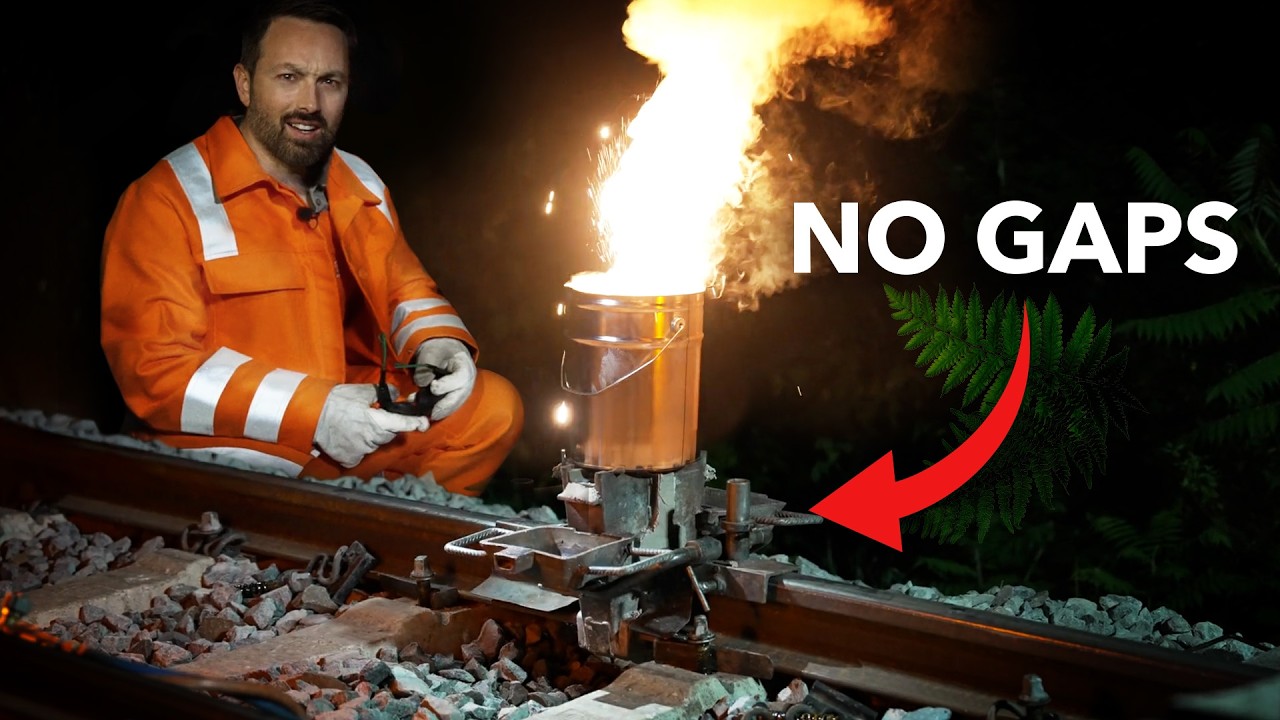
How Thermite turned the clickety-clack of railroads into seamless, silent tracks. Get an exclusive 15% discount on Saily data plans! Use code veritasium at checkout. Download Saily app or go to https://saily.com/veritasium
A massive thank you to everyone at Goldschmidt for making this possible. With special thanks to Dr. Axel Hoeschen, Christof Gassmann and Claudia Koch.
If you want to learn all the details about why we don’t need expansion joints anymore, check out Grady’s excellent video here: youtu.be/zqmOSMAtadc
If you’re looking for a molecular modeling kit, try Snatoms, a kit I invented where the atoms snap together magnetically. https://snatoms.com/
Sign up to the Veritasium newsletter for weekly science updates - https://ve42.co/Newsletter
▀▀▀
00:00 The problem with continuous welded rail
03:33 How to weld two rails together
10:16 Why is rapidly cooled steel brittle?
11:40 Thermite reaction and a see-through mould
16:30 Clean up
19:11 Metallurgy
22:15 How strong is the weld?
24:26 Why don’t the rails buckle?
▀▀▀
References:
Practical Engineering. Why Railroads Don't Need Expansion Joints youtu.be/zqmOSMAtadc
Stress–strain curve In Wikipedia - https://ve42.co/stressstrain
The Efficient Engineer. Understanding Metals via Youtube https://youtu.be/PaGJwOPg2kU
moodlemech. Properties and Grain Structure via Youtube - youtu.be/uG35D_euM-0
Images & Video:
bhadeshi123. Martensitic transformation via Youtube youtu.be/OQ5lVjYssko
Stratford Works In Wikipedia - https://ve42.co/stratford
Electric Tram 1881 In Wikipedia - https://ve42.co/tram
Water Quenched Steel In Wikipedia - https://ve42.co/quench
Synagoge 1922 In Wikipedia - https://ve42.co/synagoge
▀▀▀
Special thanks to our Patreon supporters!
Join the community to help us keep our videos free, forever: https://ve42.co/PatreonDE
Alexander Tamas, Autodidactic Studios, Farbod Mansorian, Gnare, Juan Benet, Lee Redden, Meekay, Orlando Bassotto, Paul Peijzel, Richard Sundvall, Sam Lutfi, Ubiquity Ventures, Adam Foreman, Albert Wenger, Anton Ragin, Bertrand Serlet, Blake Byers, Bruce, Dave Kircher, David Johnston, Evgeny Skvortsov, Garrett Mueller, gpoly, Greg Scopel, I. H., KeyWestr, Kyi, Marinus Kuivenhoven, Matthias Wrobel, meg noah, Michael Krugman, Spilmann Reed, Tj Steyn, TTST, wolfee.
▀▀▀
Directed by Derek Muller and Casper Mebius
Written by Derek Muller and Casper Mebius
Edited by Trenton Oliver
Animated by Mike Radjabov, Rokas Vikšraitis and Fabio Albertelli
Filmed by Derek Muller, David Bochmann, Casper Mebius, Luise Dietert, Henning Fischer and Harald Schweiger
Additional research by Geeta Thakur
Produced by Derek Muller, Casper Mebius, Gregor Čavlović, Geeta Thakur, Rob Beasley Spence, Emily Lazard and Tori Brittain
Thumbnail contributions by Peter Sheppard and Ren Hurley
Additional video/photos supplied by Getty Images and Story Blocks
Music from Epidemic Sound

Origami is inspiring a plethora of new engineering designs. Try yourself: https://ve42.co/Origami
Thanks Audible! Start listening with a 30-day trial and your first audiobook, plus two Audible Originals free when you go to https://audible.com/veritasium or text veritasium to 500500
Huge thanks to:
Dr. Robert Lang https://langorigami.com
Prof. Larry Howell https://www.compliantmechanisms.byu.edu/
On first glance it's surprising that origami -- a centuries old art of folding paper to achieve particular aesthetics -- is applicable to engineering. But upon closer consideration there are a lot of reasons methods developed for paper folding are also applicable to engineering: origami allows you to take a flat sheet of material and convert it to almost any shape only by folding. Plus for large flat structures, origami provides a way of shrinking dimensions while ensuring simply deployment - this is particularly useful for solar arrays in space applications. Furthermore, motions designed to take advantage of the flexibility of paper can also be used to form compliant mechanisms for engineering like the kaleidocycle. Since the principles of origami are scalable, mechanisms can also be dramatically miniaturized.
Some of the work shown is based upon work supported by the National Science Foundation and the Air Force Office of Scientific Research under Grant No. EFRI-ODISSEI-1240417. Any opinions, findings, and conclusions or recommendations expressed in this material are those of the author(s) and do not necessarily reflect the views of the National Science Foundation.
Special thanks to Patreon supporters:
Alfred Wallace, Arjun Chakroborty, Bryan Baker, Chris Vargas, Chuck Lauer Vose, DALE HORNE, Donal Botkin, halyoav, James Knight, Jasper Xin, Joar Wandborg, Kevin Beavers, kkm, Leah Howard, Lyvann Ferrusca, Michael Krugman, Noel Braganza, Pindex, Ron Neal, Sam Lutfi, Stan Presolski, Tige Thorman
Edited by
Jonny Hyman, Isaac Frame, and Derek Muller
Music by
Jonny Hyman