Science
Sub Category

Students are introduced to renewable energy, including its relevance and importance to our current and future world. They learn the mechanics of how wind turbines convert wind energy into electrical energy and the concepts of lift and drag. Then they apply real-world technical tools and techniques to design their own aerodynamic wind turbines that efficiently harvest the most wind energy. Specifically, teams each design a wind turbine propeller attachment. They sketch rotor blade ideas, create CAD drawings (using Google SketchUp) of the best designs and make them come to life by fabricating them on a 3D printer. They attach, test and analyze different versions and/or configurations using a LEGO wind turbine, fan and an energy meter. At activity end, students discuss their results and the most successful designs, the aerodynamics characteristics affecting a wind turbine's ability to efficiently harvest wind energy, and ideas for improvement. The activity is suitable for a class/team competition. Example 3D rotor blade designs are provided.
View the full activity at TeachEngineering:
https://www.teachengineering.o....rg/activities/view/n
TeachEngineering has over 1,500 FREE lessons and activities. Visit http://www.TeachEngineering.org for more!
Music: Straighty Baby - Audionautix
Straighty Baby by Audionautix is licensed under a Creative Commons Attribution license (https://creativecommons.org/licenses/by/4.0/)
Artist: http://audionautix.com/
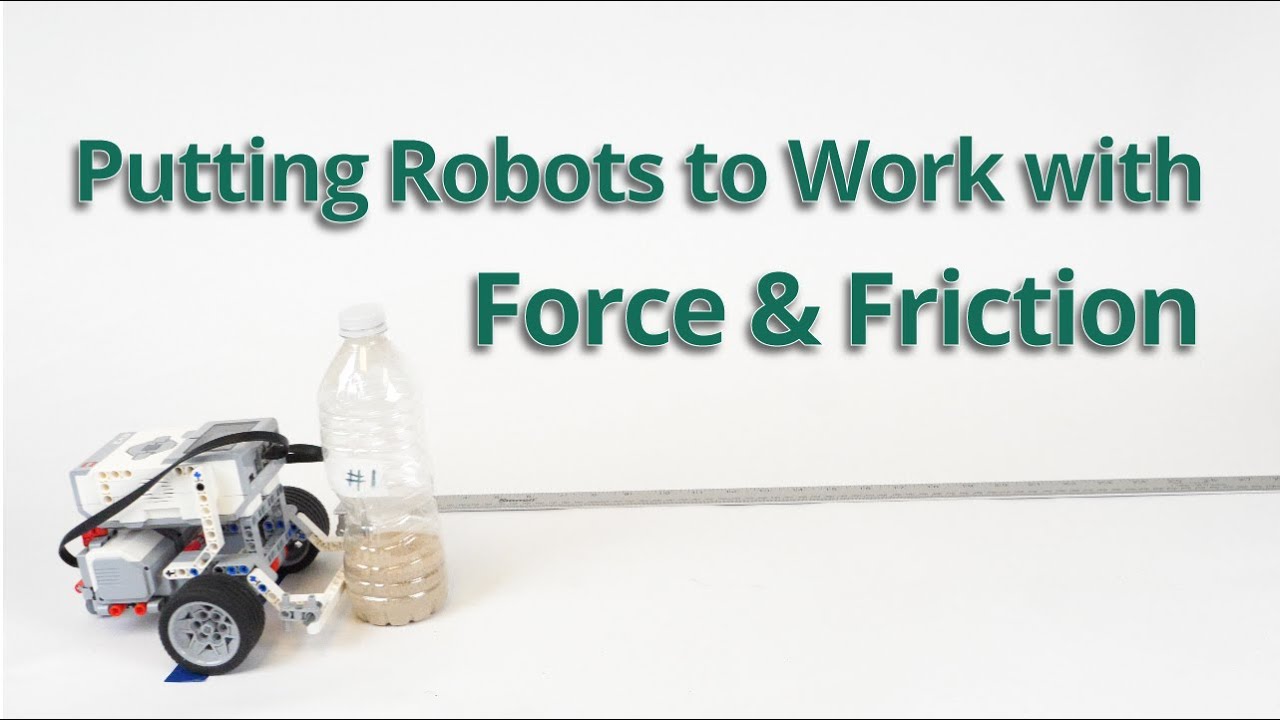
Students learn about the concept of pushing, as well as the relationship between force and mass. Students practice measurement skills using pan scales and rulers to make predictions about mass and distance. A LEGO® MINDSTORMS® robot is used to test their hypotheses. By the end of the activity, students have a better understanding of robotics, mass and friction and the concept of predicting.
View the full activity on TeachEngineering:
https://www.teachengineering.o....rg/activities/view/n
TeachEngineering has over 1,500 FREE lessons and activities. Visit https://www.teachengineering.org/ for more
Music: Dream of a Day

Students use their understanding of projectile physics and fluid dynamics to find the water pressure in water guns. By measuring the range of the water jets, they are able to calculate the theoretical pressure. Students create graphs to analyze how the predicted pressure relates to the number of times they pump the water gun before shooting.
View the full activity at TeachEngineering:
https://www.teachengineering.o....rg/activities/view/c
TeachEngineering has over 1,500 FREE lessons and activities. Visit http://www.TeachEngineering.org for more!
Music: New Land

In this hands-on activity, students explore the electrical force that takes place between two objects. Each student builds an electroscope and uses the device to draw conclusions about objects' charge intensity. Students also determine what factors influence electric force.
View the full activity on TeachEngineering:
https://www.teachengineering.o....rg/activities/view/c
TeachEngineering has over 1,500 FREE lessons and activities. Visit https://www.teachengineering.org/ for more!
Music: Weekend In The City - Silent Partner

Students conduct an experiment to determine the relationship between the speed of a wooden toy car at the bottom of an incline and the height at which it is released. They observe how the photogate-based speedometer instrument "clocks" the average speed of an object (the train). They gather data and create graphs plotting the measured speed against start height. After the experiment, as an optional extension activity, students design brakes to moderate the speed of the cart at the bottom of the hill to within a specified speed range.
View the full activity on TeachEngineering:
https://www.teachengineering.o....rg/activities/view/n
TeachEngineering has over 1,500 FREE lessons and activities. Visit https://www.teachengineering.org/ for more!
Music: Educated Man - Max McFerren

Students design their own logos, pictures or other graphic images and then use handheld GPS receivers to map them out. They write out the image on a field or playground, walk the route, and log GPS data. Displaying the collected data on the GPS receiver screen results in the finished artwork. The process requires students to use geometry, sketch, measure distances and make scaling calculations, and familiarizes them with technological devices. A student worksheet is provided.
View the full activity on TeachEngineering:
https://www.teachengineering.o....rg/activities/view/c
TeachEngineering has over 1,500 FREE lessons and activities. Visit https://www.teachengineering.org/ for more
Music: Comparsa Latinesque

Students observe a model waterwheel to investigate the transformations of energy involved in turning the blades of a hydro-turbine. They work as engineers to create model waterwheels while considering resources such as time and materials, in their designs. Students also discuss and explore the characteristics of hydropower plants.
View the full activity on TeachEngineering:
https://www.teachengineering.o....rg/activities/view/c
TeachEngineering has over 1,500 FREE lessons and activities. Visit http://www.TeachEngineering.org for more!
Music: Sunny - Bensound.com

Refreshed with an understanding of the six simple machines; screw, wedge, pully, incline plane, wheel and axle, and lever, student groups receive materials and an allotted amount of time to act as mechanical engineers to design and create machines that can complete specified tasks. For the competition, they choose from pre-determined goal options such as: 1) dumping goldfish into a bowl, 2) popping a balloon, or 3) dropping mint candies into soda pop (creating a fizzy reaction). Students demonstrate their functioning contraptions to the class, earning points for using all six simple machines, successful transitions from one chain reaction to the next, and completion of the end goal.
View the full activity at TeachEngineering:
https://www.teachengineering.o....rg/activities/view/c
TeachEngineering has over 1,500 FREE lessons and activities. Visit https://www.teachengineering.org/ for more!
Music: Stand - Anno Domini Beats

In this multi-day activity, students explore environments, ecosystems, energy flow and organism interactions by creating a scale model biodome, following the steps of the engineering design process. The Procedure section provides activity instructions for Biodomes unit, lessons 2-6, as students work through Parts 1-6 to develop their model biodome. Subjects include energy flow and food chains, basic needs of plants and animals, and the importance of decomposers. Students consider why a solid understanding of one's environment and the interdependence of an ecosystem can inform the choices we make and the way we engineer our own communities. This activity can be conducted as either a very structured or open-ended design.
View the full activity on TeachEngineering: https://www.teachengineering.o....rg/activities/view/c
TeachEngineering has over 1,500 FREE lessons and activities. Visit https://www.teachengineering.org/ for more!
Music: Skinny Leonard - Audionautix
Skinny Leonard by Audionautix is licensed under a Creative Commons Attribution license (https://creativecommons.org/licenses/by/4.0/)
Artist: http://audionautix.com/

After a brief history of plastics, students look more closely as some examples from the abundant types of plastics found in our day-to-day lives. They are introduced to the mechanical properties of plastics, including their stress-strain relationships, which determine their suitability for different industrial and product applications. These physical properties enable plastics to be fabricated into a wide range of products. Students learn about the different roles that plastics play in our lives, Young's modulus, and the effects that plastics have on our environment. Then students act as industrial engineers, conducting tests to compare different plastics and performing a cost-benefit analysis to determine which are the most cost-effective for a given application, based on their costs and measured physical properties.
View the full activity at TeachEngineering:
https://www.teachengineering.o....rg/activities/view/n
TeachEngineering has over 1,500 FREE lessons and activities.
Visit http://www.TeachEngineering.org for more!
Music: Jazz Apricot

Students practice their multiplication skills using robots with wheels built from LEGO® MINDSTORMS® kits. They brainstorm distance travelled by the robots without physically measuring distance and then apply their math skills to correctly calculate the distance and compare their guesses with physical measurements. Through this activity, students estimate parameters other than by physically measuring them, practice multiplication, develop measuring skills, and use their creativity to come up with successful solutions.
View the full activity on TeachEngineering:
https://www.teachengineering.o....rg/activities/view/n
TeachEngineering has over 1,500 FREE lessons and activities. Visit https://www.teachengineering.org/ for more
Music: Electrodoodle - Kevin MacLeod

Students learn how engineers design and construct buildings to withstand earthquake damage by building their own model structures using toothpicks and marshmallows. They experiment to see how earthquake-proof their buildings are by testing them in an earthquake simulated in a pan of Jell-O®.
View the full activity on TeachEngineering: https://www.teachengineering.o....rg/activities/view/c
TeachEngineering has over 1,500 FREE lessons and activities. Visit http://www.TeachEngineering.org for more!
Music: Ukulele - Bensound.com

Students act as engineers contracted by NASA to create water filtration devices that clean visible particulates from teacher-prepared "dirty water." They learn about the worldwide need for potable water and gain appreciation for why water quality is an important issue for people on Earth as well as on the International Space Station. Working in groups, students experience the entire engineering design process, including a read-aloud book about the water cycle; a visiting water engineer presentation; their own online research about filter methods and designs; group brainstorming of designs (using ordinary household materials); filter construction and testing; redesign and retesting; lab book documentation of their notes, research, plans and results; and a summary poster presentation at a mini-engineering fair. Two design planning worksheets, a poster layout suggestion sheet and a grading rubric are provided.
View the full activity at TeachEngineering:
https://www.teachengineering.o....rg/activities/view/u
TeachEngineering has over 1,500 FREE lessons and activities. Visit https://www.teachengineering.org/ for more!
Music: Splashing Around - The Green Orbs

As a class, students work through an example showing how DNA provides the "recipe" for making human body proteins. They see how the pattern of nucleotide bases (adenine, thymine, guanine, cytosine) forms the double helix ladder shape of DNA, and serves as the code for the steps required to make genes. Students extend their knowledge by conducting the associated activities to learn ways that engineers and scientists are applying their understanding of DNA in our world.
View the full lesson on TeachEngineering: https://www.teachengineering.o....rg/lessons/view/cub_
TeachEngineering has over 1,500 FREE lessons and activities. Visit https://www.teachengineering.org/ for more

Students are introduced to the similarities and differences in the behaviors of elastic solids and viscous fluids. Several types of fluid behaviors are described—Bingham plastic, Newtonian, shear thinning and shear thickening—along with their respective shear stress vs. rate of shearing strain diagrams. In addition, fluid material properties such as viscosity are introduced, along with the methods that engineers use to determine those physical properties.
View the full lesson on TeachEngineering:
https://www.teachengineering.o....rg/lessons/view/cub_
TeachEngineering has over 1,900 FREE lessons and activities. Visit http://www.TeachEngineering.org for more!

Students explore orbit transfers and, specifically, Hohmann transfers. They investigate the orbits of Earth and Mars by using cardboard and string. Students learn about the planets' orbits around the sun, and about a transfer orbit from one planet to the other. After the activity, students will know exactly what is meant by a delta-v maneuver!
View the full activity on TeachEngineering:
https://www.teachengineering.o....rg/activities/view/c
TeachEngineering has over 1,500 FREE lessons and activities. Visit https://www.teachengineering.org/ for more

To increase students' awareness of possible invisible pollutants in drinking water sources, students perform an exciting lab requiring them to think about how solutions and mixtures exist even in unsuspecting places such as ink. They use alcohol and chromatography paper to separate the components of black and colored marker ink. Students witness first-hand how components of a solution can be separated, even when those individual components are not visible in solution.
View the full activity on TeachEngineering:
https://www.teachengineering.o....rg/activities/view/w
TeachEngineering has over 1,500 FREE lessons and activities. Visit https://www.teachengineering.org/ for more!
Music: Arriba Mami -Jingle Punks

Students come to understand the basics of engineering associated with the use, selection, and properties of fabrics. A wide variety of natural and synthetic fibers are used in our clothing, home furnishings and in our travel and sports equipment. The specific material chosen for each application depends on how closely the properties of the material match the design needs. This activity focuses on the different characteristics of fabrics and shows students how natural and synthetic fabrics differ from one another. Students weigh the advantages and disadvantages of fabrics when considering the appropriate fabric to be used.
View the full activity on TeachEngineering:
https://www.teachengineering.o....rg/activities/view/c
TeachEngineering has over 1,500 FREE lessons and activities. Visit https://www.teachengineering.org/ for more
Music - Brightly Fancy Oddities

Students explore the inhalation/exhalation process that occurs in the lungs during respiration. Using everyday materials, each student team creates a model pair of lungs.
View the full activity on TeachEngineering:
https://www.teachengineering.o....rg/activities/view/c
TeachEngineering has over 1,500 FREE lessons and activities. Visit https://www.teachengineering.org/ for more!
Music: Sophomore Makeout - Silent Partner

Students build a saltwater circuit, which is an electrical circuit that uses saltwater as part of the circuit. Students investigate the conductivity of saltwater, and develop an understanding of how the amount of salt in a solution impacts how much electrical current flows through the circuit. They learn about one real-world application of a saltwater circuit — as a desalination plant tool to test for the removal of salt from ocean water.
View the full activity at TeachEngineering:
https://www.teachengineering.o....rg/activities/view/c
TeachEngineering has over 1,500 FREE lessons and activities. Visit https://www.teachengineering.org/ for more!
Music: Chopsticks - Jorge Hernandez

Students practice the initial steps involved in an engineering design challenge. They begin by reviewing the steps of the engineering design loop and discussing the client need for the project. Next, they identify a relevant context, define the problem within their design teams, and examine the project's requirements and constraints. (Note: Conduct this activity in the context of a design project that students are working on, which could be a challenge determined by the teacher, brainstormed with the class, or the example project challenge provided [to design a prosthetic arm that can perform a mechanical function].)
View the full activity on TeachEngineering:
https://www.teachengineering.o....rg/activities/view/c
TeachEngineering has over 1,500 FREE lessons and activities. Visit https://www.teachengineering.org/ for more
music - Dream of A Day

Engineers make everyone happy: Environmental and electrical engineers design industrial air filters (such as electrostatic precipitators) that remove harmful pollutants from factory air without slowing down the production of the plant. Implementation of this technology has resulted in cleaner emissions into the air we breathe, from power plants, steel mills and other manufacturing and industrial processes and factories. Engineers can do this because they study static electricity and understand what is happening at the very tiny level of electrical charges, which are too small to see.
View the full activity at TeachEngineering:
https://www.teachengineering.o....rg/activities/view/c
TeachEngineering has over 1,500 FREE lessons and activities. Visit http://www.TeachEngineering.org for more!
Music: Safety Net-Riot
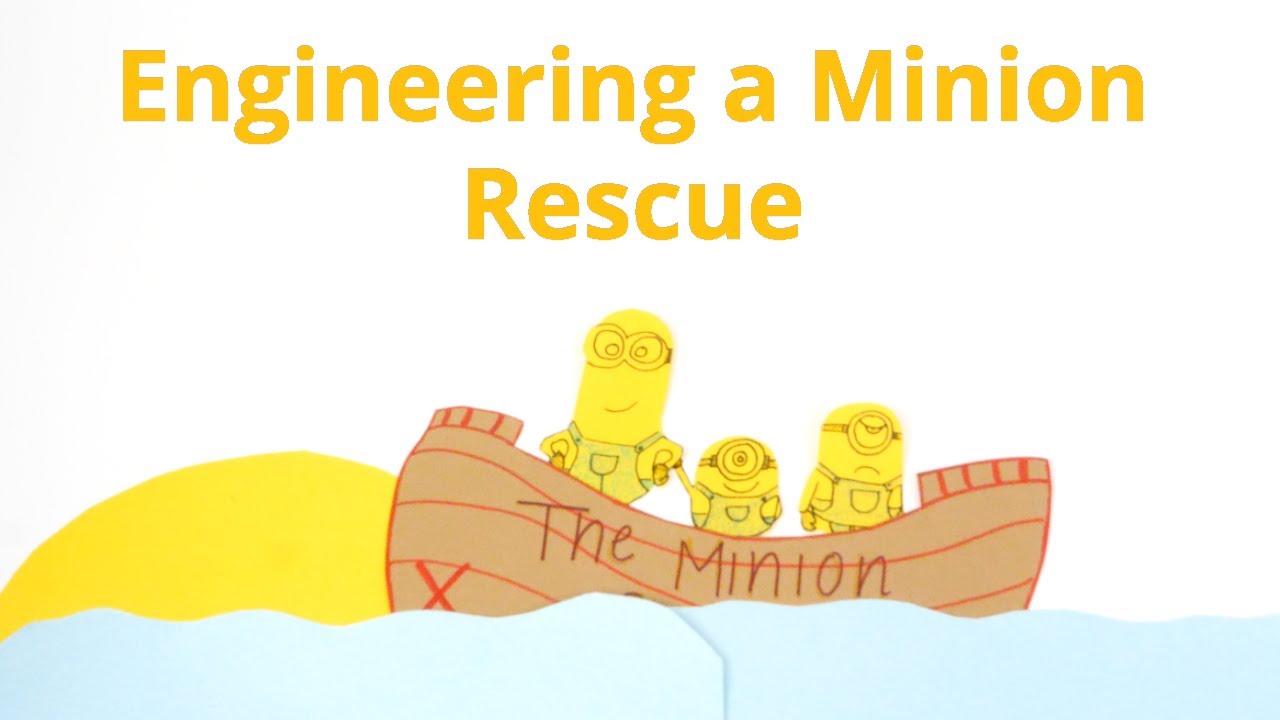
The minions are stuck on a deserted island! Students use the engineering design process to research, design, create and test boats that can rescue the minions. They learn about the physical properties of matter as well as the construction of boats and buoyancy while they engineer a minion rescue.
View the full activity on TeachEngineering:
https://www.teachengineering.o....rg/activities/view/u
TeachEngineering has over 1,500 FREE lessons and activities. Visit https://www.teachengineering.org/ for more
Music - Arriba Mami by Jingle Punks

Using paper, paper clips and tape, student teams design flying/falling devices to stay in the air as long as possible and land as close as possible to a given target. Student teams use the steps of the engineering design process to guide them through the initial conception, evaluation, testing and re-design stages. The activity culminates with a classroom competition and scoring to evaluate how each team's design performed.
View the full activity at TeachEngineering:
https://www.teachengineering.o....rg/activities/view/n
TeachEngineering has over 1,500 FREE lessons and activities. Visit http://www.TeachEngineering.org for more!
Music: Inevitable - Diamond Ortiz

We design and create objects to make our lives easier and more comfortable. The houses in which we live are excellent examples of this. Depending on your local climate, the features of your house have been designed to satisfy your particular environmental needs: protection from hot, cold, windy and/or rainy weather. In this activity, students design and build model houses, then test them against various climate elements, and then re-design and improve them. Using books, websites and photos, students learn about the different types of roofs found on various houses in different environments throughout the world.
View the full activity at TeachEngineering:
https://www.teachengineering.o....rg/activities/view/r
TeachEngineering has over 1,500 FREE lessons and activities.
Visit http://www.TeachEngineering.org for more!
Music: Why did you do it- Everet Almond