Top videos

This video was sponsored by Skillshare.
The first 1000 people to use the link will get a free trial of Skillshare Premium Membership.
https://skl.sh/tecmath10201
The game of nim is an easy to learn math strategy game, that can be played anywhere with matchsticks, rocks, twigs....
But best of all, whilst it looks fair, there is a math strategy you can employ to win everytime!
Game of Nim link: https://www.archimedes-lab.org..../game_nim/play_nim_g
To donate to the tecmath channel:https://paypal.me/tecmathlocale.x=en_AU
To support tecmath on Patreon: https://www.patreon.com/tecmath
To buy tecmath mechandise: teespring.com/stores/tecmath-store
#skillshare
#sponsoredvideo
#mathgame

Quadratic equations can be factorised rapidly with this cool fast math trick. Algebra made easy.
To donate to the tecmath channel:https://paypal.me/tecmath
To support tecmath on Patreon: https://www.patreon.com/tecmath
To buy tecmath mechandise: https://teespring.com/stores/tecmath-store

The Little Grumpy Cat that Wouldn't (Grumpy Cat) - Children's Stories Read Aloud
Click here to purchase The Little Grumpy Cat that Wouldn't: https://www.amazon.com/Little-....Grumpy-that-Wouldnt-
The most famous cat in the world stars in her very own Little Golden Book!
Grumpy Cat has 8 million Facebook followers, her own TV movie, and now . . . a Little Golden Book! In this story featuring an all-new iconic art style, Grumpy Cat’s friends and admirers try to get her to try new things and have fun, and each time she is even more resolved to say NO. In the end, she is right. Having fun is awful.

In eastern Europe, in the 17th century a couple of "great powers" were coming into their own. The vast empire of Russia was modernizing under Peter the Great, and the relatively tiny state of Prussia was evolving as well. Russia (and Tsar Peter) reformed many aspects of Russian governance, realigning them toward the way things were done in western Europe. In Prussia, efficiency of institutions became a thing, and Prussia turned into "a large army with a small state attached."
Crash Course is on Patreon! You can support us directly by signing up at http://www.patreon.com/crashcourse
Thanks to the following patrons for their generous monthly contributions that help keep Crash Course free for everyone forever:
Eric Prestemon, Sam Buck, Mark Brouwer, Timothy J Kwist, Brian Thomas Gossett, Haxiang N/A Liu, Jonathan Zbikowski, Siobhan Sabino, Zach Van Stanley, Bob Doye, Jennifer Killen, Nathan Catchings, Brandon Westmoreland, dorsey, Indika Siriwardena, Kenneth F Penttinen, Trevin Beattie, Erika & Alexa Saur, Justin Zingsheim, Jessica Wode, Tom Trval, Jason Saslow, Nathan Taylor, Khaled El Shalakany, SR Foxley, Sam Ferguson, Yasenia Cruz, Eric Koslow, Caleb Weeks, Tim Curwick, David Noe, Shawn Arnold, William McGraw, Andrei Krishkevich, Rachel Bright, Jirat, Ian Dundore
--
Want to find Crash Course elsewhere on the internet?
Facebook - http://www.facebook.com/YouTubeCrashCourse
Twitter - http://www.twitter.com/TheCrashCourse
Tumblr - http://thecrashcourse.tumblr.com
Support Crash Course on Patreon: http://patreon.com/crashcourse
CC Kids: http://www.youtube.com/crashcoursekids
Sources
Hosking, Geoffrey. Russia: People and Empire. Cambridge: Harvard University Press, 1997.
Hunt, Lynn et al. Challenge of the West: Peoples and Cultures from 1320 to the Global
Age. Lexington: D. C. Heath, 1995.
Kivelson, Valerie A. and Ronald Grigor Suny. Russia’s Empires. New York: Oxford
University Press, 2016.
Stites, Richard. Serfdom, Society, and the Arts in Imperial Russia The Pleasure and the Power. New Haven: Yale University Press, 2008.
IMAGES and FOOTAGE:
Wikimedia Commons
iStock/fotoVoyager
Storyblocks/guillaumelynn
Active galaxies pour out lots of energy, due to their central supermassive black holes gobbling down matter. Galaxies tend not to be loners but instead exist in smaller groups and larger clusters. Our Milky Way is part of the Local Group, and will one day collide with the Andromeda galaxy. Clusters of galaxies also clump together to form superclusters, the largest structures in the Universe. In total, there are hundreds of billions of galaxies in the Universe.
Check out the Crash Course Astronomy solar system poster here: http://store.dftba.com/product....s/crashcourse-astron
--
Chapters:
Introduction: Active Galaxies 00:00
Active Galaxy Structure: Central Black Hole 2:26
Active Galaxy Structure: Accretion Disks 3:42
The Milky Way's Supermassive Black Hole 5:38
The Local Group 6:45
Miklomeda: Andromeda and the Milky Way Collide! 7:29
Galaxy Clusters 9:47
Superclusters 11:19
How Many Galaxies Are There? 12:32
Review 14:25
--
PBS Digital Studios: http://youtube.com/pbsdigitalstudios
Follow Phil on Twitter: https://twitter.com/badastronomer
Want to find Crash Course elsewhere on the internet?
Facebook - http://www.facebook.com/YouTubeCrashCourse
Twitter - http://www.twitter.com/TheCrashCourse
Tumblr - http://thecrashcourse.tumblr.com
Support CrashCourse on Patreon: http://www.patreon.com/crashcourse
--
PHOTOS/VIDEOS
Galactic Wreckage in Stephan's Quintet http://hubblesite.org/newscent....er/archive/releases/ [credit: NASA, ESA, and the Hubble SM4 ERO Team]
Best image of bright quasar 3C 273 http://www.spacetelescope.org/images/potw1346a/ [credit: ESA/Hubble & NASA]
Nearby Quasar 3C 273 http://hubblesite.org/newscent....er/archive/releases/ [credit: NASA, M. Clampin (STScI), H. Ford (JHU), G. Illingworth (UCO/Lick Observatory), J. Krist (STScI), D. Ardila (JHU), D. Golimowski (JHU), the ACS Science Team, J. Bahcall (IAS) and ESA]
Gamma Rays http://chandra.harvard.edu/pho....to/2014/archives/arc [credit: X-ray: NASA/CXC/SAO, Optical: NASA/STScI, Radio: NSF/NRAO/VLA]
Black hole (artist's impression) http://www.spacetelescope.org/....videos/hst15_black_h [credit: ESA/Hubble (M. Kornmesser & L. L. Christensen)]
Matter accreting around a supermassive black hole (artist's impression) http://www.spacetelescope.org/....videos/hubblecast43c [credit: ESA/Hubble (M. Kornmesser)]
Artist’s animation of galaxy with jets from a supermassive black hole http://www.spacetelescope.org/videos/heic1511a/ [credit: ESA/Hubble, L. Calçada (ESO)]
NASA's Swift Finds 'Missing' Active Galaxies https://svs.gsfc.nasa.gov/cgi-....bin/details.cgi?aid= [credit: NASA/Goddard Space Flight Center]
Sagittarius A*: NASA's Chandra Detects Record-Breaking Outburst from Milky Way's Black Hole http://chandra.harvard.edu/photo/2015/sgra/ [credit: NASA/CXC/Amherst College/D.Haggard et al]
NASA Hubble Sees Sparring Antennae Galaxies https://www.nasa.gov/content/g....oddard/nasa-hubble-s [credit: Hubble/European Space Agency]
A New Dawn http://svs.gsfc.nasa.gov/cgi-b....in/details.cgi?aid=1 [credit: NASA, ESA, G. Besla (Columbia University) and R. van der Marel (STScI)]
Galaxy Sky http://svs.gsfc.nasa.gov/vis/a....010000/a011000/a0110 [credit: NASA, ESA, Z. Levay and R. van der Marel (STScI) T. Hallas, and A. Mellinger]
Virgo Cluster http://deepskycolors.com/astro..../2015/06/RBA_VirgoCl [credit: Rogelio Bernal Andreo]
Cosmic Clumps http://svs.gsfc.nasa.gov/cgi-b....in/details.cgi?aid=1 [credit: NASA's Scientific Visualization Studio]
Laniakea: Our Home Supercluster of Galaxies http://apod.nasa.gov/apod/ap140910.html [credit: R. Brent Tully (U. Hawaii) et al., SDvision, DP, CEA/Saclay]
Webb Science Simulations http://svs.gsfc.nasa.gov/vis/a....010000/a010600/a0106 [credit: NASA/Goddard Space Flight Center and the Advanced Visualization Laboratoy at the National Center for Supercomputing Applications]
Hubble Deep Field https://upload.wikimedia.org/w....ikipedia/commons/5/5 [credit: R. Williams (STScI), the Hubble Deep Field Team and NASA]
Hubble Ultra Deep Field 2014 http://hubblesite.org/newscent....er/archive/releases/ [credit: NASA, ESA, H. Teplitz and M. Rafelski (IPAC/Caltech), A. Koekemoer (STScI), R. Windhorst (Arizona State University), and Z. Levay (STScI)]
In which John Green teaches you about the Protestant Reformation. Prior to the Protestant Reformation, pretty much everyone in Europe was a Roman Catholic. Not to get all "great man," but Martin Luther changed all that. Martin Luther didn't like the corruption he saw in the church, especially the sale of indulgences, so he left the church and started his own. And it caught on! And it really did kind of change the world. The changes increased literacy and education, and some even say the Protestant Reformation was the beginning of Capitalism in Europe.
Crash Course is on Patreon! You can support us directly by signing up at http://www.patreon.com/crashcourse
Want to find Crash Course elsewhere on the internet?
Facebook - http://www.facebook.com/YouTubeCrashCourse
Twitter - http://www.twitter.com/TheCrashCourse
Instagram - https://www.instagram.com/thecrashcourse/
CC Kids: http://www.youtube.com/crashcoursekids

In which John Green teaches you the history of Islam, including the revelation of the Qu'ran to Muhammad, the five pillars of Islam, how the Islamic empire got its start, the Rightly Guided Caliphs, and more. Learn about hadiths, Abu Bakr, and whether the Umma has anything to do with Uma Thurman (spoiler alert: it doesn't). Also, learn a little about the split between Sunni and Shia Muslims, and how to tell if this year's Ramadan is going to be difficult for your Muslim friends. Let's try to keep the flame wars out of this reasoned discussion.
Chapters:
Introduction: Islam 00:00
Origins of Islam 0:51
The Quran 2:36
The Five Pillars of Islam 3:24
An Open Letter to the 72 Virgins 4:50
Sharia Law 5:48
Muhammad, Medina, and Mecca 6:27
The First Caliph 7:41
How did Islam spread? 9:26
The Islamic Empire's Legacy 11:10
Credits 12:18
Crash Course is on Patreon! You can support us directly by signing up at http://www.patreon.com/crashcourse
Want to find Crash Course elsewhere on the internet?
Facebook - http://www.facebook.com/YouTubeCrashCourse
Twitter - http://www.twitter.com/TheCrashCourse
Instagram - https://www.instagram.com/thecrashcourse/
CC Kids: http://www.youtube.com/crashcoursekids

Massive stars fuse heavier elements in their cores than lower-mass stars. This leads to the creation of heavier elements up to iron. Iron robs critical energy from the core, causing it to collapse. The shock wave, together with a huge swarm of neutrinos, blasts through the star’s outer layers, causing it to explode. The resulting supernova creates even more heavy elements, scattering them through space. Also, happily, we’re in no danger from a nearby supernova.
Check out the Crash Course Astronomy solar system poster here: http://store.dftba.com/product....s/crashcourse-astron
--
Chapters:
Introduction: High Mass Stars 00:00
Core Fusion Creates Heavier Elements 0:51
Other Stages of High Mass Stars 2:22
Silicone & Iron Fusion 3:43
Core Collapse 6:20
Supernova Remnants 8:22
Explosive Nucleosynthesis 9:50
Review 11:04
--
PBS Digital Studios: http://youtube.com/pbsdigitalstudios
Follow Phil on Twitter: https://twitter.com/badastronomer
Want to find Crash Course elsewhere on the internet?
Facebook - http://www.facebook.com/YouTubeCrashCourse
Twitter - http://www.twitter.com/TheCrashCourse
Tumblr - http://thecrashcourse.tumblr.com
Support CrashCourse on Patreon: http://www.patreon.com/crashcourse
--
PHOTOS/VIDEOS
Blowing Bubbles http://chandra.harvard.edu/res....ources/animations/pn [credit: NASA/CXC/April Jubett]
The Sizes of Stars http://www.eso.org/public/images/eso1030c/ [credit: ESO/M. Kornmesser]
Red giants https://commons.wikimedia.org/....wiki/File:Redgiants. [credit: Wikimedia Commons]
Alpha Orionis http://imgsrc.hubblesite.org/h....u/db/images/hs-1996- [credit: A. Dupree (CfA), NASA, ESA]
Sun and VY Canis Majoris https://commons.wikimedia.org/....wiki/File:Sun_and_VY [credit: Wikimedia Commons]
Witch Head Nebula and Rigel http://www.deepskycolors.com/a....rchive/2009/11/16/wi [credit: Rogelio Bernal Andreo]
Layers of a massive star https://en.wikipedia.org/wiki/....User:FT2/scc#/media/ [credit: Wikimedia Commons]
NASA's Swift Reveals New Phenomenon in a Neutron Star http://www.nasa.gov/mission_pa....ges/swift/bursts/new [credit: NASA's Goddard Space Flight Center]
What is a black hole? http://www.nasa.gov/audience/f....orstudents/k-4/stori [credit: NASA/CXC/M.Weiss]
The Death of Stars http://www.spacetelescope.org/....videos/hubblecast52a [credit: ESA/Hubble]
Giant Mosaic of the Crab Nebula http://www.nasa.gov/multimedia..../imagegallery/image_ [credit: NASA, ESA, J. Hester (Arizona State University)]
Hubble and Chandra spot a celestial bauble http://www.spacetelescope.org/images/heic1018b/ [credit: NASA, ESA, the Hubble Heritage Team (STScI/AURA), and NASA/CXC/SAO/J. Hughes]
Vela Supernova Remnant http://www.glitteringlights.co....m/Images/Nebulae/i-p [credit: Marco Lorenzi]
Spica [credit: Phil Plait]
Cassiopeia A https://en.wikipedia.org/wiki/....Cassiopeia_A#/media/ [credit: Oliver Krause (Steward Observatory) George H. Rieke (Steward Observatory) Stephan M. Birkmann (Max-Planck-Institut fur Astronomie) Emeric Le Floc'h (Steward Observatory) Karl D. Gordon (Steward Observatory) Eiichi Egami (Steward Observatory) John Bieging (Steward Observatory) John P. Hughes (Rutgers University) Erick Young (Steward Observatory) Joannah L. Hinz (Steward Observatory) Sascha P. Quanz (Max-Planck-Institut fur Astronomie) Dean C. Hines (Space Science Institute)]
Sloshing Supernova http://svs.gsfc.nasa.gov/cgi-b....in/details.cgi?aid=1 [credit: NASA's Goddard Space Flight Center Video and images courtesy of NASA/JPL-Caltech]
Star Burst http://svs.gsfc.nasa.gov/cgi-b....in/details.cgi?aid=1 [credit: NASA's Goddard Space Flight Center Video courtesy of ESA/Hubble/L. Calcada]

Hank describes how cells regulate their contents and communicate with one another via mechanisms within the cell membrane.
"Concert" music used with permission from Chameleon Circuit.
This video uses sounds from Freesound.org
Table of Contents time codes:
1) Passive Transport - 1:17
2) Diffusion - 1:25
3) Osmosis - 2:12
4) Channel Proteins- 4:37
5) Active Transport - 4:58
6) ATP - 5:37
7) Transport Proteins - 6:19
8) Biolography - 6:37
9) Vesicular Transport - 9:02
10) Exocytosis - 9:21
11) Endocytosis - 9:50
12) Phagocytosis - 9:57
13) Pinocytosis - 10:29
14) Receptor-Mediated Endocytosis - 10:48
Crash Course is on Patreon! You can support us directly by signing up at http://www.patreon.com/crashcourse
Want to find Crash Course elsewhere on the internet?
Facebook - http://www.facebook.com/YouTubeCrashCourse
Twitter - http://www.twitter.com/TheCrashCourse
Instagram - https://www.instagram.com/thecrashcourse/
CC Kids: http://www.youtube.com/crashcoursekids
I'm sure you've heard of Pavlov's Bell, but what was Ivan Pavlov up to, exactly? And how are our brains trained? And what is a "Skinner Box"? All those questions and more are answered in today's Crash Course Psychology, in which Hank talks about some of the aspects of learning.
Want more videos about psychology? Check out our sister channel SciShow Psych at https://www.youtube.com/scishowpsych!
--
Chapters:
Introduction: Ivan Pavlov 00:00
Associative Learning 1:33
Classical Conditioning 2:47
Behaviorist Theory 4:22
Watson's Experiments 4:46
Operant Conditioning 5:42
Positive & Negative Reinforcement 7:18
Primary Reinforcers & Conditioned Reinforcers 8:54
Reinforcement Scheduling 9:32
Review & Credits 11:00
--
Crash Course is on Patreon! You can support us directly by signing up at http://www.patreon.com/crashcourse
Want to find Crash Course elsewhere on the internet?
Facebook - http://www.facebook.com/YouTubeCrashCourse
Twitter - http://www.twitter.com/TheCrashCourse
Instagram - https://www.instagram.com/thecrashcourse/
CC Kids: http://www.youtube.com/crashcoursekids
Today, we’re going to take a closer look at borders and the stories they tell. When we look at a map, the shapes we’re seeing can seem so permanent, but a map is just a snapshot of the Earth at a particular time, and by looking a countries shape (and how it has changed across time) we can learn so much about how power moves and the ebb and flow of conflict. We’ll talk about the different types of borders, and power dynamics at play in Armenia and Azerbaijan and even look to the oceans as we explore conflict in the South China Sea.
SOURCES
General
CIA Factbook: https://www.cia.gov/library/pu....blications/resources
Getis, Bjelland, and Getis. Introduction to Geography, 15 ed. McGraw-Hill Education. 2017. ISBN: 978-1-259-57000-1
Gregory, Derek, Ron Johnston, Geraldine Pratt, Michael Watts, and Sarah Whatmore, eds. 2009. The Dictionary of Human Geography. 5th ed. Willey-Blackwell. ISBN: 978-1-4051-3288-6
For a free and open source option for Intro to Human Geography, see:
https://humangeography.pressbooks.com/
For a free and open source option for World Regional Geography, see:
https://worldgeography.pressbo....oks.com/front-matter
Cracking the AP Human Geography Exam: 2020 edition. The Princeton Review.
https://www.cia.gov/the-world-....factbook/field/dispu
South China Sea
https://www.nytimes.com/2016/0....7/15/world/asia/sout
https://www.cfr.org/global-con....flict-tracker/confli
https://en.wikipedia.org/wiki/South_China_Sea
Armenian/Azerbaijan Conflicts
https://www.youtube.com/watch?v=YU2v38hRRbg
https://www.cia.gov/the-world-....factbook/countries/a
https://www.cia.gov/the-world-....factbook/countries/a
https://pulitzercenter.org/sto....ries/how-azerbaijan-
https://www.mei.edu/publicatio....ns/diplomacy-attriti
https://www.bbc.com/travel/art....icle/20200721-nakhch
https://en.wikipedia.org/wiki/....Nakhchivan_Autonomou
https://www.youtube.com/watch?v=YU2v38hRRbg
Watch our videos and review your learning with the Crash Course App!
Download here for Apple Devices: https://apple.co/3d4eyZo
Download here for Android Devices: https://bit.ly/2SrDulJ
Crash Course is on Patreon! You can support us directly by signing up at http://www.patreon.com/crashcourse
Thanks to the following patrons for their generous monthly contributions that help keep Crash Course free for everyone forever:
Dave Freeman, Hasan Jamal, DL Singfield, Jeremy Mysliwiec, Shannon McCone, Amelia Ryczek, Ken Davidian, Stephen Akuffo, Toni Miles, Erin Switzer, Steve Segreto, Michael M. Varughese, Kyle & Katherine Callahan, Laurel A Stevens, Vincent, Michael Wang, Stacey Gillespie, Jaime Willis, Krystle Young, Michael Dowling, Alexis B, Burt Humburg, Aziz Y, DAVID MORTON HUDSON, Perry Joyce, Scott Harrison, Mark & Susan Billian, Junrong Eric Zhu, Alan Bridgeman, Rachel Creager, Jennifer Smith, Matt Curls, Tim Kwist, Jonathan Zbikowski, Jennifer Killen, Sarah & Nathan Catchings, Brandon Westmoreland, team dorsey, Trevin Beattie, Divonne Holmes à Court, Eric Koslow, Jennifer Dineen, Indika Siriwardena, Khaled El Shalakany, Jason Rostoker, Shawn Arnold, Siobhán, Ken Penttinen, Nathan Taylor, Les Aker, William McGraw, Andrei Krishkevich, ThatAmericanClare, Rizwan Kassim, Sam Ferguson, Alex Hackman, Jirat, Katie Dean, NileMatotle, Wai Jack Sin, Ian Dundore, Justin, Jessica Wode, Mark, Caleb Weeks
__
Want to find Crash Course elsewhere on the internet?
Facebook - http://www.facebook.com/YouTubeCrashCourse
Twitter - http://www.twitter.com/TheCrashCourse
Tumblr - http://thecrashcourse.tumblr.com
Support Crash Course on Patreon: http://patreon.com/crashcourse
CC Kids: http://www.youtube.com/crashcoursekids
#CrashCourse #Geography #Borders
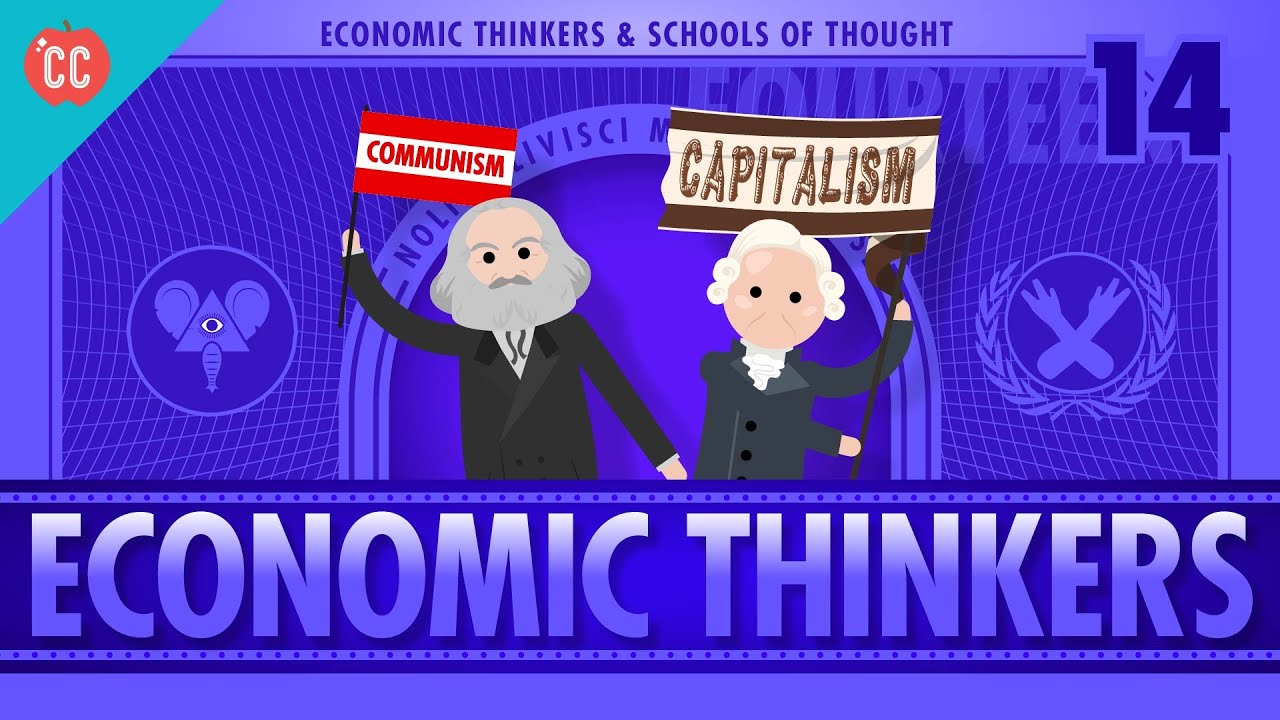
We talk a lot about Keynesian economics on this show, pretty much because the real world currently runs on Keynesian principles. That said, there are some other economic ideas out there, and today we're going to talk about a few of them. So, if you've been aching to hear about socialism, communism, the Chicago School, or the Austrian School, this episode is for you.
Crash Course is on Patreon! You can support us directly by signing up at http://www.patreon.com/crashcourse
Thanks to the following Patrons for their generous monthly contributions that help keep Crash Course free for everyone forever:
Fatima Iqbal, Penelope Flagg, Eugenia Karlson, Alex S, Jirat, Tim Curwick, Christy Huddleston, Eric Kitchen, Moritz Schmidt, Today I Found Out, Avi Yashchin, Chris Peters, Eric Knight, Jacob Ash, Simun Niclasen, Jan Schmid, Elliot Beter, Sandra Aft, SR Foxley, Ian Dundore, Daniel Baulig, Jason A Saslow, Robert Kunz, Jessica Wode, Steve Marshall, Anna-Ester Volozh, Christian, Caleb Weeks, Jeffrey Thompson, James Craver, and Markus Persson
Want to find Crash Course elsewhere on the internet?
Facebook - http://www.facebook.com/YouTubeCrashCourse
Twitter - http://www.twitter.com/TheCrashCourse
Tumblr - http://thecrashcourse.tumblr.com
Support Crash Course on Patreon: http://patreon.com/crashcourse
CC Kids: http://www.youtube.com/crashcoursekids
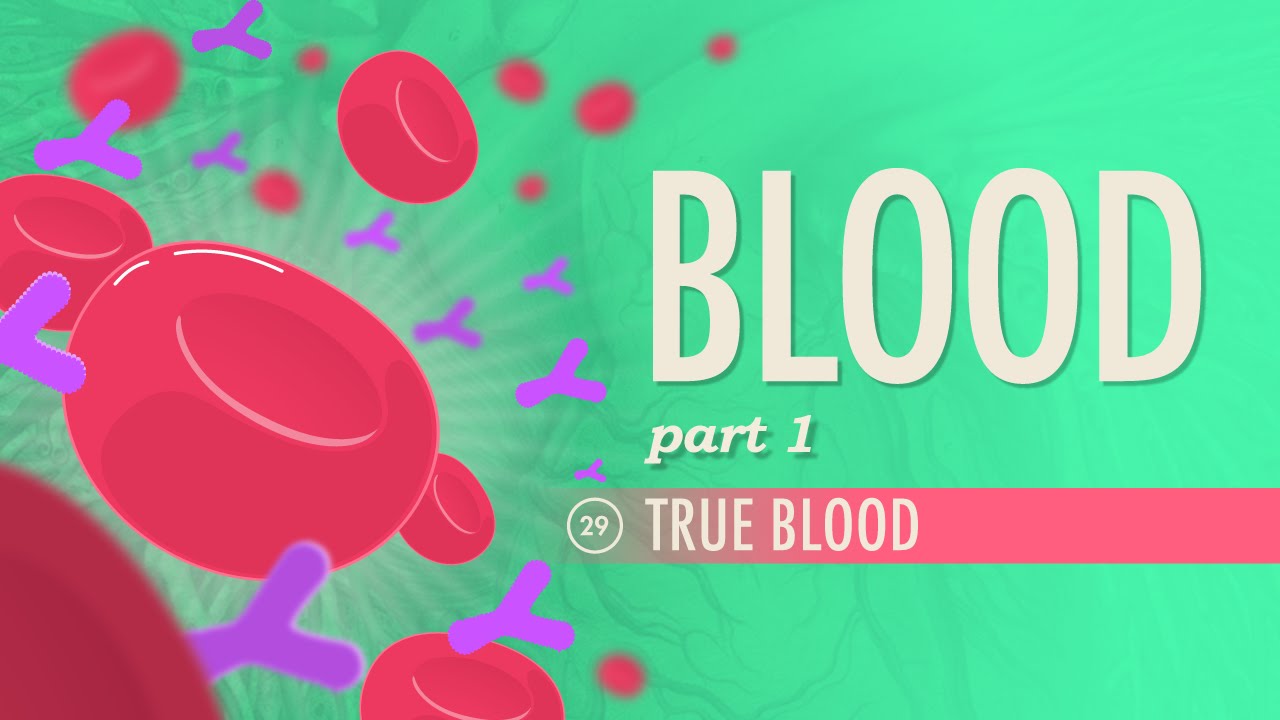
Now that we've talked about your blood vessels, we're going to zoom in a little closer and talk about your blood itself. We'll start by outlining the basic components of blood -- including erythrocytes, leukocytes, platelets, and plasma -- as well as the basic process of hemostasis that stops bleeding, and how antigens are responsible for the blood type that you have. By the end of this episode, you should be totally prepared for your next blood drive.
Pssst... we made flashcards to help you review the content in this episode! Find them on the free Crash Course App!
Download it here for Apple Devices: https://apple.co/3d4eyZo
Download it here for Android Devices: https://bit.ly/2SrDulJ
Chapters:
Introduction: Let's Talk Blood 00:00
How Blood Donation Works 2:00
Blood Components: Erythrocytes, Leukocytes, Platelets, and Plasma 3:00
Plasma - Electrolytes 3:38
Plasma Proteins 4:03
Hemostasis: How Bleeding Works 4:30
Antigens & Blood Types 6:21
Review 9:05
Credits 9:32
***
Crash Course is on Patreon! You can support us directly by signing up at http://www.patreon.com/crashcourse
Thanks to the following Patrons for their generous monthly contributions that help keep Crash Course free for everyone forever:
Mark, Jan Schmid, Simun Niclasen, Robert Kunz, Daniel Baulig, Jason A Saslow, Eric Kitchen, Christian, Beatrice Jin, Anna-Ester Volozh, Eric Knight, Elliot Beter, Jeffrey Thompson, Ian Dundore, Stephen Lawless, Today I Found Out, James Craver, Jessica Wode, Sandra Aft, Jacob Ash, SR Foxley, Christy Huddleston, Steve Marshall, Chris Peters
--
Want to find Crash Course elsewhere on the internet?
Facebook - http://www.facebook.com/YouTubeCrashCourse
Twitter - http://www.twitter.com/TheCrashCourse
Tumblr - http://thecrashcourse.tumblr.com
Support Crash Course on Patreon: http://patreon.com/crashcourse
CC Kids: http://www.youtube.com/crashcoursekids
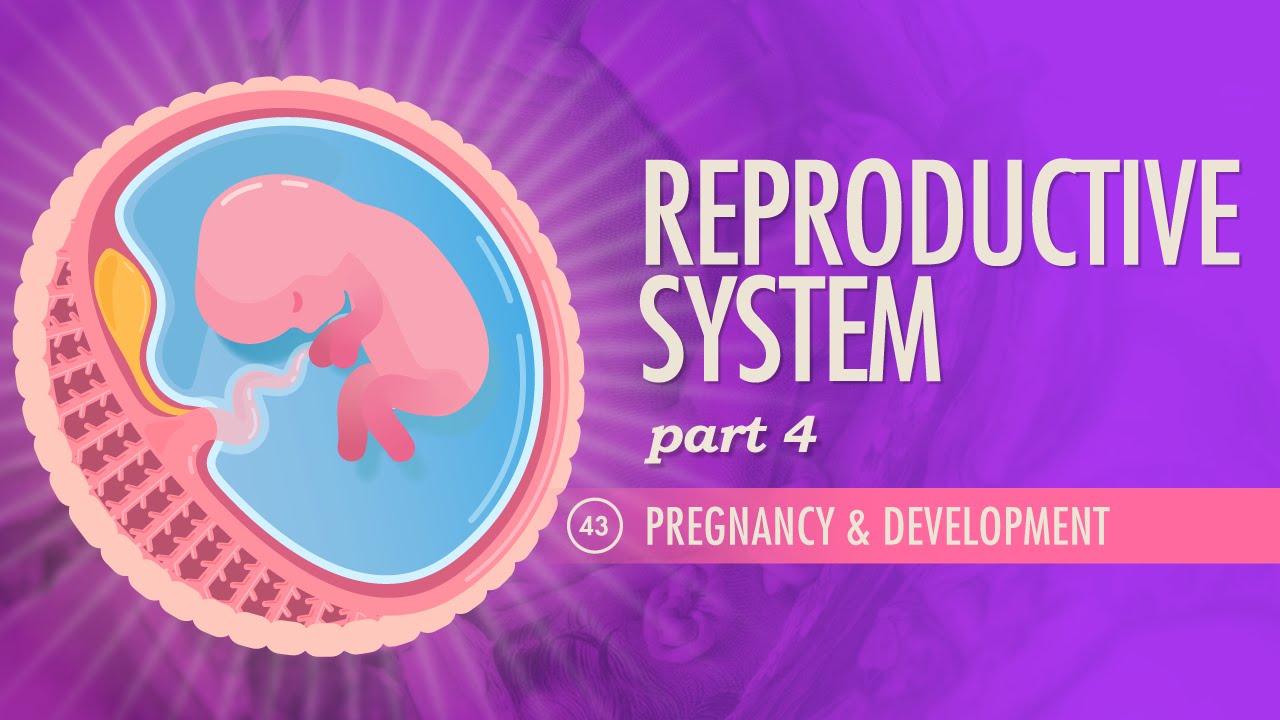
We've reached the grand finale of our four-part series on human reproduction: BABIES! Today Hank walks you through the stages of pregnancy, beginning with how a zygote develops into blastomeres to a morula to a blastocyst, and finally to an embryo and a fetus. He also explains some of the amazing anatomical changes that take place in the mother and the hormonal sequence of events that lead to labor.
Pssst... we made flashcards to help you review the content in this episode! Find them on the free Crash Course App!
Download it here for Apple Devices: https://apple.co/3d4eyZo
Download it here for Android Devices: https://bit.ly/2SrDulJ
Chapters:
Introduction: How Did You Get Here? 00:00
Cleavage Stage: Zygote, Blastomeres, Morula, Blastocyst1:34
Implantation 3:08
The Placenta 4:50
Embryonic Stage 5:07
Female Anatomical Changes During Pregnancy 5:30
Hormonal Sequences Leading to Labor 7:12
Stages of Labor: Dilation, Expulsion, Placental Delivery 8:35
Review 9:34
***
Crash Course is on Patreon! You can support us directly by signing up at http://www.patreon.com/crashcourse
Thanks to the following Patrons for their generous monthly contributions that help keep Crash Course free for everyone forever:
Mark, Eric Kitchen, Jessica Wode, Jeffrey Thompson, Steve Marshall, Moritz Schmidt, Robert Kunz, Tim Curwick, Jason A Saslow, SR Foxley, Elliot Beter, Jacob Ash, Christian, Jan Schmid, Jirat, Christy Huddleston, Daniel Baulig, Chris Peters, Anna-Ester Volozh, Ian Dundore, Caleb Weeks
--
Want to find Crash Course elsewhere on the internet?
Facebook - http://www.facebook.com/YouTubeCrashCourse
Twitter - http://www.twitter.com/TheCrashCourse
Tumblr - http://thecrashcourse.tumblr.com
Support Crash Course on Patreon: http://patreon.com/crashcourse
CC Kids: http://www.youtube.com/crashcoursekids

What’s the life of a cell like? In this episode of Crash Course Biology, we’ll follow a cell’s life cycle, from its beginning as a shiny new cell all the way to division via mitosis. We’ll learn how our cells control this process, and what happens when things go wrong.
Chapters:
Main Character Energy 00:00
Cellular Division 1:26
Interphase 2:36
Mitosis & Cytokinesis 5:06
The Cell Cycle Control System 8:24
Cancer & Dr. Jane Cooke Wright 9:14
Review & Credits 9:53
This series was produced in collaboration with HHMI BioInteractive, committed to empowering educators and inspiring students with engaging, accessible, and quality classroom resources. Visit https://BioInteractive.org/CrashCourse for more information.
Check out our Biology playlist here: https://www.youtube.com/playli....st?list=PL8dPuuaLjXt
Watch this series in Spanish on our Crash Course en Español channel here: https://www.youtube.com/playli....st?list=PLkcbA0DkuFj
Sources: https://docs.google.com/docume....nt/d/1GLDtAXE6ekg4Ch
***
Crash Course is on Patreon! You can support us directly by signing up at http://www.patreon.com/crashcourse
Thanks to the following patrons for their generous monthly contributions that help keep Crash Course free for everyone forever:
Leah H., David Fanska, Andrew Woods, Tawny Whaley, Sean Saunders, DL Singfield, Ken Davidian, Stephen Akuffo, Toni Miles, Steve Segreto, Kyle & Katherine Callahan, Laurel Stevens, Burt Humburg, Aziz Y, Perry Joyce, Scott Harrison, Mark & Susan Billian, Alan Bridgeman, Breanna Bosso, Matt Curls, Jennifer Killen, Starstuff42, Jon Allen, Sarah & Nathan Catchings, team dorsey, Bernardo Garza, Trevin Beattie, Eric Koslow, Indija-ka Siriwardena, Jason Rostoker, Siobhán, Ken Penttinen, Nathan Taylor, Barrett Nuzum, Les Aker, William McGraw, Vaso, ClareG, Rizwan Kassim, Constance Urist, Alex Hackman, Pineapples of Solidarity, Katie Dean, Stephen McCandless, Thomas Greinert, Wai Jack Sin, Ian Dundore, Caleb Weeks
__
Want to find Crash Course elsewhere on the internet?
Instagram - https://www.instagram.com/thecrashcourse/
Facebook - http://www.facebook.com/YouTubeCrashCourse
Twitter - http://www.twitter.com/TheCrashCourse
CC Kids: http://www.youtube.com/crashcoursekids
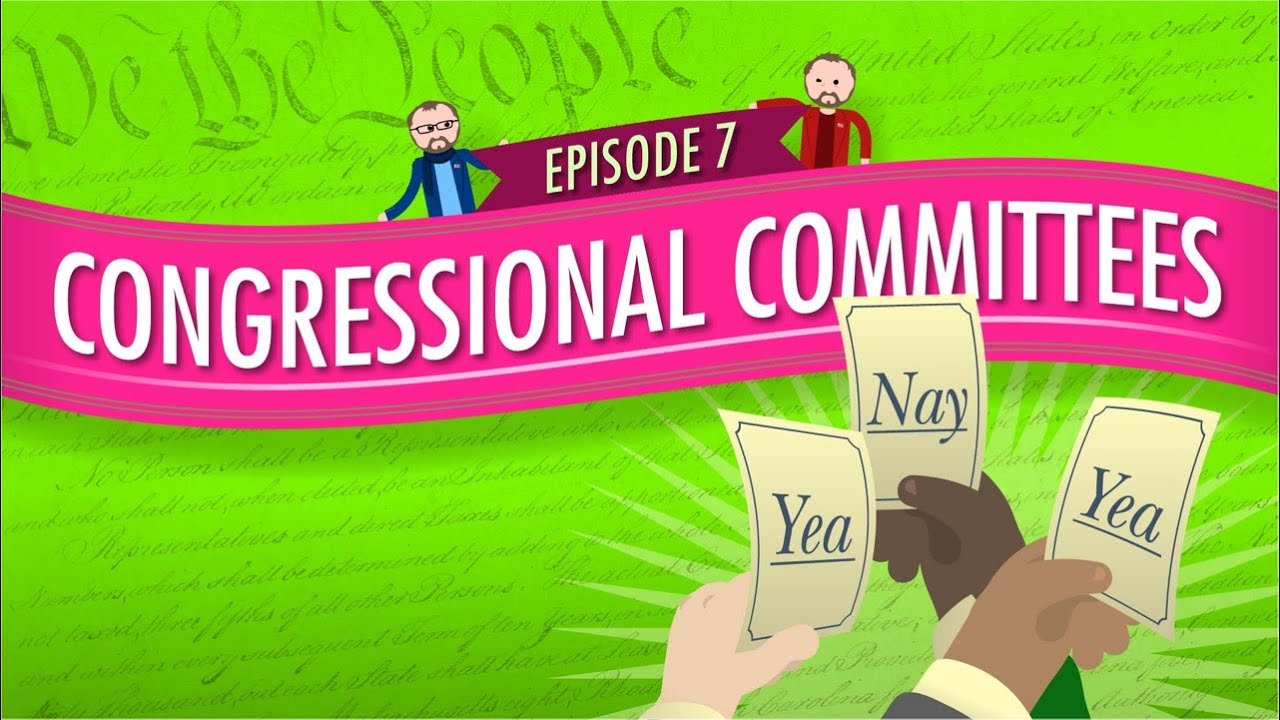
This week Craig Benzine clears up the role of committees in Congress. We’ll talk about standing committees, joint committees, conference committees, and caucuses (and not the candidate-choosing kinds) as well as the staff agencies that help advise these committees and congresspeople. As most bills never even make it to the house and senate floors for a vote, the role of committees, and their respective chairpersons as gatekeepers is pretty important. There’s a lot to demystify here as the legislative process can seem pretty arcane at times, but the model, at least in theory, helps Congress run more efficiently.
Produced in collaboration with PBS Digital Studios: http://youtube.com/pbsdigitalstudios
Support is provided by Voqal: http://www.voqal.org
Chapters:
Introduction: How does Congress work? 00:00
Congressional committees 0:40
Why does Congress have committees? 1:52
How do congressional committees work? 2:44
How Congress got its leadership structure 4:09
Congressional staff 5:03
Specialized staff agencies in Congress 5:35
Caucuses in Congress 6:15
Caucuses, congressional staff, & committees help make lawmaking more efficient 7:16
Credits 7:55
Crash Course is on Patreon! You can support us directly by signing up at http://www.patreon.com/crashcourse
Want to find Crash Course elsewhere on the internet?
Facebook - http://www.facebook.com/YouTubeCrashCourse
Twitter - http://www.twitter.com/TheCrashCourse
Instagram - https://www.instagram.com/thecrashcourse/
CC Kids: http://www.youtube.com/crashcoursekids
Now that we’ve left behind the philosophy of religion, it’s time to start exploring what other ways might exist to find meaning in the world. Today we explore essentialism and its response: existentialism. We’ll also learn about Jean-Paul Sartre and his ideas about how to find meaning in a meaningless world.
--
Taylor Swift drawing by Joezart: http://joezart.deviantart.com/....art/Taylor-Swift-569 Graduate and proud parents by Christopher Brown: https://www.flickr.com/photos/....xopherbrown/56211258
All other images and video either public domain or via VideoBlocks, Unsplash, or Wikimedia Commons, licensed under Creative Commons BY 4.0: https://creativecommons.org/licenses/by/4.0/
--
Produced in collaboration with PBS Digital Studios: http://youtube.com/pbsdigitalstudios
Crash Course Philosophy is sponsored by Squarespace.
http://www.squarespace.com/crashcourse
--
Want to find Crash Course elsewhere on the internet?
Facebook - http://www.facebook.com/YouTubeCrashC...
Twitter - http://www.twitter.com/TheCrashCourse
Tumblr - http://thecrashcourse.tumblr.com
Support CrashCourse on Patreon: http://www.patreon.com/crashcourse
CC Kids: http://www.youtube.com/crashcoursekids
After serial photography became a thing, it wasn't long before motion pictures started to develop. And, at the front of that development was Thomas Edison, who you may know as an inventor and business person. In this episode of Crash Course Film History, Craig talks to us about Edison, his assistant W.K.L. Dickson, and their inventions that pioneered motion pictures.
Produced in collaboration with PBS Digital Studios: http://youtube.com/pbsdigitalstudios
Want to know more about Craig?
https://www.youtube.com/user/wheezywaiter
The Latest from PBS Digital Studios: https://www.youtube.com/playli....st?list=PL1mtdjDVOoO
***
Images Used are in the Public Domain and from the Library of Congress.
***
Want to find Crash Course elsewhere on the internet?
Facebook - http://www.facebook.com/YouTubeCrashCourse
Twitter - http://www.twitter.com/TheCrashCourse
Tumblr - http://thecrashcourse.tumblr.com
Support Crash Course on Patreon: http://patreon.com/crashcourse
CC Kids: http://www.youtube.com/crashcoursekids
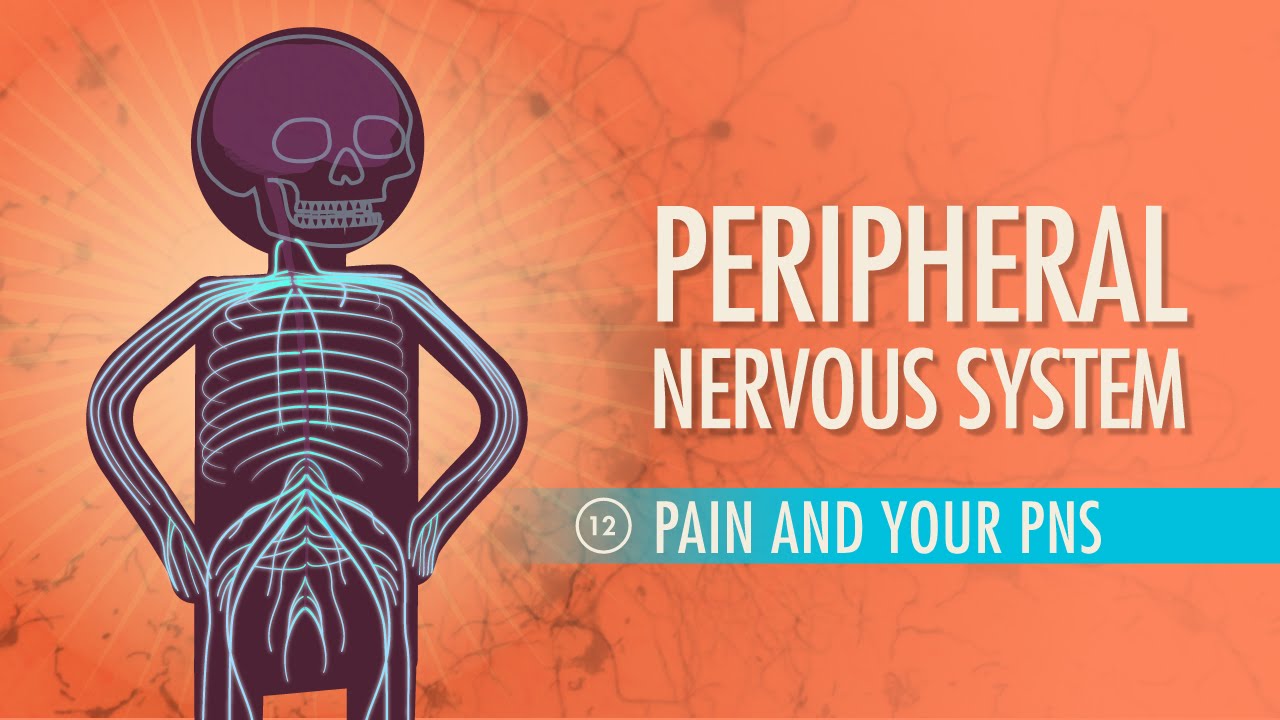
It is now time to meet the system that helps your brain stay in touch with the outside world. We follow up last week's tour of the central nervous system with a look at your peripheral nervous system, its afferent and efferent divisions, how it processes information, the reflex arc, and what your brain has to say about pain.
Pssst... we made flashcards to help you review the content in this episode! Find them on the free Crash Course App!
Download it here for Apple Devices: https://apple.co/3d4eyZo
Download it here for Android Devices: https://bit.ly/2SrDulJ
Chapters:
Introduction: Peripheral Nervous System 00:00
Sensory Nerve Receptors: Thermoreceptors, Photoreceptors, Chemoreceptors, Mechanoreceptors, and Nociceptors 0:56
What is Pain? 1:54
How Pain is Processed 2:51
Pain Threshold vs Pain Tolerance 3:50
How the Brain Processes Pain 4:25
Afferent and Efferent Divisions 5:42
Five Steps of the Reflex Arc 6:38
What the Brain Says About Pain 8:09
Review 9:09
Credits 9:39
***
Crash Course is on Patreon! You can support us directly by signing up at http://www.patreon.com/crashcourse
Want to find Crash Course elsewhere on the internet?
Facebook - http://www.facebook.com/YouTubeCrashCourse
Twitter - http://www.twitter.com/TheCrashCourse
Instagram - https://www.instagram.com/thecrashcourse/
CC Kids: http://www.youtube.com/crashcoursekids
***SUPPORTER THANK YOU!***
Thank you so much to all of our awesome supporters for their contributions to help make Crash Course possible and freely available for everyone forever:
Dan Rajan
Josh Greenberg @wordlessrage
Tanmay Sheth
Chriztopher North
Teodora Miclaus
Jessica Baker
Julie Anne Mathieu
Moti Lieberman
Leanne Gover
www.justplainsomething.com

You're already learning on YouTube — why not get college credit for it? https://link.gostudyhall.com/my1
In this episode of Crash Course: How to College, Erica helps us think about how to best choose the right school for us. There's a lot to think about, like: what kind of learner you are, what kind of environment you like, how to know if your school is looking out for your success, what kinds of support do different schools offer, and of course what do you want to study?
Crash Course: How to College is part of Study Hall, a partnership between ASU and Crash Course. Head over to our new Study Hall channel to check out our Fast Guide series which break down different college majors.
***
Now you can take top-tier college courses with Study Hall! Study Hall videos are available to watch at no cost, and first-year courses are $25 to sign-up and begin coursework. Once you're satisfied with your grade, receive credit for only $400. Sign up at https://link.gostudyhall.com/my1
Follow Study Hall on socials!
Twitter: https://twitter.com/gostudyhall
Instagram: https://Instagram.com/GoStudyHall
Facebook: https://www.facebook.com/GoStudyHall
__________________________________________________________________________
Chapters:
0:00 - Introduction
1:00 - How to find the right fit
4:10 - Types of colleges to choose from
5:57 - How to choose
6:21 - Modalities
7:09 - Conclusion
__________________
Watch our videos and review your learning with the Crash Course App!
Download here for Apple Devices: https://apple.co/3d4eyZo
Download here for Android Devices: https://bit.ly/2SrDulJ
Crash Course is on Patreon! You can support us directly by signing up at http://www.patreon.com/crashcourse
Thanks to the following patrons for their generous monthly contributions that help keep Crash Course free for everyone forever:
Dave Freeman, Hasan Jamal, DL Singfield, Lisa Owen, Jeremy Mysliwiec, Amelia Ryczek, Ken Davidian, Stephen Akuffo, Toni Miles, Erin Switzer, Steve Segreto, Michael M. Varughese, Kyle & Katherine Callahan, Laurel Stevens, Vincent, Michael Wang, Stacey Gillespie (Stacey J), Alexis B, Burt Humburg, Aziz Y, Shanta, DAVID MORTON HUDSON, Perry Joyce, Scott Harrison, Mark & Susan Billian, Junrong Eric Zhu, Rachel Creager, Breanna Bosso, Matt Curls, Tim Kwist, Jonathan Zbikowski, Jennifer Killen, Sarah & Nathan Catchings, team dorsey, Trevin Beattie, Divonne Holmes à Court, Eric Koslow, Jennifer, Dineen, Indika Siriwardena, Khaled El Shalakany, Jason Rostoker, Shawn Arnold, Siobhán, Ken Penttinen, Nathan Taylor, Les Aker, ClareG, Rizwan Kassim, Alex Hackman, Jirat, Katie Dean, Avi Yashchin, NileMatotle, Wai Jack Sin, Ian Dundore, Justin, Mark, Caleb Weeks
__
Want to find Crash Course elsewhere on the internet?
Facebook - http://www.facebook.com/YouTubeCrashC...
Twitter - http://www.twitter.com/TheCrashCourse
Tumblr - http://thecrashcourse.tumblr.com
Support Crash Course on Patreon: http://patreon.com/crashcourse
CC Kids: http://www.youtube.com/crashcoursekids"
#CrashCourse #HowtoCollege #StudyHall
***
Watch our videos and review your learning with the Crash Course App!
Download here for Apple Devices: https://apple.co/3d4eyZo
Download here for Android Devices: https://bit.ly/2SrDulJ
Crash Course is on Patreon! You can support us directly by signing up at http://www.patreon.com/crashcourse
Thanks to the following patrons for their generous monthly contributions that help keep Crash Course free for everyone forever:
Dave Freeman, Hasan Jamal, DL Singfield, Lisa Owen, Jeremy Mysliwiec, Amelia Ryczek, Ken Davidian, Stephen Akuffo, Toni Miles, Erin Switzer, Steve Segreto, Michael M. Varughese, Kyle & Katherine Callahan, Laurel Stevens, Vincent, Michael Wang, Stacey Gillespie (Stacey J), Alexis B, Burt Humburg, Aziz Y, Shanta, DAVID MORTON HUDSON, Perry Joyce, Scott Harrison, Mark & Susan Billian, Junrong Eric Zhu, Rachel Creager, Breanna Bosso, Matt Curls, Tim Kwist, Jonathan Zbikowski, Jennifer Killen, Sarah & Nathan Catchings, team dorsey, Trevin Beattie, Divonne Holmes à Court, Eric Koslow, Jennifer, Dineen, Indika Siriwardena, Khaled El Shalakany, Jason Rostoker, Shawn Arnold, Siobhán, Ken Penttinen, Nathan Taylor, Les Aker, ClareG, Rizwan Kassim, Alex Hackman, Jirat, Katie Dean, Avi Yashchin, NileMatotle, Wai Jack Sin, Ian Dundore, Justin, Mark, Caleb Weeks
__
Want to find Crash Course elsewhere on the internet?
Facebook - http://www.facebook.com/YouTubeCrashCourse
Twitter - http://www.twitter.com/TheCrashCourse
Tumblr - http://thecrashcourse.tumblr.com
Support Crash Course on Patreon: http://patreon.com/crashcourse
CC Kids: http://www.youtube.com/crashcoursekids
Today, Craig Benzine is going to tell you about the Supreme Court's most important case, Marbury v. Madison, and how the court granted itself the power of judicial review. Judicial review is the power to examine and invalidate actions of the legislative and executive branches. It happens at both the state and federal court levels, but today we're going to focus primarily on the court at the top - the Supreme Court of the United States. Now it's important to remember that the court has granted itself these powers and they aren't found within the Constitution, but as with the executive and legislative branches, the courts rely heavily on implied powers to get stuff done.
Produced in collaboration with PBS Digital Studios: http://youtube.com/pbsdigitalstudios
Support is provided by Voqal: http://www.voqal.org
All Flickr.com images are licensed under Creative Commons by Attribution 2.0
https://creativecommons.org/li....censes/by/2.0/legalc
Want to find Crash Course elsewhere on the internet?
Facebook - http://www.facebook.com/YouTubeCrashCourse
Twitter - http://www.twitter.com/TheCrashCourse
Tumblr - http://thecrashcourse.tumblr.com
Support Crash Course on Patreon: http://patreon.com/crashcourse
CC Kids: http://www.youtube.com/crashcoursekids

In this video you will find a compilation of videos that are focused on learning the vowels and numbers 1-10. By watching this video you will encounter how to write, pronounce and use each vowel in a sentence. Each vowel explanation is followed by a catchy song. Also, you will discover fun ways to learn how to count, such as with Suki the cookie. Come with us on this fun learning adventure! This video belongs to a collection of videos that teaches kids the basic foundations of knowledge. These videos always engage children with catchy songs and creative characters.
Thanks for visiting us! If you want your children to smile and learn, subscribe! :D
We only upload our own content, designed by educators so that children smile and learn while watching a video.
All of our content reinforces educational values, encouraging the use of multiple intelligences and language learning.
If you like our videos, download “The Smart Library” now. You’ll discover more than 70 interactive games and stories for children designed by educators. The stories are based on VALUES like friendship, respect, and generosity, and our games cover all of the MULTIPLE INTELLIGENCES. All our content is in SPANISH, ENGLISH, FRENCH, ITALIAN and PORTUGUESE.
The perfect tool to use in and out of school.
Download it today!
-Apple Store: https://itunes.apple.com/us/ap....p/smart-edutainment-
-Google Play: https://play.google.com/store/....apps/details?id=net.
www.smileandlearn.com
Thank you for trusting us with your children's education!

Kids educational video, to learn how to cook delicious recipes, like the tiramisu dessert or the watermelon shake. Ideal for family cooking at any time of the year.
This is a compilation video about dessert cooking, part of a larger video collection on Nutrition and Recipes, for kids to learn how to cook in a fun way. Wonderful resource for Primary School and Preschool.
Thanks for visiting us! If you want your children to smile and learn, subscribe! :D
We only upload our own content, designed by educators so that children smile and learn while watching a video.
All of our content reinforces educational values, encouraging the use of multiple intelligences and language learning.
If you like our videos, download “The Smart Library” now. You’ll discover more than 70 interactive games and stories for children designed by educators. The stories are based on VALUES like friendship, respect, and generosity, and our games cover all of the MULTIPLE INTELLIGENCES. All our content is in SPANISH, ENGLISH, FRENCH, ITALIAN and PORTUGUESE.
The perfect tool to use in and out of school.
Download it today!
-Apple Store: https://itunes.apple.com/us/ap....p/smart-edutainment-
-Google Play: https://play.google.com/store/....apps/details?id=net.
www.smileandlearn.com
Thank you for trusting us with your children's education!

Educational video for children that talks about plants, including plant classification, photosynthesis and the parts of a plant. To begin, we can classify plants into two types: plants without flowers, called cryptogams and flowering plants, called phanerogams. The main characteristic of cryptogams is that they don't have flowers and we cannot easily distinguish the parts that form them because the root, the stem and leaves are not very well defined. Phanerogams are flowering plants. The reproduction of these plants is usually sexual, which means that it requires a female and a male reproductive cell to come together. Phanerogams always reproduce by seeds. In addition, it is important to remember that plants do photosynthesis. Photosynthesis is a process that plants do to produce their own food. In the process of photosynthesis the plant transforms water, sunlight and carbon dioxide into oxygen. Finally, we will learn the parts of the plant. One of them is the root, which is the part below the ground. Its functions are supporting the plants and absorbing water and mineral salts. The stem gives stability to the plants, transports water and mineral salts absorbed by the roots, and distributes the food produced by photosynthesis throughout the plant. Leaves grow from the stem and are green in color due to the pigment called chlorophyll. Plants use them to breathe and photosynthesize.
This video is a very useful and interesting resource for children. It is perfect for children to learn all about plants. It is an excellent video for primary education.
Thanks for visiting us! If you want your children to smile and learn, subscribe! :D
If you like our videos, download Smile and Learn now. You’ll discover thousands of activities for children aged 3 to 12 years, all designed by educators. We have hundreds of games, interactive stories and videos in five languages: English, Spanish, Portuguese, Italian, Turkish and French. Try a month for free and start the adventure!
www.smileandlearn.com

Educational video for children to learn what terrestrial habitats are. We call habitat a place that has the necessary resources so that living beings can survive. These resources are the light, the water, the temperature, the ground and the oxygen. There are two types of natural habitats: terrestrial and aquatic. Thanks to this video, the little ones will discover the characteristics of terrestrial habitats and the living beings that live there. Our explorer will walk children through the desert, the jungle, the woods, the prairie and the savanna.
Thanks for visiting us! If you want your children to smile and learn, subscribe! :D
We only upload our own content, designed by educators so that children smile and learn while watching a video.
All of our content reinforces educational values, encouraging the use of multiple intelligences and language learning.
If you like our videos, download Smile and Learn now. You’ll discover more than 5.000 activities for children aged 3 to 12 yeards, all designed by educators. We have 250 games and interactive stories and over 280 videos in five languages: English, Spanish, Portuguese, Italian and French. Try a month for free and start the adventure!