Top videos
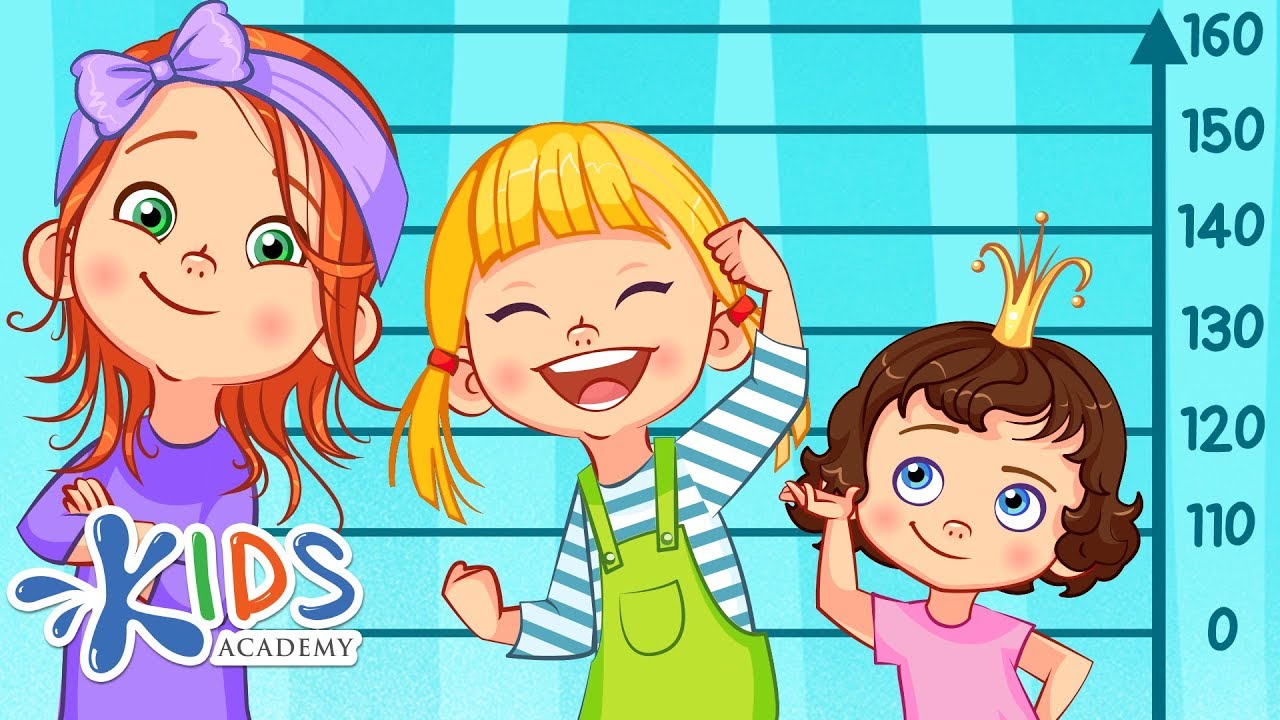
Thousands of parents and educators are turning to the kids’ learning app that makes real learning truly fun. Try Kids Academy with
3-day FREE TRIAL! https://bit.ly/2GuGyL2
Teaching measurement and comparing lengths has many benefits. Young children that have a good understanding of measurement have the skills to compare attributes of objects and classify things in their environments in different ways. Measurement links math to their everyday lives, other school subjects, and increases understanding of number concepts and spatial skills.
At Kid’s Academy, measurement and comparing lengths are explained and taught clearly and concisely with video lessons and worksheet activities.
The video lessons include instruction on comparing lengths and height of objects. Students learn how to classify objects as tallest, shortest, or longer and shorter. Students use higher order thinking skills to answer questions such as: what is the second shortest object or what object is shorter than the giraffe but taller than the tiger? The recorded lessons about comparing lengths for kids include answering questions such as finding the correct illustration with clues such as: Emma is shorter that Jenny, Jenny is shorter than Sarah. The video teachers define measurement terms and show students how to think through the more difficult questions with illustrations and examples on the teacher whiteboard.
Often in life, measuring without a ruler or other tool is required. Students, using these video lessons have the opportunity to measure items using non-standard units as well as measuring using an inch ruler. Comparing non-standard units to standard measurement tools allows students to connect measurement to their world.
Think of activities that go beyond the video lessons. Comparing length for kids is more fun when learning is extended. Compare the heights of children in the home or classroom. In the classroom, who has the longest pencil as compared to the teacher’s pencil? Ask the students if it is better to measure the length of a book with paper clips or a broomstick. Go outside and measure the length of the playground with a yardstick and a ruler. Have fun with this math skill!
The video illustrations are colorful, engaging and relevant for school and home classes that are comparing lengths for 1st grade. Teachers and parents using these resources from Kids Academy find the videos ideal for teaching, re-teaching, practice and enrichment.
Subscribe to our channel: https://goo.gl/iG2Bdr
#TalentedAndGifted #LearnWithKidsAcademy
Kids Academy Talented and Gifted Program for kids aged 2-10:
*****
Connect with us on :
App Store: https://smart.link/59833db06a6b8
Google Play: https://smart.link/597210af6eb83
Our website: http://www.kidsacademy.mobi
Facebook: https://www.facebook.com/KidsAcademyCompany
Twitter: https://twitter.com/KidsAcademyCo

2 1/4 + 3 1/2 – 2 1/3 =
3 2/5 – 3/4 + 5 1/2 =
Order of Operations:
1. https://youtu.be/xc2vTTNJmtk
2. https://youtu.be/H9pGgZiPnW0
3. https://youtu.be/erBUPGvisKA
4. https://youtu.be/X0KvWNfPeeI
5. https://youtu.be/vKNxfR-xD-Q
6. https://youtu.be/sJMPHWvIR28
7. https://youtu.be/0dyqntVf2WY
LCD
1. https://youtu.be/xddo-X_1xAY
2. https://youtu.be/9z6iZOu0kK4
3. https://youtu.be/k9L_2W49FEw
4. https://youtu.be/KYv7QmJutUs
Paano Mag SELF REVIEW | Sekreto para PUMASA:
1. https://youtu.be/cY9WMaMmaKk
2. https://youtu.be/SiZFsdcvSqw
Paano e turn OFF ang annoying SUBTITLE:
https://youtu.be/ID2YekF5Ka4
You can SHARE the LINK of my videos but DO NOT re-upload.
FB Page:
Free Civil Service Reviewers managed by Leonalyn
https://www.facebook.com/Leona....lynMutiaTayoneFreeRe
FB Group:
Philippine Civil Service Review for all
https://www.facebook.com/group....s/121644125187853/?r
Huwag nyong lagyan ng SUBTITLE mga videos ko para makapanood kayo ng buo at walang sagabal. Watch this kung paano:
https://youtu.be/ID2YekF5Ka4
Behind the scene:
https://youtu.be/qJgEzWnDp_8
Editing Apps: VivaVideo
SamsungNote5: Snote
Back-up: SamsungNote9
Solving Math Problems for:
AFPSAT AQE SWE MATH CIVIL SERVICE EXAM
UPCAT LET PNPACAT PMA NCAE NAPOLCOM College Entrance Test DOST PMAEE

Kids educational video about another group of vertebrate animals: amphibians. These vertebrate animals are oviparous and they can live both on land and in the water. Kids will learn all about how amphibians breathe, where they’re born and what is the meaning of metamorphosis, among lots of other interesting facts.
This video is part of a larger video collection about animals for kids to learn in a fun way. Wonderful resource for Science class in Primary School.
Thanks for visiting us! If you want your children to smile and learn, subscribe! :D
We only upload our own content, designed by educators so that children smile and learn while watching a video.
All of our content reinforces educational values, encouraging the use of multiple intelligences and language learning.
If you like our videos, download “The Smart Library” now. You’ll discover more than 70 interactive games and stories for children designed by educators. The stories are based on VALUES like friendship, respect, and generosity, and our games cover all of the MULTIPLE INTELLIGENCES. All our content is in SPANISH, ENGLISH, FRENCH, ITALIAN and PORTUGUESE.
The perfect tool to use in and out of school.
Download it today!
-Apple Store: https://itunes.apple.com/us/ap....p/smart-edutainment-
-Google Play: https://play.google.com/store/....apps/details?id=net.
www.smileandlearn.com
Thank you for trusting us with your children's education!

This story is about telling the truth and explains to kids that lies can be dangerous for everyone. In the anthill, there is an ant that doesn’t tell the truth and this causes a big problem for everyone.
Thanks for visiting us! If you want your children to smile and learn, subscribe! :D
Why is it good for children to see Smile and Learn’s videos?
+We only upload our own content, designed by educators so that children smile and learn while watching a video.
+All of our content reinforces educational values, encouraging the use of multiple intelligences and language learning.
*If you like our videos, download “The Smart Library” now. You’ll discover more than 30 interactive games and stories for children designed by educators. The stories are based on VALUES like friendship, respect, and generosity, and our games cover all of the MULTIPLE INTELLIGENCES. All our content is in SPANISH, ENGLISH, and FRENCH.
The perfect tool to use in and out of school.
Download it today!
-Apple Store: http://bit.ly/Biblioteca_Intel....igente_SmileandLearn
-Google Play: http://bit.ly/Biblioteca_Inteligente_GooglePlay
For more information, visit our website: https://smileandlearn.net/
If you want the latest news and new stories or games:
Follow us on:
+Facebook: https://www.facebook.com/Smileandlearn
+Instagram: https://www.instagram.com/smileandlearnapp/
+Twitter: https://twitter.com/smileandlearn
+Pinterest: https://es.pinterest.com/smileandlearn/
Thank you for trusting us with your children's education!
Using a number line, we'll explain the rule of "invert and multiply" when dividing two fractions.
Practice this lesson yourself on KhanAcademy.org right now: https://www.khanacademy.org/math/pre-algebra/fractions-pre-alg/div-fractions-fractions-pre-alg/e/understanding-dividing-fractions-by-fractions?utm_source=YT&utm_medium=Desc&utm_campaign=PreAlgebra
Watch the next lesson: https://www.khanacademy.org/math/pre-algebra/fractions-pre-alg/div-fractions-fractions-pre-alg/v/another-dividing-fractions-example?utm_source=YT&utm_medium=Desc&utm_campaign=PreAlgebra
Missed the previous lesson?
https://www.khanacademy.org/math/pre-algebra/fractions-pre-alg/dividing-fractions-pre-alg/v/dividing-fractions-word-problem?utm_source=YT&utm_medium=Desc&utm_campaign=PreAlgebra
Pre-Algebra on Khan Academy: No way, this isn't your run of the mill arithmetic. This is Pre-algebra. You're about to play with the professionals. Think of pre-algebra as a runway. You're the airplane and algebra is your sunny vacation destination. Without the runway you're not going anywhere. Seriously, the foundation for all higher mathematics is laid with many of the concepts that we will introduce to you here: negative numbers, absolute value, factors, multiples, decimals, and fractions to name a few. So buckle up and move your seat into the upright position. We're about to take off!
About Khan Academy: Khan Academy offers practice exercises, instructional videos, and a personalized learning dashboard that empower learners to study at their own pace in and outside of the classroom. We tackle math, science, computer programming, history, art history, economics, and more. Our math missions guide learners from kindergarten to calculus using state-of-the-art, adaptive technology that identifies strengths and learning gaps. We've also partnered with institutions like NASA, The Museum of Modern Art, The California Academy of Sciences, and MIT to offer specialized content.
For free. For everyone. Forever. #YouCanLearnAnything
Subscribe to KhanAcademy’s Pre-Algebra channel:: https://www.youtube.com/channe....l/UCIMlYkATtXOFswVoC
Subscribe to KhanAcademy: https://www.youtube.com/subscr....iption_center?add_us

สะเทือนวงการ AI อีกครั้ง เมื่อ Anthropic เปิดตัวโมเดลเรือธงรุ่นใหม่ Claude Opus 4.6 อย่างเป็นทางการ
ซึ่งจะไม่ได้มาเป็นผู้ช่วยแชตบอตอีกต่อไป แต่มากำหนดนิยามใหม่ของพนักงานดิจิทัลในยุค AI
#AI #ClaudeOpus46 #ClaudeAI #Anthropic #AI #TNNTech
—--
#TNNOriginals
—--
ติดตามข่าวสารทันโลก ทันเหตุการณ์
https://www.tnnthailand.com
https://www.facebook.com/TNNthailand/
https://twitter.com/tnnthailand
https://www.instagram.com/tnn_online/
https://www.tiktok.com/@tnnonline
This video is for those of you who are considering joining my YouTube Channel Membership Program.
Join The YouTube Membership Program:
https://www.youtube.com/channe....l/UCEWpbFLzoYGPfuWUM
Patreon Membership Program:
https://www.patreon.com/MathScienceTutor

#navodaya
#sainik
#aissee
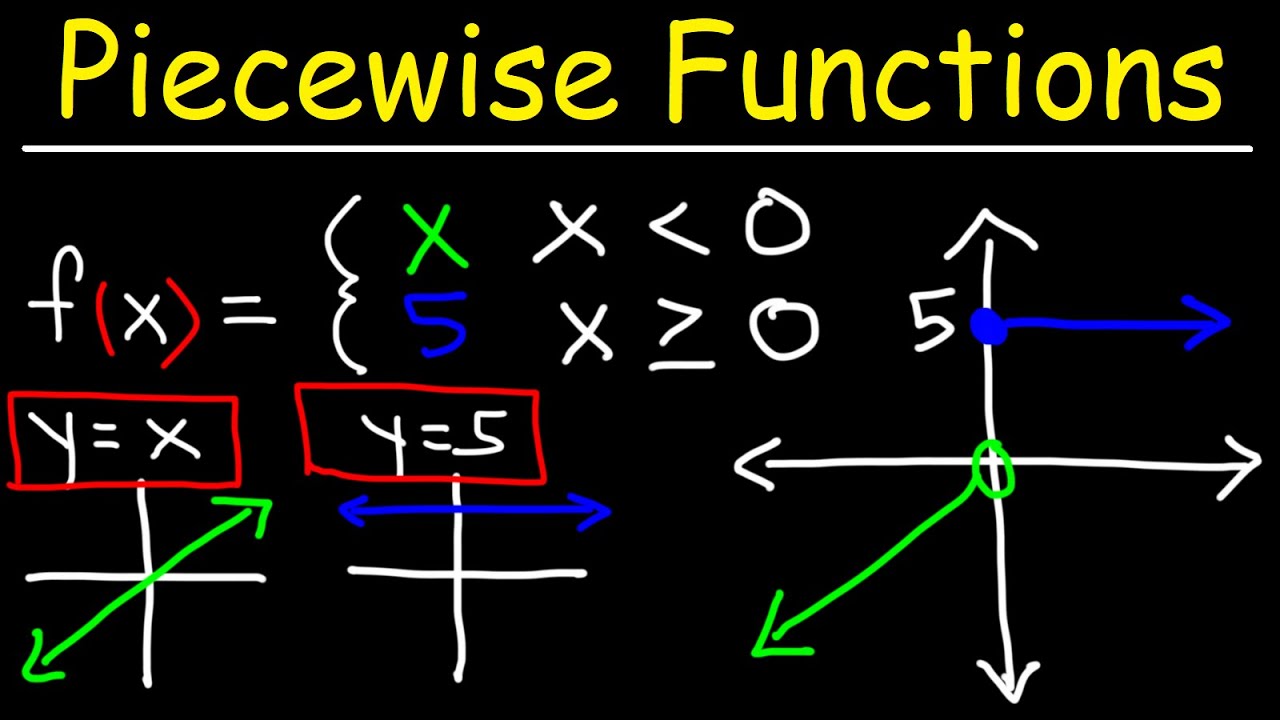
This precalculus video tutorial provides a basic introduction on graphing piecewise functions. It contains linear functions, quadratic functions, radical functions, and rational functions. This video contains plenty examples and practice problems on how to graph piecewise functions.
Introduction to Functions:
https://www.youtube.com/watch?v=DrEXTC6mIO8
Evaluating Functions:
https://www.youtube.com/watch?v=HyNie_PYgsY
Function Operations:
https://www.youtube.com/watch?v=3gaxVHVI4cI
Increasing and Decreasing Functions:
https://www.youtube.com/watch?v=Dyl7jPlJXOM
Relative Maximum & Minimum Values:
https://www.youtube.com/watch?v=GaltHJF6WyI
_____________________________________
Relations and Functions:
https://www.youtube.com/watch?v=wbBY2tTqXDA
Domain and Range From a Graph:
https://www.youtube.com/watch?v=KirGQOwjBVI
How To Find The Domain of a Function:
https://www.youtube.com/watch?v=djT6-YamHaA
Average Rate of Change of a Function:
https://www.youtube.com/watch?v=f_Q0qlwlclQ
The Difference Quotient of a Function:
https://www.youtube.com/watch?v=qQgVomi8lCc
_____________________________________
Evaluating Piecewise Functions:
https://www.youtube.com/watch?v=OYOXMyFKotc
Graphing Piecewise Functions:
https://www.youtube.com/watch?v=Uzw9tsGq2Pw
Composite Functions:
https://www.youtube.com/watch?v=ZFPkQkURSxk
How To Evaluate Composite Functions:
https://www.youtube.com/watch?v=6vQxIG4lJ3w
Composite Functions - Data Table:
https://www.youtube.com/watch?v=6vQxIG4lJ3w
Comp. of 3 Functions - Data Table:
https://www.youtube.com/watch?v=Ote1KvW6BXw
Decomposing Functions:
https://www.youtube.com/watch?v=NmfaC7etZms
_________________________________
Introduction to Inverse Functions:
https://www.youtube.com/watch?v=TN4ybFiuV3k
How To Find The Inverse of a Function:
https://www.youtube.com/watch?v=2zeYEx4eTdc
Verifying Inverse Functions:
https://www.youtube.com/watch?v=6QamgSPprjA
Horizontal Line Test - 1 to 1 Functions:
https://www.youtube.com/watch?v=6u9Qh1Vi_Qw
Vertical Line Test:
https://www.youtube.com/watch?v=Mxe2lX1htNk
Graphing Inverse Functions:
https://www.youtube.com/watch?v=ukEtad_aml4
Composite and Inverse Functions:
https://www.youtube.com/watch?v=GEgFmxxOJno
__________________________________
Even and Odd Functions:
https://www.youtube.com/watch?v=fKyBOLsqRlo
Transformations of Functions:
https://www.youtube.com/watch?v=Tmdrjs9xufc
Linear Functions:
https://www.youtube.com/watch?v=BtcKotD6Ni8
Functions and Graphs - Problems:
https://www.youtube.com/watch?v=kvU9sOzT2mk
Functions - Test Review:
https://www.youtube.com/watch?v=1xATmTI-YY8
______________________________________
Final Exams and Video Playlists:
https://www.video-tutor.net/
Full-Length Videos and Worksheets:
https://www.patreon.com/MathSc....ienceTutor/collectio
Scientists tend to be careful and resistant to big claims. So evidence for the possible end of the living world took a while to be seen as such. In this episode of Crash Course History of Science, Hank talks to us about where Climate Science started and how it works today.
***
Crash Course is on Patreon! You can support us directly by signing up at http://www.patreon.com/crashcourse
Thanks to the following patrons for their generous monthly contributions that help keep Crash Course free for everyone forever:
Eric Prestemon, Sam Buck, Mark Brouwer, Laura Busby, Zach Van Stanley, Bob Doye, Jennifer Killen, Naman Goel, Nathan Catchings, Brandon Westmoreland, dorsey, Indika Siriwardena, Kenneth F Penttinen, Trevin Beattie, Erika & Alexa Saur, Glenn Elliott, Justin Zingsheim, Jessica Wode, Tom Trval, Jason Saslow, Nathan Taylor, Brian Thomas Gossett, Khaled El Shalakany, SR Foxley, Yasenia Cruz, Eric Koslow, Caleb Weeks, Tim Curwick, D.A. Noe, Shawn Arnold, Malcolm Callis, William McGraw, Andrei Krishkevich, Rachel Bright, Jirat, Ian Dundore
--
Want to find Crash Course elsewhere on the internet?
Facebook - http://www.facebook.com/YouTubeCrashCourse
Twitter - http://www.twitter.com/TheCrashCourse
Tumblr - http://thecrashcourse.tumblr.com
Support Crash Course on Patreon: http://patreon.com/crashcourse
CC Kids: http://www.youtube.com/crashcoursekids

This physics video tutorial provides a basic introduction into conservative and nonconservative forces. Examples of conservative forces include the electric force, the elastic force, and the gravitational force. Examples of nonconservative forces include friction, the applied force, any push or pull action including the tension force. This video connects the work done by conservative and nonconservative forces with the conservation of mechanical energy and shows how it's related to the change in the kinetic energy and potential energy of an object.
Work, Energy, and Power - Mega Review:
https://www.youtube.com/watch?v=_MR1Dp8-F8w
Kinetic Energy and Potential Energy:
https://www.youtube.com/watch?v=DyaVgHGssos
Mechanical Energy:
https://www.youtube.com/watch?v=VrLVUfB_t_U
What Is The Difference - Work Vs Energy?
https://www.youtube.com/watch?v=x5mJRp8f6Ok
Work - Dot Product Formula:
https://www.youtube.com/watch?v=p9938IIEhXU
___________________________________
Work Done By Gravity:
https://www.youtube.com/watch?v=j8Rf6hXXmUQ
Elastic Potential Energy and Hooke's Law:
https://www.youtube.com/watch?v=OmMIOZtM1ks
Work Required To Compress a Spring:
https://www.youtube.com/watch?v=H5fiVnbHIf4
Conservation of Energy:
https://www.youtube.com/watch?v=_DwG8fukuj4
Force and Potential Energy:
https://www.youtube.com/watch?v=e2QxsIyPjVI
____________________________________
Work Problems - Calculus:
https://www.youtube.com/watch?v=TLw8xbmnY3c
The Siphon - Potential Energy:
https://www.youtube.com/watch?v=LcgHlrtacJk
Homopolar Motor Compilation:
https://www.youtube.com/watch?v=MEdAvKiFe9w
Full-Length Videos and Worksheets:
https://www.patreon.com/MathSc....ienceTutor/collectio
Physics PDF Worksheets:
https://www.video-tutor.net/ph....ysics-basic-introduc
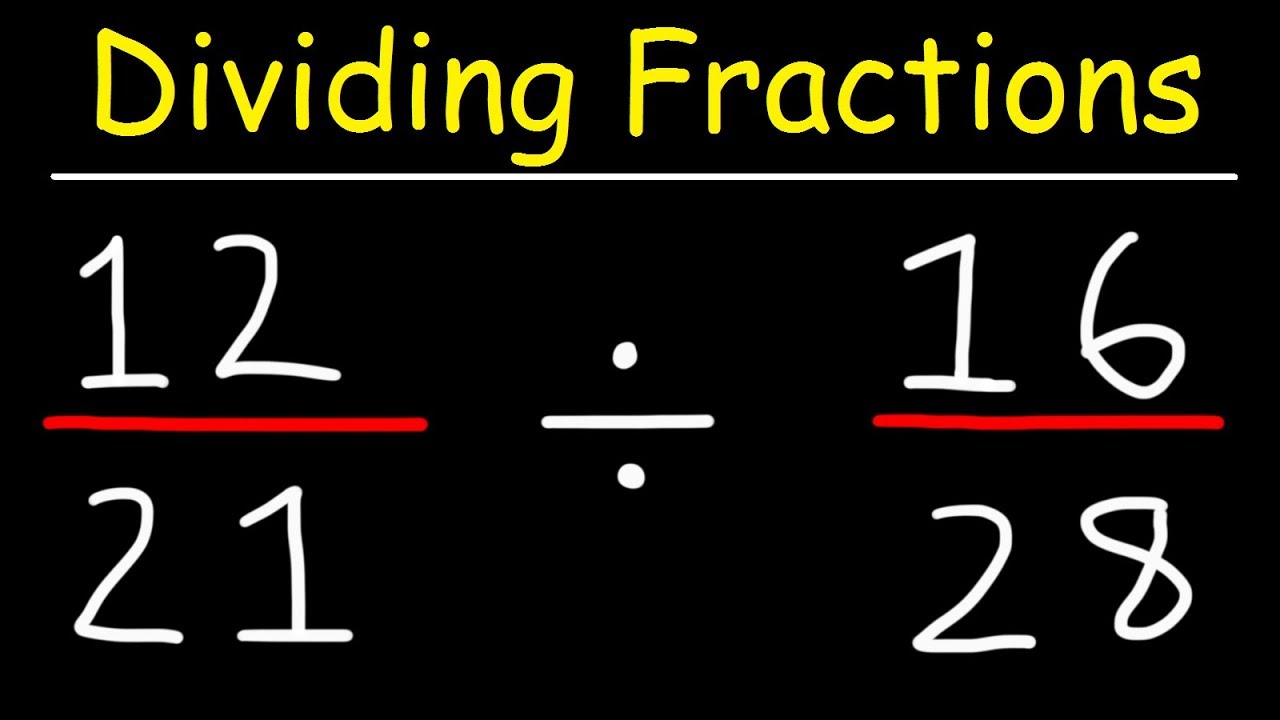
This math video tutorial provides a basic introduction into dividing fractions. It explains how to convert a division problem into a multiplication problem by using "Keep Change Flip".
Fractions - Basic Introduction: https://www.youtube.com/watch?v=3TklZi6MeJ4
Adding Fractions - Unlike Denominators:
https://www.youtube.com/watch?v=5fbzZEK77DQ
Subtracting Fractions:
https://www.youtube.com/watch?v=8ZbIrASBj54
Multiplying Fractions:
https://www.youtube.com/watch?v=sR83TDp_g2c
Dividing Fractions:
https://www.youtube.com/watch?v=Ht8O3cJ9yJ8
_____________________________________
Mixed Numbers - Basic Intro:
https://www.youtube.com/watch?v=PZGx0nSxzjs
Improper Fractions to Mixed Numbers:
https://www.youtube.com/watch?v=zvLql0wBM4E
Improper Fractions to Decimals:
https://www.youtube.com/watch?v=jt6UQD08azc
How To Convert Fractions to Decimals:
https://www.youtube.com/watch?v=pDs4a4ijqh0
Percent to Fraction:
https://www.youtube.com/watch?v=5ZHccsyr_JI
_____________________________________
Comparing Fractions:
https://www.youtube.com/watch?v=KHvnQLA9AmI
Equivalent Fractions:
https://www.youtube.com/watch?v=v31RGvrYIjU
Fractions on a Number Line:
https://www.youtube.com/watch?v=fLY9yRdBObQ
How To Simplify Complex Fractions:
https://www.youtube.com/watch?v=AqUvxoTKayI
Fractions & Mixed Numbers - Review:
https://www.youtube.com/watch?v=Vb5c7ay0ziU
_____________________________________
Final Exams and Video Playlists:
https://www.video-tutor.net/
Music Track:
https://audiojungle.net/item/g....litch-futuristic-ins

How do lenses work? How do they form images? Well, in order to understand how optics work, we have to understand the physics of light. In this episode of Crash Course Physics, Shini talks to us about optical instruments and how they make magnification possible.
--
Produced in collaboration with PBS Digital Studios: http://youtube.com/pbsdigitalstudios
--
Want to find Crash Course elsewhere on the internet?
Facebook - http://www.facebook.com/YouTubeCrashC...
Twitter - http://www.twitter.com/TheCrashCourse
Tumblr - http://thecrashcourse.tumblr.com
Support CrashCourse on Patreon: http://www.patreon.com/crashcourse
CC Kids: http://www.youtube.com/crashcoursekids
What is culture? How do we define it and how does it change? We’ll explore different categories of culture, like low culture, high culture, and sub-cultures. We'll also revisit our founding theories to consider both a structural functionalist and a conflict theory perspective on what cultures mean for society.
Crash Course is made with Adobe Creative Cloud. Get a free trial here: https://www.adobe.com/creativecloud.html
***
Crash Course is on Patreon! You can support us directly by signing up at http://www.patreon.com/crashcourse
Thanks to the following Patrons for their generous monthly contributions that help keep Crash Course free for everyone forever:
Mark, Les Aker, Bob Kunz, Mark Austin, William McGraw, Jeffrey Thompson, Ruth Perez, Jason A Saslow, Eric Prestemon, Malcolm Callis, Steve Marshall, Advait Shinde, Rachel Bright, Ian Dundore, Tim Curwick, Ken Penttinen, Dominic Dos Santos, Caleb Weeks, Frantic Gonzalez, Kathrin Janßen, Nathan Taylor, Yana Leonor, Andrei Krishkevich, Brian Thomas Gossett, Chris Peters, Kathy & Tim Philip, Mayumi Maeda, Eric Kitchen, SR Foxley, Tom Trval, Andrea Bareis, Moritz Schmidt, Jessica Wode, Daniel Baulig, Jirat
--
Want to find Crash Course elsewhere on the internet?
Facebook - http://www.facebook.com/YouTubeCrashCourse
Twitter - http://www.twitter.com/TheCrashCourse
Tumblr - http://thecrashcourse.tumblr.com
Support Crash Course on Patreon: http://patreon.com/crashcourse
CC Kids: http://www.youtube.com/crashcoursekids
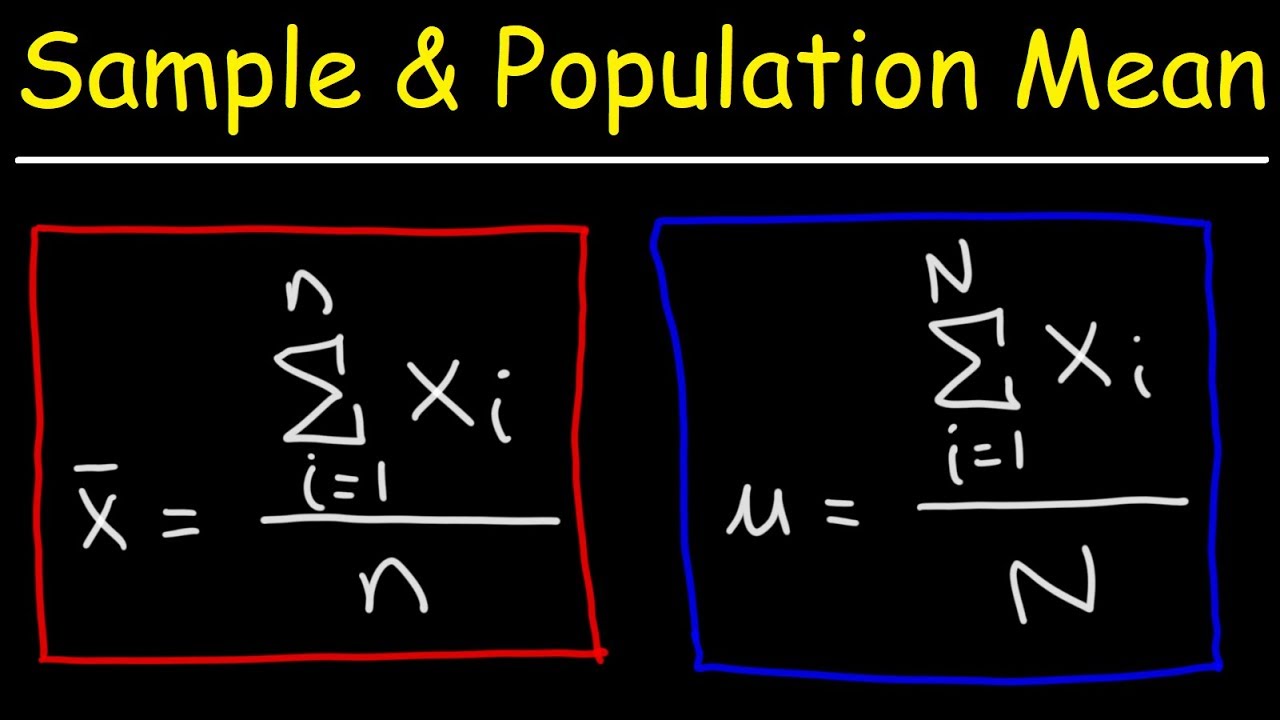
This statistics video tutorial provides a basic introduction into sample mean and population mean.
Introduction to Statistics: https://www.youtube.com/watch?v=XZo4xyJXCak
Arithmetic, Geometric, & Harmonic Mean:
https://www.youtube.com/watch?v=6G6i8vSa8Zs
Simple Frequency Tables:
https://www.youtube.com/watch?v=lyRbCwDDnJo
Relative Frequency Distribution Table:
https://www.youtube.com/watch?v=gq3FPpm2yvA
Cumulative Relative Frequency Table:
https://www.youtube.com/watch?v=6hJGa4Zp62M
_________________________________
Dot Plots and Frequency Tables:
https://www.youtube.com/watch?v=Iu17mY1VfZU
Stem and Leaf Plots:
https://www.youtube.com/watch?v=MUCvUgGfzdo
Side By Side Stem and Leaf Plots:
https://www.youtube.com/watch?v=wkAjnGmRPVo
Histograms:
https://www.youtube.com/watch?v=AndS0RLdxtk
How To Make a Frequency Polygon:
https://www.youtube.com/watch?v=y7Wb9AjbRjo
__________________________________
Quartiles, Deciles, & Percentiles:
https://www.youtube.com/watch?v=40o82o3uNfk
Interquartile Range & Outliers:
https://www.youtube.com/watch?v=STSP8gTSdT8
Skewness & Symmetric Distribution:
https://www.youtube.com/watch?v=U0NZu6f5TMI
Sample Mean and Population Mean:
https://www.youtube.com/watch?v=cmtBUWCC-6A
Mean, Median, & Mode - Grouped Data:
https://www.youtube.com/watch?v=zjHfAhcU6kE
____________________________________
Final Exams and Video Playlists:
https://www.video-tutor.net/

This video goes over the steps needed to multiply decimals by a power of ten.
In this video we cover:
A quick review of the powers of ten
Quick review on multiplying whole numbers by a power of ten
Step by step instructions for multiplying decimals by a power of ten
4 practice examples on multiplying decimals by a power of ten
Other Videos Mentioned:
Powers of Ten: https://youtu.be/9bx4ChX82_8
Multiplying Whole Numbers by a Power of Ten: https://youtu.be/kiEMc0CrNQY
Improved math is a channel created to provide additional instruction on essential math concepts. I love everything about math and I know firsthand how important math concepts are in the real world.
Teachers, parents, guardians, homeschoolers, and students can use these videos to help reinforce math skills.
For more information on math topics or for free printable worksheets and answer sheets, you can also visit my website at improvedmath.com
#powersoften
#multiplyingdecimals
#exponents
#mathhelp
#multiplyingdecimalsbyapoweroften
#5thgrademath
#6thgrademath
#mathvideos
#homeschoolmath
https://www.youtube.com/c/ImprovedMath
https://improvedmath.com
https://www.tiktok.com/@improvedmath1?
https://www.pinterest.com/improvedmath/
Don’t forget to like, share, and subscribe!

In the 1920s, there was a blossoming of all kinds of art made by African Americans in the New York neighborhood Harlem. Let's call it a renaissance. While all the arts were having a great run, some extremely interesting things were happening in the theater. Writers like Langston Hughes and Zora Neale Hurston were writing plays, and black theater companies were drawing larger audiences than ever before.
Crash Course is on Patreon! You can support us directly by signing up at http://www.patreon.com/crashcourse
Thanks to the following Patrons for their generous monthly contributions that help keep Crash Course free for everyone forever:
Sam Buck, Mark Brouwer, Jennifer French Lee, Brandon Westmoreland, dorsey, Indika Siriwardena, James Hughes, Kenneth F Penttinen, Trevin Beattie, Satya Ridhima Parvathaneni, Erika & Alexa Saur, Glenn Elliott, Justin Zingsheim, Jessica Wode, Eric Prestemon, Kathrin Benoit, Tom Trval, Jason Saslow, Nathan Taylor, Brian Thomas Gossett, Khaled El Shalakany, SR Foxley, Sam Ferguson, Yasenia Cruz, Eric Koslow, Caleb Weeks, Tim Curwick, D.A. Noe, Shawn Arnold, Malcolm Callis, Advait Shinde, William McGraw, Andrei Krishkevich, Rachel Bright, Kathy & Tim Philip, Jirat, Ian Dundore
--
Want to find Crash Course elsewhere on the internet?
Facebook - http://www.facebook.com/YouTubeCrashCourse
Twitter - http://www.twitter.com/TheCrashCourse
Tumblr - http://thecrashcourse.tumblr.com
Support Crash Course on Patreon: http://patreon.com/crashcourse
CC Kids: http://www.youtube.com/crashcoursekids
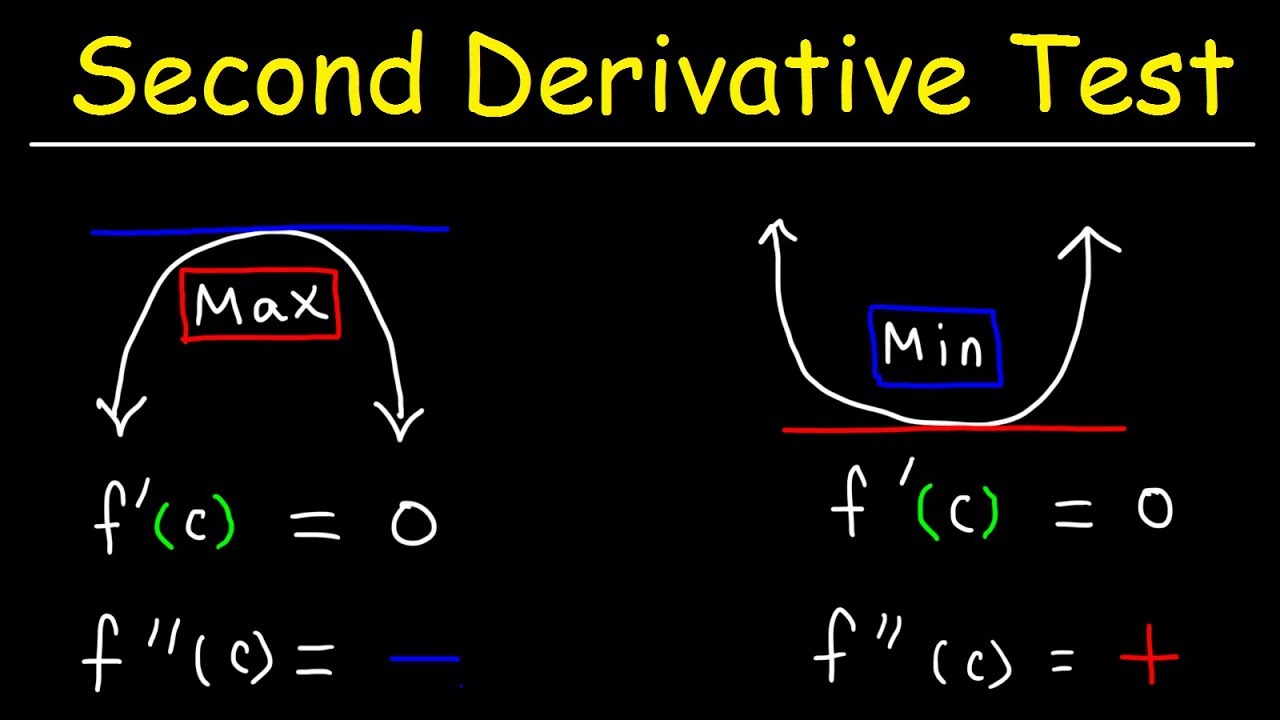
This calculus video tutorial provides a basic introduction into the second derivative test. It explains how to use the second derivative test to identify the presence of a relative maximum or a relative minimum at a critical point. If the second derivative is positive at a critical number - a local minimum is present. If the second derivative is negative at a critical number - a local maximum is present. So to identify the relative extrema, find the first derivative, set it equal to zero and identify the critical numbers. Plug the critical numbers into the second derivative function to determine the concavity of the function to see if its concave up or concave down. If it's concave up - it's a relative maximum. If it's concave down, it's a relative minimum. You can confirm the results of the second derivative test using the first derivative test with a sign chart on a number line.
Introduction to Limits:
https://www.youtube.com/watch?v=YNstP0ESndU
Derivatives - Fast Review:
https://www.youtube.com/watch?v=5yfh5cf4-0w
Introduction to Related Rates:
https://www.youtube.com/watch?v=I9mVUo-bhM8
_____________________________
Extreme Value Theorem:
https://www.youtube.com/watch?v=Sx2lPZlnWfs
Finding Critical Numbers:
https://www.youtube.com/watch?v=Bp9EbV3COVA
Local Maximum & Minimum:
https://www.youtube.com/watch?v=WCq3sRzsJfs
Absolute Extrema:
https://www.youtube.com/watch?v=3wrXDw5ETh4
Rolle's Theorem:
https://www.youtube.com/watch?v=LHym1ARc2cE
________________________________
Mean Value Theorem:
https://www.youtube.com/watch?v=SL2RobwU_M4
Increasing and Decreasing Functions:
https://www.youtube.com/watch?v=Dyl7jPlJXOM
First Derivative Test:
https://www.youtube.com/watch?v=G5wlKltW7pM
Concavity & Inflection Points:
https://www.youtube.com/watch?v=OhqNbQi9QPk
Second Derivative Test:
https://www.youtube.com/watch?v=G8GAsYkZlpE
_________________________________
L'Hopital's Rule:
https://www.youtube.com/watch?v=Gh48aOvWcxw
Curve Sketching With Derivatives:
https://www.youtube.com/watch?v=JTVNUdL7sWs
Newton's Method:
https://www.youtube.com/watch?v=-5e2cULI3H8
Optimization Problems:
https://www.youtube.com/watch?v=lx8RcYcYVuU
_______________________________________
Final Exams and Video Playlists:
https://www.video-tutor.net/
Full-Length Videos and Worksheets:
https://www.patreon.com/MathSc....ienceTutor/collectio
Hank veers away from human anatomy to teach us about the (mostly) single-celled organisms that make up two of the three taxonomic domains of life, and one of the four kingdoms: Archaea, Bacteria, and Protists. They are by far the most abundant organisms on Earth and are our oldest, oddest relatives.
References:
http://users.rcn.com/jkimball.....ma.ultranet/BiologyP
http://www.cod.edu/people/facu....lty/fancher/prokeuk.
http://www.genomenewsnetwork.o....rg/articles/03_00/ga
http://biology.clc.uc.edu/cour....ses/bio106/protista.
:http://www.ucmp.berkeley.edu/p....rotista/basalprotist
http://www.ucmp.berkeley.edu/p....rotista/testaceafilo
http://www.ucmp.berkeley.edu/p....rotista/slimemolds.h
http://www.ucmp.berkeley.edu/p....rotista/alveolates.h
http://www.ucmp.berkeley.edu/p....rotista/rhodophyta.h
Table of Contents
1) Archaea 03:23
a) Methanogens 04:02
b) Extremophiles 04:24
2) Bacteria 05:24:2
3) Gram Positive 06:50
a) Proteobacteria 07:15
b) Cyanobacteria 07:30
c) Spirochetes 07:42
d) Chlamydias 07:52
4) Protists 08:12
a) Protozoa 09:03
b) Algae 09:54
c) Slime Molds 11:13
Crash Course is on Patreon! You can support us directly by signing up at http://www.patreon.com/crashcourse
Want to find Crash Course elsewhere on the internet?
Facebook - http://www.facebook.com/YouTubeCrashCourse
Twitter - http://www.twitter.com/TheCrashCourse
Instagram - https://www.instagram.com/thecrashcourse/
CC Kids: http://www.youtube.com/crashcoursekids
In which John Green teaches you about the Little Ice Age. The Little Ice Age was a period of global cooling that occurred from the 13th to the 19th centuries. This cooling was likely caused by a number of factors, including unusual solar activity and volcanic eruptions. The Little Ice Age greatly impacted human social orders, especially during the 17th century. When the climate changed, and the weather became unpredictable, the world changed profoundly. Poor harvests led to hunger, which led to even less productivity, which even resulted in violent upheaval in a lot of places. All this from a little change in the temperature? Definitely.
Reference:
Global Crisis by Geoffrey Parker: https://bit.ly/3M99AvQ
Crash Course is on Patreon! You can support us directly by signing up at http://www.patreon.com/crashcourse
Want to find Crash Course elsewhere on the internet?
Facebook - http://www.facebook.com/YouTubeCrashCourse
Twitter - http://www.twitter.com/TheCrashCourse
Instagram - https://www.instagram.com/thecrashcourse/
CC Kids: http://www.youtube.com/crashcoursekids