Top videos

¡Bienvenidos a la segunda parte de nuestra lección sobre los 50 verbos más importantes en español!
En esta clase de español, exploraremos la segunda parte de los verbos y aprenderemos a usarlos en situaciones cotidianas.
Recordad que estos verbos están en pasado simple, lo que los hace esenciales para comunicarte sobre acciones pasadas.
Verbos Destacados:
Hacer: "Hice mis tareas." (I did my homework)
Deber: "Debí haber preguntado antes, lo siento." (I should have asked earlier, I'm sorry)
Preguntar: "Pregunté si alguien había visto el gato." (I asked if someone had seen the cat)
Visitar: "Visité a mi madre en el hospital." (I visited my mother in the hospital)
Ir: "Vine, aprendí y me fui." (I came, I learned, and I left)
Tomar: "Tomé un trozo de pastel del refrigerador." (I took a piece of cake from the fridge)
Planear: "Planeé nuestras vacaciones." (I planned our vacations)
Decir: "Le dije a mi padre cuanto le quería." (I told my father how much I loved him)
Lograr: "Logré pasar los exámenes." (I managed to pass the exams)
Enviar: "Envié un paquete por correo." (I sent a package by mail)
Ejemplos Útiles:
"Busqué vuelos para mis vacaciones." (I searched for flights for my holidays)
"Intenté aprender español." (I tried to learn Spanish)
"Viví en Galicia." (I lived in Galicia)
"Quise comprar el vestido pero no había de mi talla." (I wanted to buy the dress, but they didn't have my size)
Puedes encontrar la primera parte de este vídeo aquí: https://youtu.be/1xbBH34MiX0
Suscríbete a nuestro canal ✍, dale al like 👍 y activa las notificaciones🔔 para no perderte ningún nuevo vídeo!
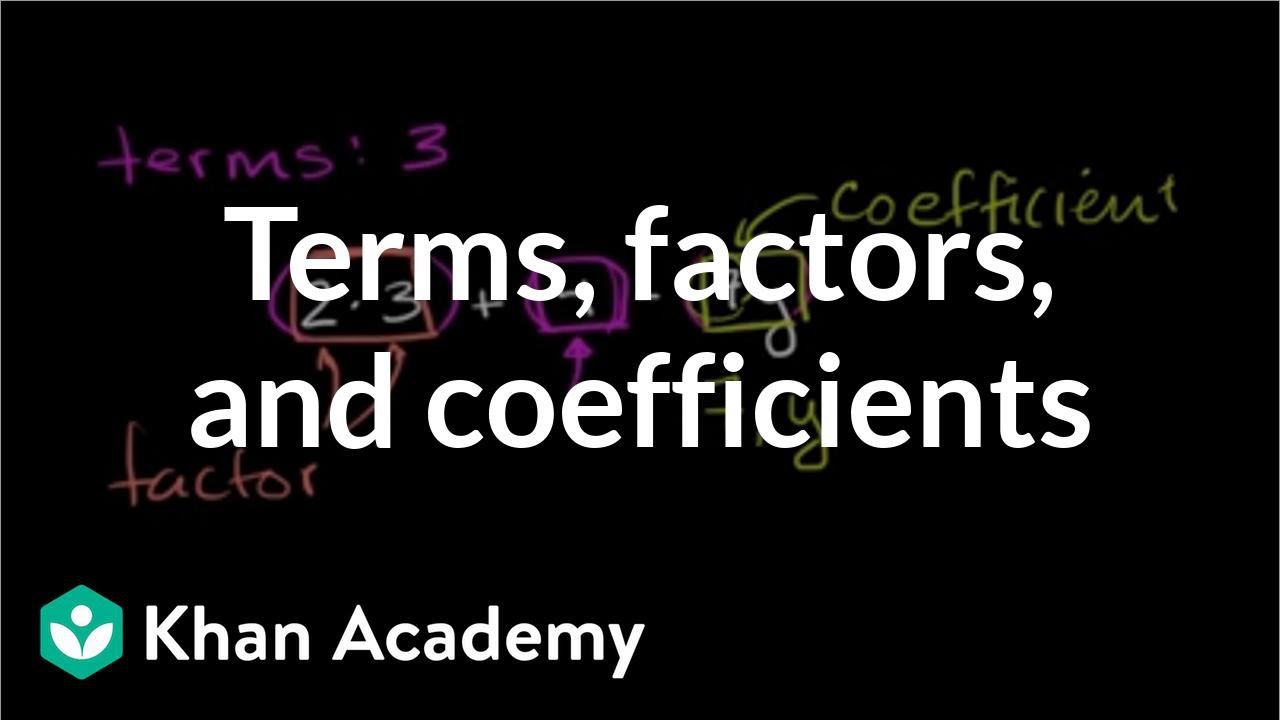
This video explains what the words term, factor, and coefficient mean. Think of an expression as a sentence. A sentence has parts, and so does an algebraic expression.
Practice this lesson yourself on KhanAcademy.org right now:
https://www.khanacademy.org/math/cc-sixth-grade-math/cc-6th-expressions-and-variables/cc-6th-parts-of-expressions/e/identifying-parts-of-expressions?utm_source=YT&utm_medium=Desc&utm_campaign=6thgrade
Watch the next lesson: https://www.khanacademy.org/math/cc-sixth-grade-math/cc-6th-expressions-and-variables/cc-6th-writing-expressions/v/writing-expressions-with-variables-examples?utm_source=YT&utm_medium=Desc&utm_campaign=6thgrade
Missed the previous lesson? https://www.khanacademy.org/math/cc-sixth-grade-math/cc-6th-expressions-and-variables/cc-7th-evaluating-expressions-word-problems/v/evaluating-exponential-expressions?utm_source=YT&utm_medium=Desc&utm_campaign=6thgrade
Grade 6th on Khan Academy: By the 6th grade, you're becoming a sophisticated mathemagician. You'll be able to add, subtract, multiply, and divide any non-negative numbers (including decimals and fractions) that any grumpy ogre throws at you. Mind-blowing ideas like exponents (you saw these briefly in the 5th grade), ratios, percents, negative numbers, and variable expressions will start being in your comfort zone. Most importantly, the algebraic side of mathematics is a whole new kind of fun! And if that is not enough, we are going to continue with our understanding of ideas like the coordinate plane (from 5th grade) and area while beginning to derive meaning from data! (Content was selected for this grade level based on a typical curriculum in the United States.)
About Khan Academy: Khan Academy offers practice exercises, instructional videos, and a personalized learning dashboard that empower learners to study at their own pace in and outside of the classroom. We tackle math, science, computer programming, history, art history, economics, and more. Our math missions guide learners from kindergarten to calculus using state-of-the-art, adaptive technology that identifies strengths and learning gaps. We've also partnered with institutions like NASA, The Museum of Modern Art, The California Academy of Sciences, and MIT to offer specialized content.
For free. For everyone. Forever. #YouCanLearnAnything
Subscribe to Khan Academy à ªs 6th grade channel:
https://www.youtube.com/channe....l/UCnif494Ay2S-PuYlD
Subscribe to Khan Academy: https://www.youtube.com/subscr....iption_center?add_us

En este video para aprender español veremos vocabulario en español para citas.
Sergio y Andrea tienen una cita. Veremos montones de diálogos y vocabulario.
Podrás practicar conversación, aprender un montón de palabras románticas y a expresarte en español. Además puedes repetir las conversaciones y practicar tu pronunciación.
De paso aprenderás unas cuantas frases en español para tu próxima cita 😉
No te pierdas nuestro culebrón para aprender español!
Frases para seducir
No olvides suscribirte a nuestro canal si quieres aprender español con videos divertidos🔔
# Clase 68
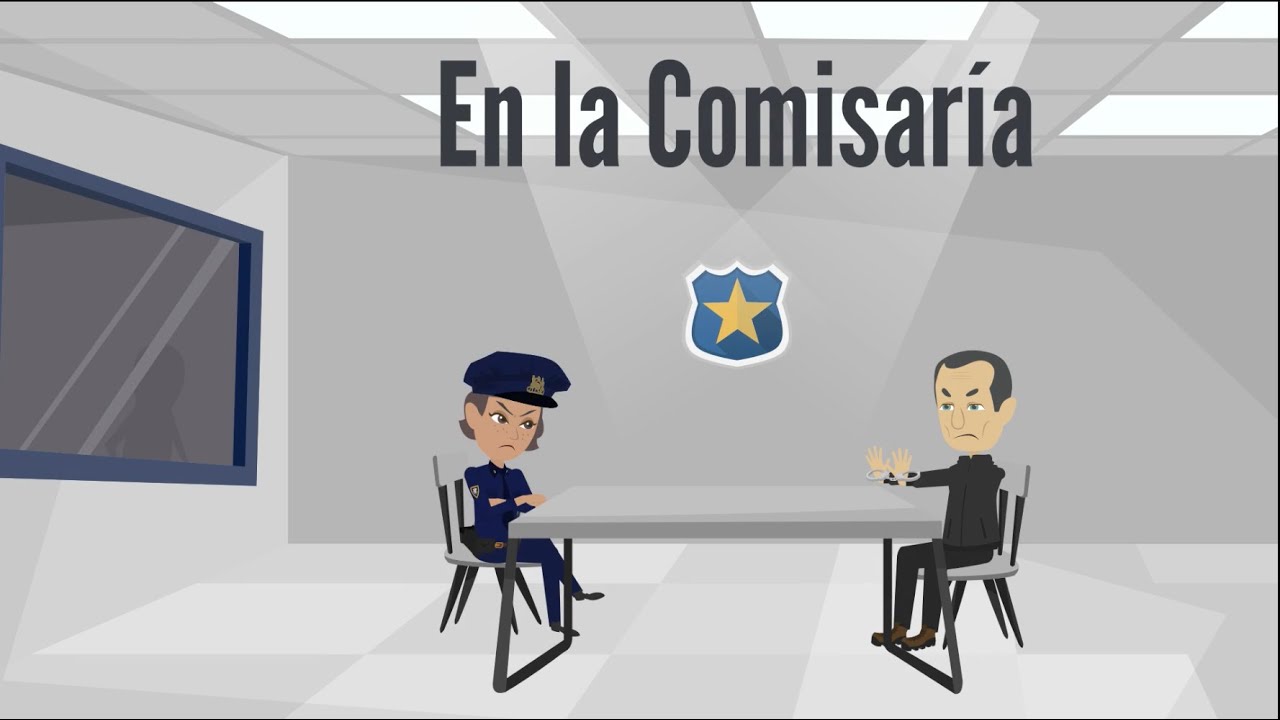
En este video para aprender español, exploramos el vocabulario relacionado con el crimen y la justicia a través de una historia con ejemplos en la vida real.
La narrativa incluye términos esenciales como "oficial de policía", "huellas dactilares", "abogado defensor", "causa penal", "condena", "jueza", "veredicto", "esposas" y "cárcel". Cada escena presenta situaciones reales y problemas por resolver, utilizando un lenguaje coloquial.
Vocabulario Clave:
Oficial de Policía: Persona encargada de mantener el orden y hacer cumplir la ley.
Huellas dactilares: Impresiones dejadas por los dedos que pueden identificar a una persona.
Abogado Defensor: Profesional del derecho que defiende al acusado en un juicio.
Causa Penal: Procedimiento judicial donde se juzga un delito.
Condena: Pena impuesta a una persona declarada culpable de un delito.
Jueza: Persona que tiene autoridad para juzgar y sentenciar en un tribunal.
Veredicto: Decisión final del juez o jurado sobre la culpabilidad o inocencia del acusado.
Esposas: Instrumento utilizado para inmovilizar las manos de una persona.
Cárcel: Institución donde se encierra a las personas condenadas por delitos.
Frases Importantes
¿Qué ha pasado? ¿Hay testigos?
Bien, vamos a buscar huellas dactilares para identificar al sospechoso.
Te hemos identificado por tus huellas dactilares.
Quiero hablar con mi abogado defensor.
Este caso es serio y hay pruebas que debemos considerar.
Sus huellas han sido encontradas en el lugar de los hechos.
Vamos a seguir con la causa penal.
Después de considerar todas las evidencias, el veredicto es... culpable.
Se condena al acusado a cinco años de cárcel.
Debes ponerte las esposas, por favor.
Nunca imaginé que acabaría en la cárcel.
Detalles de la Historia:
00:00 Escena 1: En la Joyería
Oficial de Policía: Hemos recibido un aviso de robo en esta joyería. ¿Qué ha pasado? ¿Hay testigos?
Empleada: Sí, yo estaba aquí. Un hombre alto, con chaqueta negra, nos amenazó con un arma y nos pidió que entreguemos todas las joyas de los mostradores.
Oficial de Policía: ¿Este hombre utilizaba guantes?
Empleada: No, no tenía guantes.
Oficial de Policía: ¿Ha tocado los mostradores?
Empleada: Sí, lo he visto apoyarse en ese cristal.
Oficial de Policía: Bien, vamos a buscar huellas dactilares para identificar al sospechoso.
01:19 Escena 2: En la Comisaría (con el sospechoso detenido)
Oficial de Policía: Te hemos identificado por tus huellas dactilares. ¿Qué tienes para declarar sobre lo sucedido?
Sospechoso: No tengo nada que ver con ese robo. Quiero hablar con mi abogado defensor.
Oficial de Policía: Está en camino. Mientras tanto, quedas bajo custodia.
Sospechoso: Qué injusticia, no tengo nada que ver con esto, quiero irme a mi casa.
Oficial de Policía: Por el momento, eso no será posible.
02:14 Escena 3: En el Tribunal
Abogado Defensor: Su señoría, mi cliente no tiene antecedentes y niega todas las acusaciones. Tienen a la persona equivocada. No es culpable de este delito.
Jueza: Este caso es serio y hay pruebas que debemos considerar. Sus huellas han sido encontradas en el lugar de los hechos. Vamos a seguir con la causa penal.
Abogado Defensor: Pero, señoría, mi cliente es un ciudadano ejemplar.
Jueza: Abogado, su cliente no tiene una coartada creíble, la descripción de los testigos coincide con su aspecto físico y sus huellas fueron encontradas en el lugar de los hechos.
Abogado Defensor: Pero no han encontrado el arma con la que se ha consumado el delito.
Jueza: Es cierto, pero el peso de las pruebas es suficiente para continuar con el caso.
04:00 Escena 4: Veredicto
Jueza: Después de considerar todas las evidencias, el veredicto es... culpable.
Abogado Defensor: Se está cometiendo un terrible error. Apelaremos la decisión, su señoría.
Jueza: Tiene derecho a hacerlo, pero por ahora, se mantiene la condena. Se condena al acusado a cinco años de cárcel. Este es el castigo por el delito cometido.
Oficial de Policía: Debe ponerse las esposas, por favor.
Acusado: No puedo creer que esto esté pasando. ¡Soy inocente!
Abogado Defensor: Mantendremos la lucha por tu libertad. No te preocupes.
05:19 Escena 5: En la Cárcel
Guardia: Bienvenido. Aquí está tu celda.
Acusado: Nunca imaginé que acabaría en la cárcel. Esto es una pesadilla. Soy inocente.
Guardia: El juez te ha condenado, solo te queda esperar el resultado de la apelación.
Acusado: Espero que se haga justicia.
Guardia: Mientras tanto, puedes ponerte cómodo.
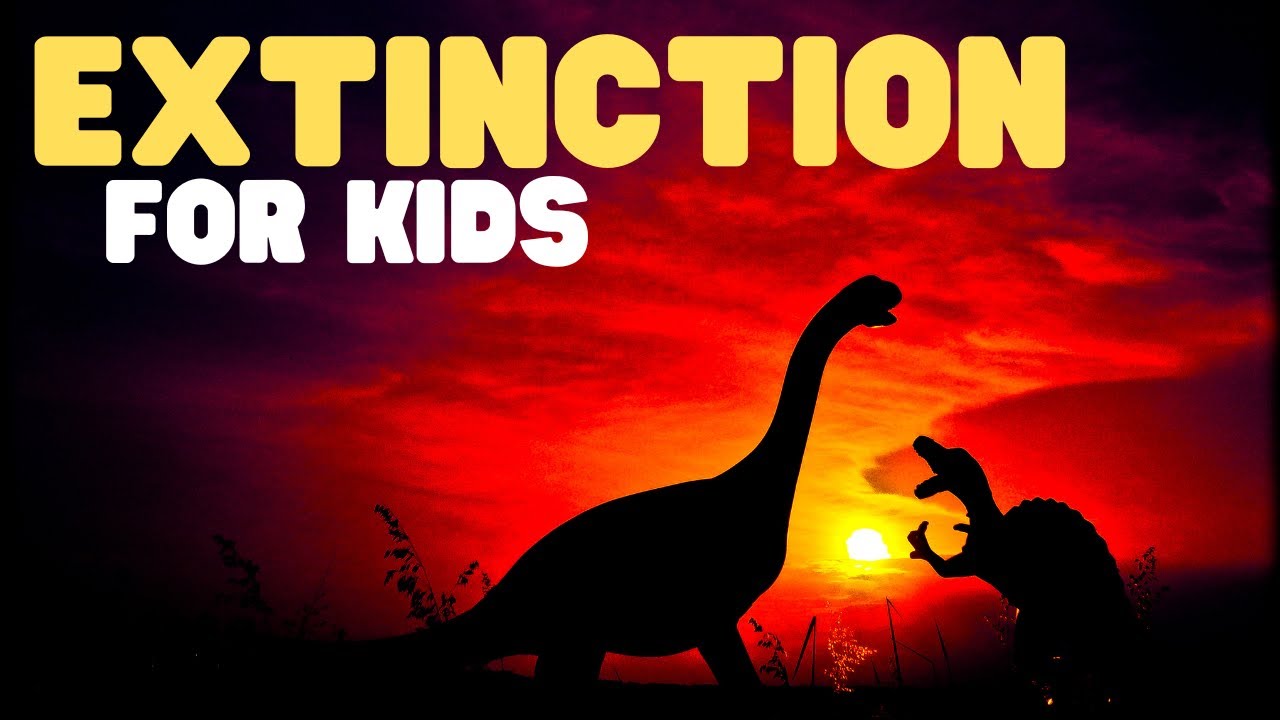
Have you ever wondered why there are no dinosaurs anymore? In Extinction for Kids, you will learn why dinosaurs no longer roam the planet. You will also learn about some other species that likewise died off. Believe it or not, plants can become extinct too, and the process happens more quickly than it does for animals.
Most of the time, extinction happens over a long period of time. When certain animals can no longer reproduce, they begin to die off. Or when animals can't adapt to their changing environment, this can also lead them to extinction. In cases of mass extinction, many species of plants and animals die out very quickly. Many scientists believe that this is what happened to the dinosaurs and other plants and animals that were on the planet millions of years ago. An asteroid may have collided with the surface of the earth and caused these species to die.
Humans can also contribute to the possibility of extinction for various species through things like overhunting, destroying habitats, or introducing nonnative species to areas where they are not usually found. In fact, have you ever heard of the dodo bird? When animals like pigs and cats were introduced to the dodo bird's environment, the bird became prey to the pigs and cats. As a result, they eventually became extinct because they could not adapt quickly enough to survive.
We hope you and your student(s) enjoyed learning about how animals and plants become extinct! If you want to learn even more, head over to our website and download one of our many free lesson plans about extinction, full of activities, worksheets, and more!
https://learnbright.org/lesson....s/science/extinct-an
https://learnbright.org/lesson....s/science/extinction
https://learnbright.org/lessons/science/dinosaurs/
https://learnbright.org/lessons/science/fossils/
What you will learn in Extinction for Kids:
0:00 Introduction to extinction and why species go extinct
1:17 What happened to the dinosaurs and other reasons species die out
1:56 How humans can cause extinction
3:11 Animals in danger of becoming extinct
3:38 Ways to help prevent extinction
4:01 Review of the facts
Thank you for watching and learning with us! We’re constantly releasing new content and videos, so click that “Subscribe” button and you’ll get notified.
Find and Follow Us Online:
Facebook: https://www.facebook.com/LearnBright/
Instagram: https://instagram.com/LearnBrightEducation
Pinterest: https://pinterest.com/LearnBrightEducation
YouTube: @LearnBright
Website: https://learnbright.org/
*Teachers and Parents! Did you know? In addition to these great videos, we have also created a library of high-quality and engaging lessons for your elementary aged student(s). Visit us, sign up for a free account, and instantly you'll have access to thousands of lesson plans, learning materials, teaching instructions, activities, and assignments that your kids will really enjoy! We hope to see you soon!
Browse our entire collection of Science lesson plans: https://learnbright.org/lessons/?filter_subject=science
#ExtinctionForKids
#Extinction
WEBSITE: http://www.teachertube.com Explanation of interval notation and its meaning on the real number line.

In our video "Food Chain for Kids" we learn all about the different food chains and food webs. All of us eat. You may eat meat or only eat vegetables but one way or another every living thing eats. When you eat something it gives you energy. In a way, the energy comes from the food you eat, but the energy actually came from the Sun first. You are simply the last organism in the food chain to eat the food. A food chain is a path that energy takes from producers to consumers all the way down to decomposers.
Throughout this fun scientific video we will will walk with you through the energy cycle... from the sun to plants, plants to animals and humans, and much more! We will learn about producers, primary consumers, secondary consumers, and decomposers and how each of these living things play an important role in the food chain.
If you're looking for even more food chain resources we invite you to download our comprehensive 9 page food chain lesson plan that comes with more content pages, worksheets, food chain activities and more! Available for free download here: https://learnbright.org/lesson....s/science/food-chain
Thank you for watching and learning with us! We’re constantly releasing new content and videos, so click that “Subscribe” button and you’ll get notified.
Find and Follow Us Online:
Facebook: https://www.facebook.com/LearnBright/
Instagram: https://instagram.com/LearnBrightEducation
Pinterest: https://pinterest.com/LearnBrightEducation
YouTube: https://www.youtube.com/LearnBright
Website: https://learnbright.org/
*Teachers and Parents! Did you know? In addition to these great videos, we have also created a library of high quality and engaging lessons for your elementary aged student(s). Visit us, sign up for a free account, and instantly you'll have access to thousands of lesson plans, learning materials, teaching instructions, activities, and assignments that your kids will really enjoy! We hope to see you soon!
Browse our entire collection of Science lesson plans: https://learnbright.org/lessons/?filter_subject=science
#TheFoodChainForKids
#FoodChain

We hope you and your student(s) enjoyed learning about this huge natural landform! If you want even more information, head over to our website and download one of our many free lesson plans, full of activities, worksheets, and more!
https://learnbright.org/lesson....s/social-studies/all
What you will learn in The Grand Canyon for Kids:
0:00 Introduction to the canyon
0:35 Where it is and how it formed
1:16 Significant peoples
2:01 How big is it?
3:17 Other factors that change the formation over time
4:24 Animals of the Grand Canyon
5:16 Review of the facts
Thank you for watching and learning with us! We’re constantly releasing new content and videos, so click that “Subscribe” button and you’ll get notified.
Find and Follow Us Online:
Facebook: https://www.facebook.com/LearnBright/
Instagram: https://instagram.com/LearnBrightEducation
Pinterest: https://pinterest.com/LearnBrightEducation
YouTube: @LearnBright
Website: https://learnbright.org/
*Teachers and Parents! Did you know? In addition to these great videos, we have also created a library of high-quality and engaging lessons for your elementary aged student(s). Visit us and sign up for a free account, and you'll instantly have access to thousands of lesson plans, learning materials, teaching instructions, activities, and assignments that your kids will really enjoy! We hope to see you soon!
Browse our entire collection of Social Studies lesson plans: https://learnbright.org/lessons/?filter_subject=social-studies
#Arizona
#GrandCanyon

TeacherTube User: Kelsnorr
TeacherTube URL: http://www.teachertube.com/vie....wVideo.php?video_id=
This is a math video lesson to help you with new math, math tricks, and or simple math questions you may have.
This video is great for teaching the area of squares and rectangles
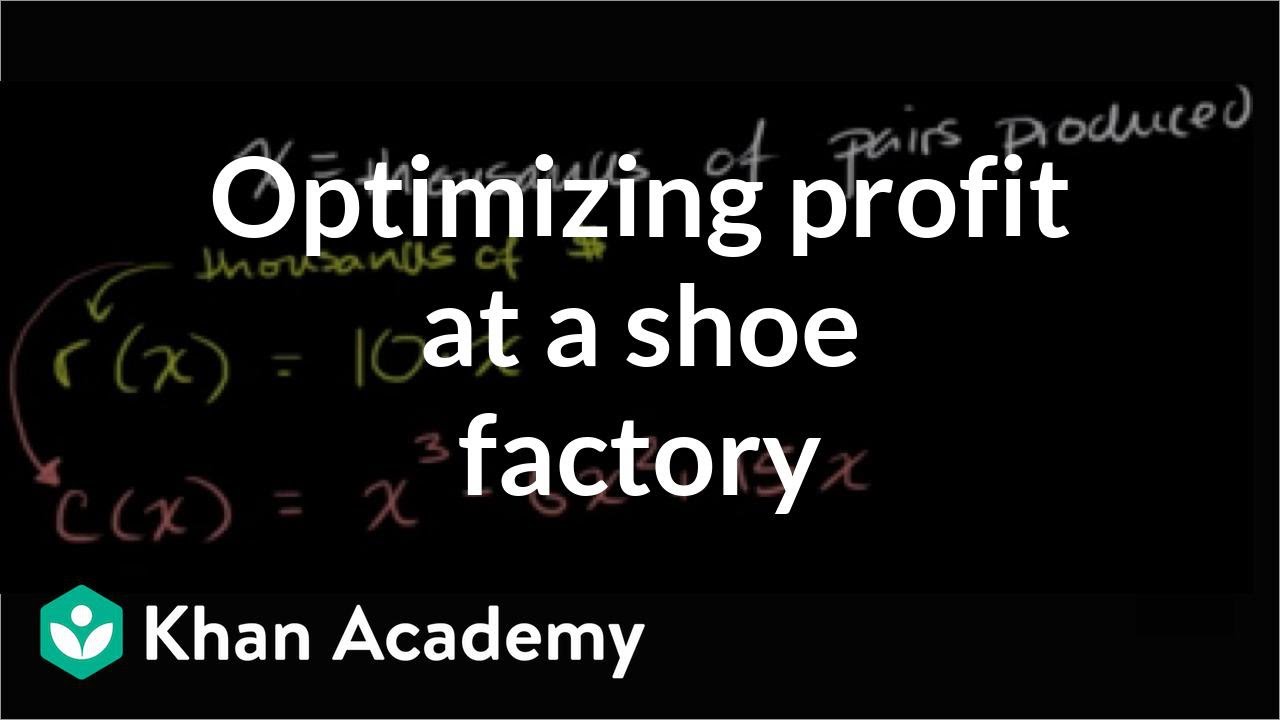
Courses on Khan Academy are always 100% free. Start practicing—and saving your progress—now: https://www.khanacademy.org/ma....th/ap-calculus-ab/ab
Who knows, you may end up running a shoe factory one day. So it might not be a bad idea to know how to maximize profits. Created by Sal Khan.
Watch the next lesson: https://www.khanacademy.org/math/ap-calculus-ab/ab-applications-derivatives/ab-optimization/v/minimizing-the-cost-of-a-storage-container?utm_source=YT&utm_medium=Desc&utm_campaign=APCalculusAB
Missed the previous lesson? https://www.khanacademy.org/math/ap-calculus-ab/ab-applications-derivatives/ab-optimization/v/optimizing-box-volume-analytically?utm_source=YT&utm_medium=Desc&utm_campaign=APCalculusAB
AP Calculus AB on Khan Academy: Bill Scott uses Khan Academy to teach AP Calculus at Phillips Academy in Andover, Massachusetts, and heÕs part of the teaching team that helped develop Khan AcademyÕs AP lessons. Phillips Academy was one of the first schools to teach AP nearly 60 years ago.
About Khan Academy: Khan Academy is a nonprofit with a mission to provide a free, world-class education for anyone, anywhere. We believe learners of all ages should have unlimited access to free educational content they can master at their own pace. We use intelligent software, deep data analytics and intuitive user interfaces to help students and teachers around the world. Our resources cover preschool through early college education, including math, biology, chemistry, physics, economics, finance, history, grammar and more. We offer free personalized SAT test prep in partnership with the test developer, the College Board. Khan Academy has been translated into dozens of languages, and 100 million people use our platform worldwide every year. For more information, visit www.khanacademy.org, join us on Facebook or follow us on Twitter at @khanacademy. And remember, you can learn anything.
For free. For everyone. Forever. #YouCanLearnAnything
Subscribe to Khan AcademyÕs AP Calculus AB channel: https://www.youtube.com/channe....l/UCyoj0ZF4uw8VTFbml
Subscribe to Khan Academy: https://www.youtube.com/subscr....iption_center?add_us
WEBSITE: http://www.teachertube.com naming quadrilaterals

En este video para aprender español, exploramos vocabulario esencial y situaciones comunes en una ciudad.
A través de diálogos cotidianos entre un hombre y una mujer, abordamos temas como el aparcamiento, carriles bici, buzones de correos, rotondas, pasos de cebra, semáforos, zonas peatonales, plazas y atascos.
Cada diálogo incluye frases típicas y lenguaje coloquial, ideal para estudiantes extranjeros que quieren mejorar su español.
Frases Importantes y Vocabulario:
00:02 Aparcamiento
Hombre: Vamos a llegar tarde si no encontramos un sitio para aparcar rápidamente.
Mujer: ¿Y si probamos el aparcamiento subterráneo de La Plaza de Oriente?
Nota: Uso del futuro simple y del subjuntivo ("si no encontramos").
00:35 Carril bici
Mujer: ¡Cuidado con la bicicleta! Estás en el carril bici.
Hombre: Uf, no me acostumbro a estar controlando el carril bici.
Nota: Uso del presente continuo para describir acciones actuales.
01:16 Buzón de correos
Hombre: ¿Sabría decirme dónde puedo enviar una carta?
Mujer: Si necesitas comprar los sellos tendrás que ir a correos o al estanco a comprarlos. Si ya los tienes puedes tirar la carta en un buzón.
Nota: Uso del condicional y del presente para dar instrucciones.
02:15 Rotonda
Mujer: ¿Por qué no avanzamos en la rotonda? Estamos dando vueltas sin salir.
Hombre: Es que no sé cuál es nuestra salida, estoy esperando que el GPS me lo diga.
Nota: Uso del presente continuo y del presente simple.
03:01 Paso de cebra
Hombre: ¡Espera a que el semáforo se ponga en verde antes de cruzar el paso de cebra!
Mujer: Pero no viene ningún coche, ¡podemos cruzar ya!
Nota: Uso del imperativo y del subjuntivo.
03:41 Semáforo
Mujer: ¿Has pasado el semáforo en rojo?
Hombre: No, estaba cambiando.
Nota: Uso del pretérito perfecto y del pasado continuo.
04:12 Zona peatonal
Hombre: ¿Se puede entrar con el coche en la zona peatonal?
Mujer: Los carteles dicen que si vas al hotel puedes entrar.
Nota: Uso del presente y del condicional para preguntar y dar información.
04:48 Plaza
Hombre: Esta es la plaza que acaban de reformar, creo que han acertado con la reforma.
Mujer: ¡Qué bonita ha quedado! ¿Quieres sentarnos un rato en el banco?
Nota: Uso del pretérito perfecto y del presente.
05:24 Atasco
Hombre: ¡Estamos atrapados en un atasco y llegaremos tarde!
Mujer: ¿Estamos atrapados en un atasco o nosotros somos el atasco?
Nota: Uso del presente continuo y del presente simple.
Estructuras Gramaticales
Presente continuo: Estamos dando vueltas, Estás en el carril bici.
Imperativo: Espera a que el semáforo se ponga en verde.
Condicional: ¿Podríamos eliminar algunos detalles para reducir costos?
Subjuntivo: Si no encontramos un sitio.
Pretérito perfecto: Has pasado el semáforo en rojo.
¡Suscríbete ✍, dale al like 👍 y activa la 🔔 para no perderte ningún video!

Courses on Khan Academy are always 100% free. Start practicing—and saving your progress—now: https://www.khanacademy.org/ma....th/old-ap-calculus-a
Find the volume of a solid of revolution by rotating around the x-axis using the shell method. Created by Sal Khan.
Practice this lesson yourself on KhanAcademy.org right now: https://www.khanacademy.org/math/ap-calculus-ab/ab-applications-definite-integrals/ab-shell-method/e/volumes-of-solids-of-revolution-by-shells?utm_source=YT&utm_medium=Desc&utm_campaign=APCalculusAB
Watch the next lesson: https://www.khanacademy.org/math/ap-calculus-ab/ab-applications-definite-integrals/ab-shell-method/v/shell-method-with-two-functions-of-x?utm_source=YT&utm_medium=Desc&utm_campaign=APCalculusAB
Missed the previous lesson? https://www.khanacademy.org/math/ap-calculus-ab/ab-applications-definite-integrals/ab-shell-method/v/evaluating-integral-for-shell-method-example?utm_source=YT&utm_medium=Desc&utm_campaign=APCalculusAB
AP Calculus AB on Khan Academy: Bill Scott uses Khan Academy to teach AP Calculus at Phillips Academy in Andover, Massachusetts, and heÕs part of the teaching team that helped develop Khan AcademyÕs AP lessons. Phillips Academy was one of the first schools to teach AP nearly 60 years ago.
About Khan Academy: Khan Academy is a nonprofit with a mission to provide a free, world-class education for anyone, anywhere. We believe learners of all ages should have unlimited access to free educational content they can master at their own pace. We use intelligent software, deep data analytics and intuitive user interfaces to help students and teachers around the world. Our resources cover preschool through early college education, including math, biology, chemistry, physics, economics, finance, history, grammar and more. We offer free personalized SAT test prep in partnership with the test developer, the College Board. Khan Academy has been translated into dozens of languages, and 100 million people use our platform worldwide every year. For more information, visit www.khanacademy.org, join us on Facebook or follow us on Twitter at @khanacademy. And remember, you can learn anything.
For free. For everyone. Forever. #YouCanLearnAnything
Subscribe to Khan AcademyÕs AP Calculus AB channel: https://www.youtube.com/channe....l/UCyoj0ZF4uw8VTFbml
Subscribe to Khan Academy: https://www.youtube.com/subscr....iption_center?add_us
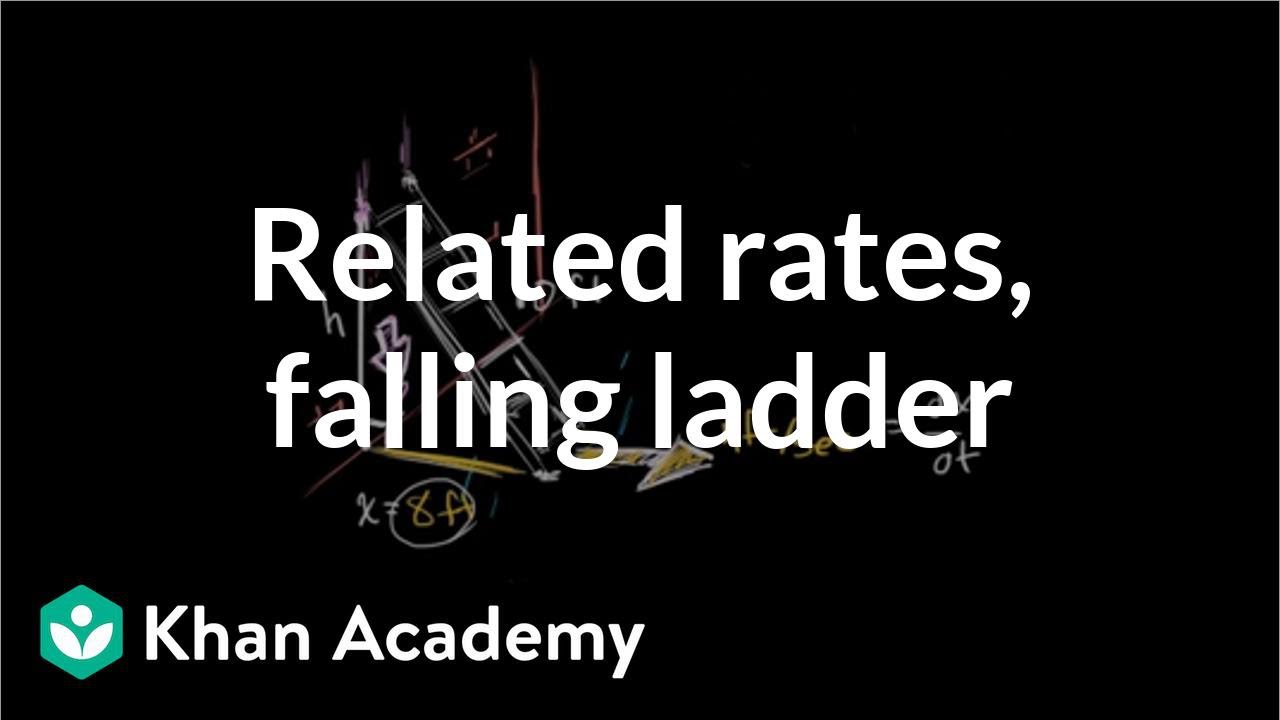
Courses on Khan Academy are always 100% free. Start practicing—and saving your progress—now: https://www.khanacademy.org/ma....th/ap-calculus-ab/ab
You're on a ladder. The bottom of the ladder starts slipping away from the wall. Amidst your fright, you realize this would make a great related rates problem... Created by Sal Khan.
Practice this lesson yourself on KhanAcademy.org right now: https://www.khanacademy.org/math/ap-calculus-ab/ab-applications-derivatives/ab-related-rates/e/related-rates-pythagorean-theorem?utm_source=YT&utm_medium=Desc&utm_campaign=APCalculusAB
Watch the next lesson: https://www.khanacademy.org/math/ap-calculus-ab/ab-applications-derivatives/ab-related-rates/v/related-rates-of-water-pouring-into-cone?utm_source=YT&utm_medium=Desc&utm_campaign=APCalculusAB
Missed the previous lesson? https://www.khanacademy.org/math/ap-calculus-ab/ab-applications-derivatives/ab-related-rates/v/rate-of-change-of-distance-between-approaching-cars?utm_source=YT&utm_medium=Desc&utm_campaign=APCalculusAB
AP Calculus AB on Khan Academy: Bill Scott uses Khan Academy to teach AP Calculus at Phillips Academy in Andover, Massachusetts, and heÕs part of the teaching team that helped develop Khan AcademyÕs AP lessons. Phillips Academy was one of the first schools to teach AP nearly 60 years ago.
About Khan Academy: Khan Academy is a nonprofit with a mission to provide a free, world-class education for anyone, anywhere. We believe learners of all ages should have unlimited access to free educational content they can master at their own pace. We use intelligent software, deep data analytics and intuitive user interfaces to help students and teachers around the world. Our resources cover preschool through early college education, including math, biology, chemistry, physics, economics, finance, history, grammar and more. We offer free personalized SAT test prep in partnership with the test developer, the College Board. Khan Academy has been translated into dozens of languages, and 100 million people use our platform worldwide every year. For more information, visit www.khanacademy.org, join us on Facebook or follow us on Twitter at @khanacademy. And remember, you can learn anything.
For free. For everyone. Forever. #YouCanLearnAnything
Subscribe to Khan AcademyÕs AP Calculus AB channel: https://www.youtube.com/channe....l/UCyoj0ZF4uw8VTFbml
Subscribe to Khan Academy: https://www.youtube.com/subscr....iption_center?add_us

En esta nueva clase de español vamos a conocer los países de Latinoamérica dónde se habla español:
Colombia: https://youtu.be/2s0BivJRodE?t=18
Paraguay: https://youtu.be/2s0BivJRodE?t=70
Ecuador: https://youtu.be/2s0BivJRodE?t=114
Panamá: https://youtu.be/2s0BivJRodE?t=183
México: https://youtu.be/2s0BivJRodE?t=224
Honduras: https://youtu.be/2s0BivJRodE?t=263
Chile: https://youtu.be/2s0BivJRodE?t=327
Argentina: https://youtu.be/2s0BivJRodE?t=379
Bolivia: https://youtu.be/2s0BivJRodE?t=458
Venezuela: https://youtu.be/2s0BivJRodE?t=506
Perú: https://youtu.be/2s0BivJRodE?t=549
Costa Rica: https://youtu.be/2s0BivJRodE?t=601
Cuba: https://youtu.be/2s0BivJRodE?t=646
El Salvador: https://youtu.be/2s0BivJRodE?t=701
Guatemala: https://youtu.be/2s0BivJRodE?t=759
Haití: https://youtu.be/2s0BivJRodE?t=797
Nicaragüa: https://youtu.be/2s0BivJRodE?t=846
República Dominicana: https://youtu.be/2s0BivJRodE?t=883
Uruguay: https://youtu.be/2s0BivJRodE?t=910
¿Sabías que en todos estos países latinoaméricanos se hablaba español?
Otro motivo más para aprender español
/ Clase 130
Recuerda suscribirte a nuestro canal y activar las notificaciones 🔔

In our Easter Facts for Kids video we provide an overview of both the Christian and Non-Christian story of Easter. Easter is a wonderful spring holiday that has a lot of meaning for Christians. The death and resurrection of Jesus Christ is considered the pinnacle moment in all of history. Easter is a celebration of his life, death and resurrection and provides hope for many across the globe.
For those who are not Christian Easter is a time to celebrate the new life of spring. This is done by spending time with family, meals, and who can forget Easter Egg hunts! We provide a overview and fun facts about Easter appropriate to share with anyone!
For more Easter fun, download our free lesson plan:
https://learnbright.org/lesson....s/social-studies/wha
Thank you for watching and learning with us! We’re constantly releasing new content and videos so click that “Subscribe” button and you’ll notified.
Find and Follow Us Online:
Facebook: https://www.facebook.com/LearnBright/
Instagram: https://instagram.com/LearnBrightEducation
Pinterest: https://pinterest.com/LearnBrightEducation
YouTube: https://www.youtube.com/LearnBright
Website: https://learnbright.org/
*Teachers and Parents! Did you know? In addition to these great videos, we have also created a library of high quality and engaging lessons for your elementary aged student(s). Visit us, sign up for a free account, and instantly you'll have access to thousands of lesson plans, learning materials, teaching instructions, activities, and assignments that your kids will really enjoy! We hope to see you soon!
Browse our entire collection of Social Studies lesson plans: https://learnbright.org/lessons/?filter_subject=social-studies
#ASL
#HistoryOfEaster

TeacherTube User: Mrdcarson
TeacherTube URL: http://www.teachertube.com/vie....wVideo.php?video_id=
This is a math video lesson to help you with new math, math tricks, and or simple math questions you may have.
Math terms to help educatate others about Bullying
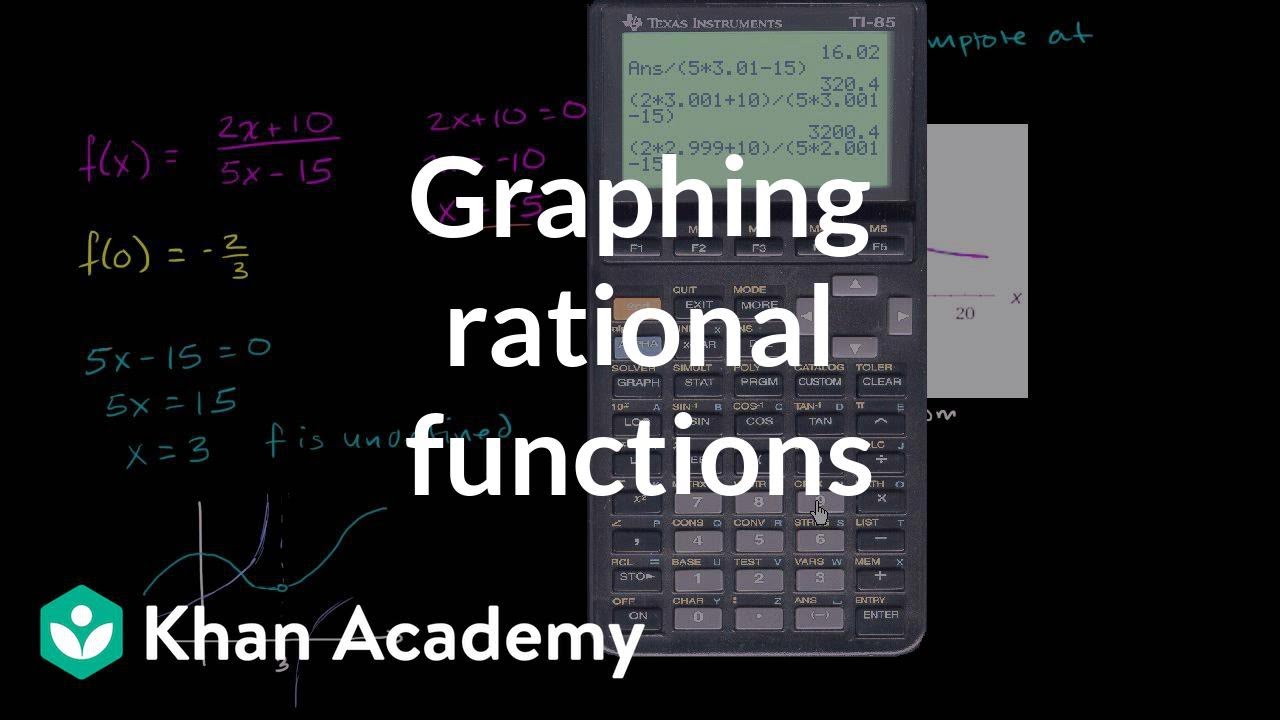
Watch the next lesson: https://www.khanacademy.org/math/algebra2/rational-expressions/rational-function-graphing/v/example-rational-functions-graphs?utm_source=YT&utm_medium=Desc&utm_campaign=AlgebraII
Missed the previous lesson?
https://www.khanacademy.org/math/algebra2/rational-expressions/solving-rational-equations/v/rational-inequalities-2?utm_source=YT&utm_medium=Desc&utm_campaign=AlgebraII
Algebra II on Khan Academy: Your studies in algebra 1 have built a solid foundation from which you can explore linear equations, inequalities, and functions. In algebra 2 we build upon that foundation and not only extend our knowledge of algebra 1, but slowly become capable of tackling the BIG questions of the universe. We'll again touch on systems of equations, inequalities, and functions...but we'll also address exponential and logarithmic functions, logarithms, imaginary and complex numbers, conic sections, and matrices. Don't let these big words intimidate you. We're on this journey with you!
About Khan Academy: Khan Academy offers practice exercises, instructional videos, and a personalized learning dashboard that empower learners to study at their own pace in and outside of the classroom. We tackle math, science, computer programming, history, art history, economics, and more. Our math missions guide learners from kindergarten to calculus using state-of-the-art, adaptive technology that identifies strengths and learning gaps. We've also partnered with institutions like NASA, The Museum of Modern Art, The California Academy of Sciences, and MIT to offer specialized content.
For free. For everyone. Forever. #YouCanLearnAnything
Subscribe to Khan Academy’s Algebra II channel:
https://www.youtube.com/channe....l/UCsCA3_VozRtgUT7wW
Subscribe to Khan Academy: https://www.youtube.com/subscr....iption_center?add_us

SUBSCRIBE for more Spanish videos: http://bit.ly/XGe7we
and make sure to click the notification bell!
Follow me on Facebook: https://www.facebook.com/srjordanspanish
Tweet me: https://twitter.com/senorjordan
Check out my website: http://www.senorjordan.com
Follow me on Instagram: @senorjordanvideos
Listen to my music on Soundcloud:
https://soundcloud.com/senorjordanspanish
Listen to my music on Spotify:
https://open.spotify.com/artis....t/2nyJ9GgLNMckXCuBHU
Buy my songs on iTunes:
https://music.apple.com/us/artist/1621526948
Buy my songs on Amazon:
https://www.amazon.com/music/p....layer/artists/B09Z35
Donate to my video-making project:
https://paypal.me/srjordanvideos?country.x=US&locale.x=en_US
~~~~~~~~~~~~~~~~~~~~~~~~~~~~~~
*re-uploaded to fix title error!

Have you ever heard of the name Sitting Bull? In this video, you and your kids will learn all about this incredible Lakota chief. Sitting Bull lived during the time of Manifest Destiny and the Indian Removal Act. Manifest Destiny was the idea that it was America's God-given right to expand westward and own all the land. The Indian Removal Act allowed the US government to force Native Americans to reservations.
Sitting Bull was born in 1831 with the name of Jumping Badger. It wasn't until he was 14 that he earned the name Sitting Bull after defeating an enemy. This brave act foreshadowed a life of courage as he continually defended his people throughout his life. Most famously, he and his people defeated the US soldiers under George Custer's command in the Valley of the Little Bighorn.
Sadly, Sitting Bull and his people were forced onto reservations despite the Treaty of Fort Laramie that promised the Black Hills of South Dakota to the Lakota nation. He was given permission to travel and met Annie Oakley and Buffalo Bill Cody. Cody managed a wild west traveling show to which Sitting Bull became a part. However, Sitting Bull experienced a lot of persecution and eventually left the show. He lived out the remainder of his days on the reservation until he was killed in 1890.
We hope you and your student(s) enjoyed learning about this incredible Native American chief! If you want to learn even more, head over to our website and download one of our many free lesson plans, full of activities, worksheets, and more!
https://learnbright.org/lesson....s/social-studies/sit
https://learnbright.org/lesson....s/social-studies/bat
Thank you for watching and learning with us! We’re constantly releasing new content and videos, so click that “Subscribe” button and you’ll get notified.
What you will learn in Who Was Sitting Bull? for Kids:
0:00 Introduction to Native American history
0:33 Sitting Bull childhood
1:34 US Government and Indian Removal Act
2:58 Battle of Little Bighorn
3:49 After the battle and last days
4:43 Review of the facts
Find and Follow Us Online:
Facebook: https://www.facebook.com/LearnBright/
Instagram: https://instagram.com/LearnBrightEducation
Pinterest: https://pinterest.com/LearnBrightEducation
YouTube: @LearnBright
Website: https://learnbright.org/
*Teachers and Parents! Did you know? In addition to these great videos, we have also created a library of high-quality and engaging lessons for your elementary aged student(s). Visit us, sign up for a free account, and instantly you'll have access to thousands of lesson plans, learning materials, teaching instructions, activities, and assignments that your kids will really enjoy! We hope to see you soon!
Browse our entire collection of Social Studies lesson plans: https://learnbright.org/lessons/?filter_subject=social-studies
#ASL
#SittingBull
#NativeAmericanHistory