Science


In this math activity, students conduct a strength test using modeling clay, creating their own stress vs. strain graphs, which they compare to typical steel and concrete graphs. They learn the difference between brittle and ductile materials and how understanding the strength of materials, especially steel and concrete, is important for engineers who design bridges and structures.
View the full activity at TeachEngineering:
https://www.teachengineering.o....rg/activities/view/c
TeachEngineering has over 1,500 FREE lessons and activities. Visit http://www.TeachEngineering.org for more!
Music: Cali Buzz - Yung Logos
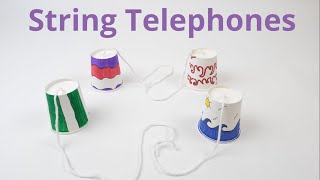
Students investigate how sound travels through string and air. First, they analyze the sound waves with a paper cup attached to a string. Then, they combine the string and cup with a partner to model a string telephone. Finally, they are given a design challenge to redesign the string telephone for distance. They think about their model as it compares a modern telephone and the impact the invention of the telephone has had on society.
View the full activity on TeachEngineering:
https://www.teachengineering.o....rg/activities/view/c
TeachEngineering has over 1,500 FREE lessons and activities. Visit https://www.teachengineering.org/ for more
Music: Daily Beetle - Kevin MacLeod

Students groups use balsa wood and glue to build their own towers using some of the techniques they learned from the associated lesson. While general guidelines are provided, give students freedom with their designs and encourage them to implement what they have learned about structural engineering. The winning team design is the tower with the highest strength-to-weight ratio.
View the full activity on TeachEngineering:
https://www.teachengineering.o....rg/activities/view/d
TeachEngineering has over 1,500 FREE lessons and activities. Visit https://www.teachengineering.org/ for more!
Music: Payday - Silent Partner

Students are introduced to Pascal's law, Archimedes' principle and Bernoulli's principle. Fundamental definitions, equations, practice problems and engineering applications are supplied. Students can use the associated activities to strengthen their understanding of relationships between the previous concepts and real-life examples. A PowerPoint® presentation, practice problems and grading rubric are provided.
View the full lesson on TeachEngineering: https://www.teachengineering.o....rg/lessons/view/uoh_
TeachEngineering has over 1,500 FREE lessons and activities. Visit http://www.TeachEngineering.org for more!

During a power failure, or when we go outside at night, we grab a flashlight so we can find our way. What happens inside a flashlight that makes the bulb light up? Why do we need a switch to turn on a flashlight? Have you ever noticed that for the flashlight to work you must orient the batteries a certain way as you insert them into the casing? Many people do not know that a flashlight is a simple series circuit. In this hands-on activity, students build this everyday household item and design their own operating series circuit flashlights.
View the full activity on TeachEngineering: https://www.teachengineering.o....rg/activities/view/c
TeachEngineering has over 1,500 FREE lessons and activities. Visit http://www.TeachEngineering.org for more!
Music: Alternate - Vibe Tracks

By better understanding a specific type of disability through a cultural lens, students can better understand how to use the engineering design process to solve specific problems. In this activity, students research, brainstorm, and design a type of pre-braille (a type of braille that is used to introduce children at a young age) toy that is readily accessible to young students. They then create and test their toys while gaining information on what needs to be improved within their design through feedback provided by their classmates and teachers. To show understanding of the objective, students create a marketing poster explaining their findings and the use of their toy.
View the full lesson on Teach Engineering:
https://www.teachengineering.o....rg/activities/view/u
Teach Engineering has over 1,900 FREE lessons and activities. Visit https://www.teachengineering.org/ for more
Life of Riley - Kevin MacLeod

Student pairs design, build, and test model vehicles capable of rolling down a ramp and then coasting freely as far as possible. The challenge is to make the vehicles entirely out of dry pasta using only adhesive (such as hot glue) to hold the components together. Creativity is encouraged and different types of pasta are provided to support different functions such as round pasta for wheels and sheet pasta for the chassis. Students become familiar with the concepts of gravitational potential energy, kinetic energy and rolling resistance. Teams follow the steps of the engineering design process as they design, test and redesign their small-sized vehicles, working within the project's material constraints. The winner of the competitive final event is the pasta car that travels the longest distance beyond the bottom of the ramp.
View the full activity on TeachEngineering:
https://www.teachengineering.o....rg/activities/view/u
TeachEngineering has over 1,500 FREE lessons and activities. Visit https://www.teachengineering.org/ for more
Music: Comparsa Latinesque - Kevin MacLeod

Students apply their knowledge about mountains and rocks to transportation engineering, with the task of developing a model mountain tunnel that simulates the principles behind real-life engineering design. Student teams design and create model tunnels through a clay mountain, working within design constraints and testing for success; the tunnels must meet specific design requirements and withstand a certain load.
View the full activity on TeachEngineering:
https://www.teachengineering.o....rg/activities/view/c
TeachEngineering has over 1,500 FREE lessons and activities. Visit https://www.teachengineering.org/ for more
Music: Lone Wolf - Dan Lebowitz

Students explore the effect of chemical erosion on statues and monuments. They use chalk to see what happens when limestone is placed in liquids with different pH values. They also learn several engineering approaches to reduce the effects of acid rain.
View the full activity at TeachEngineering:
https://www.teachengineering.o....rg/activities/view/c
TeachEngineering has over 1,500 FREE lessons and activities. Visit http://www.TeachEngineering.org for more!
Music: Life of Riley - Kevin MacLeod
Life of Riley by Kevin MacLeod is licensed under a Creative Commons Attribution license (https://creativecommons.org/licenses/by/4.0/)
Source: http://incompetech.com/music/r....oyalty-free/index.ht
Artist: http://incompetech.com/

Students gain an understanding of air pressure by using candy or cookie wafers to model how it changes with altitude, by comparing its magnitude to gravitational force per unit area, and by observing its magnitude with an aluminum can crushing experiment. Three student worksheets (and answer keys) are provided.
View the full activity at TeachEngineering:
https://www.teachengineering.o....rg/activities/view/c
TeachEngineering has over 1,500 FREE lessons and activities.
Visit http://www.TeachEngineering.org for more!
Music: Komputo

Student groups construct simple conductivity probes and then integrate them into two different circuits to test the probe behavior in solutions of varying conductivity (salt water, sugar water, distilled water, tap water). The activity culminates with student-designed experiments that utilize the constructed probes. The focus is to introduce students to the fabrication of the probe and expose them to two different ways to integrate the probe to obtain qualitative and quantitative measurements, while considering the application and utility of a conductivity probe within an engineering context. A provided handout guides teams through the process: background reading and questions; probe fabrication including soldering; probe testing and data gathering (including circuit creation on breadboard); probe connection to Arduino (including circuit creation and code entry) and a second round of testing and data gathering; design and conduct their own lab experiments that use the probes; online electrolyte/non-electrolyte reading, short video, comprehension check and analysis questions.
View the full activity on TeachEngineering:
https://www.teachengineering.o....rg/activities/view/n
TeachEngineering has over 1,500 FREE lessons and activities. Visit https://www.teachengineering.org/ for more!
Music: Go To Town - Silent Partner

Students design and build model landfills using materials similar to those used by engineers for full-scale landfills. Their completed small-size landfills are "rained" on and subjected to other erosion processes. The goal is to create landfills that hold the most garbage, minimize the cost to build and keep trash and contaminated water inside the landfill to prevent it from causing environmental damage. Teams create designs within given budgets, test the landfills' performance, and graph and compare designs for capacity, cost and performance.
View the full activity at TeachEngineering: https://www.teachengineering.o....rg/activities/view/c
TeachEngineering has over 1,500 FREE lessons and activities. Visit https://www.teachengineering.org/ for more!
Music: How We Like It - Dan Lebowitz

Students learn the history of the waterwheel and common uses for water turbines today. They explore kinetic energy by creating their own experimental waterwheel from a two-liter plastic bottle. They investigate the transformations of energy involved in turning the blades of a hydro-turbine into work, and experiment with how weight affects the rotational rate of the waterwheel. Students also discuss and explore the characteristics of hydroelectric plants.
View the full activity on TeachEngineering: https://www.teachengineering.o....rg/activities/view/c
TeachEngineering has over 1,500 FREE lessons and activities. Visit http://www.TeachEngineering.org for more!
Music: Inevitable

Students learn about the different structures that comprise cell membranes, fulfilling part of the Research and Revise stages of the legacy cycle. They view online animations of cell membrane dynamics (links provided). Then they observe three teacher demonstrations that illustrate diffusion and osmosis concepts, as well as the effect of movement through a semi-permeable membrane using Lugol's solution. Lastly, students use the associated activity to test their understanding of the cell structure and membrane.
View the full lesson on Teach Engineering:
https://www.teachengineering.o....rg/lessons/view/van_
Teach Engineering has over 1,500 FREE lessons and activities. Visit https://www.teachengineering.org/ for more

Students construct three-dimensional models of water catchment basins using everyday objects to form hills, mountains, valleys and water sources. They experiment to see where rain travels and collects, and survey water pathways to see how they can be altered by natural and human activities. Students discuss how engineers design structures that impact water collection, as well as systems that clean and distribute water.
View the full activity on TeachEngineering:
https://www.teachengineering.o....rg/activities/view/c
TeachEngineering has over 1,500 FREE lessons and activities. Visit https://www.teachengineering.org/ for more!
Music: Rank and File - Silent Partner

After watching a short online video that recaps the enormous scale of accumulating plastic waste in our oceans, student teams are challenged to devise a method to remove the most plastic microbeads from a provided commercial personal care product—such as a facial cleanser or body wash. They brainstorm filtering methods ideas and design their own specific procedures that use teacher-provided supplies (coffee filters, funnels, plastic syringes, vinyl tubing, water, plastic bags) to extract the microplastics as efficiently as possible. The research and development student teams compare the final masses of their extracted microbeads to see which filter solutions worked best. Students suggest possible future improvements to their filter designs.
View the full activity at TeachEngineering:
https://www.teachengineering.o....rg/activities/view/u
TeachEngineering has over 1,500 FREE lessons and activities. Visit http://www.TeachEngineering.org for more!
Music: It's All Happening - Huma-Huma
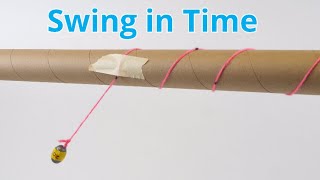
Students examine the motion of pendulums and come to understand that the longer the pendulum string, the fewer the number of swings in a given time interval. Student groups conduct an experiment, collecting and graphing data on a worksheet. They see that changing the weight on the pendulum does not have an effect on the period
View the full activity on TeachEngineering:
https://www.teachengineering.o....rg/activities/view/c
TeachEngineering has over 1,500 FREE lessons and activities. Visit https://www.teachengineering.org/ for more
music -The_Temperature_of_the_Air_on_the_Bow_of_the_Kaleetan

Students learn about electrical connections, how they work and their pervasiveness in our world. They consider the usefulness of wireless electrical connections for connecting electrical devices. Morse code is introduced as a communication method that takes advantage of on/off states to transmit messages by electrical bursts sent via wires, light or sound. They learn the Morse code rules and translate a few phrases into Morse code. Specifically, they learn about a wireless connection type known as Bluetooth that can be used to control LEGO robots remotely from Android devices, which leads into the associated activity.
View the full lesson on TeachEngineering:
https://www.teachengineering.o....rg/lessons/view/umo_
TeachEngineering has over 1,900 FREE lessons and activities. Visit http://www.TeachEngineering.org for more!

While we know air exists around us all the time, we usually do not notice the air pressure. During this activity, students use Bernoulli's principle to manipulate air pressure so its influence can be seen on the objects around us.
View the full activity at TeachEngineering:
https://www.teachengineering.o....rg/activities/view/c
TeachEngineering has over 1,500 FREE lessons and activities. Visit http://www.TeachEngineering.org for more!
Music: Aimless Amos

Students learn about biomimicry and how engineers often imitate nature in the design of innovative new products. They demonstrate their knowledge of biomimicry by practicing brainstorming and designing a new product based on what they know about animals and nature.
View the full activity on TeachEngineering:
https://www.teachengineering.o....rg/activities/view/c
TeachEngineering has over 1,500 FREE lessons and activities. Visit https://www.teachengineering.org/ for more
Music: Sunday Spirit

Students explore the basics of DC circuits, analyzing the light from light bulbs when connected in series and parallel circuits. Ohm's law and the equation for power dissipated by a circuit are the two primary equations used to explore circuits connected in series and parallel. Students measure and see the effect of power dissipation from the light bulbs. Kirchhoff's voltage law is used to show how two resistor elements add in series, while Kirchhoff's current law is used to explain how two resistor elements add when in parallel. Students also learn how electrical engineers apply this knowledge to solve problems. Power dissipation is particularly important with the introduction of LED bulbs and claims of energy efficiency, and understanding how power dissipation is calculated helps when evaluating these types of claims. This activity is designed to introduce students to the concepts needed to understand how circuits can be reduced algebraically.
View the full lesson on TeachEngineering:
https://www.teachengineering.o....rg/activities/view/w
TeachEngineering has over 1,500 FREE lessons and activities. Visit https://www.teachengineering.org/ for more
Music: Life_of_Riley
Artist: Kevin MacLeod

Students learn about the types of waves and how they change direction, as well as basic wave properties such as wavelength, frequency, amplitude and speed. During the presentation of lecture information on wave characteristics and properties, students take notes using a handout. Then they label wave parts on a worksheet diagram and draw their own waves with specified properties (crest, trough and wavelength). They also make observations about the waves they drew to determine which has the highest and the lowest frequency. With this knowledge, students better understand waves and are a step closer to understanding how humans see color.
View the full lesson on TeachEngineering:
https://www.teachengineering.o....rg/lessons/view/clem
TeachEngineering has over 1,500 FREE lessons and activities. Visit https://www.teachengineering.org/ for more

In this lesson, students learn about work as defined by physical science and see that work is made easier through the use of simple machines. Already encountering simple machines everyday, students will learn about their widespread uses in improving everyday life. This lesson serves as the starting point for the Simple Machines Unit.
View the full lesson on TeachEngineering:
https://www.teachengineering.o....rg/lessons/view/cub_
TeachEngineering has over 1,500 FREE lessons and activities. Visit https://www.teachengineering.org/ for more

Students use the associated activity to learn about atoms and their structure (protons, electrons, neutrons) — the building blocks of matter. They see how scientific discoveries about atoms and molecules influence new technologies developed by engineers.
View the full lesson on TeachEngineering: https://www.teachengineering.o....rg/lessons/view/cub_
TeachEngineering has over 1,500 FREE lessons and activities. Visit https://www.teachengineering.org/ for more

After a discussion about what a parachute is and how it works, students create parachutes using different materials that they think will work best. They test their designs, and then contribute to a class discussion (and possible journal writing) to report which paper materials worked best.
View the full activity on TeachEngineering:
https://www.teachengineering.o....rg/activities/view/d
TeachEngineering has over 1,500 FREE lessons and activities. Visit https://www.teachengineering.org/ for more!
Music: Safety Net - Riot