Latest videos

To gain a better understanding of the roles and functions of components of the human respiratory system and our need for clean air, students construct model lungs that include a diaphragm and chest cavity. They see how air moving in and out of the lungs coincides with diaphragm movement. Then student teams design and build a prototype face mask pollution filter. They use their model lungs to evaluate their prototypes to design requirements.
View the full activity on TeachEngineering:
https://www.teachengineering.o....rg/activities/view/c
TeachEngineering has over 1,500 FREE lessons and activities. Visit https://www.teachengineering.org/ for more
Music: Sky Scraper - Geographer

Students are introduced to brainstorming and the design process in problem solving as it relates to engineering. They perform an activity to develop and understand problem solving with an emphasis on learning from history. Using only paper, straws, tape and paper clips, they create structures that can support the weight of at least one textbook. In their first attempts to build the structures, they build whatever comes to mind. For the second trial, they examine examples of successful buildings from history and try again.
View the full activity on TeachEngineering:
https://www.teachengineering.o....rg/activities/view/c
TeachEngineering has over 1,500 FREE lessons and activities. Visit https://www.teachengineering.org/ for more!
Music: Comparsa-Latinesque - Kevin MacLeod

To understand the challenges of satellite construction, student teams design and create model spacecraft to protect vital components from the harsh conditions found on Mercury and Venus. They use slices of butter in plastic eggs to represent the internal data collection components of the spacecraft. To discover the strengths and weaknesses of their designs, they test their unique thermal protection systems in a planet simulation test box that provides higher temperature and pressure conditions.
This engineering curriculum aligns to Next Generation Science Standards (NGSS).
View the full activity on TeachEngineering:
https://www.teachengineering.o....rg/activities/view/c
TeachEngineering has over 1,500 FREE lessons and activities. Visit https://www.teachengineering.org/ for more
Music: EDM Detection Mode

Student groups are challenged to design and construct model towers out of newspaper. They are given limited supplies including newspaper, tape and scissors, paralleling the real-world limitations faced by engineers, such as economic restrictions as to how much material can be used in a structure. Students aim to build their towers for height and stability, as well as the strength to withstand a simulated lateral "wind" load.
View the full activity at TeachEngineering:
https://www.teachengineering.o....rg/activities/view/d
TeachEngineering has over 1,500 FREE lessons and activities. Visit https://www.teachengineering.org/ for more!
Music: Fugetaboutit - Dan Lebowitz

This activity focuses on the use of graphene in organic fibers, and their applications in organic electronics, e-textiles and wearable technologies. Students learn about the properties of graphene—a unique form of carbon—and how graphene-based fibers are fabricated, how to measure resistance, how to calculate resistivity, and how a material changes its electrical properties. Students also learn about the importance of defining design parameters, which is an important concept in the engineering design process. Students create graphite-based fibers using sodium alginate as the medium and a calcium coagulation bath, which is similar to the way in which graphene-based fibers are created in engineering research laboratories. Students then determine the factors that contribute to resistivity and vary these parameters to optimize fiber resistivity.
View the full activity on TeachEngineering: https://www.teachengineering.o....rg/activities/view/r
TeachEngineering has over 1,500 FREE lessons and activities. Visit https://www.teachengineering.org/ for more!
Music: Educated Man - Max McFerren

To further their understanding of sound energy, students identify the different pitches and frequencies created by a vibrating ruler and a straw kazoo. They create high- and low-pitch sound waves.
This engineering curriculum aligns to Next Generation Science Standards (NGSS).
View the full activity on TeachEngineering:
https://www.teachengineering.o....rg/activities/view/c
TeachEngineering has over 1,500 FREE lessons and activities. Visit https://www.teachengineering.org/ for more
Music: Tyler Kimbell
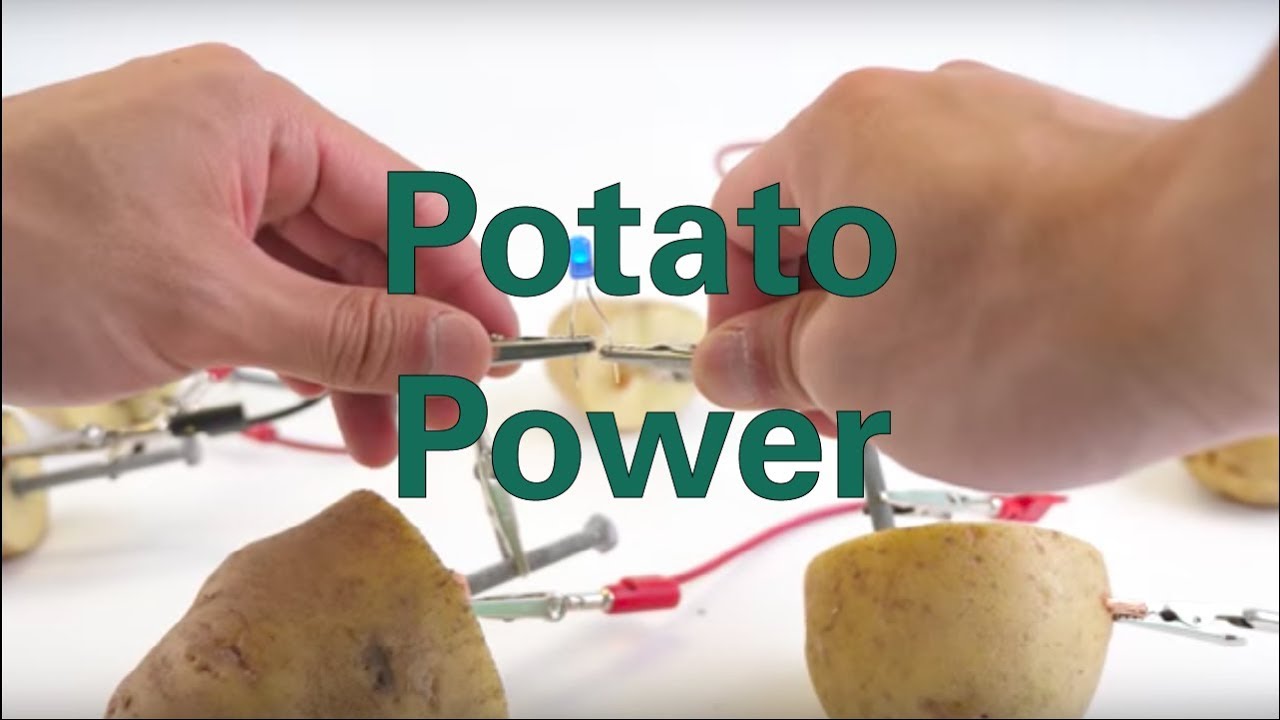
Students use potatoes to light an LED clock (or light bulb) as they learn how a battery works in a simple circuit and how chemical energy changes to electrical energy. As they learn more about electrical energy, they better understand the concepts of voltage, current and resistance.
View the full activity on TeachEngineering: https://www.teachengineering.o....rg/activities/view/c
TeachEngineering has over 1,500 FREE lessons and activities. Visit http://www.TeachEngineering.org for more!
Music: Moose - Bensound.com

The purpose of this lesson is to introduce students to the basic elements of our Earth's crust: rocks, soils and minerals. They learn how we categorize rocks, soils and minerals and how they are literally the foundation for our civilization. Students also explore how engineers use rocks, soils and minerals to create the buildings, roads, vehicles, electronics, chemicals, and other objects we use to enhance our lives.
View the full lesson on TeachEngineering: https://www.teachengineering.o....rg/lessons/view/cub_
TeachEngineering has over 1,500 FREE lessons and activities. Visit https://www.teachengineering.org/ for more
Continuing the Asteroid Impact challenge, student teams test rocks to identify their physical properties such as luster, hardness, color, etc., and classify them as igneous, metamorphic or sedimentary. They complete a data table to record all of the rock properties, and then answer worksheet questions to deepen their understanding of rock properties and relate them to the cavern design problem.
View the full lesson on TeachEngineering:
https://www.teachengineering.o....rg/activities/view/c
TeachEngineering has over 1,900 FREE lessons and activities. Visit https://www.teachengineering.org/ for more
Music: Elite_Syncopations
By: E's Jammy Jams

In a class demonstration, the teacher places different pill types ("chalk" pill, gel pill, and gel tablet) into separate glass beakers of vinegar, representing human stomach acid. After 20-30 minutes, the pills dissolve. Students observe which dissolve the fastest, and discuss the remnants of the various pills. What they learn contributes to their ongoing objective to answer the challenge question presented in lesson 1 of this unit.
View the full activity at TeachEngineering:
https://www.teachengineering.o....rg/activities/view/v
TeachEngineering has over 1,500 FREE lessons and activities. Visit https://www.teachengineering.org/ for more!
Music: Hot Mess - Audionautix
Hot Mess by Audionautix is licensed under a Creative Commons Attribution license (https://creativecommons.org/licenses/by/4.0/)
Artist: http://audionautix.com/

With an introduction to the ideas of energy, students discuss specific energy types and practical energy sources. Associated hands-on activities help them identify energy types in their surroundings and enhance their understanding of the concept of energy.
View the full lesson on TeachEngineering:
https://www.teachengineering.o....rg/lessons/view/cub_
TeachEngineering has over 1,500 FREE lessons and activities. Visit https://www.teachengineering.org/ for more
Music: Redwood Highway
Students explore the composition and practical application of parallel circuitry, compared to series circuitry. Students design and build parallel circuits and investigate their characteristics, and apply Ohm's law.
View the full lesson on TeachEngineering:
https://www.teachengineering.o....rg/lessons/view/cub_
TeachEngineering has over 1,900 FREE lessons and activities. Visit http://www.TeachEngineering.org for more!

Students are introduced to the space environment, learning about the major differences between the environment on Earth and that of outer space (atmosphere, radiation, microgravity)— and the engineering challenges that arise because of these differences. To prepare students for the upcoming lessons on the human body, they are challenged to think about how their bodies would change and adapt in the unique environment of space.
View the full lesson on TeachEngineering:
https://www.teachengineering.o....rg/lessons/view/cub_
TeachEngineering has over 1,500 FREE lessons and activities. Visit https://www.teachengineering.org/ for more

Students are introduced to the concept of engineering biological organisms and studying their growth to be able to identify periods of fast and slow growth. They learn that bacteria are found everywhere, including on the surfaces of our hands. Student groups study three different conditions under which bacteria are found and compare the growth of the individual bacteria from each source. In addition to monitoring the quantity of bacteria from differ conditions, they record the growth of bacteria over time, which is an excellent tool to study binary fission and the reproduction of unicellular organisms.
View the full activity on TeachEngineering:
https://www.teachengineering.o....rg/activities/view/n
TeachEngineering has over 1,500 FREE lessons and activities. Visit https://www.teachengineering.org/ for more!
Music: Blue Macaw - Quincas Moreira

In this activity, students gain first-hand experience with the mechanical advantage of pulleys. They set up different pulley systems, compare the theoretical and actual mechanical advantage of each and develop an understanding of error in experiments.
View the full lesson on TeachEngineering:
https://www.teachengineering.o....rg/activities/view/c
TeachEngineering has over 1,500 FREE lessons and activities. Visit https://www.teachengineering.org/ for more
Music - EDM Detection Mode By Kevin MacLeod

Through investigating the nature, sources and level of noise produced in their environment, students are introduced to the concept of noise pollution. They learn about the undesirable and disturbing effects of noise and the resulting consequences on people's health, as well as on the health of the environment. They use a sound level meter that consists of a sound sensor attached to the LEGO® EV3 Intelligent Brick to record the noise level emitted by various sources. They are introduced to engineering concepts such as sensors, decibel (dB) measurements, and sound pressure used to measure the noise level. Students are introduced to impairments resulting from noise exposure such as speech interference, hearing loss, sleep disruption and reduced productivity. They identify potential noise pollution sources, and based on recorded data, they classify these sources into levels of annoyance. Students also explore the technologies designed by engineers to protect against the harmful effects of noise pollution.
View the full activity at TeachEngineering:
https://www.teachengineering.o....rg/activities/view/n
TeachEngineering has over 1,500 FREE lessons and activities.
Visit http://www.TeachEngineering.org for more!
Music: Valerie_Plain- Rondo Brothers
Air pressure is pushing on us all the time although we do not usually notice it. In this activity, students learn about the units of pressure and get a sense of just how much air pressure is pushing on them.
View the full lesson on TeachEngineering:
https://www.teachengineering.o....rg/activities/view/c
TeachEngineering has over 1,500 FREE lessons and activities. Visit https://www.teachengineering.org/ for more

Student groups make simple conductivity testers each using a battery and light bulb. They learn the difference between conductors and insulators of electrical energy as they test a variety of materials for their ability to conduct electricity.
View the full activity on TeachEngineering:
https://www.teachengineering.o....rg/activities/view/c
TeachEngineering has over 1,500 FREE lessons and activities. Visit https://www.teachengineering.org/ for more
Music: Venice Beach

Students design and construct electromagnets that must pick up 10 staples. They begin with only minimal guidance, and after the basic concept is understood, are informed of the properties that affect the strength of that magnet. They conclude by designing their own electromagnets to complete the challenge of separating scrap steel from scrap aluminum for recycling, and share it with the class.
View the full activity on TeachEngineering:
https://www.teachengineering.o....rg/activities/view/v
TeachEngineering has over 1,500 FREE lessons and activities. Visit http://www.TeachEngineering.org for more!
Music: Sunday Spirit - Audionautix
Sunday Spirit by Audionautix is licensed under a Creative Commons Attribution license (https://creativecommons.org/licenses/by/4.0/)
Artist: http://audionautix.com/

Working as if they are engineers who work for (the hypothetical) Build-a-Toy Workshop company, students apply their imaginations and the engineering design process to design and build prototype toys with moving parts. They set up electric circuits using batteries, wire and motors. They create plans for project material expenses to meet a budget.
View the full activity on TeachEngineering: https://www.teachengineering.o....rg/activities/view/c
TeachEngineering has over 1,500 FREE lessons and activities. Visit http://www.TeachEngineering.org for more!
Music: Fun - Vibe Tracks

Students are introduced to the differences between acids and bases and how to use indicators, such as pH paper and red cabbage juice, to distinguish between them. They learn why it is important for engineers to understand acids and bases.
View the full activity on TeachEngineering: https://www.teachengineering.o....rg/activities/view/c
TeachEngineering has over 1,500 FREE lessons and activities. Visit http://www.TeachEngineering.org for more!
Music: Bubblegum Ballgame - JR Tundra

Students are introduced to the concept and steps of the engineering design process and taught how to apply it. Students first receive some background information about biomedical engineering (aka bioengineering). Then they learn about material selection and material properties by using a provided guide. In small groups, students learn of their design challenge (improve a cast for a broken arm), brainstorm solutions, are given materials and create prototypes. To finish, teams communicate their design solutions through class poster presentations.
View the full activity on TeachEngineering:
https://www.teachengineering.o....rg/activities/view/b
TeachEngineering has over 1,500 FREE lessons and activities. Visit https://www.teachengineering.org/ for more!
Music: Dragonfly

Students learn about various natural hazards and specific methods engineers use to prevent these hazards from becoming natural disasters. They study a hypothetical map of an area covered with natural hazards and decide where to place natural disaster prevention devices by applying their critical thinking skills and an understanding of the causes of natural disasters.
This engineering curriculum aligns to Next Generation Science Standards (NGSS).
View the full activity on TeachEngineering:
https://www.teachengineering.o....rg/activities/view/c
TeachEngineering has over 1,500 FREE lessons and activities. Visit https://www.teachengineering.org/ for more
Music: EDM Detection Mode
Students learn the metric units engineers use to measure mass, distance (or length) and volume. They make estimations using these units and compare their guesses with actual values. To introduce the concepts, the teacher needs access to a meter stick, a one-liter bottle, a glass container that measures milliliters and a gram scale.
View the full lesson on TeachEngineering:
https://www.teachengineering.o....rg/lessons/view/cub_
TeachEngineering has over 1,900 FREE lessons and activities. Visit http://www.TeachEngineering.org for more!

Students act as structural engineers and learn about forces and load distributions as they follow the steps of the engineering design process to design and build small-scale bridges using wooden tongue depressors and glue. Teams brainstorm ideas that meet the size and material design constraints and create prototype bridges of the most promising solutions. They test their bridges to see how much weight they can hold until they break and then determine which have the highest strength-to-weight ratios. They examine the prototype failures to identify future improvements. This activity is part of a unit in which multiple activities are brought together for an all-day school/multi-school concluding “engineering field day” competition.
View the full activity on TeachEngineering: https://www.teachengineering.o....rg/activities/view/u
TeachEngineering has over 1,500 FREE lessons and activities. Visit https://www.teachengineering.org/ for more!
Music: Undeniable - Text Me Records / Bobby Renz