Top videos
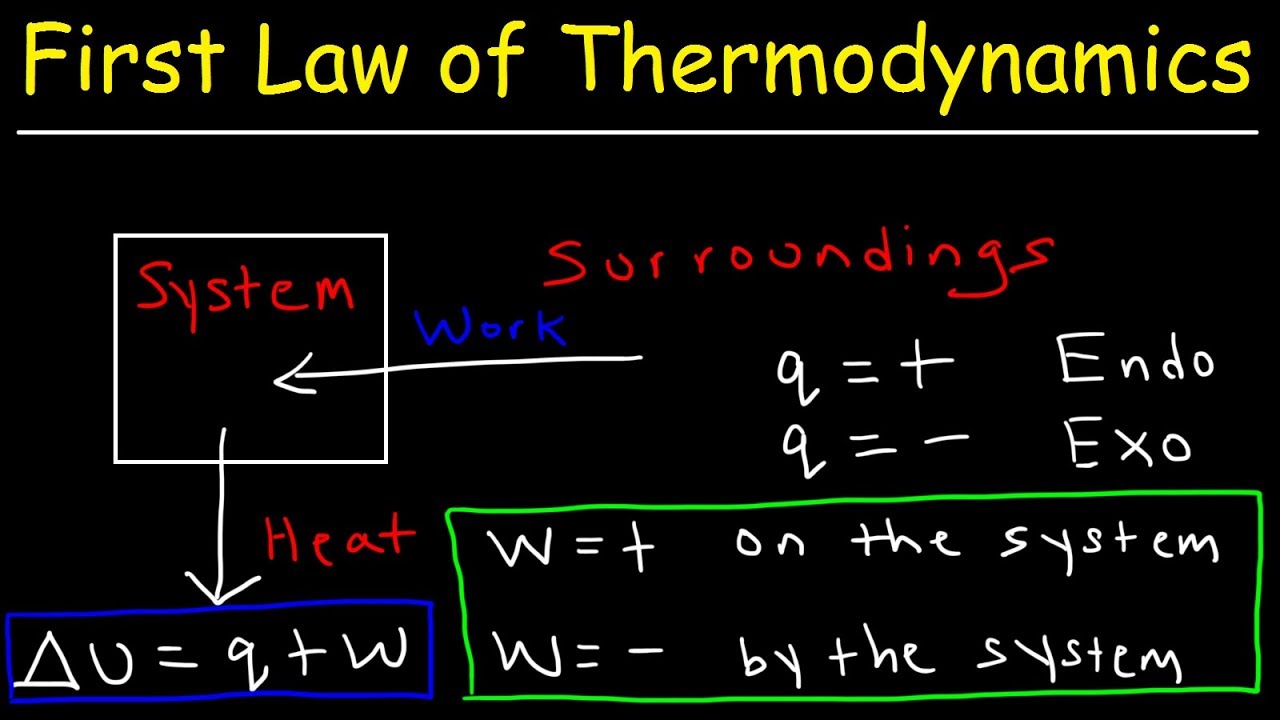
This chemistry video tutorial provides a basic introduction into the first law of thermodynamics. It shows the relationship between internal energy, heat, and work. It discusses the difference between the system and surroundings and distinguishes an open system from a closed system and an isolated system. In chemistry, work is positive whenever work is done on the system and work is negative whenever work is done by the system. During an exothermic process, heat flows out of the system and it flows into the system during an endothermic process.
First Law of Thermodynamics:
https://www.youtube.com/watch?v=NyOYW07-L5g
Thermochemistry Equations:
https://www.youtube.com/watch?v=GL3gCBUua4c
Internal Energy, Heat, and Work:
https://www.youtube.com/watch?v=E7s-hIoyNqY
Thermochemical Equations:
https://www.youtube.com/watch?v=qDrcHR4tSdE
Specific Vs Molar Heat Capacity:
https://www.youtube.com/watch?v=IoHXMaiwT80
________________________________
Basic Calorimetry Problems:
https://www.youtube.com/watch?v=BGcDUybbTW0
Final Temperature Calorimetry Problems:
https://www.youtube.com/watch?v=lxMwyxvSqgk
Latent Heat of Fusion & Vaporization:
https://www.youtube.com/watch?v=dxtz2POUTJE
Coffee Cup Calorimeter:
https://www.youtube.com/watch?v=-XnUypVXE88
More Calorimeter Problems:
https://www.youtube.com/watch?v=F2cMvNDRqQA
__________________________________
Specific Heat Capacity Problems:
https://www.youtube.com/watch?v=ePm_N6RgLfk
Hess Law Problems:
https://www.youtube.com/watch?v=2ixEf2zpR8E
More Hess Law Problems:
https://www.youtube.com/watch?v=Idv2C8HBbug
Enthalpy of Formation & Heat Combustion:
https://www.youtube.com/watch?v=FP-VYfTYi8Y
Enthalpy Practice Problems:
https://www.youtube.com/watch?v=Xe_N7WYl5BI
__________________________________
Speed of Light, Frequency, & Wavelength:
https://www.youtube.com/watch?v=LgYMxH1LCdo
Final Exams and Video Playlists:
https://www.video-tutor.net/
Full-Length Videos and Worksheets:
https://www.patreon.com/MathSc....ienceTutor/collectio

भिन्न के सवाल | Fractions | Maths kaise sikhen | Basic Maths Series by Explain 4U | bhinn ke sawal
In This Video, We Learn about how to start learning fractions in maths step by step. it is a very easy and simple subject. we learn 5 tips to improve mathematics. I hope you like this video. This tip helps you to solve maths problems in an easy way. I also uploaded full maths topic videos. You must watch this.
More Videos Links
1) Maths kaise strong kare
https://youtu.be/NA0vpBYT7bY
2) समीकरण के कठिन सवाल सीखे | Equations
https://youtu.be/somp7RZcSuU
3) भिन्न का जोड़ घटाव गुणा भाग | Fractions
https://youtu.be/ad7Q0XmHy0c
4) Lcm और Hcf निकालना सीखे |
https://youtu.be/gyLXf01rqzc
5) गुणनखंड करना सीखे | Factorisation
https://youtu.be/HLTAKlCXMZo
6) प्रतिशत निकालना सीखे | Percentage
https://youtu.be/jnzdpaKyxqg
7) रूट का जोड़ घटाव गुणा और भाग |
https://youtu.be/gpfaEdQtnpg
8) संख्याओं को काटना सीखें | How to Divide Numbers | Divisibilty Rule
https://youtu.be/NpE3MNhHP08
9) दशमलव का भाग करना सीखे | Decimal Division Trick
https://youtu.be/ebUP64oLvtI
10) BODMAS Rule | बोडमास का नियम सीखे
https://youtu.be/PCy77upPiw0
More Playlists Links:-
1) समीकरण ( Equations ): https://www.youtube.com/playli....st?list=PLUfMjsqKXxW
2) भिन्न के सवाल ( Fractions ): https://www.youtube.com/playli....st?list=PLUfMjsqKXxW
3) Best Videos for Class 10 Maths: https://www.youtube.com/playli....st?list=PLUfMjsqKXxW
Agar aap ko Video achcha laga to like kre and hamare channel explain 4u ko subscribe kre hum aaise hi mathematics content apne chennel par late rahte he.
Thank you.
Like | Share | Subscribe |
Follow me on :-
Telegram -
https://telegram.me/Explain_4u
Instagram - https://www.instagram.com/hemant_patil97/
Facebook Page - https://m.facebook.com/Explain4u/
Instagram Page - https://www.instagram.com/explain_4u/
Facebook - https://www.facebook.com/patil.sahab.376
Join this channel to get access to perks:
https://www.youtube.com/channe....l/UC09ATg5o6ZJYNyotQ
About This Video :-
1) bhinn ka jod ghatav guna bhag
2) fractions in hindi
3) fractions class 7 and 8
4) bhinn ka guna bhag
5) bhinn ka jod ghatana guna bhag ek sath
6) addition subtraction multiplication division of fractions
7) भिन्न का जोड़ घटाव गुणा भाग
8) bodmas rule in maths
9) how to learn maths
10) maths kaise sikhen
#explain4u #fractions #bodmasrule #bodmas #bodmas_rule #bhinnkesawal #basicmaths #bhinnkabhag #bhinnkagunabhag #bhinn_ka_ghatana #bhinnkajor
#mathskaisesikhe #maths

Anthropic đã trở thành nhà cung cấp trí tuệ nhân tạo lập trình hàng đầu, tạo ra làn sóng tìm kiếm và nghiên cứu khắp Thung lũng Silicon. Làm thế nào họ đạt được điều này?
Trong video này, chúng ta sẽ khám phá cách Anthropic đã tạo ra bước đột phá với mô hình Claude Sonnet 3.5 vào tháng 6/2024, mang đến khả năng viết mã chất lượng cao mà các nhà phát triển tự hào. Chúng ta sẽ phân tích các kỹ thuật đằng sau thành công này, từ Constitutional AI đến Reinforcement Learning from AI Feedback (RLAIF).
Bạn sẽ hiểu tại sao Anthropic vẫn dẫn đầu sau hơn một năm, trong khi các đối thủ như OpenAI, Meta và xAI của Elon Musk vẫn đang cố gắng bắt kịp. Khám phá cách công nghệ này đã tạo ra hiện tượng "vibe coding" và cách nó đang định hình tương lai của phát triển phần mềm.
Đây là phần 3 trong chuỗi 4 video ngắn về Anthropic AI lập trình.
🔗 NGUỒN THAM KHẢO:
Business Insider: https://www.businessinsider.co....m/anthropic-ai-break
Trang web Anthropic: https://www.anthropic.com
Đăng ký kênh để nhận thêm video về trí tuệ nhân tạo, lập trình và tương lai công nghệ!
#laptrinhai #claudesonnet #trituenhantao
Model Context Protocol (MCP) is an open standard that allows AI models (like ChatGPT or others) to connect with external tools, APIs, and data sources—in a secure and structured way.
In simple terms, MCP gives AI the ability to take real actions, not just answer questions.
Explore My project Of MCP Server on my GITHUB - https://github.com/Devansh1974/MCP_AI_Server_Agent
Connect with me on Linkedin - www.linkedin.com/in/devanshsingh2006

Educational video for kids to learn how to relax in a different way. Would you like to be as agile as cats? Learn the cat pose to strengthen your back, arms and tummy. Apart from practising several yoga poses, you'll also relax a lot. You'll have 10 seconds to do the pose at your own pace, at home or in school!
This video is part of a Yoga videos collection for kids, to learn how to relax and how to do different yoga poses, while having fun. Recommended for primary and preschool education.
Thanks for visiting us! If you want your children to smile and learn, subscribe! :D
We only upload our own content, designed by educators so that children smile and learn while watching a video.
All of our content reinforces educational values, encouraging the use of multiple intelligences and language learning.
If you like our videos, download “The Smart Library” now. You’ll discover more than 70 interactive games and stories for children designed by educators. The stories are based on VALUES like friendship, respect, and generosity, and our games cover all of the MULTIPLE INTELLIGENCES. All our content is in SPANISH, ENGLISH, FRENCH, ITALIAN and PORTUGUESE.

Educational video for childern to learn about the most used adjectives to describe objects. In this video childern will learn some of the most common adjectives and their opposites: rough, soft, gigantic, tiny, pretty, ugly, round, square, expensive, cheap. Thanks to easy and fun examples, children will discover adjectives used to describe objects.
This video is a very useful and interesting resource for children to teach them about adjectives used to describe objects. It is an excellent video for early childhood education.
Thanks for visiting us! If you want your children to smile and learn, subscribe! :D
If you like our videos, download Smile and Learn now. You’ll discover thousands of activities for children aged 3 to 12 years, all designed by educators. We have hundreds of games, interactive stories and videos in five languages: English, Spanish, Portuguese, Italian, Turkish and French. Try a month for free and start the adventure!
www.smileandlearn.com
Dette værksted indeholder 4 sjove og lærerige lege med Centicubes.
Mine elever er glade for disse små lege og spil som breaks i undervisningen, og samtidig bliver de gode til at bruge Centicubes i mine andre værksteder.
I dette værksted øver eleverne sig bl.a i at bygge figurer og plusstykker. Man kan selvfølge også lave minusstykker osv. Det er kun fantasien der sætter grænsen.
Hvis du kan lide dette værksted, må du meget gerne dele det med dine kolleger, elever og deres forældre
Du behøver kun en god stak Centicubes for at kunne bruge dette værksted, og eleverne behøver ikke at skrive noget undervejs, med mindre du foretrækker det.
Du kan også se min video "Leg med mønter" lige her: https://www.youtube.com/watch?v=mIp0qYqApV8
God fornøjelse
KH Anette K
Jeg vil blive rigtig glad, hvis du vil følge mig på alle mine kanaler
https://facebook.com/anettekmatematik/
https://instagram.com/anettekmatematik/
https://www.youtube.com/channe....l/UCR8PqEuBE7OlORn2y
https://anettekmatematik.com/
#Centicubes #matematik #lærmatematik

You're already learning on YouTube — why not get college credit for it? https://link.gostudyhall.com/my1
In this episode of Crash Course: How to College, Erica talks us through what preparing for college could entail and how we can be active in that preparation. Applying to college is exciting and stressful and lots of other things that cause a whole lot of emotions. But you can take steps now that will make the college admissions process a lot easier once you get to that point.
***
Now you can take top-tier college courses with Study Hall! Study Hall videos are available to watch at no cost, and first-year courses are $25 to sign-up and begin coursework. Once you're satisfied with your grade, receive credit for only $400. Sign up at https://link.gostudyhall.com/my1
Follow Study Hall on socials!
Twitter: https://twitter.com/gostudyhall
Instagram: https://Instagram.com/GoStudyHall
Facebook: https://www.facebook.com/GoStudyHall
_______________________________________________
Chapters:
0:00 - Introduction
0:51 - Getting organized
1:24 - Goals
2:25 - Courses
3:36 - Standardized tests
6:12 - Figuring out your interests
_______________________________________________
Links to the resources listed in this video:
GED: https://ged.com/
Kaplan: https://www.kaptest.com/study/
Career assessment tests: https://www.careeronestop.org/ https://www.mynextmove.org/explore/ip
National College Attainment Network: https://www.ncan.org/general/c....ustom.asp?page=Membe
Upward Bound: https://www2.ed.gov/programs/t....rioupbound/index.htm
Crash Course: How to College is part of Study Hall, a partnership between ASU and Crash Course. Head over to our new Study Hall channel to check out our Fast Guide series which break down different college majors.
***
Watch our videos and review your learning with the Crash Course App!
Download here for Apple Devices: https://apple.co/3d4eyZo
Download here for Android Devices: https://bit.ly/2SrDulJ
Crash Course is on Patreon! You can support us directly by signing up at http://www.patreon.com/crashcourse
Thanks to the following patrons for their generous monthly contributions that help keep Crash Course free for everyone forever:
Dave Freeman, Hasan Jamal, DL Singfield, Lisa Owen, Jeremy Mysliwiec, Amelia Ryczek, Ken Davidian, Stephen Akuffo, Toni Miles, Erin Switzer, Steve Segreto, Michael M. Varughese, Kyle & Katherine Callahan, Laurel Stevens, Vincent, Michael Wang, Stacey Gillespie (Stacey J), Alexis B, Burt Humburg, Aziz Y, Shanta, DAVID MORTON HUDSON, Perry Joyce, Scott Harrison, Mark & Susan Billian, Junrong Eric Zhu, Rachel Creager, Breanna Bosso, Matt Curls, Tim Kwist, Jonathan Zbikowski, Jennifer Killen, Sarah & Nathan Catchings, team dorsey, Trevin Beattie, Divonne Holmes à Court, Eric Koslow, Jennifer, Dineen, Indika Siriwardena, Khaled El Shalakany, Jason Rostoker, Shawn Arnold, Siobhán, Ken Penttinen, Nathan Taylor, Les Aker, ClareG, Rizwan Kassim, Alex Hackman, Jirat, Katie Dean, Avi Yashchin, NileMatotle, Wai Jack Sin, Ian Dundore, Justin, Mark, Caleb Weeks
__
Want to find Crash Course elsewhere on the internet?
Facebook - http://www.facebook.com/YouTubeCrashC...
Twitter - http://www.twitter.com/TheCrashCourse
Tumblr - http://thecrashcourse.tumblr.com
Support Crash Course on Patreon: http://patreon.com/crashcourse
CC Kids: http://www.youtube.com/crashcoursekids"
#CrashCourse #HowtoCollege #StudyHall

In which John Green teaches you about the Cold War, the decades-long conflict between the USA and the USSR. The Cold War was called cold because of the lack of actual fighting, but this is inaccurate. There was plenty of fighting, from Korea to Viet Nam to Afghanistan, but we'll get into that stuff next week. This week we'll talk about how the Cold War started. In short, it grew out of World War II. Basically, the Soviets occupied Eastern Europe and the US-supported western Europe. This setup would spill across the world, with client states on both sides. It's all in the video. You should just watch it.
Hey teachers and students - Check out CommonLit's free collection of reading passages and curriculum resources to learn more about the events of this episode. The Cold War spanned over four decades of American history, beginning with the paranoia of McCarthyism, a political witch hunt for communists: https://www.commonlit.org/texts/mccarthyism
President Kennedy delivered an Inaugural Address during the height of the Cold War, initiating a space race: https://www.commonlit.org/text....s/president-kennedy-
President Kennedy also oversaw Cuba's emergence as a Cold War rival of the United States:
https://www.commonlit.org/text....s/cold-war-rivals-cu
Want to learn more about the Cold War? Check out these other videos from Crash Course:
USA vs USSR Fight! The Cold War: Crash Course World History #39:
https://www.youtube.com/watch?v=y9HjvHZfCUI
The Cold War in Asia: Crash Course US History #38:
https://www.youtube.com/watch?v=Y2IcmLkuhG0
George HW Bush and the End of the Cold War: Crash Course US History #44:
https://www.youtube.com/watch?v=L-K19rVDxoM
The Cold War and Consumerism: Crash Course Computer Science #24:
https://www.youtube.com/watch?v=m8i38Yq1wX4
Post-War Rebuilding and the Cold War: Crash Course European History #41:
https://www.youtube.com/watch?v=-rkIqtV07HE
Chapters:
Introduction: The Cold War Era 00:00
The Aftermath of WWII 1:57
USSR Expansion & Containment 2:38
The Truman Doctrine 3:34
The Marshall Plan 5:01
The Berlin Crisis 6:18
Mystery Document 7:19
Consensus on Cold War Policies 8:28
Impact of the Cold War on Domestic Policy 10:03
Espionage, McCarthyism, and the Red Scare 10:53
Credits 12:49
-------
Crash Course is on Patreon! You can support us directly by signing up at http://www.patreon.com/crashcourse
Want to find Crash Course elsewhere on the internet?
Facebook - http://www.facebook.com/YouTubeCrashCourse
Twitter - http://www.twitter.com/TheCrashCourse
Instagram - https://www.instagram.com/thecrashcourse/
CC Kids: http://www.youtube.com/crashcoursekids
#shorts

Get started TODAY with Hostinger Horizons and use my coupon AIMASTER to get 10% off your first month! Link: https://www.hostinger.com/AIMASTER
🚀 Become an AI Master – All-in-one AI Learning https://aimaster.me/pro
In this video I show you how to build a fully functional, professional-looking web app in just minutes—no coding or design skills required. I’m using Hostinger Horizons, an all-in-one AI website builder with live support, built-in hosting, and super-simple prompts that do all the hard work for you. Whether you need a property rental platform, a product landing page, or a personal portfolio site, you can design it, launch it, and even tweak it on the fly by typing a few extra lines of instructions. If you’re tired of juggling separate tools for hosting, design, and code, Hostinger Horizons might just be the shortcut you’ve been looking for.
Learn about dialog and other reading comprehension lessons in the FREE Khan Academy Kids app! https://go.learn.khanacademy.o....rg/khanacademy/YouTu
In this video, Ollo and Reya read a book together to find the lesson in the story. They use the problem in the story to find the hint about the lesson.
Visit us at http://www.khankids.org to learn more about Khan Academy Kids, a free educational app for preschool through 2nd grade available on Apple, Google Play, and Amazon app stores.
You can also access other videos on our Reading Comprehension playlist here: http://khan.co/KhanKids-ReadingComprehension.
Subscribe to our channel for more videos like this.
Questions? Reach our team at khankids@khanacademy.org.

Check out Recraft and use code MASTER – https://go.recraft.ai/aimaster
🚀 Become an AI Master – All-in-one AI Learning https://aimaster.me/pro
In this video, discover an AI image generation tool that goes beyond the usual suspects like Midjourney, DALLE, and Stable Diffusion. This tool excels at creative projects, text generation, vector art, mockups, and more—making it a game-changer for designers and content creators. Watch as I test its features, from generating stunning images to creating detailed mockups and even editing text flawlessly. Whether you're looking to enhance your creative workflow or explore new AI possibilities, this tool has something unique to offer.

How Many Faces, Edges And Vertices Does A Octagonal Prism Have?
Here we’ll look at how to work out the faces, edges of vertices of an octagonal prism.
We’ll start by counting the faces, these are the flat surfaces that make the 3D shape. An octagonal prism has 10 faces altogether - 2 octagonal faces, as well as 8 rectangular faces.
Next we’ll work out how many edges the shape has, which are where two faces meet. An octagonal prism has 24 edges.
Next we’ll count the corners of the shape(the corners). Get counting! An octagonal prism has 160 vertices.
For the full playlist for the faces, edges and Vertices of a whole lot of 3D shapes go to https://www.youtube.com/playli....st?list=PLjbxBzUM6SL
To donate to the tecmath channel: https://paypal.me/tecmath?locale.x=en_AU
To support tecmath on Patreon: https://www.patreon.com/tecmath
To buy tecmath mechandise: https://teespring.com/stores/tecmath-store

Courses on Khan Academy are always 100% free. Start practicing—and saving your progress—now: https://www.khanacademy.org/ma....th/geometry/hs-geo-s
Two example problems involving similarity
Practice this lesson yourself on KhanAcademy.org right now:
https://www.khanacademy.org/math/geometry/similarity/triangle_similarlity/e/solving_similar_triangles_1?utm_source=YT&utm_medium=Desc&utm_campaign=Geometry
Watch the next lesson: https://www.khanacademy.org/math/geometry/similarity/triangle_similarlity/v/similarity-example-where-same-side-plays-different-roles?utm_source=YT&utm_medium=Desc&utm_campaign=Geometry
Missed the previous lesson?
https://www.khanacademy.org/math/geometry/similarity/triangle_similarlity/v/similar-triangle-example-problems?utm_source=YT&utm_medium=Desc&utm_campaign=Geometry
Geometry on Khan Academy: We are surrounded by space. And that space contains lots of things. And these things have shapes. In geometry we are concerned with the nature of these shapes, how we define them, and what they teach us about the world at large--from math to architecture to biology to astronomy (and everything in between). Learning geometry is about more than just taking your medicine ("It's good for you!"), it's at the core of everything that exists--including you. Having said all that, some of the specific topics we'll cover include angles, intersecting lines, right triangles, perimeter, area, volume, circles, triangles, quadrilaterals, analytic geometry, and geometric constructions. Wow. That's a lot. To summarize: it's difficult to imagine any area of math that is more widely used than geometry.
About Khan Academy: Khan Academy offers practice exercises, instructional videos, and a personalized learning dashboard that empower learners to study at their own pace in and outside of the classroom. We tackle math, science, computer programming, history, art history, economics, and more. Our math missions guide learners from kindergarten to calculus using state-of-the-art, adaptive technology that identifies strengths and learning gaps. We've also partnered with institutions like NASA, The Museum of Modern Art, The California Academy of Sciences, and MIT to offer specialized content.
For free. For everyone. Forever. #YouCanLearnAnything
Subscribe to Khan Academy’s Geometry channel:
https://www.youtube.com/channe....l/UCD3OtKxPRUFw8kzYl
Subscribe to Khan Academy: https://www.youtube.com/subscr....iption_center?add_us

In this tutorial, I show examples of horizontal and vertical lines graphed in the XY coordinate system. I also explain how to represent a vertical or horizontal line as an equation.
Join this channel to get access to perks:
https://www.youtube.com/channe....l/UCn2SbZWi4yTkmPUj5
:)

This time, the cross section of our solid is given as the area between two curves.
Practice this lesson yourself on KhanAcademy.org right now: https://www.khanacademy.org/math/ap-calculus-ab/ab-applications-definite-integrals/ab-vol-cross-sections/e/volumes-of-solids-of-known-cross-section?utm_source=YT&utm_medium=Desc&utm_campaign=APCalculusAB
Watch the next lesson: https://www.khanacademy.org/math/ap-calculus-ab/ab-applications-definite-integrals/ab-disk-method/v/disk-method-around-x-axis?utm_source=YT&utm_medium=Desc&utm_campaign=APCalculusAB
Missed the previous lesson? https://www.khanacademy.org/math/ap-calculus-ab/ab-applications-definite-integrals/ab-vol-cross-sections/v/volume-solid-semicircle-cross-section?utm_source=YT&utm_medium=Desc&utm_campaign=APCalculusAB
AP Calculus AB on Khan Academy: Bill Scott uses Khan Academy to teach AP Calculus at Phillips Academy in Andover, Massachusetts, and heÕs part of the teaching team that helped develop Khan AcademyÕs AP lessons. Phillips Academy was one of the first schools to teach AP nearly 60 years ago.
About Khan Academy: Khan Academy is a nonprofit with a mission to provide a free, world-class education for anyone, anywhere. We believe learners of all ages should have unlimited access to free educational content they can master at their own pace. We use intelligent software, deep data analytics and intuitive user interfaces to help students and teachers around the world. Our resources cover preschool through early college education, including math, biology, chemistry, physics, economics, finance, history, grammar and more. We offer free personalized SAT test prep in partnership with the test developer, the College Board. Khan Academy has been translated into dozens of languages, and 100 million people use our platform worldwide every year. For more information, visit www.khanacademy.org, join us on Facebook or follow us on Twitter at @khanacademy. And remember, you can learn anything.
For free. For everyone. Forever. #YouCanLearnAnything
Subscribe to Khan AcademyÕs AP Calculus AB channel: https://www.youtube.com/channe....l/UCyoj0ZF4uw8VTFbml
Subscribe to Khan Academy: https://www.youtube.com/subscr....iption_center?add_us
Courses on Khan Academy are always 100% free. Start practicing—and saving your progress—now: https://www.khanacademy.org/ma....th/algebra/x2f8bb115
Factor 45x^2-125 as 5(3x+5)(3x-5).
Practice this lesson yourself on KhanAcademy.org right now:
https://www.khanacademy.org/math/algebra2/polynomial_and_rational/quad_factoring/e/factoring_difference_of_squares_3?utm_source=YT&utm_medium=Desc&utm_campaign=AlgebraII
Watch the next lesson: https://www.khanacademy.org/math/algebra2/polynomial_and_rational/quad_factoring/v/factoring-trinomials-by-grouping-5?utm_source=YT&utm_medium=Desc&utm_campaign=AlgebraII
Missed the previous lesson?
https://www.khanacademy.org/math/algebra2/polynomial_and_rational/quad_factoring/v/u09-l2-t1-we3-factoring-special-products-3?utm_source=YT&utm_medium=Desc&utm_campaign=AlgebraII
Algebra II on Khan Academy: Your studies in algebra 1 have built a solid foundation from which you can explore linear equations, inequalities, and functions. In algebra 2 we build upon that foundation and not only extend our knowledge of algebra 1, but slowly become capable of tackling the BIG questions of the universe. We'll again touch on systems of equations, inequalities, and functions...but we'll also address exponential and logarithmic functions, logarithms, imaginary and complex numbers, conic sections, and matrices. Don't let these big words intimidate you. We're on this journey with you!
About Khan Academy: Khan Academy offers practice exercises, instructional videos, and a personalized learning dashboard that empower learners to study at their own pace in and outside of the classroom. We tackle math, science, computer programming, history, art history, economics, and more. Our math missions guide learners from kindergarten to calculus using state-of-the-art, adaptive technology that identifies strengths and learning gaps. We've also partnered with institutions like NASA, The Museum of Modern Art, The California Academy of Sciences, and MIT to offer specialized content.
For free. For everyone. Forever. #YouCanLearnAnything
Subscribe to Khan Academy’s Algebra II channel:
https://www.youtube.com/channe....l/UCsCA3_VozRtgUT7wW
Subscribe to Khan Academy: https://www.youtube.com/subscr....iption_center?add_us

Courses on Khan Academy are always 100% free. Start practicing—and saving your progress—now: https://www.khanacademy.org/ma....th/cc-eighth-grade-m
8th grade on Khan Academy: 8th grade is all about tackling the meat of algebra and getting exposure to some of the foundational concepts in geometry. If you get this stuff (and you should because you're incredibly persistent), the rest of your life will be easy. Okay, maybe not your whole life, but at least your mathematical life. Seriously, if you really get the equations and functions stuff we cover here, most of high school will feel intuitive, even relaxing. (Content was selected for this grade level based on a typical curriculum in the United States.)
About Khan Academy: Khan Academy offers practice exercises, instructional videos, and a personalized learning dashboard that empower learners to study at their own pace in and outside of the classroom. We tackle math, science, computer programming, history, art history, economics, and more. Our math missions guide learners from kindergarten to calculus using state-of-the-art, adaptive technology that identifies strengths and learning gaps. We've also partnered with institutions like NASA, The Museum of Modern Art, The California Academy of Sciences, and MIT to offer specialized content.
For free. For everyone. Forever. #YouCanLearnAnything
Subscribe to Khan Academy’s 8th grade channel:
https://www.youtube.com/channe....l/UCq341CBxj87C7AY_z
Subscribe to Khan Academy: https://www.youtube.com/subscr....iption_center?add_us

What an ion is. Using the periodic table to understand how difficult it is to ionize an atom.
More free lessons at: http://www.khanacademy.org/video?v=ywqg9PorTAw