Top videos

¿Qué es una edtech? En Chile la firma LIRMI ofrece soluciones tecnológicas educativas y recientemente, han anunciado la explotación de ChatGPT. De ello hablamos junto a Emerson Marín, cofundador y CEO de LIRMI.
Más informaciones en » http://T13.cl
Síguenos en nuestras redes sociales:
Twitter https://twitter.com/t13
Instagram https://www.instagram.com/teletrece/
Telegram http://t.me/teletrece
Facebook https://www.facebook.com/pg/teletrece
Spotify https://spoti.fi/3anZKVN
#EDTECH #T13
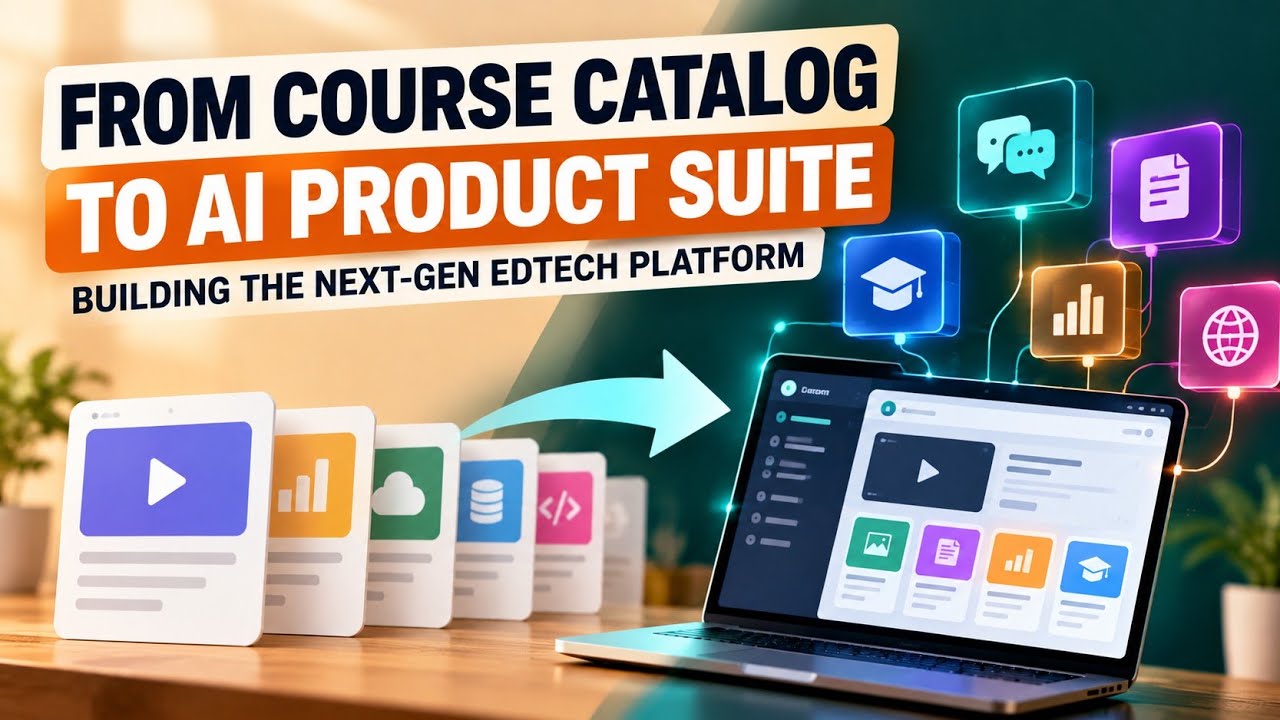
EdTech is evolving beyond traditional course libraries toward intelligent platforms that combine learning content, AI tools, personalization and workflow automation.
In this video by Uplatz, we explore how a digital learning business can evolve from a course catalog into a broader AI-powered product ecosystem.
Key topics covered include:
• EdTech transformation
• AI-powered learning platforms
• Course catalogs
• AI product suites
• Generative AI in education
• AI learning assistants
• Personalized learning
• AI tutors
• Career navigation
• Skills assessment
• Resume tools
• Learning recommendations
• AI-powered content
• Knowledge assistants
• Assessment generation
• Course discovery
• Learner analytics
• Enterprise learning
• Corporate training
• Skills intelligence
• AI agents
• Agentic AI
• SaaS products
• Product ecosystems
• Platform strategy
• Product portfolio management
• Shared AI infrastructure
• Data and integrations
• Product-led growth
• Cross-selling
• Subscription models
• B2B opportunities
• EdTech monetization
• AI product development
• Scaling digital products
A large course catalog creates valuable content, domain knowledge and relationships with learners, instructors and businesses.
AI can extend these assets beyond traditional course consumption.
Instead of simply helping users find a course, an AI-powered platform can understand their goals, identify skill gaps, recommend learning paths and support them throughout their career journey.
The same infrastructure can also power multiple products.
Shared capabilities such as authentication, AI models, user profiles, payments, analytics and knowledge retrieval can support a wider portfolio without rebuilding every product independently.
This creates opportunities to move from selling individual courses toward subscriptions, AI tools, enterprise solutions and integrated learning experiences.
The challenge is avoiding a collection of disconnected AI features.
Each product should solve a clear user problem while contributing to a broader ecosystem where data, learning content and AI capabilities reinforce one another.
The transition from course catalog to AI product suite is therefore not simply about adding AI to existing courses.
It is about rethinking the learning platform as an ecosystem of products that supports education, skills development, careers and enterprise learning.
This video by Uplatz is useful for EdTech founders, product leaders, education professionals and technology teams exploring the next generation of AI-powered learning platforms.
Subscribe to the Uplatz YouTube channel for more content on EdTech, AI products, digital learning, AI agents and emerging technologies.
#EdTech #AIProducts #AIinEducation #DigitalLearning #GenerativeAI #AIAgents #EdTechInnovation #ProductStrategy #OnlineLearning #SaaS #ArtificialIntelligence #Uplatz
----------------------------------------------
🌐 Welcome to Uplatz – Your Gateway to Career Transformation!
To access full courses or training bundles:
🌐 https://uplatz.com
📧 support@uplatz.com
🎓 About Uplatz
Uplatz is a global leader in online IT and professional training, offering comprehensive courses in AI, machine learning, data science, cloud computing, cybersecurity, and enterprise technologies such as SAP, Oracle, Salesforce, and ServiceNow. With expert-led programs and real-world learning paths, Uplatz empowers learners and organizations across 190+ countries to build future-ready skills and thrive in the digital era.
📘 Explore Uplatz Course Portfolio
Learn the most in-demand and emerging technologies with Uplatz:
✅ AI & Machine Learning – Agentic AI, LLMs, LangChain, Deep Learning, MLOps, LLMOps
✅ Cloud & DevOps – AWS, Azure, GCP, Docker, Kubernetes, Terraform, CI/CD
✅ Data & Analytics – Data Science, Data Engineering, Power BI, Tableau, Big Data (Spark, Kafka)
✅ Programming & Frameworks – Python, FastAPI, Django, Java, JavaScript, SQL
✅ Cybersecurity & Blockchain – Ethical Hacking, Cloud Security, Zero Trust, Blockchain & Web3
✅ IoT & Embedded Systems – IoT Platforms, Edge Computing, Embedded C, Microcontrollers
✅ ERP & CRM – SAP (all modules), Salesforce, Oracle ERP, Microsoft Dynamics
✅ Web & App Development – Full-Stack Development, React, Angular, Node.js, Flutter
🎓 Master cutting-edge skills. Build your tech career with Uplatz.
🌐 Learn more: https://uplatz.com
🎯 Why Choose Uplatz
✔️ Job-focused, project-based learning
✔️ Globally recognized certifications
✔️ Lifetime access & affordable pricing
✔️ Career guidance and mentorship
🔔 Subscribe for weekly tech tutorials, demos, and success stories.
📲 Follow us on LinkedIn, Instagram, Twitter, and Facebook.

The robots are coming. We (as in the people who attend TED talks and things) tend to think we will probably be fine. You know, knowledge folks and all. We might not be. What will be our coping mechanisms? What can we do to be OK?
Volker Hirsch is not afraid of placing his faith in concepts that others consider “niche”.
He has championed mobile and games for more than 15 years as an angel investor, founder, and advisor. He helped launch the world’s first mobile music services, published games on tiny black and white mobile phones and - damningly - used the term “gamification” as early as 2006. Today his focus is on education, Internet of Things (IoT) and – still – games.
Blackberry’s former Global Head of Business Development is now a founder of several companies, including software development house Blue Beck, and IoT venture programme builder Quantified Ventures. He is also a venture partner at leading EdTech accelerator Emerge Education, and the chairman of knowledge content recommendation system Bibblio.
This talk was given at a TEDx event using the TED conference format but independently organized by a local community. Learn more at http://ted.com/tedx

At iDste, we’re redefining the future of education technology with our powerful AI-powered touch panel — designed for smarter, more efficient campus operations.
This all-in-one interactive control terminal empowers schools and universities with features like:
✅ Facial recognition attendance – secure, accurate, and contactless.
✅ Digital signage integration – publish real-time notifications and campus news instantly.
✅ Classroom status monitoring – check occupancy, devices, and energy usage at a glance.
✅ Room booking system – reserve classrooms or meeting spaces effortlessly.
From the classroom to the front office, this sleek panel enhances automation, improves communication, and supports intelligent IoT campus management.
Perfect for modern smart classrooms, lecture halls, and shared learning spaces, iDste’s touch panel is a game-changer for forward-thinking schools embracing digital transformation.
🔗 Learn more:www.idste.com

Ideas are easy. AI implementation is hard. We make it smarter, faster, and more human. Subscribe now to lead AI change.
Join host Ted Wolf, Co-Founder & CEO of Guidewise, for a bold conversation with Juliette Denny—EdTech innovator, founder of Iridescent Technology, and the visionary behind Zavmo AI—on the latest episode of Implementors. Juliette dives into the transformative potential of AI-powered personalized learning, revealing how Zavmo AI is reshaping workforce education by tailoring training to individual needs, preferences, and neurodiversity. She explores why traditional learning management systems fall short, how AI can drive measurable behavior change, and why personalization is the future of corporate training. Juliette also shares her bold predictions for the future of education, the role of data in shaping smarter learning paths, and how to humanize AI to build better engagement. Whether you're a business leader, L&D professional, or curious about the evolving landscape of learning and development, this episode delivers actionable insights on using AI to build more agile, effective, and empowered teams.
ABOUT JULIETTE DENNY: Juliette Denny is a trailblazing EdTech entrepreneur and learning engagement expert with over two decades of experience revolutionizing corporate training. As the founder of Growth Engineering and Iridescent Technology, she has built award-winning platforms that combine gamification, neuroscience, and AI to drive meaningful behavior change and skill development. Her latest innovation, Zavmo AI, is an AI-powered learning companion designed to deliver highly personalized, adaptive learning experiences that empower learners across industries. Juliette is passionate about democratizing education, championing neurodiversity, and making learning engaging, human-centered, and impactful. Connect with Juliette: https://www.linkedin.com/in/juliettedyson/. Learn more about Zavmo AI: https://www.iridescenttechnology.ai/.
ABOUT GUIDEWISE: Guidewise is a next-gen consulting firm that fuses operational expertise with AI-powered workforce analytics to intelligently guide enterprises through successful change adoption, digital transformation, and implementation. Aiding our subject matter experts, our proprietary software leverages AI and machine learning to quantify and integrate deep people data directly into change management practices in real time. This adaptive infrastructure helps organizations anticipate, mitigate, and overcome resistance, ensuring seamless workforce adoption with minimal disruption. In an era of constant change, successful adoption matters more than ever. Guidewise ensures organizations implement, adapt, and thrive. Let's talk about your organization's change adoption needs today: https://www.guidewise.io/contact/.
TIMELINE:
00:00 - Introduction to AI-Driven Learning
02:12 - The Shift from Traditional to Personalized Learning
04:35 - Zavmo AI: A New Approach to Education
06:54 - The Secret Sauce of Effective Learning
11:11 - Zavmo's Unique Learning Experience
14:58 - Personalization in Learning Across Roles
17:18 - Keeping Up with AI Developments
19:22 - Humanizing AI for Better Interaction
20:45 - Common Mistakes in AI Workforce Optimization
22:06 - Preparing for AI Integration in Business
22:15 - The Evolution of Learning Management Systems
24:09 - The Future of Personalized Learning
26:03 - Data Analytics and Learning Insights
28:01 - The Role of Educators in a Tech-Driven World
29:51 - Overcoming Hesitancy in Learning with AI
30:50 - Continuous Learning and Personal Growth
34:07 - Bold Predictions for the Future of Education
36:00 - The Human Element in AI Development
39:02 - Vision for the Future of Education
PODCAST LINKS:
- Subscribe on YouTube: https://www.youtube.com/@implementorspod
- Podcast Homepage: https://www.guidewise.io/podcast
- Spotify: https://open.spotify.com/show/6uliK2fpHOOgjLDgUv1pNF?si=6520239306224710&nd=1
- Apple Podcasts: https://podcasts.apple.com/us/....podcast/guidewise-pr
- Amazon Music: https://music.amazon.com/podca....sts/8fcf7ddd-bf82-47
SOCIAL:
- YouTube: https://www.youtube.com/@implementorspod
- LinkedIn: https://www.linkedin.com/company/implementorspod/
- Twitter: https://twitter.com/implementorspod
- Facebook: https://www.facebook.com/implementorspod
- Instagram: https://www.instagram.com/implementorspod/
PARTNER DISCOUNTS:
- Reclaim.ai is the #1 AI-powered smart scheduling tool, helping you automate your calendar, prioritize tasks, and free up valuable time. Take control of your time—get started today: https://go.reclaim.ai/implementors.
- TextCortex.ai is an AI-powered writing assistant that helps you generate, enhance, and refine content effortlessly. Boost your productivity—try TextCortex today: https://textcortex.com/?via=implementors.

Teachers: stop spending hours creating reading passages from scratch.
With ChatGPT or Claude, you can generate personalized reading materials built around your students’ actual interests, vocabulary targets, grammar points, and CEFR level.
Instead of giving every student the same generic textbook passage, you can create texts about football, gaming, K-pop, careers, travel, or whatever actually interests them — while keeping the same grammar target and difficulty level.
In this example, I show how AI can help you teach the third conditional using personalized reading passages based on each student’s goals and interests.
Same grammar. Same difficulty. Different world.
Use AI to save preparation time while making English lessons more relevant and engaging.
Follow for more practical ways to use AI in English teaching.
#englishteaching #aitools #chatgptforteachers #tefl #teachingenglishonline #eslteacher #edtech #teachertips #aiforteachers #englishteacher

AI can give you the answer in seconds. What it can't give you is the judgment to know if that answer is any good.
Knowing which source to trust. Knowing when a draft is ready and when it only looks ready. Knowing what to question. None of that comes from a syllabus.
Education was never about storing answers. It was about learning to tell a good one from a bad one. The tools changed, but that premise didn't.
So the real question isn't "will AI replace learning?" It's "are we still teaching the part that matters?"
#FutureOfEducation #CriticalThinking #Sparkl #EdTech

5 ways edtechs trap you in | how data science edtech companies are scamming you | truth of edtechs
#edtech #datascience #machine learning
Welcome! I'm Aman, a Data Scientist & AI Mentor.
🚀 **Level Up Your Skills:**
* **Udemy Courses:** 🔥 **Start Learning Now!** 🔥
* Data Science Zero to Hero: https://www.udemy.com/course/d....ata-science-zero-to-
* Data Science Zero to Hero (Hindi): https://www.udemy.com/course/d....ata-science-zero-to-
* Agentic AI for Beginners: https://www.udemy.com/course/a....gentic-ai-for-beginn
* Git, GitLab, and CI/CD: https://www.udemy.com/course/g....it-gitlab-and-ci-cd/
* Docker for Beginners: https://www.udemy.com/course/d....ocker-for-beginners-
* Courses, Workshops & Webinars: https://www.unfolddatascience.com
* LinkedIn: https://www.linkedin.com/in/aman-kumar-b4881440/
* X (Twitter): @unfolds
* Instagram: @unfold_data_science
* GitHub: https://github.com/UnfoldDataS....cience/YouTube-Video
🎬 **Featured Playlists:**
* LLM for Generative AI application development - https://www.youtube.com/playli....st?list=PLmPJQXJiMoU
* Advanced NLP & Generative AI: https://www.youtube.com/watch?v=As3TT3xlddU&list=PLmPJQXJiMoUW7pge9N-J5NQuPcwhzFTfY&pp=gAQB
* AWS for Data Science: https://www.youtube.com/watch?v=0SYV7o_fd50&list=PLmPJQXJiMoUWFW2JxRSAfhcsQ0Cr9qbv-&pp=gAQB
* Deep Learning & Neural Networks: https://www.youtube.com/watch?v=2-Cg_1FtHk8&list=PLmPJQXJiMoUVvvzXCBKSt0aA8A5NlryjV
* Natural Language Processing: https://www.youtube.com/watch?v=cs049uQWbpg&list=PLmPJQXJiMoUUSqSV7jcqGiiypGmQ_ogtb
* Data Science Mock Interviews: https://www.youtube.com/watch?v=pHwUllYAXqk&list=PLmPJQXJiMoUURuxLJoroTyBf9zxvgHDvk&pp=gAQB
* Interview Question Series: https://www.youtube.com/watch?v=pufyEgNOT0s&list=PLmPJQXJiMoUU3h2LaP6pi9-U9vC3iZeU4&pp=gAQB
* Intro to Data Science:https://www.youtube.com/watch?v=Zkyog5u1OGw&list=PLmPJQXJiMoUWXbjyedFTmXPzzoeMJV4fe
* Python for Data Science: https://www.youtube.com/watch?v=NTZkMI5tuh8&list=PLmPJQXJiMoUWtuekopnh4BhTFkDBvmhnC
* Statistics & Mathematics:https://www.youtube.com/watch?v=iZ2r7aIwMbc&list=PLmPJQXJiMoUU52xCfjyoGRfoLCHKFtDxX
* Machine Learning end to end in Python:https://www.youtube.com/watch?v=8PFt4Jin7B0&list=PLmPJQXJiMoUWKj26qv_Pw5Aofxncu84JB
* Ensemble Models: https://www.youtube.com/watch?v=fuO6QXAo-5M&list=PLmPJQXJiMoUWfMvIqAn0VI_LHlw4AmVrb
* Data Science Career Guide:https://www.youtube.com/watch?v=9pytkbvF8AU&list=PLmPJQXJiMoUWoG8fRUXPRcZec9LgdHmCL
* Recommendation Systems: https://www.youtube.com/watch?v=juqpTaieIkA&list=PLmPJQXJiMoUWZeVfB5fle6dwyySg7xLMq
🎥 **My Studio Gear:**
* Camera: https://amzn.to/3mwXI9I
* Mic: https://amzn.to/34phfD0
* Tripod: https://amzn.to/3r4HeJA
* Ring Light: https://amzn.to/3gZz00F
* Music: https://www.bensound.com/royalty-free-music
#DataScience #AI #MachineLearning
Topics for the video:
5 ways edtechs trap you in
how data science edtech companies are scamming you
truth of edtechs
edtech startup
edtech company
edtech business model
edtech learning and earning platform
edtech india
edtech startup business model

In this webinar, three university leaders from the UK and Ireland discuss how to move EdTech from the margins to the heart of higher education. Professor Nick Petford (University of Northampton) details the institution's Active Blended Learning model, developed since 2016-2017, combining face-to-face and digital learning in a way that proved resilient throughout the Covid-19 crisis, with examples ranging from VR in nursing to big data analytics for campus management. Professor Elizabeth Barnes (Staffordshire University) walks through Staffordshire's Connected strategy, including its AI-powered student support bot, collaborations with EdTech startups, and its 2030 digital roadmap. Professor Mark Brown (Dublin City University) challenges the panel to think beyond integration and aim for genuine transformation, sharing DCU's approach to language, learning ecology, community co-creation of strategy, and micro-credentials. The webinar closes with a candid Q&A between speakers on culture change, partnership models, and what it takes to become a future-making institution.
Speakers
Professor Elizabeth Barnes, Vice-Chancellor and Chief Executive, Staffordshire University
Professor Nick Petford, Vice-Chancellor and CEO, University of Northampton
Professor Mark Brown, Ireland's first Chair in Digital Learning, Director of the National Institute for Digital Learning, Dublin City University
Chapters
00:00 Introduction and welcome
09:27 Panel: what does integrating EdTech in higher education mean?
12:33 University of Northampton: Active Blended Learning (Nick Petford)
29:58 Staffordshire University: Connected strategy and AI (Liz Barnes)
44:47 Dublin City University: DCU Connected and learning ecology (Mark Brown)
57:52 Q&A between speakers
1:01:33 Summary and conclusion
—
About Wooclap
Wooclap is an active learning platform grounded in the neuroscience of education. Used by educators and trainers in higher education and professional development, it transforms sessions into interactive, measurable experiences, with 20+ question types, real-time feedback, and AI that supports instructors without replacing them. Already chosen by HEC Paris, the University of Sheffield, Cegos, Vinci, and Pernod Ricard. Make learning active.
—
🔔 Subscribe to the channel so you never miss a video
📣 Turn on notifications to stay up to date!
—
🌐 FOLLOW US!
LinkedIn: http://www.linkedin.com/company/wooclapcompany/
X: http://www.x.com/wooclap
Facebook: http://www.facebook.com/wooclap
Instagram: http://www.instagram.com/wooclap/
🌍 Visit our website — http://www.wooclap.com/
#Wooclap #EdTech #HigherEducation #DigitalLearning #ActiveLearning #DigitalTransformation #UniversityLeadership
2D Animation Explainer Video for AI-Powered EdTech SaaS Platform | B2C Startup | Product Demo Videos
Looking for a standout 2D animation explainer video for your EdTech or SaaS product? Check out this explainer video example we produced for Singit, an AI-powered EdTech platform that makes English learning fun with music and gamification. Contact us to get a similar 2d explainer video for your product: https://whatastory.agency/contact-us/
As an experienced explainer video company, What a Story delivers high-quality edtech explainer animation and engaging learning platform videos designed to boost audience retention and drive results. This 2D animation explainer video is crafted to connect with both students and parents through clear storytelling, smooth motion graphics, and custom visuals that highlight Singit’s AI-driven features.
Why choose our explainer video animation?
- Studio-level 2D animation focused on engagement
- Simple storytelling that captures your brand’s message
- Compelling visuals for EdTech SaaS and learning platforms
- Seamless transitions and professional audio
- Tailored for EdTech product videos, LMS explainer videos, and SaaS solutions
Ready to see what a professional product demo video or EdTech explainer video can do for your marketing? Reach out today: https://whatastory.agency/contact-us/
Discover more from What a Story:
👉 Product Demo Videos: https://www.youtube.com/playli....st?list=PLvr0s6WLGo2
👉 Explainer Video Animation: https://www.youtube.com/playli....st?list=PLvr0s6WLGo2
👉 Customer Reviews: https://www.youtube.com/playli....st?list=PLvr0s6WLGo2
👉 Resources & Social Channels: https://url.whatastory.agency/links
Credits for this 2D explainer video:
Client: Singit (https://www.singit.io)
Producer: Ashish
Director: Dhruv and Yogendra
Designer: Yogendra
Motion Artist: Mukesh
Project Manager: Praavii
Video Type: Explainer Video, Product Demo Video
Video Style: 2D Animation, UI Animation
If you’re searching for the best explainer videos or want to promote your EdTech SaaS with creative animation, What a Story is your trusted partner.
Contact us now to grow your brand with powerful 2D animation explainer videos!
#2dAnimationExplainerVideos #ExplainerVideoExamples #ExplainerVideoCompany #EdTechExplainerAnimation #LearningPlatformVideo #EdTechExplainerVideo #EdTechProductVideo #LMSExplainerVideo #2DExplainerVideo #EdTechPromotionalVideo #ProductDemoVideos #SaaSExplainerVideo #ProductDemoVideo #ExplainerVideos #EdTechSaaS #SaaSEdTech #WhatAStory

Make AI and the Internet of Things approachable with hands-on classroom ideas that connect data, sensors, and robotics.
Explore how students can train models, investigate mistakes, and understand the technology behind smart devices.
In this EdTech Tuesdays with ATIMs and Friends session, join UAB ATiM host Pernell Allen and guest presenter Alicia from MakerMaven for “AI + IoT = OMG! Making Emerging Tech Approachable, Fun, and Classroom-Ready.”
You don’t need an extensive coding or robotics background to begin. This session introduces practical examples and tools to help you choose a starting point.

This is how Rubric AI build build edtech with direct input from assessors. In this video we have a roundtable discussion with Electrical Apprenticeship assessors and find out what they like about the version of Rubric they are using now and what we can add or change in the next version to address more pain points and ultimately make the job of assessing multi format learner evidence easier.
https://rubricai.ai

นิวยอร์ก แบน AI เด็ก สะเทือน EdTech
#เด็ก #เยาวชน #นักเรียน #ai #ใช้ai #เอไอ #เไ #นิวยอร์ก #edtech
ติดตามได้ในรายการ #businesswatch #จับกระแสธุรกิจ #businesswatchจับกระแสธุรกิจ
ทุกวันจันทร์-ศุกร์ เวลา 21:15 - 22:00 น. และวันอาทิตย์ 21:00 - 22:00 น. ทาง #tnnช่อง16
ช่องทางติดตามสถานีข่าว TNN ช่อง16
https://www.tnnthailand.com
https://tv.trueid.net/live/tnn16
https://www.youtube.com/c/tnn16
https://www.facebook.com/TNNthailand/
https://www.facebook.com/TNN16LIVE/
https://twitter.com/tnnthailand
https://www.instagram.com/tnn_online/
https://www.tiktok.com/@tnnonline
Line @TNNONLINE หรือคลิก https://lin.ee/4fP2tltIo
ทันโลก ทันเศรษฐกิจ ทันทุกความจริง กับ TNNช่อง16 สถานีข่าวที่ถือหลักการของการนำเสนอข่าวตรงประเด็น รวดเร็ว ถูกต้อง แม่นยำ และเป็นกลาง โดยทีมข่าวมืออาชีพ

Day 34 / 100 Future Career Series 🚀
⚡ Career: AI Tutor Designer
What if an AI could teach every child according to their own learning style?
That’s exactly what AI Tutor Designers do.
They combine Education + Psychology + Artificial Intelligence to create personalized, smart learning apps and virtual tutors that adapt to each student. This is the future of education.
A perfect career if you love both TEACHING and TECHNOLOGY.
🧠 Who is this career for?
Best for those who love Teaching, Psychology, Technology, and helping others learn. If you are creative, empathetic, and tech-curious, this rare career is for you. Great for BEd, BA, and BTech students alike.
📚 What to study?
BA/BSc/BTech in Education / Psychology / Computer Science / Cognitive Science
Then: MA / MTech in Educational Technology / Learning Sciences / AI in Education / Instructional Design
Skills to add: Basics of AI/ML, Learning Psychology, Prompt Engineering, Instructional Design Tools, Content Creation
Work with EdTech Companies, Universities, and Global Education Research Labs.
👇 Comment "AI TUTOR" and we’ll send you the full roadmap + best courses.
#dranupamasubin #100FutureCareers #AITutorDesigner #FutureOfEducation #EdTechCareers #AIinEducation #FutureCareers #CareerAfterBEd #EducationalTechnology #LearningSciences #InstructionalDesigner #AIJobs #CareerGuidance #DeepSight #NewAgeCareers
*Keywords for video:*
AI tutor designer career, AI in education career, future careers in EdTech, career after BEd and psychology, what is educational technology, new age careers 2026
"Riiid Joins EdSAFE Alliance of Institutes to Create Global AIEd Benchmarks”
Riiid participated in ASU+GSV Summit 21, one of the most renowned annual summits in the world for the leading minds in EdTech. This video clip captures the entire session entitled "Announcing a Global EdTech AI Benchmark Initiative", which was moderated by Riiid's Chief Officer for Equity in Learning Jim Larimore to host the panel of distinguished AIEd business leaders from some of the world's renowned EdTech institutes, such as National Science Foundation, Carnegie Learning, and Schmidt Futures Foundation.
The panelists spoke about the importance of establishing a consortium in the form of EdSAFE Alliance and creating benchmarks for usage of AI first to build trust from the consumers, investors and industries around the world.
Navigate the video with the information below:
00:00 Title
00:12 Opening Remarks (by Jim Larimore)
02:08 Why Riiid supports this Initiative (by Jim Larimore)
04:09 Why DXteras supports this Initiative (by Dale Allen)
07:35 Why IES supports this Initiative (by Mark Schneider)
08:36 The current challenges the AIEd faces (by Mark Schneider)
10:39 Why Carnegie Learning supports this Initiative (by Steve Ritter)
13:01 The inefficient use of resource of teacher (by Steve Ritter)
13:49 The findings from AIEd algorithm experiments (by Steve Ritter)
- Productive Struggle
- Unproductive Struggle
18:09 The needs of AIEd benchmarks (by Erin Mote)
19:41 Why InnovateEDU supports this Initiative (by Erin Mote)
19:55 The Challenges and in AIEd in special education (by Erin Mote)
21:31 IES's research in special education (by John Whitmer)
(in response to Erin Mote)
24:10 The importance of applying the research in practice (by Erin Mote)
(in response to John Whitmer)
25:30 The issues of scaling up of AIEd (by Mark Schneider)
- Issues of translation / dissemination
- Issues of absence of standards in AIEd
- XPRIZE Challenge that IES endorses
28:49 The Importance of EdSAFE Alliance (by Jim Larimore)
32:43 Q/A Response (by Mark Schneider)
- The most tangible outcome of XPRIZE Challenge
36:05 Closing Remarks (by Dale Allen)
For more information about EdSAFE Alliance, please visit https://www.edsafeai.org/
#aied #edsafealliance #asugsvsummit2021 #asugsvsummit #safeai #edtech #edtechconference #riiid #aiconference #cybersecurity #studentprivacyprotection #aileadership #benchmarkinitiative #aibenchmark #aieducation

What happens when a company gives students real influence over the product, not just a survey at the end, but a seat at the table from day one?
In this episode, Taylor Shead, founder and CEO of the edtech company Stimuli, talks with Kennedy Davis, a member of Stimuli's Student League and an incoming freshman at the University of Texas at Dallas. Kennedy has spent nearly two years helping shape two of Stimuli's products, Orbi Math and Founder Tycoon, through weekly co-design sessions with students from across the country.
Kennedy and Taylor walk through what that process actually looks like week to week, how student feedback shaped everything from Orbi Math's in-the-moment tutoring approach to Founder Tycoon's visual style and sound design, and why Taylor estimates students had the chance to weigh in on nearly everything the company built. Kennedy also shares how the experience pushed her to build her own AI tools, including a scholarship tracker that helped her navigate the college financial aid process.
The conversation makes a broader case for co-design in education technology: what changes for students, for companies, and for the quality of the product itself, when the people using the tool are actually part of building it.
If you work in edtech, education policy, or product design, or you're just curious what real student voice looks like in practice, this one is worth your time.
🔗 Guest Links:
https://stemuli.ai/
https://www.linkedin.com/in/taylorshead/
https://www.linkedin.com/in/kennedy-davis-z/
#EdTech #StudentVoice #K12Education #education #podcast
![[더 이상 '요약해줘(Summarize)'라고 하지 마세요!],](https://i.ytimg.com/vi/_1cGj_1nRg0/maxresdefault.jpg)
[AI와 인간의 공존, 미래 교육의 패러다임을 설계하는 'AI미래교육학자 미남교수 채널]
AI와 인간의 협업을 통해 더 나은 미래를 디자인하는 공간입니다. 급변하는 디지털 전환의 시대, 교육의 현장에서 실질적인 혁신과 변화를 이끄는 '미래를 남다르게 준비하고 실천하는 교수(미남교수)' 신종우의 공식 채널입니다.
본 채널은 신한대학교 AI융합처 처장이자 AI미래융합교육원 원장인 신종우 교수가 운영하며, 기술과 교육이 만나는 지점에서 실질적인 솔루션을 제시합니다. 단순한 지식 전달을 넘어 AI융합활용전문가로서 메타버스와 AI 에듀테크를 활용한 구체적인 실천 전략을 공유합니다. 대한민국 교육의 미래를 고민하는 교수자와 학습자 모두와 함께 디지털 대전환의 파도를 넘어, 교육의 본질을 혁신하는 다양한 콘텐츠를 선보입니다.
attachments@hanmail.net

We provide stories of successful entrepreneurs from HHL to inspire your entrepreneurial journey. 👇
If you’re exploring entrepreneurship or in the early stages of launching your very own venture, it’s important to learn from others to avoid common pitfalls and discover which decisions impacted their curve of success.
We at HHL meet and talk to successful and inspiring founders out of our worldwide alumni network willing to share their greatest advice on starting a business. Sharing their story can be an impactful tool to inspire other like-minded people.
Irene Klemm, HHL alumna and successful founder of ed-tech startup Edurino, shares her very own personal path as a successful female entrepreneur in a challenging time where our world was hit by a global pandemic.
𝗦𝘁𝗮𝗿𝘁 𝘆𝗼𝘂𝗿 𝗲𝗻𝘁𝗿𝗲𝗽𝗿𝗲𝗻𝗲𝘂𝗿𝗶𝗮𝗹 𝗷𝗼𝘂𝗿𝗻𝗲𝘆 𝘄𝗶𝘁𝗵 𝗛𝗛𝗟
Are you ready to accelerate your entrepreneurial idea and kick off your first venture? Then come and join our new Master in Entrepreneurship ▶️ https://www.hhl.de/programs/fu....ll-time-master-in-ma
What is in for you?
Gather entrepreneurial experience by developing your skills and building your network to create your venture with our new Master in Entrepreneurship track. We take you beyond standard incubation and acceleration programs. By enriching your entrepreneurial mindset with profound management skills we push your abilities to evaluate, implement and transform business ideas. Surround yourself with like-minded people and start your business idea! Get your free profile check!
_____________________________________________________________________
🔴 Subscribe to our channel to never miss a video update: https://www.youtube.com/c/HHLL....eipzigGraduateSchool
Share this channel with a friend:
https://www.youtube.com/c/HHLL....eipzigGraduateSchool
🎓 Read about our newest topics on the HHL Blog:
https://www.hhl.de/blog/
About HHL
HHL Leipzig Graduate School of Management’s history and tradition is a story of pioneering success that goes back to the 19th century. Leipzig’s entrepreneurs realized the need of educating business people to prepare them for the upcoming changes and challenges in a world becoming more globalized with its international trade. The foundation of Handelshochschule Leipzig in 1898 marks the birthplace of management education and is the first business administration faculty in German-speaking countries. Since those early days, the “honorable merchant” is recognized in the school’s emblem.
🔗 Visit our website for more information on all programs ▶️ https://www.hhl.de/
👍🏼 Keep a pulse on HHL. Give us a follow.
LinkedIn - https://www.linkedin.com/schoo....l/hhl-leipzig-gradua
Xing - https://www.xing.com/companies..../hhlleipziggraduates
Instagram - @hhlleipzig https://www.instagram.com/hhlleipzig/
Facebook - /Handelshochschule https://www.facebook.com/Handelshochschule
Twitter - @hhlleipzig https://twitter.com/hhlleipzig👇▶️

Check out the link: https://cvadm.com/UyNJLz
Join Vijender Singh Chauhan on Cazual Talk with Rohit Gupta, Co-Founder & COO of CollegeVidya, to explore solutions for navigating education in India. Discover why online degrees are gaining popularity, even compared to prestigious institutions like IIT, and how CollegeVidya helps students make informed decisions. Rohit shares inspiring stories, like a delivery boy’s journey to a cybersecurity career, and practical advice on balancing affordability with quality education. Learn how AI in education is transforming learning and what the future of EdTech holds for Indian students.
From comparing online degrees vs. IIT to understanding PhD vs. DBA, this episode offers clear guidance for students and parents seeking career clarity. Rohit also reveals how CollegeVidya’s expert counseling empowers learners to avoid misleading college ads and choose the best path, whether Indian or foreign degrees. Dive into this insightful discussion to unlock your educational potential and shape a brighter future!
Timestamps:
00:00:00 - Preview
00:00:55 - Guest Introduction: Rohit Gupta
00:02:13 - CollegeVidya’s Mission to End Confusion
00:04:26 - Rohit’s Personal Journey and CollegeVidya’s Origin
00:05:16 - Success Story: Gulam Ali’s Transformation
00:07:38 - Breaking the IIT-NIT Education Myth
00:09:19 - India’s Population: Blessing or Burden?
00:11:39 - How Online Degrees Save Big Bucks
00:13:53 - Skills Over Degrees in Today’s Job Market
00:15:16 - Your Degree Value in a Changing World
00:17:22 - Quality Control in Online Degrees
00:19:29 - Preserving Elite Institution Brands
00:21:04 - PhD vs. DBA: Academic vs. Industry Focus
00:24:23 - DBA’s Value for Professionals
00:27:31 - Indian vs. Foreign Online Degrees
00:30:24 - CollegeVidya’s Role in Decision-Making
00:32:45 - How to Avoid Traps of Flashy College Ads
00:35:02 - Modern Consulting vs. Traditional Methods
00:37:02 - Equity in Online Education
00:38:45 - Diverse Demographics in Online Learning
00:39:44 - Globalizing Indian Education
00:40:31 - Advice for Confused Students
00:41:46 - EdTech’s Future Post-COVID
00:42:16 - Closing Remarks
About Dr Vijender:
Dr Vijender Chauhan is an educator, UPSC Interviewer and Motivational speaker with an experience of over a decade. He is one of the most recognised faces among the UPSC aspirants.
Follow us on Social Media:
Instagram: https://www.instagram.com/masijeevi
Twitter: https://x.com/masijeevi?lang=en
Facebook: https://www.facebook.com/masijeevi/
Public speaking series: https://youtube.com/playlist?list=PLZsjpxNdkPe9703jiUliZrRB8cZMIXPyH&si=iIQoHc2SrsoOdI1M
Podcast with Dr Vijender: https://youtube.com/playlist?list=PLZsjpxNdkPe8xHGGNWhzZEzVbugyiyGnd&si=qyySVVRlZNSba8LI
#CareerGuidance #EdTech #CollegeVidya #EducationTips #OnlineDegrees #FutureOfEdTech #AIinEducation #CareerPlanning #IndianEducation #StudentSuccess #OnlineLearning #HigherEducation #UPSCPreparation #CollegeAdmissions

This week on Edtech News, Emil Reisser-Weston and Andy Howie from Open eLMS dive into the latest in AI at work, learning & development, and data security. Discover why a third of British workers use 'Shadow AI' without employer knowledge, and how major tech firms are restricting their own staff's AI use.
We unpack King Charles's surprising AI summit, the fight for vocational qualification parity, and the shift towards 'Human OS' investment. Join us for a critical look at the evolving landscape of Edtech and the urgent questions around AI regulation and essential training for the future workforce.
Ready to experience the future of Edtech? Visit https://openelms.com or if you have a learning requirement book a meeting https://library.openelms.com/b....ook/andy-howie-disco
![Teacher Techie Episode 8 [SEASON FINALE]: Teacher Techie Toolkit 108 - EdTech Tools Showcase](https://i.ytimg.com/vi/FWBFew0t9Ig/maxresdefault.jpg)
[The video is a replay from our Facebook Livestream: https://fb.watch/djaPko-ZNR/]
EVALUATION LINK: tinyurl.com/TechieEval8 (Open until May 31, 2022, only).
To close off our wonderful Teacher Techie Playlist, we've invited our Tatak Techie Techie Resource Speakers from our previous episodes to showcase a variety of EdTech Tools that our teachers (and future teachers) may use on our path to post-pandemic education.
All Episodes 1 - 8 are open for Certificates until May 31, 2022 only.
Check out the entire playlist here:
tinyurl.com/TechieSeason1
tinyurl.com/TechieSeason1YT
You can claim certificates by accessing the Evaluation Links found in the video description / comments of each episode.
Please also be guided with the following dates:
June 1 - 4: Distribution of Teacher Techie E-Certificates
June 6 - 8: Application for Certificate of Completion
June 13 - 17: Distribution of Certificate of Completion
From all of us here at the BUCE College Student Council, thank you for your support to the Teacher Techie Series.
#TeacherTechie
#EduConnect

IntellyJelly is a kids’ learning brand focused on building reading, writing, and creative thinking skills in children through engaging content and experiences.
In this episode of D2C Stories, Vineet Agarwala interviews Animesh Tiwari on building IntellyJelly from scratch.
Is your child spending too much time on screens? Are you worried about building strong reading and creative writing habits?
From launching a children’s magazine to building a trusted learning brand for parents across India, Animesh shares how IntellyJelly is helping kids develop creativity, confidence, and lifelong learning habits.
In this conversation, we dive deep into:
✅ Myths around children’s learning and screen time
✅ Practical parenting strategies to manage screen usage
✅ How kids can build strong reading and writing habits
✅ How IntellyJelly helps children write and publish their own work
✅ Why comics and fun content improve learning outcomes
✅ Building a D2C brand in the kids’ education space
✅ Subscription model strategy for content-led brands
✅ The future of learning, creativity, and AI for children
If you're a parent looking to unlock your child's creative potential and prepare them for a happy, successful life, this episode is for you.
Subscribe to D2C Stories for more insights on the future of direct-to-consumer brands!
#D2CStories #IntellyJelly #VineetAgarwala #AnimeshTiwari #KidsLearning #CreativeWriting #ScreenTime #ParentingIndia #ChildDevelopment #LearningForKids #EdTechIndia #D2CBrand #StartupIndia #Entrepreneurship
02:01 IntellyJelly Founder Animesh – Early Life
03:29 Animesh’s Background
04:05 IntellyJelly Mission & Vision
06:43 IntellyJelly Products Overview
09:15 Helping Kids Improve Writing Skills
11:05 Why Comics Work in Education
12:51 Fun + Learning Content Strategy
13:24 Core Purpose of IntellyJelly
14:58 IntellyJelly Target Audience
15:52 Reducing Screen Time with Reading
17:36 Channelizing Kids’ Energy
21:04 Kids’ Happiness Curriculum
23:23 Parent & Student Feedback
24:38 IntellyJelly Workshops
26:01 Content Channels & Distribution
28:48 Similar Platforms in the Market
29:48 Growth of D2C in Education
31:02 Subscription Model Strategy
32:14 Biggest Challenges Faced
33:09 Myths Around Children’s Learning
33:52 Advice to Young Entrepreneurs
35:01 Opportunities in Kids’ Learning Space
35:32 Future Content Trends
36:51 Challenges in Building a Kids Brand
38:06 Feedback & Improvement Process
38:46 Technology Behind IntellyJelly
39:58 Role of AI in Learning
41:27 Challenges AI Needs to Solve
42:26 Kids Learning AI Concepts
43:20 Future of AI in Education
44:17 Team Behind IntellyJelly
46:59 Empowering Homemakers Through Work
48:42 Language Strategy
48:59 Future Goals of IntellyJelly
50:25 Daily Habits for Children
51:17 What is “Write With Kids”?
51:52 Favourite Comic Character
52:08 A Book Every Child Should Read
52:58 Most Valuable Feedback
53:52 Dream Celebrity Endorsement

Is AI going to replace UI/UX designers, or will it make strategic designers 10x more valuable?
In this episode of Desh Theke Duniya, host Akif Hassan sits down with Fazle Rabbi Robin, Executive (UI/UX) at Panjeree Publications Limited, to break down what it actually takes to build a successful product design career in Bangladesh and scale it globally.
From demystifying the real difference between UI and UX to designing EdTech platforms for millions of Bangladeshi students, Robin shares his exact workflow, portfolio mistakes to avoid, and how to use AI as a junior design co-pilot rather than fearing automation.
Key Discussion Highlights:
UI vs UX Demystified: The restaurant analogy that explains user experience to anyone.
The AI Disruption: Why AI can generate visuals but fails at human psychology and user research.
Portfolio Secrets: Why international recruiters care about case studies over pretty Dribbble screens.
Generalist vs Specialist: How specializing in B2B or EdTech SaaS helps you command higher freelance rates.
EdTech Case Study: Designing interactive learning systems for students and teachers across Bangladesh.
Episode Chapters:
0:00 - Teaser
0:50 - Intro: Welcome Fazle Rabbi Robin
1:15 - What is UI vs UX?
1:55 - How Robin Started His UI/UX Journey
3:00 - First Paid Project & Early Design Mistakes
4:10 - The "Restaurant Analogy" & User Research
6:50 - Will AI Replace UI/UX Designers?
8:45 - Bad UX in Bangladeshi Banking Apps
11:30 - How to Use AI as a Design Partner in Figma
14:20 - Landing Global Remote Clients & Freelancing
15:50 - Designing Panjeree's EdTech App for Students & Teachers
19:10 - Paper Sketching vs. Direct PC Designing
20:15 - Rapid Fire Round
22:00 - Self-Motivation & Final Career Advice
22:55 - Outro
Host: Akif Hassan
Guest: Fazle Rabbi Robin (https://www.linkedin.com/in/robinrabbi1/)
Connect with Us
Follow Desh Theke Duniya:
Facebook Page: https://www.facebook.com/deshthekeduniyabd/
Instagram: https://www.instagram.com/deshthekeduniya/
TikTok: https://www.tiktok.com/@deshthekeduniya
#DeshThekeDuniya #AkifHassan #FazleRabbiRobin #UIUXDesign #ProductDesign #Figma #FutureOfWork #BangladeshTech #EdTech #RemoteJobs #CareerGrowth

In this demo, I show the AI Prompter in Omni Factory - a speaking assistant for presenters, educators, and course creators.
Upload a single document and turn it into a structured outline with key talking points and short source excerpts. As you speak, the assistant compares your live transcript with the plan, links your words to the relevant points, and marks what has been covered fully or partially.
You can explain things in your own words, move between topics, and return to earlier ideas. The outline helps you see what you’ve already discussed and what still needs attention.
Useful for preparing and delivering lectures, recording educational videos, rehearsing presentations, and staying on track during a talk.
This is a practical demonstration of the current version. AI can miss or misinterpret a point - the speaker remains in control.
AI-суфлёр превращает документ в план и по ходу выступления отмечает раскрытые тезисы. Для спикеров, преподавателей и авторов курсов.
Der KI-Assistent erstellt aus einem Dokument eine Gliederung und verfolgt während des Vortrags, welche Inhalte bereits behandelt wurden. Für Vortragende, Lehrende und Kursautoren.
#AI #PublicSpeaking #EdTech #CourseCreation #OmniFactory

https://www.youtube.com/watch?v=RFkxtvvLOTM&list=PLPY3c-zRUYfRTdVHyqRlX_NlbwQGVbnP7
📘 Get my WSJ Best Selling sales book here: http://venli.co/dnk-sfss-book
If you’re new to my channel, my name is Marcus Chan. I’m the CEO of Venli Consulting, in which we train B2B sales teams and AEs to hit 200% of quota with proven, repeatable systems. Prior to this I was the #1 Sales Director at Cintas Corporation, where I led a 110+ sales force to profitably deliver $190M+ TCV each year.
But I didn’t start this way so here’s my journey:
5-18 yrs old: Bus boy, dishwasher, cook, server, etc. at my parent's restaurant
18: My parents sold the rest. and I got a job selling speedos for $7.50/hr
19: Sold speedos and was an asst. swim coach
20: Sales intern selling insurance making $9/hr
21: Promoted to sales associate earning $9.50/hr
22: First B2B sales job. Almost fired after 60 days
23: Hit #1 9 months in a row and promoted 2X
24: Recession in full swing, the branch was consolidated. Demoted despite results. Decided to get my MBA at night
25: With a chip on my shoulder…destroyed numbers and got promoted 2X
26: MBA done. Decided to quit my job, take 2 steps back, and switch to a new company. In the first 6 months, my sales manager, directors and VP quit. I almost quit too but decided to keep going.
27: Became one of the top reps, promoted to captain in 6 months, and then promoted in 9 months to lead the team as the sales manager.
28: Turned the underperforming team into a perennial President's Club winning team.
29: Grew the team from 6 to 22 while maintaining the track record.
30: Promoted to director in 4.5 years in the Fortune 500 org with 85 employees. Scared and nervous if I could perform at this scale.
31: Hit Club first year as a director and decided to start a side hustle teaching others what I had done for 9 consecutive years.
32: Record-breaking results and lateral promotion to a training director over 230.
33: Internal company org shifts and back in the market director role. I'm disappointed but relieved at the same time. Grew the org to 110, kept breaking records, and stacking cash+equity.
35: After another Club year, decided to retire from corporate to go all in on my side hustle.
36: It's a rough year 1 and I wanted to quit daily. Ended up hitting 7-figures with the biz and was recognized as a LinkedIn Top Voice. Also ended up getting featured in Forbes, Yahoo! Finance, and more.
37: Started getting burnt out. Thought about quitting and then realized I needed to hire a team. Built a small team. The biz grew more.
38: With the extra capacity, wrote a book in 3 months and it became a WSJ Best Seller. Biz kept growing 🚀
39: Made some bad hires and went backward in profitability for the first time. (My fault-should have vetted them more.)
Today: We're building something truly great. We’ve brought on over 700 clients in 5 years and these are with teams and reps at big orgs like Salesforce, Google, ZoomInfo, and more down to pre-seed start-ups.
TLDR; I've sold over $700M at 2 different Fortune 500 companies, was promoted and became #1 in 12 different roles, led a 110+ sales org that profitably delivered $195M TCV a year, and then retired from the rat race by 35, and now I help driven tech teams and sales reps master the exact same sales system.
I’m excited and optimistic for the future. The best is yet to come.
To all those fighting their own battles, we're all in the middle of writing our own stories.
The worse demons we face, the more epic the story.
You either get an inspiring outcome or an inspiring story.
Either way? You WIN.
So keep getting after it.
The only way you lose is if you QUIT.
May your internal desires be far greater than your obstacles.💯
To your success,
Marcus
#sales #salesstrategy #marcuschan #venliconsulting