Video hàng đầu

Hank resists the urge to devour a slice of pizza so that he can walk you through the way we experience our major special senses. It all boils down to one thing: sensory cells translate chemical, electromagnetic, and mechanical stimuli into action potentials that our nervous system can make sense of. Today we're focusing on smell (olfaction) and taste (gustation), which are chemical senses that call on chemoreceptors. As usual, we'll begin with a quick look at how these things can go wrong.
Pssst... we made flashcards to help you review the content in this episode! Find them on the free Crash Course App!
Download it here for Apple Devices: https://apple.co/3d4eyZo
Download it here for Android Devices: https://bit.ly/2SrDulJ
Chapters:
Introduction: Anosmia 00:00
How Smell Works 2:13
Olfactory Epithelium 2:47
Olfactory Sensory Neurons 3:19
Glomerulus 3:47
How the Brain Processes Smell 4:48
How Taste Works 6:19
What Are Taste Buds (Taste Receptor Epithelial Cells)? 6:40
Types of Taste Receptor Epithelial Cells: Gustatory and Basal 7:53
How Different Tastants are Sensed 8:37
Review 9:28
Credits 10:05
***
Crash Course is now on Patreon! You can support us directly (and have your contributions matched by Patreon through April 30th!) by signing up at http://www.patreon.com/crashcourse
Thanks to the following Patrons for their generous monthly contributions that help keep Crash Course free for everyone forever:
Mark Brouwer, Simun Niclasen, Brad Wardell, Roger C. Rocha, Jan Schmid, Elliot Beter, Nevin Spoljaric, Sandra Aft, SR Foxley, Jessica Simmons, Stefan R. Finnerup, Jason A Saslow, Robert Kunz, Jessica Wode, Mike Drew, Steve Marshall, Anna-Ester Volozh, Christian Ludvigsen, Jeffrey Thompson, James Craver, Suzanne, Dustin & Owen Mets, Amy Fuller, Simon Francis, Max Bild-Enkin, Ines Krueger, King of Conquerors Gareth Mok, Chris Ronderos, Gabriella Mayer, jeicorsair, Tokyo Coquette Boutique, Konradical the nonradical
***
Crash Course is on Patreon! You can support us directly by signing up at http://www.patreon.com/crashcourse
Want to find Crash Course elsewhere on the internet?
Facebook - http://www.facebook.com/YouTubeCrashCourse
Twitter - http://www.twitter.com/TheCrashCourse
Instagram - https://www.instagram.com/thecrashcourse/
CC Kids: http://www.youtube.com/crashcoursekids

Welcome to Crash Course Statistics! In this series we're going to take a look at the important role statistics play in our everyday lives, because statistics are everywhere! Statistics help us better understand the world and make decisions from what you'll wear tomorrow to government policy. But in the wrong hands, statistics can be used to misinform. So we're going to try to do two things in this series. Help show you the usefulness of statistics, but also help you become a more informed consumer of statistics. From probabilities, paradoxes, and p-values there's a lot to cover in this series, and there will be some math, but we promise only when it's most important. But first, we should talk about what statistics actually are, and what we can do with them. Statistics are tools, but they can't give us all the answers.
Episode Notes:
On Tea Tasting:
"The Lady Tasting Tea" by David Salsburg
On Chain Saw Injuries:
https://www.cdc.gov/disasters/chainsaws.html
https://www.ncbi.nlm.nih.gov/pubmed/15027558
https://www.hindawi.com/journals/aem/2015/459697/
Crash Course is on Patreon! You can support us directly by signing up at http://www.patreon.com/crashcourse
Thanks to the following Patrons for their generous monthly contributions that help keep Crash Course free for everyone forever:
Mark Brouwer, Nickie Miskell Jr., Jessica Wode, Eric Prestemon, Kathrin Benoit, Tom Trval, Jason Saslow, Nathan Taylor, Divonne Holmes à Court, Brian Thomas Gossett, Khaled El Shalakany, Indika Siriwardena, Robert Kunz, SR Foxley, Sam Ferguson, Yasenia Cruz, Daniel Baulig, Eric Koslow, Caleb Weeks, Tim Curwick, Evren Türkmenoğlu, Alexander Tamas, Justin Zingsheim, D.A. Noe, Shawn Arnold, mark austin, Ruth Perez, Malcolm Callis, Ken Penttinen, Advait Shinde, Cody Carpenter, Annamaria Herrera, William McGraw, Bader AlGhamdi, Vaso, Melissa Briski, Joey Quek, Andrei Krishkevich, Rachel Bright, Alex S, Mayumi Maeda, Kathy & Tim Philip, Montather, Jirat, Eric Kitchen, Moritz Schmidt, Ian Dundore, Chris Peters, Sandra Aft, Steve Marshall
Want to find Crash Course elsewhere on the internet?
Facebook - http://www.facebook.com/YouTubeCrashC...
Twitter - http://www.twitter.com/TheCrashCourse
Tumblr - http://thecrashcourse.tumblr.com
Support Crash Course on Patreon: http://patreon.com/crashcourse
CC Kids: http://www.youtube.com/crashcoursekids
Today we explore the penultimate ethical theory in this unit: contractarianism. Hank explains Hobbes’ state of nature, implicit and explicit contracts, as well as the Prisoner’s Dilemma, and the benefits, and costs, of violating contracts.
--
Produced in collaboration with PBS Digital Studios: http://youtube.com/pbsdigitalstudios
--
Want to find Crash Course elsewhere on the internet?
Facebook - http://www.facebook.com/YouTubeCrashC...
Twitter - http://www.twitter.com/TheCrashCourse
Tumblr - http://thecrashcourse.tumblr.com
Support CrashCourse on Patreon: http://www.patreon.com/crashcourse
CC Kids: http://www.youtube.com/crashcoursekids
The Silk Road and Ancient Trade: In which John Green teaches you about the so-called Silk Road, a network of trade routes where goods such as ivory, silver, iron, wine, and yes, silk were exchanged across the ancient world, from China to the West. Along with all these consumer goods, things like disease and ideas made the trip as well. As is his custom, John ties the Silk Road to modern life, and the ways that we get our stuff today.
Chapters:
Introduction: The Journey of a T-Shirt 00:00
What Was the Silk Road? 1:03
Nomads, Caravans, and Traders 3:31
The Rise of Silk 4:36
An Open Letter to Billionaires 5:41
Economic Impact of the Silk Road 6:22
The Silk Road and Buddhism 6:40
The Silk Road and Disease 8:20
Credits 9:22
Resources:
Life Along the Silk Road by Susan Whitfield: https://bit.ly/3xmfdTv
The Silk Road: 2000 Years in the Heart of Asia: https://bit.ly/36dGTic
Crash Course is on Patreon! You can support us directly by signing up at http://www.patreon.com/crashcourse
Want to find Crash Course elsewhere on the internet?
Facebook - http://www.facebook.com/YouTubeCrashCourse
Twitter - http://www.twitter.com/TheCrashCourse
Instagram - https://www.instagram.com/thecrashcourse/
CC Kids: http://www.youtube.com/crashcoursekids
The big question in the comments last week was, "BUT WHAT ABOUT ECLIPSES?" Today, Phil breaks 'em down for you.
This episode is sponsored by Squarespace: http://www.squarespace.com/crashcourse
Check out the Crash Course Astronomy solar system poster here: http://store.dftba.com/product....s/crashcourse-astron
--
As promised, Phil's sun spotting recommendations:
Astronomers Without Borders (charitable org): http://store.astronomerswithoutborders.org/index.php?main_page=product_info&cPath=8&products_id=3
Rainbow Symphony glasses: http://www.rainbowsymphony.com/soleclipse.html
Wide variety of viewers from Rainbow Symphony: http://www.eclipseglasses2017.....com/buy-eclipse-glas
--
Chapters:
Introduction 00:00
How Do Solar Eclipses Work? 0:52
Umbra & Penumbra 2:04
The Sun's Corona 3:17
Solar Eclipse Totality 4:14
Annular Eclipse 5:09
Can You Look at a Solar Eclipse? 5:32
Lunar Eclipses 6:54
Size of the Earth and Moon 8:24
Review 9:27
--
PBS Digital Studios: http://youtube.com/pbsdigitalstudios
Follow Phil on Twitter: https://twitter.com/badastronomer
Crash Course is on Patreon! You can support us directly by signing up at http://www.patreon.com/crashcourse
Want to find Crash Course elsewhere on the internet?
Facebook - http://www.facebook.com/YouTubeCrashCourse
Twitter - http://www.twitter.com/TheCrashCourse
Instagram - https://www.instagram.com/thecrashcourse/
CC Kids: http://www.youtube.com/crashcoursekids
--
PHOTOS/VIDEOS
http://svs.gsfc.nasa.gov/cgi-b....in/details.cgi?aid=4
http://www.nasa.gov/audience/f....orstudents/k-4/stori
http://en.wikipedia.org/wiki/E....clipse#mediaviewer/F
http://en.wikipedia.org/wiki/S....olar_eclipse_of_Sept
http://commons.wikimedia.org/w....iki/File:Solar_eclip
http://en.wikipedia.org/wiki/S....olar_eclipse#mediavi
http://philhart.smugmug.com/Su....n/Queensland-Solar-E
http://svs.gsfc.nasa.gov/cgi-b....in/details.cgi?aid=1
http://philhart.smugmug.com/Su....n/Queensland-Solar-E
http://philhart.smugmug.com/Su....n/Queensland-Solar-E
https://www.youtube.com/watch?v=7YX2blo1eRk
http://en.wikipedia.org/wiki/S....olar_eclipse#mediavi
http://commons.wikimedia.org/w....iki/File:Geometry_of
http://svs.gsfc.nasa.gov/cgi-b....in/details.cgi?aid=1
http://en.wikipedia.org/wiki/F....ile:Lunar_eclipse_Ap
http://svs.gsfc.nasa.gov/cgi-b....in/details.cgi?aid=1
http://en.wikipedia.org/wiki/L....unar_eclipse#mediavi
http://svs.gsfc.nasa.gov/cgi-b....in/details.cgi?aid=4

In this episode of Crash Course Psychology, Hank takes a look at a few experiments that helped us understand how we develop as human beings. Things like attachment, separation anxiety, stranger anxiety, and morality are all discussed... also, a seriously unpleasant study with monkeys and fake mothers.
Want more videos about psychology? Check out our sister channel SciShow Psych at https://www.youtube.com/scishowpsych!
--
Chapters:
Introduction: Attachment 00:00
Harlow's Monkey Mother Experiment 0:47
Touch 2:16
Familiarity 3:01
Attachment Styles: Secure, Insecure Ambivalent, & Insecure Avoidant 3:57
The Importance of Attachment Styles 5:24
Developing Self-Concept 6:45
Parenting Models: Authoritarian, Permissive, & Authoritative 7:36
Kohlberg's Theory of Moral Development 8:18
Preconventional Morality Phase 9:27
Conventional Morality Phase 9:44
Postconventional Morality Phase 10:00
Review & Credits 10:48
--
Crash Course is on Patreon! You can support us directly by signing up at http://www.patreon.com/crashcourse
Want to find Crash Course elsewhere on the internet?
Facebook - http://www.facebook.com/YouTubeCrashCourse
Twitter - http://www.twitter.com/TheCrashCourse
Instagram - https://www.instagram.com/thecrashcourse/
CC Kids: http://www.youtube.com/crashcoursekids

Today we explore what obligations we hold with our personal beliefs. Hank explains epistemic responsibility and the issues it raises with everything from religious belief, to ship owning, to vaccinations.
--
Images via Wikimedia Commons, licensed under Creative Commons by 4.0: https://creativecommons.org/licenses/by/4.0/
--
Produced in collaboration with PBS Digital Studios: http://youtube.com/pbsdigitalstudios
Crash Course Philosophy is sponsored by Squarespace.
http://www.squarespace.com/crashcourse
--
Want to find Crash Course elsewhere on the internet?
Facebook - http://www.facebook.com/YouTubeCrashC...
Twitter - http://www.twitter.com/TheCrashCourse
Tumblr - http://thecrashcourse.tumblr.com
Support CrashCourse on Patreon: http://www.patreon.com/crashcourse
CC Kids: http://www.youtube.com/crashcoursekids

Today we're going to take a closer look at ecosystems -- which are communities of living organisms in an area interacting with their environment -- and how this relationship between the amount of energy a place receives and the movement of nutrients is what makes the incredible diversity of life possible. We'll also take a look at the patterns we see in the main global biomes, show you why some biomes (like tropical rainforests) are so productive, and discuss an agricultural practice some farmers have employed to help preserve their local ecosystems.
Watch our videos and review your learning with the Crash Course App!
Download here for Apple Devices: https://apple.co/3d4eyZo
Download here for Android Devices: https://bit.ly/2SrDulJ
Crash Course is on Patreon! You can support us directly by signing up at http://www.patreon.com/crashcourse
Thanks to the following patrons for their generous monthly contributions that help keep Crash Course free for everyone forever:
Alexis B, Rene Duedam, Burt Humburg, Aziz, Nick, DAVID MORTON HUDSON, Perry Joyce, Scott Harrison, Mark & Susan Billian, Junrong Eric Zhu, Alan Bridgeman, Jennifer Smith, Matt Curls, Tim Kwist, Jonathan Zbikowski, Jennifer Killen, Sarah & Nathan Catchings, Brandon Westmoreland, team dorsey, Trevin Beattie, Eric Koslow, Indika Siriwardena, Khaled El Shalakany, Shawn Arnold, Siobhán, Ken Penttinen, Nathan Taylor, William McGraw, Laura Damon, Andrei Krishkevich, Sam Ferguson, Eric Prestemon, Jirat, Brian Thomas Gossett, Wai Jack Sin, Ian Dundore, Jason A Saslow, Justin, Jessica Wode, Mark, Caleb Weeks
__
Want to find Crash Course elsewhere on the internet?
Facebook - http://www.facebook.com/YouTubeCrashCourse
Twitter - http://www.twitter.com/TheCrashCourse
Tumblr - http://thecrashcourse.tumblr.com
Support Crash Course on Patreon: http://patreon.com/crashcourse
CC Kids: http://www.youtube.com/crashcoursekids
#CrashCourse #Geography #Ecosystems
In which John Green teaches you how the Civil War played a large part in making the United States the country that it is today. He covers some of the key ways in which Abraham Lincoln influenced the outcome of the war, and how the lack of foreign intervention also helped the Union win the war. John also covers the technology that made the Civil War different than previous wars. New weapons helped to influence the outcomes of battles, but photography influenced how the public at large perceived the war. In addition, John gets into the long-term effects of the war, including the federalization and unification of the United States. All this plus homesteading, land grant universities, railroads, federal currency, and taxes.
Check out the US National Archives Flickr. They have an awesome collection of Matthew Brady Civil War photography here: http://www.flickr.com/photos/u....snationalarchives/co
Hey teachers and students - Check out CommonLit's free collection of reading passages and curriculum resources to learn more about the events of this episode. One of the most influential moments of the Civil War was when President Lincoln issued the Emancipation Proclamation: https://www.commonlit.org/text....s/the-emancipation-p
However, Lincoln faced a long and difficult road before abolishing slavery, as seen in his relationship with Frederick Douglass: https://www.commonlit.org/text....s/abolishing-slavery
When President Lincoln was assassinated, the nation grieved and pondered how it would recover from the Civil War: https://www.commonlit.org/text....s/o-captain-my-capta
Learn more about the Civil War, Frederick Douglass, and more in Crash Course Black American History:
Frederick Douglass (#17): https://www.youtube.com/watch?v=7QOTexnD-NE
Black Americans in the Civil War (#18): https://www.youtube.com/watch?v=_NgdnsjPFNE
Chapters:
Introduction 00:00
Did Lincoln Free the Slaves? 0:59
How Some Slaves Freed Themselves 1:55
Why Lincoln Signed the Emancipation Proclamation 2:41
The Gettysburg Address 4:20
The First Modern War 5:01
Mystery Document 6:04
Matthew Brady - Civil War Photographer 6:26
A New Nation 7:01
The Homestead Act, Morrill Land Grant Act, and Pacific Railway Act 8:16
Financing the Civil War 8:54
Post-War Industrialization 9:37
Credits 10:21
Crash Course is on Patreon! You can support us directly by signing up at http://www.patreon.com/crashcourse
Want to find Crash Course elsewhere on the internet?
Facebook - http://www.facebook.com/YouTubeCrashCourse
Twitter - http://www.twitter.com/TheCrashCourse
Instagram - https://www.instagram.com/thecrashcourse/
CC Kids: http://www.youtube.com/crashcoursekids
In which John Green teaches you about one of the least funny subjects in history: slavery. John investigates when and where slavery originated, how it changed over the centuries, and how Europeans and colonists in the Americas arrived at the idea that people could own other people based on skin color.
Slavery has existed as long as humans have had civilization, but the Atlantic Slave Trade was the height, or depth, of dehumanizing, brutal, chattel slavery. American slavery ended less than 150 years ago. In some parts of the world, it is still going on. So how do we reconcile that with modern life? In a desperate attempt at comic relief, Boba Fett makes an appearance.
Learn more about the Transatlantic Slave Trade in Episode #1 of Crash Course Black American History here: https://youtu.be/S72vvfBTQws
Chapters:
Introduction 00:00
The Atlantic Slave Trade 0:30
The History of European Slave Trade 1:12
How Africans Became Enslaved 1:54
Living Conditions of Enslaved People 2:55
An Open Letter to the Word 'Slave' 5:41
What is the Definition of Slavery? 6:45
Other Models of Slavery: Greek, Roman, Judeo-Christian, and Muslim 7:26
Credits 10:35
Resources:
Inhuman Bondage by David Brion Davis: https://bit.ly/3vdSdTX
Up From Slavery by Booker T Washington: https://bit.ly/3JJlxH4
Crash Course is on Patreon! You can support us directly by signing up at http://www.patreon.com/crashcourse
Want to find Crash Course elsewhere on the internet?
Facebook - http://www.facebook.com/YouTubeCrashCourse
Twitter - http://www.twitter.com/TheCrashCourse
Instagram - https://www.instagram.com/thecrashcourse/
CC Kids: http://www.youtube.com/crashcoursekids
So, during times of inflation or deflation, why doesn't the government just set prices? It sounds reasonable, but price ceilings or floors just don't work. Adriene and Jacob explain why. Subsidies, however, are a little different, and sometimes they even work. We'll also explain that. Today you'll learn about stuff like price controls, deadweight loss, subsidies, and efficiency.
Crash Course is on Patreon! You can support us directly by signing up at http://www.patreon.com/crashcourse
Thanks to the following Patrons for their generous monthly contributions that help keep Crash Course free for everyone forever:
Mark, Eric Kitchen, Jessica Wode, Jeffrey Thompson, Steve Marshall, Moritz Schmidt, Robert Kunz, Tim Curwick, Jason A Saslow, SR Foxley, Elliot Beter, Jacob Ash, Christian, Jan Schmid, Jirat, Christy Huddleston, Daniel Baulig, Chris Peters, Anna-Ester Volozh, Ian Dundore, Caleb Weeks
--
Want to find Crash Course elsewhere on the internet?
Facebook - http://www.facebook.com/YouTubeCrashCourse
Twitter - http://www.twitter.com/TheCrashCourse
Tumblr - http://thecrashcourse.tumblr.com
Support Crash Course on Patreon: http://patreon.com/crashcourse
CC Kids: http://www.youtube.com/crashcoursekids
This week Jacob and Adriene teach you about marginal analysis, which you're using RIGHT NOW! The video is coming from inside the house! Or something. You'll learn how marginal analysis guides the decision making if cities, nations, companies, and amusement park enthusiasts. We'll also look at the idea of elasticity, and what people are willing to pay for certain stuff based on the supply. Why is a Van Gogh worth more than an OBEY poster? (hint: it's because they're still cranking out the OBEY posters, and Vincent is dead) All this and more on Crash Course Economics!
***
Crash Course is on Patreon! You can support us directly by signing up at http://www.patreon.com/crashcourse
Thanks to the following Patrons for their generous monthly contributions that help keep Crash Course free for everyone forever:
Mark, Eric Kitchen, Jessica Wode, Jeffrey Thompson, Steve Marshall, Moritz Schmidt, Robert Kunz, Tim Curwick, Jason A Saslow, SR Foxley, Elliot Beter, Jacob Ash, Christian, Jan Schmid, Jirat, Christy Huddleston, Daniel Baulig, Chris Peters, Anna-Ester Volozh, Ian Dundore, Caleb Weeks
--
Want to find Crash Course elsewhere on the internet?
Facebook - http://www.facebook.com/YouTubeCrashCourse
Twitter - http://www.twitter.com/TheCrashCourse
Tumblr - http://thecrashcourse.tumblr.com
Support Crash Course on Patreon: http://patreon.com/crashcourse
CC Kids: http://www.youtube.com/crashcoursekids
In which John Green teaches you about the beginning of the so-called Age of Discovery. You've probably heard of Christopher Columbus, who "discovered" America in 1492, but what about Vasco da Gama? How about Zheng He? Columbus gets a bad rap from many modern historians, but it turns out he was pretty important as far as the history of the world goes. That said, he wasn't the only pioneer plying the seas in the 1400s. In Portugal, Vasco da Gama was busy integrating Europe into the Indian Ocean Trade by sailing around Africa. Chinese admiral Zheng He was also traveling far and wide in the largest wooden ships ever built. Columbus, whether portrayed as a hero or a villain, is usually credited as the great sailor of the 15th century, but he definitely wasn't the only contender. What better way to settle this question than with a knock-down, drag-out, no holds barred, old-fashioned battle royal? We were going to make it a cage match, but welding is EXPENSIVE.
Chapters:
Introduction 00:00
Notable Sailors of the 15th Century 0:39
Zheng He, Chinese Admiral 1:23
Reasons for China's 15th Century Naval Expeditions 2:57
Vasco da Gama, Portuguese Explorer 4:24
Vasco da Gama's Motivations and Strategies 5:05
Myths about Christopher Columbus 6:33
An Open Letter to the Line of Demarcation 7:21
Christopher Columbus's First Voyage 8:15
Who Was the Greatest Mariner of the 15th Century? 9:29
Credits 10:00
Resources:
The Age of Reconnaissance by JH Parry - An explanation of the technologies that made these voyages possible, and a nice detailed record of many of the important voyages. https://bit.ly/3uCvKRg
When China Ruled the Sea by Louise Levathes: A history of the Ming dynasty's ventures into maritime exploration. https://bit.ly/3jB0Rqb
Unknown Seas by Ronald Watkins: A highly readable account of Vasco da Gama's introduction of Europe into the Indian Ocean trade. https://bit.ly/3M0QvMh
Want to find Crash Course elsewhere on the internet?
Facebook - http://www.facebook.com/YouTubeCrashCourse
Twitter - http://www.twitter.com/TheCrashCourse
Instagram - https://www.instagram.com/thecrashcourse/
CC Kids: http://www.youtube.com/crashcoursekids

The Harlem Renaissance produced many remarkable artists, writers, and thinkers. Today we'll talk about one of the most interesting minds of the time, Zora Neale Hurston. Hurston was an anthropologist by training and spent much of her career studying and documenting the lives of Black people in the southern US. She later went on to write several remarkable novels, including Their Eyes Were Watching God, which we discussed in Crash Course Literature. https://www.youtube.com/watch?v=4kF0U8kIMp4&t=1s
Clint's book, How the Word is Passed is available now! https://bookshop.org/a/3859/9780316492935
VIDEO SOURCES
Susan Reverby, Examining Tuskegee: The Infamous Syphilis Study and Its Legacy (Chapel Hill, N.C.: University of North Carolina Press, 2009).
Susan Reverby ed., Tuskegee’s Truth’s: Rethinking the Tuskegee Syphilis Study (Chapel Hill, N.C.: University of North Carolina Press, 2000).
Harriet A. Washington, Medical Apartheid: The Dark History of Medical Experimentation on Black Americans from Colonial Times to the Present (New York: Penguin Random House, 2008).
“Alice Walker ~ Alice Walker Shines Light on Zora Neale Hurston | American Masters | PBS.” 2014. American Masters. January 30, 2014. https://www.pbs.org/wnet/ameri....canmasters/alice-wal
Burke, Marion C. 2012. “Zora Neale Hurston’s ‘Sweat’ and the Black Female Voice: The Perspective of the African-American Woman.” Inquiries Journal 4 (05). http://www.inquiriesjournal.co....m/articles/646/zora-
Hemenway, Robert E. n.d. “UI Press | Robert E. Hemenway | Zora Neale Hurston: A Literary Biography.” Accessed June 23, 2021. https://www.press.uillinois.ed....u/books/catalog/75wf
“John Simon Guggenheim Foundation | Zora Neale Hurston.” n.d. Accessed June 23, 2021. https://www.gf.org/fellows/all....-fellows/zora-Neale-
“Zora Neale Hurston | Biography, Books, Short Stories, & Facts.” n.d. Encyclopedia Britannica. Accessed June 23, 2021. https://www.britannica.com/bio....graphy/Zora-Neale-Hu
Salamone, Frank A. "His Eyes Were Watching Her: Papa Franz Boas, Zora Neale Hurston, and Anthropology." Anthropos 109, no. 1 (2014): 217-24. Accessed July 4, 2021. http://www.jstor.org/stable/43861696.
https://www.c250.columbia.edu/....c250_celebrates/rema
Propaganda and aesthetics : the literary politics of Afro-American magazines in the twentieth century. Johnson, Abby Arthur. / Amherst : University of Massachusetts Press, 1979
Watch our videos and review your learning with the Crash Course App!
Download here for Apple Devices: https://apple.co/3d4eyZo
Download here for Android Devices: https://bit.ly/2SrDulJ
Crash Course is on Patreon! You can support us directly by signing up at http://www.patreon.com/crashcourse
Thanks to the following patrons for their generous monthly contributions that help keep Crash Course free for everyone forever:
Dave Freeman, Hasan Jamal, DL Singfield, Jeremy Mysliwiec, Shannon McCone, Amelia Ryczek, Ken Davidian, Stephen Akuffo, Toni Miles, Erin Switzer, Steve Segreto, Michael M. Varughese, Kyle & Katherine Callahan, Laurel A Stevens, Vincent, Michael Wang, Stacey Gillespie, Jaime Willis, Alexis B, Burt Humburg, Aziz Y, DAVID MORTON HUDSON, Perry Joyce, Scott Harrison, Mark & Susan Billian, Junrong Eric Zhu, Rachel Creager, Matt Curls, Tim Kwist, Jonathan Zbikowski, Jennifer Killen, Sarah & Nathan Catchings, Brandon Westmoreland, team dorsey, Trevin Beattie, Divonne Holmes à Court, Eric Koslow, Jennifer Dineen, Indika Siriwardena, Khaled El Shalakany, Jason Rostoker, Shawn Arnold, Siobhán, Ken Penttinen, Nathan Taylor, Les Aker, ThatAmericanClare, Rizwan Kassim, Sam Ferguson, Alex Hackman, Jirat, Katie Dean, Avi Yashchin, NileMatotle, Wai Jack Sin, Ian Dundore, Justin, Caleb Weeks
__
Want to find Crash Course elsewhere on the internet?
Facebook - http://www.facebook.com/YouTubeCrashCourse
Twitter - http://www.twitter.com/TheCrashCourse
Tumblr - http://thecrashcourse.tumblr.com
Support Crash Course on Patreon: http://patreon.com/crashcourse
CC Kids: http://www.youtube.com/crashcoursekids
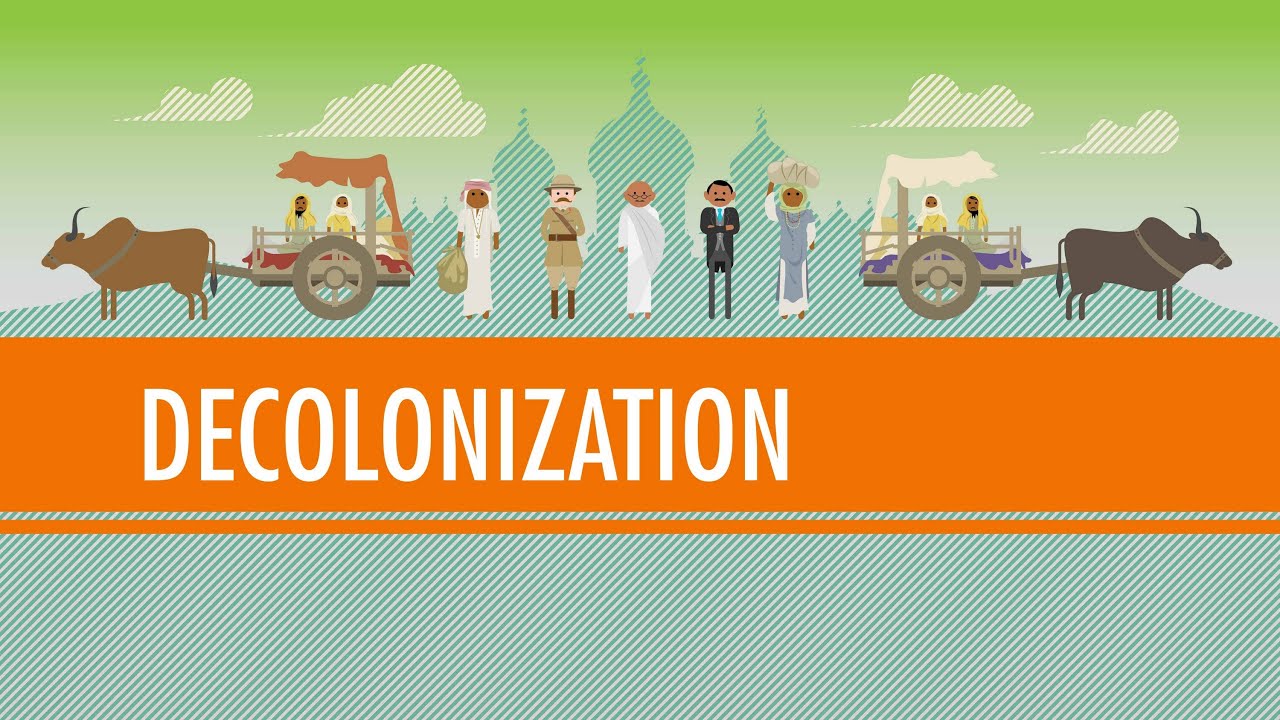
In which John Green teaches you about the post-World War II breakup of most of the European empires. As you'll remember from previous installments of Crash Course, Europeans spent several centuries sailing around the world creating empires, despite the fact that most of the places they conquered were perfectly happy to carry on alone. After World War II, most of these empires collapsed. This is the story of those collapses. In most places, the end of empire was not orderly, and violence often ensued. While India was a (sort of) shining example of non-violent change, in places like The Congo, Egypt, Rwanda, Vietnam, Cambodia, and Laos, things didn't go smoothly at all. John brings you all this, plus pictures of Sea Monkeys. Sadly, they don't look anything like those awesome commercials in the comic books.
Chapters:
Introduction: Decolonization 00:00
What Happens When Empires Fall? 0:33
Post-WWII Decolonization 2:24
Decolonization in India 3:14
Mohandas K. Gandhi 3:47
An Open Letter to Hunger Strikers 5:43
Indonesian Nationalism 6:40
The End of Colonization in French Indochina (Vietnam, Laos, and Cambodia) 7:51
Gamal Abdul Nasser and Egyptian Nationalism 8:35
Decolonization in Central and Southern Africa 9:16
Credits 12:10
Resources:
The Columbia History of the 20th Century https://bit.ly/3xrdpZ9
Crash Course is on Patreon! You can support us directly by signing up at http://www.patreon.com/crashcourse
Want to find Crash Course elsewhere on the internet?
Facebook - http://www.facebook.com/YouTubeCrashCourse
Twitter - http://www.twitter.com/TheCrashCourse
Instagram - https://www.instagram.com/thecrashcourse/
CC Kids: http://www.youtube.com/crashcoursekids

In which John Green, Hank Green, and Emily Graslie teach you about the Anthropocene, an unofficial geological era that covers the last century or so, in which humanity has made massive progress. We've discovered the Higgs-Boson particle, and awesome electric cars, and amazing smartphones. So all this collective learning and progress has been good for everyone, right? Maybe not. We'll look at some of the pros and cons of all this "progress," including environmental impact, changes in the way people live and work, and political changes and wars that come along with the modern world. We've come a long way, but there's a long way to go. Crash Course will also take a look at what's going to happen in the near future. If we manage to make our way through the coming bottlenecks, we could be OK in coming centuries. Don't get too hopeful, though. The Sun will eventually die, and the Earth will be destroyed, and later the universe will eventually experience heat death. But we won't talk about those downers until next week.
For more information: http://www.bighistoryproject.com
How does education work? Where does the money come from? Who pays for it? Is going to college a good investment? Adriene and Jacob are talking today about the economics of education. Most countries require that their citizens get some education, and most countries pay for basic education, but the quality of education can vary widely. And in the US, post-secondary education can come with a lot of costs.
Crash Course is on Patreon! You can support us directly by signing up at http://www.patreon.com/crashcourse
Thanks to the following Patrons for their generous monthly contributions that help keep Crash Course free for everyone forever:
Mark, Eric Kitchen, Jessica Wode, Jeffrey Thompson, Steve Marshall, Moritz Schmidt, Robert Kunz, Tim Curwick, Jason A Saslow, SR Foxley, Elliot Beter, Jacob Ash, Christian, Jan Schmid, Jirat, Christy Huddleston, Daniel Baulig, Chris Peters, Anna-Ester Volozh, Ian Dundore, Caleb Weeks
--
Want to find Crash Course elsewhere on the internet?
Facebook - http://www.facebook.com/YouTubeCrashCourse
Twitter - http://www.twitter.com/TheCrashCourse
Tumblr - http://thecrashcourse.tumblr.com
Support Crash Course on Patreon: http://patreon.com/crashcourse
CC Kids: http://www.youtube.com/crashcoursekids
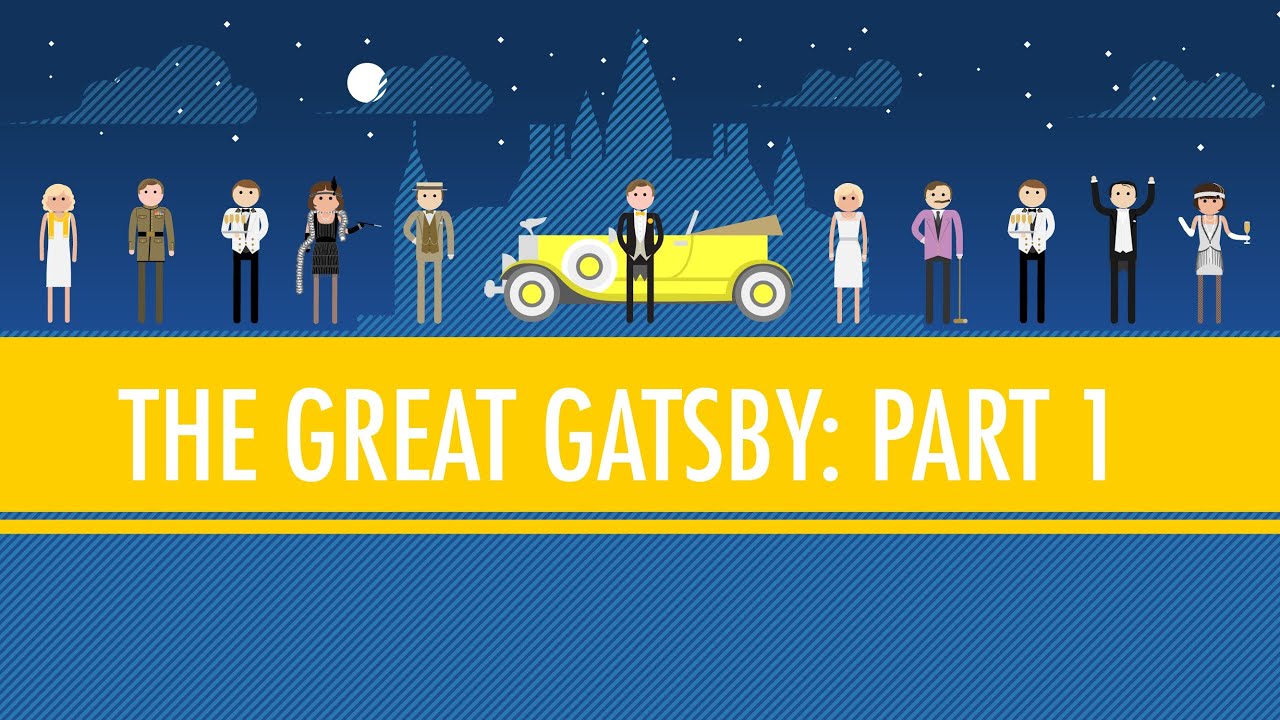
In which John Green explores F. Scott Fitzgerald's novel of the Jazz Age, The Great Gatsby. John introduces you to Nick Carraway, Jay Gatsby, Daisy and Tom Buchanan, and the other characters in the novel, and tries to look beyond the surface story to figure out what this thing is ABOUT. Set in the 1920s against a conflicted backdrop of prohibition and excess, The Great Gatsby takes a close look at the American Dream as it existed in Fitzgerald's time. It turns out, it had a lot to do with money and status, and it still does today. John will cover the rich symbolism of the novel, from the distant green light to the pale gold of wealth and decay. Also, Paris Hilton drops by.
Turn on the captions. You'll like it.
Consider supporting local bookstores by purchasing your books through our Bookshop affiliate link https://bookshop.org/shop/complexly or at your local bookseller.
Crash Course is on Patreon! You can support us directly by signing up at http://www.patreon.com/crashcourse
Want to find Crash Course elsewhere on the internet?
Facebook - http://www.facebook.com/YouTubeCrashCourse
Twitter - http://www.twitter.com/TheCrashCourse
Instagram - https://www.instagram.com/thecrashcourse/
CC Kids: http://www.youtube.com/crashcoursekids

In which John relates a condensed history of India, post-Indus Valley Civilization. John explores Hinduism and the origins of Buddhism. He also gets into the reign of Ashoka, the Buddhist emperor who, in spite of Buddhism's structural disapproval of violence, managed to win a bunch of battles.
Chapters:
Introduction 00:00
The Vedas 0:55
The Caste System 1:33
Dharma 2:40
Samsara, Moksha, and Karma 3:33
Buddhism 5:18
Chutes and Ladders 8:04
Ashoka 9:18
Hinduism 11:04
Credits 11:47
Resources:
India: A History by John Keay: https://bit.ly/3uEgVxE
The Bhagavad Gita: https://bit.ly/3O8A96l
The Bhagavad Gita, Upanishads, and Rig Veda, all-in-one edition: https://bit.ly/3xqP85N
Credits:
Executive Producer: John Green
Producer: Stan Muller
Writer and historian: Raoul Meyer
Script Supervisor: Danica Johnson
Music: Jason Weidner
Thought Bubble is a product of the Smart Bubble Society: http://dft.ba/-smartbubble
the Smart Bubble Society is:
Suzanna Brusikiewicz
Jonathon Corbiere
Nick Counter
Allan Levy
James Tuer
Adam Winnik
Set Design: Donna Sink
Props: Brian McCutcheon
Photos:
David Shankbone
ClipWorks
Crash Course is on Patreon! You can support us directly by signing up at http://www.patreon.com/crashcourse
Want to find Crash Course elsewhere on the internet?
Facebook - http://www.facebook.com/YouTubeCrashCourse
Twitter - http://www.twitter.com/TheCrashCourse
Instagram - https://www.instagram.com/thecrashcourse/
CC Kids: http://www.youtube.com/crashcoursekids
This week, Adriene and Jacob teach you about macroeconomics. This is the stuff of big picture economics, and the major movers in the economy. Like taxes and monetary policy and inflation and policy. We need this stuff, because if you don't have a big picture of the economy, crashes and panics are more likely. Of course, economics is extremely complex and unpredictable. Today we'll talk about GDP as a measure of a country's economic health, the basics of economic analysis, and even a little about full employment, unemployment
Crash Course is on Patreon! You can support us directly by signing up at http://www.patreon.com/crashcourse
Thanks to the following Patrons for their generous monthly contributions that help keep Crash Course free for everyone forever:
Mark, Jan Schmid, Simun Niclasen, Robert Kunz, Daniel Baulig, Jason A Saslow, Eric Kitchen, Christian, Beatrice Jin, Anna-Ester Volozh, Eric Knight, Elliot Beter, Jeffrey Thompson, Ian Dundore, Stephen Lawless, Today I Found Out, James Craver, Jessica Wode, Sandra Aft, Jacob Ash, SR Foxley, Christy Huddleston, Steve Marshall, Chris Peters
--
Want to find Crash Course elsewhere on the internet?
Facebook - http://www.facebook.com/YouTubeCrashCourse
Twitter - http://www.twitter.com/TheCrashCourse
Tumblr - http://thecrashcourse.tumblr.com
Support Crash Course on Patreon: http://patreon.com/crashcourse
CC Kids: http://www.youtube.com/crashcoursekids
John Green teaches you about the so-called Dark Ages, which it turns out weren't as uniformly dark as you may have been led to believe. While Europe was indeed having some issues, many other parts of the world were thriving and relatively enlightened. John covers European Feudalism, the cultural blossoming of the Islamic world, and the scientific and artistic advances in China, all during these "Dark Ages." Along the way, John will raise questions about the validity of Europe's status as a continent, reveal the best and worst years of his life, and frankly state that science and religion were once able to coexist.
Chapters:
Introduction: Europe 00:00
Why are they called The Dark Ages? 0:50
Feudalism in Medieval Europe 1:34
Dar al Islam and the Umayyad Dynasty 3:55
The Abbasids 4:42
An Open Letter to Science and Religion 7:17
Spanish Muslims in Cordoba 8:15
China's Golden Age 9:12
Credits 10:52
Crash Course is on Patreon! You can support us directly by signing up at http://www.patreon.com/crashcourse
Want to find Crash Course elsewhere on the internet?
Facebook - http://www.facebook.com/YouTubeCrashCourse
Twitter - http://www.twitter.com/TheCrashCourse
Instagram - https://www.instagram.com/thecrashcourse/
CC Kids: http://www.youtube.com/crashcoursekids

In which John Green teaches you, at long last, about the most exceptional bunch of empire-building nomads in the history of the world, the Mongols! How did the Mongols go from being a relatively small band of herders who occasionally engaged in some light hunting-gathering to being one of the most formidable fighting forces in the world? It turns out Genghis Khan was a pretty big part of it, but you probably already knew that. The more interesting questions might be, what kind of rulers were they, and what effect did their empire have on the world we know today? Find out, as John FINALLY teaches you about the Mongols.
Chapters:
Introduction: Wait for it...The Mongols! 00:00
What does it mean to be a nomad? 1:13
Genghis Khan 2:39
An Open Letter to Genghis Khan's Descendants 4:45
The Mongols After Genghis Khan 5:30
Five Reasons the Mongols Were Awesome 6:54
Five Reasons the Mongols Weren't Awesome 8:30
Credits 10:34
Crash Course is on Patreon! You can support us directly by signing up at http://www.patreon.com/crashcourse
Want to find Crash Course elsewhere on the internet?
Facebook - http://www.facebook.com/YouTubeCrashCourse
Twitter - http://www.twitter.com/TheCrashCourse
Instagram - https://www.instagram.com/thecrashcourse/
CC Kids: http://www.youtube.com/crashcoursekids
You may think you know all about hypnosis from the movies. Zoolander, The Manchurian Candidate, etc... but there's a whole lot more going on. In this episode of Crash Course Psychology, Hank tells us about some of the many altered states of consciousness, including hypnosis.
Want more videos about psychology? Check out our sister channel SciShow Psych at https://www.youtube.com/scishowpsych
--
Chapters:
Introduction: Hypnosis & Altered States of Consciousness 00:00
Facts & Fallacies About Hypnosis 2:00
How does hypnosis work? 3:05
Drug Tolerance & Neuroadaptation 4:49
Psychoactive Drugs 5:51
Depressants 6:28
Stimulants 7:35
Hallucinogens/Psychedelics 9:04
Non-Drug Induced Hallucinations 9:33
Review & Credits 10:32
--
Crash Course is on Patreon! You can support us directly by signing up at http://www.patreon.com/crashcourse
Want to find Crash Course elsewhere on the internet?
Facebook - http://www.facebook.com/YouTubeCrashCourse
Twitter - http://www.twitter.com/TheCrashCourse
Instagram - https://www.instagram.com/thecrashcourse/
CC Kids: http://www.youtube.com/crashcoursekids
In which Hank does some push-ups for science and describes the "economy" of cellular respiration and the various processes whereby our bodies create energy in the form of ATP.
Special thanks go to Stafford Fitness (www.staffordfitness.net) for allowing us to shoot the gym scenes in their facilities.
This video uses sounds from Freesound.org
Table of Contents:
1) Cellular Respiration 01:00
2) Adenosine Triphosphate 01:29
3) Glycolysis 4:13
A) Pyruvate Molecules 5:00
B) Anaerobic Respiration/Fermentation 5:33
C) Aerobic Respiration 6:45
4) Krebs Cycle 7:06
A) Acetyl COA 7:38
B) Oxaloacetic Acid 8:21
C) Biolography: Hans Krebs 8:37
D) NAD/FAD 9:48
5) Electron Transport Chain 10:55
6) Check the Math 12:33
Crash Course is on Patreon! You can support us directly by signing up at http://www.patreon.com/crashcourse
Want to find Crash Course elsewhere on the internet?
Facebook - http://www.facebook.com/YouTubeCrashCourse
Twitter - http://www.twitter.com/TheCrashCourse
Instagram - https://www.instagram.com/thecrashcourse/
CC Kids: http://www.youtube.com/crashcoursekids
In the aftermath of the revolutions and upheaval in 18th and early 19th century Europe, there was a hunger for reform across the continent. Reformers like Robert Owen, Charles Fourier, and Auguste Comte proposed radical new ideas, and at the same time, regular people began to stand up and ask for greater equality, and a louder voice in how they were governed. Results were mixed, but a lot of the ideas that emerged during this time are still echoing in our world today.
Sources
-Hosking, Geoffrey. Russia: People and Empire. Cambridge: Harvard University Press, 1997.
-Hunt, Lynn et al. The Making of the West: Peoples and Cultures. 6th ed. Boston: Bedford St. Martin’s, 2019.
-Judson, Pieter M. The Hapsburg Empire: A New History. Cambridge: Harvard University Press,
-Kent, Susan Kingsley. A New History of Britain: Four Nations and an Empire. New York: Oxford University Press, 2017.
-Sperber, Jonathan. Revolutionary Europe 1780-1850. 2nd ed. London: Routledge, 2017.
Crash Course is on Patreon! You can support us directly by signing up at http://www.patreon.com/crashcourse
Thanks to the following patrons for their generous monthly contributions that help keep Crash Course free for everyone forever:
Eric Prestemon, Sam Buck, Mark Brouwer, Indika Siriwardena, Avi Yashchin, Timothy J Kwist, Brian Thomas Gossett, Haixiang N/A Liu, Jonathan Zbikowski, Siobhan Sabino, Zach Van Stanley, Jennifer Killen, Nathan Catchings, Brandon Westmoreland, dorsey, Kenneth F Penttinen, Trevin Beattie, Erika & Alexa Saur, Justin Zingsheim, Jessica Wode, Tom Trval, Jason Saslow, Nathan Taylor, Khaled El Shalakany, SR Foxley, Sam Ferguson, Yasenia Cruz, Eric Koslow, Tim Curwick, David Noe, Shawn Arnold, William McGraw, Andrei Krishkevich, Rachel Bright, Jirat, Ian Dundore
--
Want to find Crash Course elsewhere on the internet?
Facebook - http://www.facebook.com/YouTubeCrashCourse
Twitter - http://www.twitter.com/TheCrashCourse
Tumblr - http://thecrashcourse.tumblr.com
Support Crash Course on Patreon: http://patreon.com/crashcourse
CC Kids: http://www.youtube.com/crashcoursekids
#crashcourse #history #europeanhistory