Top videos

Kære venner
Glædelig Jul :)
Jeg sender dig en julehilsen med ønsket om den bedste jul til dig og din familie.
Hvis du har lyst, kan du være med i konkurrencen om at vinde mit nye kortspil med repræsentationer af tal.
Du skal blot skrive en hilsen under min video på facebook eller instagram, så er du med. Så du har faktisk 2 chancer - held og lykke.
Jeg trækker to vindere d. 15 december.
KH Anette K
Følg mig gerne her:
https://facebook.com/anettekmatematik/
https://instagram.com/anettekmatematik/
https://www.youtube.com/channe....l/UCR8PqEuBE7OlORn2y
https://anettekmatematik.com/
#anettekmatematik #værkstedsundervisning #lærmatematik

Kære venner
Om et par dage uploader jeg mit værksted "Racerbiler" her på siden.
Det har vi meget sjov med i mine klasser, hvor vi dyster med terninger, racerbiler og snakker om chance og sandsynlighed.
Og så er eleverne vilde med at bygge de her små biler til brug i undervisningen.
Her kan du se en DIY video omkring de små biler, og husk at holde øje med siden her. Så kommer værkstedet op til brug gratis i løbet af ugen.
Del gerne med kolleger
Kh Anette
Følg mig gerne her:
https://facebook.com/anettekmatematik/
https://instagram.com/anettekmatematik/
https://www.youtube.com/channe....l/UCR8PqEuBE7OlORn2y
https://anettekmatematik.com/
#DIY #anettekmatematik #værkstedsundervisning

Kære venner.
Jeg bruger ofte rolleregning i forbindelse med mine værksteder, og jeg tror du vil kunne få meget glæde af, at prøve det med dine elever (hvis du ikke allerede bruger metoden).
I denne video viser jeg en række eksempler på, hvordan jeg bruger rolleregning. Det er super fint til værkstedsundervisning, fordi eleverne ved hvad de skal og hjælper hinanden med at udføre opgaverne. Samtidig er det en fordel, at de skiftes til at have de forskellige roller.
Du kan hente materialerne til værkstederne i videoen her:
https://anettekmatematik.com/minus-med-store-tal/
https://anettekmatematik.com/byg-sma-tal/
Og ellers kan metoden bruges til langt de fleste værksteder, så det er bare at kaste sig ud i det
KH Anette
Følg mig gerne her:
https://facebook.com/anettekmatematik/
https://instagram.com/anettekmatematik/
https://www.youtube.com/channe....l/UCR8PqEuBE7OlORn2y
https://anettekmatematik.com/
#anettekmatematik #værkstedsundervisning #lærmatematik

Kære venner
I sidste uge delte jeg en video med jer "Leg med terninger", som I har taget så fantastisk godt imod. 1000 tak for det.
Jeg bruger mange spil med terninger i min undervisning, fordi jeg synes, det er både sjovt og meget lærerigt for børnene.
Man kan sige, at de leger sig til viden og får opbygget nogle virkelig gode regnestrategier. De giver samtidig rigtig god matematiksnak med dem om deres valg af strategier, og ofte overraskes jeg over deres kreativitet.
Her er så "Leg med terninger 2" med 3 nye aktiviteter lige til at bruge i timerne - de kræver kun en håndfuld terninger og noget papir.
Hvis du kan lide denne video, så husk at der på min hjemmeside er flere af samme slags spil og lege i kategorien "Leg med..."
Der er mange flere værksteder på min hjemmeside, som du kan tjekke ud. Og følg mig gerne, så bliver jeg glad.
Kh Anette K
https://facebook.com/anettekmatematik/
https://instagram.com/anettekmatematik/
https://www.youtube.com/channe....l/UCR8PqEuBE7OlORn2y
https://anettekmatematik.com/
#legoglæring #matematikspil #lærmatematik

I denne video kan du se, hvordan man let kan gange to- og tre cifrede tal.
Mange elever der har svært ved de traditionelle gangemetoder er glade for gangekassen.
Hent materialet gratis her: https://anettekmatematik.com/gangekassen/
Hvis du kan lide videoen, håber jeg du vil følge mig og holde øje med mine kommende videoer både her på kanalen og på mine andre sociale medier.
Hilsen Anette K
https://facebook.com/anettekmatematik/
https://instagram.com/anettekmatematik/
https://www.youtube.com/channe....l/UCR8PqEuBE7OlORn2y
https://anettekmatematik.com/
#matematikhjælp #gangemetode
https://facebook.com/anettekmatematik/
https://instagram.com/anettekmatematik/
https://www.youtube.com/channe....l/UCR8PqEuBE7OlORn2y
https://anettekmatematik.com/
#matematikhjælp #matematikiindskolingen #regnemetode

For centuries, the mystery of the pyramids has baffled the world — how did ancient Egyptians move millions of massive stone blocks without modern machines? Now, archaeologists may have cracked the code. From hidden canals to clever engineering tricks, new evidence is rewriting history and revealing just how advanced this ancient civilization really was. Get ready to uncover the secrets of Egypt like never before.
Animation is created by Bright Side.
----------------------------------------------------------------------------------------
Music from TheSoul Sound: https://thesoul-sound.com/
Check our Bright Side podcast on Spotify and leave a positive review! https://open.spotify.com/show/....0hUkPxD34jRLrMrJux4V
Subscribe to Bright Side: https://goo.gl/rQTJZz
----------------------------------------------------------------------------------------
Our Social Media:
Facebook: https://www.facebook.com/brightplanet/
Instagram: https://www.instagram.com/brightside.official
TikTok: https://www.tiktok.com/@bright....side.official?lang=e
Stock materials (photos, footages and other):
https://www.depositphotos.com
https://www.shutterstock.com
https://www.eastnews.ru
----------------------------------------------------------------------------------------
For more videos and articles visit: http://www.brightside.me
----------------------------------------------------------------------------------------
This video is made for entertainment purposes. We do not make any warranties about the completeness, safety and reliability. Any action you take upon the information in this video is strictly at your own risk, and we will not be liable for any damages or losses. It is the viewer's responsibility to use judgement, care and precaution if you plan to replicate.

Not only is this the first time a commercial company is sending people into space, it is also the first crewed mission to the International Space Station to be launched from American soil in 9 years since the Space Shuttle was decommissioned. On the 27th of May SpaceX will make spaceflight history by being the first commercial company to transport humans to the ISS on a Falcon9 rocket in the SpaceX Dragon Crew spacecraft. This is the beginning of commercial spaceflight and potentially the beginning of space tourism.
#spacex #NASA #DomainOfScience
--- Credits --
NASA image and Video library https://images.nasa.gov/
Music: Verified Picasso by Scary Island, Song of Sadhana and Spenta Mainyu by Jesse Gallagher.
If you’d like to support my free educational content: https://www.patreon.com/domainofscience
--- Posters ----
DFTBA Store: https://store.dftba.com/collec....tions/domain-of-scie
RedBubble Store: https://www.redbubble.com/people/DominicWalliman
I have also made posters available for educational use which you can find here: https://www.flickr.com/photos/95869671@N08/
-- Some Awesome People ---
And many thanks to my $10 supporters on Patreon, you are awesome!
Theodore Chu
Sebastian
Duong Nguyen
Eric Epstein
Join the gang and help support me produce free and high quality science content:
https://www.patreon.com/domainofscience
--- My Science Books ----
I also write science books for kids! You can see them all here:
http://profastrocat.com
--- Follow me around the internet ---
http://dominicwalliman.com
https://twitter.com/DominicWalliman
https://www.instagram.com/dominicwalliman

Arguably the most likely way we will first discover alien life on another planet will be using the power of atomic spectroscopy. You can grab the Map of Quantum Physics here https://store.dftba.com/collec....tions/domain-of-scie
Aliens will most likely leave a tell tale trace of their life in the atmosphere’s of their planet. But how do we know what chemicals the atmosphere of a distant planet contains? The answer is atomic spectroscopy. If we see a planet passing in front of it’s star, some of that starlight is absorbed in a very specific pattern called an atomic absorption spectrum. Each element has a specific pattern like a barcode, so through careful analysis of the light it can tell us which gasses are in the atmosphere and their proportions. We already use this technique for other space objects like stars and nebulae, measuring properties like temperature, density, ionization and relative velocity. This is a gift that nature and quantum physics has given us and the majority of what we know about the universe is based on this technique.
#spectroscopy #ThreeByThree #DomainOfScience
If you’d like to support my free educational content: https://www.patreon.com/domainofscience
--- Posters ----
DFTBA Store: https://store.dftba.com/collec....tions/domain-of-scie
RedBubble Store: https://www.redbubble.com/people/DominicWalliman
I have also made posters available for educational use which you can find here: https://www.flickr.com/photos/95869671@N08/
-- Some Awesome People ---
And many thanks to my $10 supporters on Patreon, you are awesome!
Theodore Chu
Petr Murmak
Sebastian
Eric Epstein
Alex Polo
Kevin Delaney
Join the gang and help support me produce free and high quality science content:
https://www.patreon.com/domainofscience
--- My Science Books ----
I also write science books for kids called Professor Astro Cat. You can see them all here:
http://profastrocat.com
--- Follow me around the internet ---
http://dominicwalliman.com
https://twitter.com/DominicWalliman
https://www.instagram.com/dominicwalliman
--- Credits ---
Music and SFX by Dominic Walliman

The Map of Science explores what science really is. Check out this video's sponsor https://brilliant.org/dos
In this video I investigate what makes a science a science, and how the scientific method is used in different subjects. I lay out all of the areas of human endeavor and show how they relate to each other from philosophy, through the sciences, to the social sciences, the arts and back to philosophy which I have drawn as a big donut. The main theme is that the scientific method is harder and harder to apply to subjects as they deal with more and more complex systems.
When I said I did in depth maps of ‘all’ of these subjects, I meant just the main ones, mathematics, physics, chemistry, biology and computer science.
#science #DomainOfScience
You can get the poster here:
North America: https://store.dftba.com/produc....ts/the-donut-of-know
Everywhere else: https://www.redbubble.com/people/dominicwalliman
I have also made versions available for educational use which you can find here: https://www.flickr.com/photos/95869671@N08/
If you want to check out my Professor Astro Cat books go here:
http://profastrocat.com
The trippy ending uses footage from this amazing video: https://youtu.be/-Z4jx5VMw8M
And is inspired by this other amazing video: https://youtu.be/uwmeH6Rnj2E
Thanks so much to my supporters on Patreon. If you enjoy my videos and would like to help me make more this is the best way and I appreciate it very much. https://www.patreon.com/domainofscience
Find me on twitter, instagram, and my website:
http://dominicwalliman.com
https://twitter.com/DominicWalliman
https://www.instagram.com/dominicwalliman
https://www.facebook.com/domainofscience
https://www.patreon.com/domainofscience

🐸 Have you ever heard The Five Little Speckled Frogs song for kids? 🤩 It's extremely catchy and lots of fun to sing along with, especially for preschoolers, toddlers, and babies. 🥳 Enjoy this fully animated 5 Little Speckled Frogs song for kids in ultra HD 4k with your entire family as everyone sings and dances to the catchy tune and lyrics! ✨ Children love it, and they'll learn a few things about counting (and frogs) along the way!
Make learning easy and exciting for your little ones with Lucas 🦁 and Ruby 🐰, two animated animal friends who will sing along with the song as it plays. ✔️ Both characters star in many free learning apps and videos from RV AppStudios, so you may even recognize them! 🥰 Sing along with the fully animated 5 Speckled Frogs nursery rhyme for kids. 🐸
🎧 Lyrics to the 'Five Little Speckled Frogs' nursery rhyme:
Five little speckled frogs,
Sat on a speckled log,
Eating the most delicious bugs (yum, yum),
One jumped into the pool,
Where it was nice and cool,
Then there were four speckled frogs (glub, glub).
Four little speckled frogs,
Sat on a speckled log,
Eating the most delicious bugs (yum, yum),
One jumped into the pool,
Where it was nice and cool,
Then there were three speckled frogs (glub, glub).
Three little speckled frogs,
Sat on a speckled log,
Eating the most delicious bugs (yum, yum),
One jumped into the pool,
Where it was nice and cool,
Then there were two speckled frogs (glub, glub).
Two little speckled frogs,
Sat on a speckled log,
Eating the most delicious bugs (yum, yum),
One jumped into the pool,
Where it was nice and cool,
Then there was one speckled frog (glub, glub).
One little speckled frog,
Sat on a speckled log,
Eating the most delicious bugs (yum, yum),
He jumped into the pool,
Where it was nice and cool,
Then there were no speckled frogs.
⭐ RV AppStudios is thrilled to expand our kids songs and nursery rhymes with this brand new sing-along, one we're sure your kids will love singing along with! 👍 As always, be sure to LIKE and SHARE this kids song to show more families that it can be easy and fun to learn 🔔 And don't forget to SUBSCRIBE for more free animated sing-along songs and nursery rhymes for kids by RV Kids! 🔥
📢 Also, check out our FREE coloring pages for kids and much more - https://www.rvappstudios.com
🎯 Try our FREE Educational Apps for Babies & Toddlers:
🟡 Google Play: https://play.google.com/store/....apps/dev?id=74300059
🟣 iOS: https://apps.apple.com/develop....er/rv-appstudios-llc
Copyright © RV AppStudios
#NurseryRhymes #BabySongs #ForKids
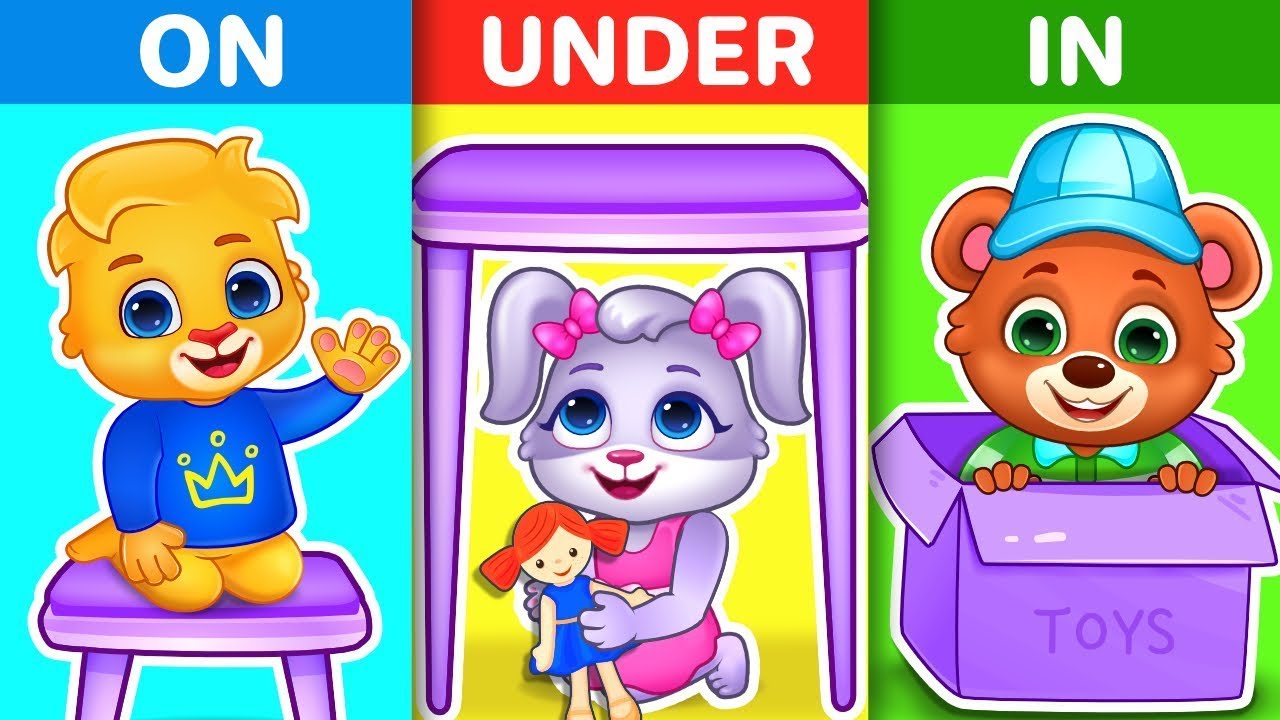
✔️ Help your toddler learn new words, join Lucas and Ruby from Lucas & Friends as they teach new words while making your toddler or preschooler smile in this fun educational video. Having a tough time explaining prepositions to your children? Lucas & Friends can help! 🦁 This fun and educational video introduces propositions for kids in a simple, easy way. Before you know it, your kids will be preposition experts! 🤩
This toddler learning video was created to make learning new prepositions words super simple and easy to learn.
📙 Learning different parts of speech can be tough for kids, especially when grammar is involved. 📚 English prepositions are common connecting words most kids know but can struggle to get just right. In this animated video, Lucas and his pals will explain prepositions in a fun way, making it easy for kids of all ages to learn! 🎓
What are prepositions? 💡 Words that tell where a noun is located, such as under, outside, inside, front, near, far, around. But you don’t have to worry about explaining all of that, as Lucas & Friends will do it for you with animated nursery rhyme examples! Watch it with your children in ultra HD 4k today! 🎯
⦿ List of Prepositions Word:
00:00 - Lucas & Friends Introduction
0:11 Near
0:59 Between
1:45 Inside
2:46 Front
3:47 On
4:37 Under
5:28 Behind
6:31 Outside
7:31 Around
8:27 Far
⭐ Hope you enjoy the fun baby & toddler learning video to learn new words and improve vocabulary. If our educational video entertains your child and makes them happy, please hit the LIKE button. SHARE it with your friends and family members so that more and more kids can sing and have fun. 👍 SUBSCRIBE to our channel to watch our other nursery rhymes, kids songs, and educational videos for children and parents. 🔔 And make sure you turn on the bell icon to get notified as soon as our new videos come up. 🔥
🛍️ Official Lucas & Friends Store Now Open - https://shop.rvappstudios.com
📢 Checkout Lucas & Friends Educational Children's Books: https://www.amazon.com/Lucas-F....riends-by-RV-AppStud
🎯 Try our FREE Educational Apps for Babies & Toddlers:
🟡 Google Play: https://play.google.com/store/....apps/dev?id=74300059
🟣 iOS: https://apps.apple.com/develop....er/rv-appstudios-llc
🟢 RV AppStudios: https://www.rvappstudios.com/kidsapp.html
🌟 More fun educational videos for toddlers by RV AppStudios:
🟠 Baby's First Words - https://youtu.be/c-aiPRcTpao
📘 Opposite Words for Kids - https://youtu.be/BWdXN0wwi6A
📅 Months of the Year Song - https://youtu.be/jRNpIQ8jzq0
✋ Body Parts for Kids - https://youtu.be/G-7AMnZLOCM
Copyright © RV AppStudios
#EducationalVideos #KidsEducation #ToddlerLearningVideo

🤩 Babies & Toddlers join Lucas & Friends for an amazing adventure with over 30 baby songs, nursery rhymes, and fun educational games! This toddler and baby learning video is packed with excitement: kids learn ABCs, colors, shapes, opposite words, first words like mommy & daddy, practice pretend play, and enjoy lively activities, all with catchy nursery rhymes and kids songs! 🎉
✨ Watch your child learn colors, ABCs, numbers, shapes, words, emotions, and play with fun toys like police car, tractor, train, jeep, and scooter. Let little ones talk, dance, and sing along in this joyful learning journey full of music, friendship, and games! 👧
🌟 Songs & Activities for Babies and Toddlers with Lucas & Friends:
00:00 Jump Jump When You Feel Happy Baby Song - Learn Hello, and enjoy playful learning. 🦁
00:32 ABC Song for Baby - Fun alphabet song to help kids learn ABCs. 🔤
01:28 Lucas & Elephant Playtime - Pretend play with a tractor! 🐘
01:51 Tractor, Tractor, My Tractor Kids Song - A playful song about riding a tractor. 🚜
02:11 Lucas & Ruby Fun Activity - Fun toddler friendship fun. 😊
03:02 This is Red Color Song - Learn the color red with baby song. 🎨
03:23 Fire Truck Song for Toddler - Sing and play with a fire truck. 🚒
03:56 Tag Game (Toddler Activity) - Kids learn to run, laugh, and play indoors. 🏃
06:12 Brody and Monkey Kids Song - A silly jungle tune for toddler learning. 🐒
06:54 Police Car Baby Song - Sing about a police car toy. 🚓
09:12 Lucas and Kangaroo - Jump and hop with learning joy! 🦘
11:00 My Little Cat Toddler Song - A cute nursery rhyme about a cat. 🐱
11:16 Bunnies and Brody - Adorable moments with bunnies! 🐰
11:38 Color Train Kids Song - Toddlers learn colors on a train ride! 🚂
12:06 Green Color Song - Learn green with this cheerful baby song. 💚
12:31 Jeep Fun Song - A fun kids song about a jeep adventure. 🚙
13:08 I'm Ready With the Hammer Toddler Song - A playful song about using a hammer! 🔨
13:56 Circle & Square Shape Song - Baby learning shapes song! ⭕🟦
16:03 Farmer Game Song - Pretend play and fun on the farm. 🐮
16:56 I'm Riding My Tractor Song - More tractor fun and bringing food! 🚜
18:35 Pig Playtime - Oink and enjoy playful animal fun. 🐷
19:19 Frogs Go Jumping Song - Rhyme about jumping frogs. 🐸
19:56 Color Train is On the Way - Color learning with a train. 🚂
20:24 This is Blue Color Song - Kids learn the color blue with this song. 💙
20:49 I'm Driving My Car Toddler Song - Pretend play driving a car! 🚗
21:34 Shape Learning Song - Kids learn triangle and rectangle shapes. 🔺🟧
23:40 Laughing Song for Toddlers - Fun baby song for laughter and play! 🙈
24:00 Color Train Toddler Song - Learn colors while riding. 🚂
24:28 This is Yellow Color Song - Learn the color yellow! 💛
24:57 Wheels on the Bus Nursery Rhyme - A classic nursery rhyme for kids. 🚌
27:33 Oh My Daddy Song - A heartwarming baby song for first words like Daddy! 👨👧
28:00 Color Train is On the Way Song - Learn purple with the train. 💜
28:56 Ride Ride I'm Riding My Scooter Song - A fun song about riding a scooter! 🛵
31:15 I Love You Mommy Song - A sweet toddler song about first words like Mommy! 👩👧
31:33 Fun Learning with Drawing, Find the Tail & Opposites – Kids learn letters, draw animals (Monkey, Frog, Kangaroo, Elephant, Lion, Rabbit, Pig, Whale, Xylophone), play Find the Tail, and practice opposites like big-small, in-out, fast-slow, up-down, open-close, left-right — all in one fun game! 🐒🎨⚖️
📌 This video is the perfect toddler learning experience packed with songs, games, and activities that make learning fun! 🚀
🎯 Lucas & Friends baby learning videos are great for:
✔ ️Toddlers learning ABC, colors and shapes
✔ ️Baby learning sounds, movements, and emotions
✔ ️Kids learning first words, opposite words, and vocabulary
✔ ️Babies learning to talk, play, and recognize feelings
✔ ️Encouraging joyful moments, friendship, and life lessons
✔ ️Teaching through games and learning through play
📚 This toddler learning video helps build skills like speaking, counting, recognizing colors, and new words. 🎓 From ABCs and first words to nursery rhymes and toy play — it’s joyful learning for babies, toddlers & preschoolers! 🏅
⭐ Discover 4K adventure with Lucas & Friends! Perfect for toddlers & preschool kids, 12 months and older! 👍 Like, SHARE & SUBSCRIBE for more fun learning videos, baby songs, and toddler-friendly content. Tap the 🔔 to stay updated!
✨ Keep Learning with Lucas & Friends! ✨
📱 Try our free toddler learning apps
🛍️ Shop official Lucas & Friends products
Copyright © RV AppStudios
#toddlerlearning #babylearning #kidssongs

Our color song is the perfect way to teach children basic colors in song form! Our colors song will introduce children to the color blue, green, orange, red, yellow and more! 🎨 Fun sing along songs for children are a great way to teach them new skills. 🤩 We hope toddlers, preschoolers and kindergarteners all love our colors song and it truly helps your child! 🌟
Colors are fun, but it can be difficult for young kids to remember all of the names. ✔️ Our colors for kids song in 4K includes the name of colors with spelling, matching them to pictures of each color, all while engaging children with fun and catchy rhymes and songs. Everything is presented by two of our favorite characters Lucas 🦁 and Ruby 🐰. The beautiful graphics and adorable characters will easily draw children's attention & boost children's creativity. Learning colors for kids couldn't be easier! 🎉
While our color for kids song in English will introduce children to all the primary colors such as blue, green, orange, red, yellow; however, be sure to sing along nice and loud with your toddlers & babies! 🎨 Help your child learn colours, while having fun as they sing with us. 🎵
Parents and teachers can use this video to keep kids entertained through fun learning. 🎯 We hope you enjoy our first of many videos and look forward to creating more kids songs and nursery rhymes! 🔥
🔗 Check out our website for coloring pages for kids and much more - https://www.rvappstudios.com
🎯 Try our Free Educational Apps for Babies & Toddlers:
🟡 Google Play: https://play.google.com/store/....apps/dev?id=74300059
🟣 iOS: https://apps.apple.com/develop....er/rv-appstudios-llc
Copyright © RV AppStudios
#Colors #KidsSong #LearnColors

🎅 Get ready to enjoy We Wish You a Merry Christmas plus a compilation of our best Christmas songs for kids! 🎄 Enjoy a collection of Christmas songs including 'Jingle Bells Song, Five Little Monkeys Jumping on the Bed, and Bingo Dog Song and We Wish You a Merry Christmas Song, these are all Christmas themed nursery rhymes for kids to enjoy during Christmas. 🤩 RV AppStudios creates cute animated Christmas carols for children to enjoy with the family this holiday season! 🌟 Enjoy singing these classic festive Christmas nursery rhymes starring everyone's favorite characters, 🦁 Lucas and Ruby 🐰!
👉🏻 Tap on the time track to enjoy your favorite nursery rhyme:.
00:11 We Wish You a Merry Christmas 🎉
02:59 Jingle Bell Jingle Bell Jingle on the Way 🔔
04:29 Five Little Monkeys Jumping On The Bed (Xmas Songs) 🐒
05:58 BINGO Dog Song with Christmas Music (B-I-N-G-O) 🐶
🎊 Parents, get ready to enjoy the most popular Christmas songs for kids by RV AppStudios back to back in one video. ✨ Turn on your TV and Chromecast these beautiful nursery rhymes in ultra HD 4K. 🥰
⭐ RV AppStudios is thrilled to expand our kids songs and nursery rhymes with this brand new sing-along, one we're sure your kids will love singing along with! 👍 As always, be sure to LIKE and SHARE this kids song to show more families that it can be easy and fun to learn. 🔔 SUBSCRIBE to our channel for more ultra HD 4K nursery rhymes and kids songs by RV Kids! 🔥
📢 Also, check out our FREE coloring pages for kids and much more - https://www.rvappstudios.com
🎯 Try our FREE Educational Apps for Babies & Toddlers:
🟡 Google Play: https://play.google.com/store/....apps/dev?id=74300059
🟣 iOS: https://apps.apple.com/develop....er/rv-appstudios-llc
Copyright © RV AppStudios
#ChristmasSongs #NurseryRhymes #MerryChristmas

👨🍳 Oh, that muffin man! 🧁 The popular and timeless "muffin song" has returned in a wonderful sing along form! Sit down with your children (preschool, toddler, and older) and sing the Do You Know the Muffin Man song, complete with lyrics and gorgeous animations. 🥰
The muffin man nursery rhyme is all about the talented baker who creates delicious muffins for the whole village to enjoy. 🥳 The song is easy to sing (Do you know the muffin man? 👨🍳 Yes I know the muffin man!), and with gorgeous ultra HD 4k visuals and your child's favorite friends Lucas 🦁 and Ruby 🐰 along for the ride, you're guaranteed to have a fun time. 🤩
👉 Check out the "Do You Know the Muffin Man" song in ultra HD 4k today. ✔️ Make learning fun for the whole family! 💚
🎤 Muffin Man Song Lyrics:
Do you know the muffin man,
The muffin man, the muffin man,
Do you know the muffin man,
Who lives on Drury Lane?
Yes, I know the muffin man,
The muffin man, the muffin man,
Yes, I know the muffin man,
Who lives on Drury Lane.
⭐ RV AppStudios is thrilled to expand our kids songs and nursery rhymes with this brand new sing-along, one we're sure your kids will love singing along with! 👍 As always, be sure to LIKE and SHARE this kids song to show more families that it can be easy and fun to learn 🔔 And don't forget to SUBSCRIBE for more free animated sing-along songs and nursery rhymes for kids by RV Kids! 🔥
📢 Also, check out our FREE coloring pages for kids and much more - https://www.rvappstudios.com
🎯 Try our FREE Educational Apps for Babies & Toddlers:
🟡 Google Play: https://play.google.com/store/....apps/dev?id=74300059
🟣 iOS: https://apps.apple.com/develop....er/rv-appstudios-llc
Copyright © RV AppStudios
#NurseryRhymes #ForKids #BabySongs

Educational video for kids that talks about the characteristics and types of communication. Communication is how we transmit and receive information. It allows us to share ideas and express our emotions. In all communication, there are the following elements: the sender, the receiver, the message, the channel and the code. The sender is the person who transmits the information. The receiver is the person who receives that information. The message is the information being transmitted. The channel is how that information is shared. The code is the system used to transmit the information (i.e. the language, such as Spanish, English or Chinese).
Communication can be both verbal and non-verbal. Verbal communication takes place when we use words or sign language. It is spoken or written language, like what we use in a conversation or when writing a letter or a text message to a friend. Non-verbal communication occurs through gestures, images or sounds. It goes beyond what we say with words. For example, waving allows us to communicate with others without using words.
This video is a very useful and interesting resource for children. It is perfect to explain to children what communication is. It is an excellent video for elementary school.
Thanks for visiting us! If you want your children to smile and learn, subscribe! :D
If you like our videos, download Smile and Learn now. You’ll discover thousands of activities for children aged 3 to 12 years, all designed by educators. We have hundreds of games, interactive stories and videos in five languages: English, Spanish, Portuguese, Italian, Turkish and French. Try a month for free and start the adventure!
www.smileandlearn.com

Educational video for children in which they will discover how their brain works when they feel intense emotions and how they can learn to self-regulate. Through a clear and relatable visual metaphor, they will understand that the brain is like a house with two floors: a more impulsive one and a more reflective one.
In this video they will learn:
🧠 To identify the ""downstairs brain"" and its most basic and emotional functions
🧠 To understand the role of the stairs as a connection between emotion and thought
🛋️ To recognize the ""upstairs brain"" as the place where decisions are made and problems are solved
💡 Simple strategies to calm down and think before you act
A powerful tool for fostering emotional intelligence, self-control and decision-making in pre-teens. Perfect for working on self-regulation in the classroom or at home, with clear explanations and age-appropriate visual resources.
Thanks for visiting us! If you want your children to smile and learn, subscribe! :D
If you like our videos, download Smile and Learn now. You’ll discover thousands of activities for children aged 3 to 12 years, all designed by educators. We have hundreds of games, interactive stories and videos in five languages: English, Spanish, Portuguese, Italian, Turkish and French. Try a month for free and start the adventure!
www.smileandlearn.com

Master the basics of Algebra 1 with our comprehensive video tutorials. Explore key topics like Equations, Inequalities, and Functions. Ideal for beginners, high school students, and those looking for a refresher. Clear explanations, step-by-step solutions, and practical examples included. Perfect for homework help, exam prep, and foundational mathematics understanding. Keywords:
Algebra 1 basics, linear equations, quadratic functions, solving polynomials, high school algebra, beginner-friendly, math tutorials, step-by-step guide, practical mathematics, homework assistance, exam preparation.
Join this channel to get access to perks:
https://www.youtube.com/channe....l/UCS1YNEY54RYgt9Obz
Get Our Premium Course -- ultimate-algebra.com
Over 200+ videos with quizzes and answer site, covers pre-algebra, algebra 1 and algebra 2.
GED preparations. Get videos, lessons and tests.
https://ultimateged.com

Are you ready for the GED MATH TEST 20203. Check your readiness.
Get our full GED Math Course @ ultimateGED.com
Join this channel to get access to perks:
https://www.youtube.com/channe....l/UCS1YNEY54RYgt9Obz
Get Our Premium Course -- ultimate-algebra.com
Over 200+ videos with quizzes and answer site, covers pre-algebra, algebra 1 and algebra 2.

Join this channel to get access to perks:
https://www.youtube.com/channe....l/UCS1YNEY54RYgt9Obz
Get Our Premium Course -- ultimate-algebra.com
Over 200+ videos with quizzes and answer site, covers pre-algebra, algebra 1 and algebra 2.
GED preparations. Get videos, lessons and tests.
https://ultimateged.com

20 Most important GED Math Test preparations Questions. Pass the GED Math Test by learning how to solve graphs, equations, geometry, word problems and more with this 20 standard GED Math Questions
Join this channel to get access to perks:
https://www.youtube.com/channe....l/UCS1YNEY54RYgt9Obz
Get Our Premium Course -- http://bit.ly/2w0aCY2
Over 200+ videos with quizzes and answer site, covers pre-algebra, algebra 1 and algebra 2.
Get Our Free Course -- http://bit.ly/2oqd2Zw
This will help you master the basics of algebra in less than 1hr
GED preparations. Get videos, lessons and tests
https://ultimateged.com

This video has been edited for the classroom.
For the full video please visit
https://www.youtube.com/channe....l/UC1J5R-2zsrrICAYmk

I thought this was a fun one, I hope you love it!

Learn how to navigate the basic construction tools within the Geogebra program as well as how to relabel points and change the color or style of objects.
Music: bensound.com