Los mejores videos

Ideas like liberty, freedom, and self-determination were hot stuff in the late 18th century, as evidenced by our recent revolutionary videos. Although freedom was breaking out all over, many of the societies that were touting these ideas relied on slave labor. Few places in the world relied so heavily on slave labor as Saint-Domingue, France's most profitable colony. Slaves made up nearly 90% of Saint-Domingue's population, and in 1789 they couldn't help but hear about the revolution underway in France. All the talk of liberty, equality, and fraternity sounded pretty good to a person in bondage, and so the slaves rebelled. This led to not one but two revolutions and ended up with France, the rebels, Britain, and Spain all fighting in the territory. Spoiler alert: the slaves won. So how did the slaves of what would become Haiti throw off the yoke of one of the world's great empires? John Green tells how they did it, and what it has meant in Haiti and in the rest of the world.
Chapters:
Introduction: The Haitian Revolution 00:00
The Saint-Domingue Colony 0:30
Slavery in Haiti 3:08
Radical Petit Blancs 4:24
Toussaint L'ouverture Leads Saint-Domingue to Independence 5:37
Revolution Part 2: France Returns 7:45
An Open Letter to Disease 9:10
Haiti Gains Independence 10:13
Why the Haitian Revolutions Matter 10:58
Credits 11:49
Crash Course is on Patreon! You can support us directly by signing up at http://www.patreon.com/crashcourse
Want to find Crash Course elsewhere on the internet?
Facebook - http://www.facebook.com/YouTubeCrashCourse
Twitter - http://www.twitter.com/TheCrashCourse
Instagram - https://www.instagram.com/thecrashcourse/
CC Kids: http://www.youtube.com/crashcoursekids

In which John Green teaches you about China's Revolutions. While the rest of the world was off having a couple of World Wars, China was busily uprooting the dynastic system that had ruled there for millennia. Most revolutions have some degree of tumult associated with them, but China's 20th-century revolutions were REALLY disruptive. In 1911 and 1912, Chinese nationalists brought 3000 years of dynastic rule to an end. China plunged into chaos as warlords staked out regions of the country for themselves. The nationalists and communists joined forces briefly to bring the nation back together under the Chinese Republic, and then they quickly split and started fighting the Chinese Civil War. The fight between nationalists and communists went on for decades and was interrupted by an alliance to fight the invading Japanese during World War II. After World War II ended, the Chinese Civil War was back on. Mao and the communists were ultimately victorious, and Chiang Kai-Shek ended up in Taiwan. And then it got weird. Mao spent years repeatedly trying to purify the Communist Party and build up the new People's Republic of China with Rectifications, Anti Campaigns, Five Year Plans. the Great Leap Forward, and the Cultural Revolution. These had mixed results, to say the least. John will cover all this and more in this week's Crash Course World History.
Chapters:
Introduction: China's Revolutions 00:00
Calls for Reform in China 0:58
An Open Letter to Sun Yat Sen 1:33
Overthrowing the Qing Dynasty 2:38
The Guomindang and the Chinese Communist Party 3:44
Mao Establishes the People's Republic of China 6:09
China's Soviet-inspired Five Year Plans 8:11
China's Cultural Revolution 9:52
Credits 11:30
Resources:
The Search for Modern China by Jonathan D. Spence https://bit.ly/3rLxlCL
Blood Red Sunset: A Memoir of the Cultural Revolution by Ma Bo https://bit.ly/3EjstK4
Crash Course is on Patreon! You can support us directly by signing up at http://www.patreon.com/crashcourse
Want to find Crash Course elsewhere on the internet?
Facebook - http://www.facebook.com/YouTubeCrashCourse
Twitter - http://www.twitter.com/TheCrashCourse
Instagram - https://www.instagram.com/thecrashcourse/
CC Kids: http://www.youtube.com/crashcoursekids
In which John Green teaches you about the War of 1812. The War of 1812 was fought between the United States and its former colonial overlord England. It started in, you guessed it 1812. The war lasted until 1815, and it resolved very little. John will take you through the causes of the war, tell you a little bit about the fighting itself, and get into just why the US Army couldn't manage to make any progress invading Canada. And yes, Canadians, we're going to talk about the White House getting burned down. The upshot: no territory changed hands, and most of the other bones of contention were solved prior to the actual war. Although nothing much changed for the US and England, the Native Americans were the big losers. Tecumseh was killed, and the Indian tribes lost a lot of their territory. Watch as John lays it all out for you.
Chapters:
Introduction: The War of 1812 00:00
Causes for The War of 1812 - British Impressment of American Sailors 0:44
Henry Clay and the Warhawks 2:13
Americans Wanted Canada 3:02
Mystery Document 3:42
Expansion into Native American Territory 4:19
Tecumseh and the Battle of Tippecanoe 4:57
The U.S.'s First Declaration of War 6:32
Battles of The War of 1812 7:19
The Treaty of Ghent 9:45
Outcomes of The War of 1812 10:23
The Hartford Convention 11:03
American Nationalism After The War of 1812 11:31
Credits 12:09
Crash Course is on Patreon! You can support us directly by signing up at http://www.patreon.com/crashcourse
Want to find Crash Course elsewhere on the internet?
Facebook - http://www.facebook.com/YouTubeCrashCourse
Twitter - http://www.twitter.com/TheCrashCourse
Instagram - https://www.instagram.com/thecrashcourse/
CC Kids: http://www.youtube.com/crashcoursekids
In which John Green teaches you about the changes wrought by contact between the Old World and the New. John does this by exploring the totally awesome history book "The Columbian Exchange" by Alfred Crosby, Jr. After Columbus "discovered" the Americas, European conquerors, traders, and settlers brought all manner of changes to the formerly isolated continents. Disease and invasive plant and animal species remade the New World, usually in negative ways. While native people, plants, and animals were being displaced in the Americas, the rest of the world was benefitting from American imports, especially foods like maize, tomatoes, potatoes, pineapple, blueberries, sweet potatoes, and manioc. Was the Columbian Exchange a net positive? It's debatable. So debate.
The Columbian Exchange, by Alfred Crosby, Jr: https://bit.ly/3M3ZtbG
Chapters:
Introduction: The Columbian Exchange 00:00
Diseases of the Columbian Exchange 1:14
John Green Does the Cinnamon Challenge (Ew) 4:21
An Open Letter to Tobacco 5:09
Animals of the Columbian Exchange 5:51
Plants of the Columbian Exchange 7:27
People of the Columbian Exchange 9:53
Credits 11:36
Crash Course is on Patreon! You can support us directly by signing up at http://www.patreon.com/crashcourse
Want to find Crash Course elsewhere on the internet?
Facebook - http://www.facebook.com/YouTubeCrashCourse
Twitter - http://www.twitter.com/TheCrashCourse
Instagram - https://www.instagram.com/thecrashcourse/
CC Kids: http://www.youtube.com/crashcoursekids
In which John Green examines Romeo & Juliet by William Shakespeare. John delves into the world of Bill Shakespeare's famous star-crossed lovers and examines what the play is about, its structure, and the context in which it was written. Have you ever wanted to know what iambic pentameter is? Then you should watch this video. Have you ever pondered what kind of people actually went to see a Shakespeare play in 1598? Watch this video. Were you aware that wherefore means "why?" Whether you were or not, watch this video. In Shakespeare's time, entertainment choices ranged from taking in a play to watching a restrained bear try to fight off a pack of dogs. Today on YouTube, our entertainment choices are just as wide-ranging. So you can either choose to watch the modern equivalent of bear-baiting (another cinnamon challenge) or you can be edified and entertained by John and Crash Course. So wherefore are you reading this description instead of watching the video?
Consider supporting local bookstores by purchasing your books through our Bookshop affiliate link https://bookshop.org/shop/complexly or at your local bookseller.
Crash Course is on Patreon! You can support us directly by signing up at http://www.patreon.com/crashcourse
Want to find Crash Course elsewhere on the internet?
Facebook - http://www.facebook.com/YouTubeCrashCourse
Twitter - http://www.twitter.com/TheCrashCourse
Instagram - https://www.instagram.com/thecrashcourse/
CC Kids: http://www.youtube.com/crashcoursekids

In which you are introduced to the life and accomplishments of Alexander the Great, his empire, his horse Bucephalus, the empires that came after him, and the idea of Greatness. Is greatness a question of accomplishment, of impact, or are people great because the rest of us decide they're great?
Also discussed are Kim Kardashian and the Situation, gender bias in history, Catherine the Great's death (not via horse love), the ardent love other generals--from Pompey the Great to Napoleon--had for Alexander, and a bit of Persian history.
Chapters:
Introduction 00:00
What Makes Historical Figures So 'Great?' 1:19
The Life of Alexander the Great 2:01
Death & Legacy of Alexander the Great 4:28
The Legend of Alexander the Great 6:11
An Open Letter to the Ladies 7:29
What Makes Alexander So Great? 8:34
Credits 10:29
Crash Course is on Patreon! You can support us directly by signing up at http://www.patreon.com/crashcourse
Want to find Crash Course elsewhere on the internet?
Facebook - http://www.facebook.com/YouTubeCrashCourse
Twitter - http://www.twitter.com/TheCrashCourse
Instagram - https://www.instagram.com/thecrashcourse/
CC Kids: http://www.youtube.com/crashcoursekids
Our next stop on our tour of ethics is Kant’s ethics. Today Hank explains hypothetical and categorical imperatives, the universalizability principle, autonomy, and what it means to treat people as ends-in-themselves, rather than as mere means.
--
All other images and video either public domain or via VideoBlocks, or Wikimedia Commons, licensed under Creative Commons BY 4.0: https://creativecommons.org/licenses/by/4.0/
--
Produced in collaboration with PBS Digital Studios: http://youtube.com/pbsdigitalstudios
Crash Course Philosophy is sponsored by Squarespace.
http://www.squarespace.com/crashcourse
--
Want to find Crash Course elsewhere on the internet?
Facebook - http://www.facebook.com/YouTubeCrashC...
Twitter - http://www.twitter.com/TheCrashCourse
Tumblr - http://thecrashcourse.tumblr.com
Support CrashCourse on Patreon: http://www.patreon.com/crashcourse
CC Kids: http://www.youtube.com/crashcoursekids
So, it turns out we have an easy time reading emotions in facial expressions, but emotions can straight up kill us! In this episode of Crash Course Psychology, Hank discusses stress, emotions, and their overall impact on our health.
Want more videos about psychology? Check out our sister channel SciShow Psych at https://www.youtube.com/scishowpsych!
--
Chapters:
Introduction: How Emotions Work 00:00
Facial Expressions 1:24
Expressing Emotions 2:18
How Many Emotions Are There? 2:57
Two-Dimensional Model of Emotional Experience 3:29
Defining Stress 4:52
Chronic Stress & the Autonomic Nervous System 6:36
Stress & Heart Disease 7:43
Pessimism & Depression 8:30
Review & Credits 9:30
--
Crash Course is on Patreon! You can support us directly by signing up at http://www.patreon.com/crashcourse
Want to find Crash Course elsewhere on the internet?
Facebook - http://www.facebook.com/YouTubeCrashCourse
Twitter - http://www.twitter.com/TheCrashCourse
Instagram - https://www.instagram.com/thecrashcourse/
CC Kids: http://www.youtube.com/crashcoursekids
Today, Craig is going to dive into the controversy of monetary and fiscal policy. Monetary and fiscal policy are ways the government, and most notably the Federal Reserve, influences the economy - for better or for worse. So we’re going to start by looking at monetary policy, and specifically how the Federal Reserve uses interests rates as a means of controlling (or at least attempting to control) inflation. We’ll then move onto fiscal policy - that is the government’s use of taxation to raise and spend money. It’s all, well, pretty controversial, but as it seems Americans hate taxes the most, monetary policy is most often used - meaning that the Federal Reserve plays a hugely significant role in steering the U.S. economy.
Produced in collaboration with PBS Digital Studios: http://youtube.com/pbsdigitalstudios
Support is provided by Voqal: http://www.voqal.org
All attributed images are licensed under Creative Commons by Attribution 4.0
https://creativecommons.org/licenses/...
Want to find Crash Course elsewhere on the internet?
Facebook - http://www.facebook.com/YouTubeCrashC...
Twitter - http://www.twitter.com/TheCrashCourse
Tumblr - http://thecrashcourse.tumblr.com
Support Crash Course on Patreon: http://patreon.com/crashcourse
CC Kids: http://www.youtube.com/crashcoursekids
Today on Crash Course Anatomy & Physiology, Hank breaks down the parts and functions of one of your body's unsung heroes: your epithelial tissue.
Pssst... we made flashcards to help you review the content in this episode! Find them on the free Crash Course App!
Download it here for Apple Devices: https://apple.co/3d4eyZo
Download it here for Android Devices: https://bit.ly/2SrDulJ
Chapters:
Introduction 00:00
Proper Epithelium & Glandular Epithelium 1:38
We're All Just Tubes! 2:12
Cell Shapes: Squamous, Cuboidal, or Columnar 3:34
How Form Relates to Function 4:15
Layering: Simple or Stratified 5:26
Epithelial Cells: Apical & Basal Sides 7:06
Glandular Epithelial Tissue Forms Endocrine & Exocrine Glands 8:20
Review 9:16
Credits 9:54
***
Crash Course is on Patreon! You can support us directly by signing up at http://www.patreon.com/crashcourse
Want to find Crash Course elsewhere on the internet?
Facebook - http://www.facebook.com/YouTubeCrashCourse
Twitter - http://www.twitter.com/TheCrashCourse
Instagram - https://www.instagram.com/thecrashcourse/
CC Kids: http://www.youtube.com/crashcoursekids
Chances are, when you hear the phrase "Special Effects," you may have images pop into your mind. The Hulk smashing a city, a lightsaber fight, or maybe an alien world. But effects can be much more subtle and have been around really since the beginning of filmmaking. In this episode of Crash Course Film Production, Lily Gladstone talks about the basics of special effects.
***
Produced in collaboration with PBS Digital Studios: http://youtube.com/pbsdigitalstudios
***
Want to find Crash Course elsewhere on the internet?
Facebook - http://www.facebook.com/YouTubeCrashCourse
Twitter - http://www.twitter.com/TheCrashCourse
Tumblr - http://thecrashcourse.tumblr.com
Support Crash Course on Patreon: http://patreon.com/crashcourse
In which John Green concludes teaching you about Chinua Achebe's Things Fall Apart. You'll learn about the historical contexts of Things Fall Apart, including 19th-century colonization and 20th-century decolonization. We're going to learn a little bit about Achebe's childhood between two cultures, cover Okonkwo's sad, sad end, and even learn a little about The Babysitters Club.
Consider supporting local bookstores by purchasing your books through our Bookshop affiliate link https://bookshop.org/shop/complexly or at your local bookseller.
Crash Course is on Patreon! You can support us directly by signing up at http://www.patreon.com/crashcourse
Want to find Crash Course elsewhere on the internet?
Facebook - http://www.facebook.com/YouTubeCrashCourse
Twitter - http://www.twitter.com/TheCrashCourse
Instagram - https://www.instagram.com/thecrashcourse/
CC Kids: http://www.youtube.com/crashcoursekids

How do art and morality intersect? Today we look at an ethically questionable work of art and discuss R. G. Collingwood’s view that art is best when it helps us live better lives. We’ll go over Aristotle’s concept of catharsis and how it can resolve the problem of tragedy. We are also exploring the paradox of fiction and the debate between autonomism and moralism.
--
Produced in collaboration with PBS Digital Studios: http://youtube.com/pbsdigitalstudios
Crash Course Philosophy is sponsored by Squarespace.
http://www.squarespace.com/crashcourse
--
Want to find Crash Course elsewhere on the internet?
Facebook - http://www.facebook.com/YouTubeCrashCourse
Twitter - http://www.twitter.com/TheCrashCourse
Tumblr - http://thecrashcourse.tumblr.com
Support CrashCourse on Patreon: http://www.patreon.com/crashcourse
CC Kids: http://www.youtube.com/crashcoursekids
This week, we're learning about sonnets, and English Literature's best-known purveyor of those fourteen-line paeans, William Shakespeare. We'll look at a few of Willy Shakes's biggest hits, including Sonnet 18, "Shall I compare thee to a summer's day," Sonnet 116, "Let me not to the marriage of true minds admit impediment," and Sonnet 130, "My mistresses's eyes are nothing like the sun." We'll talk about what makes a sonnet, a little bit about their history, and even a little bit about how reading poetry helps us understand how to be human beings.
Consider supporting local book stores by purchasing your books through our Bookshop affiliate link https://bookshop.org/shop/complexly or at your local book seller.
Crash Course is on Patreon! You can support us directly by signing up at http://www.patreon.com/crashcourse
In 2006, a movie took on authoritarianism and the violent aftershocks of the Spanish Civil War—all through the eyes of an innocent young girl and the fairy tale world she discovers in the woods. Pan's Labyrinth is both a beautifully crafted fairy tale, and harrowing R rated adventure film. In this episode of Crash Course Film Criticism, Michael Aranda talks us through Guillermo Del Toro's film, Pan's Labyrinth.
***
Check out all 15 films we'll be talking about below!!!
Citizen Kane
Aliens
Where Are My Children?
Selma
In the Mood For Love
Do the Right Thing
Lost In Translation
Apocalypse Now
Pan's Labyrinth
The Limey
Three Colors: Blue
The Eagle Huntress
Moonlight
Beasts of No Nation
2001: A Space Odyssey
***
Produced in collaboration with PBS Digital Studios: http://youtube.com/pbsdigitalstudios
The Latest from PBS Digital Studios: https://www.youtube.com/playlist?list...
***
Want to find Crash Course elsewhere on the internet?
Facebook - http://www.facebook.com/YouTubeCrashC...
Twitter - http://www.twitter.com/TheCrashCourse
Tumblr - http://thecrashcourse.tumblr.com
Support Crash Course on Patreon: http://patreon.com/crashcourse
Honestly, “spreadsheets” are kind of the vegetables of the business world -- the very idea of them makes some people queasy. But that’s ok! They can be intimidating, but they’re not impossible to understand. Today we’re going to learn to love ‘em, because basic accounting can make or break a business. If we lose track of expenses or overestimate a revenue stream, we might end up questioning where all the money has gone.
Software Advice: https://blog.hubspot.com/sales..../small-business-acco
***
Crash Course is on Patreon! You can support us directly by signing up at http://www.patreon.com/crashcourse
Thanks to the following patrons for their generous monthly contributions that help keep Crash Course free for everyone forever:
Eric Prestemon, Sam Buck, Mark Brouwer, Indika Siriwardena, Avi Yashchin, Timothy J Kwist, Brian Thomas Gossett, Haixiang N/A Liu, Jonathan Zbikowski, Siobhan Sabino, Zach Van Stanley, Jennifer Killen, Nathan Catchings, Brandon Westmoreland, dorsey, Kenneth F Penttinen, Trevin Beattie, Erika & Alexa Saur, Justin Zingsheim, Jessica Wode, Tom Trval, Jason Saslow, Nathan Taylor, Khaled El Shalakany, SR Foxley, Sam Ferguson, Yasenia Cruz, Eric Koslow, Tim Curwick, David Noe, Shawn Arnold, William McGraw, Andrei Krishkevich, Rachel Bright, Jirat, Ian Dundore
--
Want to find Crash Course elsewhere on the internet?
Facebook - http://www.facebook.com/YouTubeCrashCourse
Twitter - http://www.twitter.com/TheCrashCourse
Tumblr - http://thecrashcourse.tumblr.com
Support Crash Course on Patreon: http://patreon.com/crashcourse

We’ve all heard the phrase “opposites attract.” It may or may not be true for people, but it’s definitely true in organic chemistry. In this episode of Crash Course Organic Chemistry, we’re learning about electronegativity, polarity, resonance structures, and resonance hybrids. We’ll practice a very important skill for this course that will help us avoid a lot of memorization in the future: electron pushing. It’ll be a lot of trial and error at first, but we all start somewhere!
Episode Sources:
“THINK BIG! Must the molecules of life always be Left-Handed or Right-Handed?” Smithsonian Magazine.
Spinoff 2004 - “A NATURAL WAY TO STAY SWEET”, NASA.
Series Sources:
Brown, W. H., Iverson, B. L., Ansyln, E. V., Foote, C., Organic Chemistry; 8th ed.; Cengage Learning, Boston, 2018.
Bruice, P. Y., Organic Chemistry, 7th ed.; Pearson Education, Inc., United States, 2014.
Clayden, J., Greeves, N., Warren., S., Organic Chemistry, 2nd ed.; Oxford University Press, New York, 2012.
Jones Jr., M.; Fleming, S. A., Organic Chemistry, 5th ed.; W. W. Norton & Company, New York, 2014.
Klein., D., Organic Chemistry; 1st ed.; John Wiley & Sons, United States, 2012.
Louden M., Organic Chemistry; 5th ed.; Roberts and Company Publishers, Colorado, 2009.
McMurry, J., Organic Chemistry, 9th ed.; Cengage Learning, Boston, 2016.
Smith, J. G., Organic chemistry; 6th ed.; McGraw-Hill Education, New York, 2020.
Wade., L. G., Organic Chemistry; 8th ed.; Pearson Education, Inc., United States, 2013.
***
Watch our videos and review your learning with the Crash Course App!
Download here for Apple Devices: https://apple.co/3d4eyZo
Download here for Android Devices: https://bit.ly/2SrDulJ
Crash Course is on Patreon! You can support us directly by signing up at http://www.patreon.com/crashcourse
Thanks to the following patrons for their generous monthly contributions that help keep Crash Course free for everyone forever:
Phil Simmons, Alexander Thomson, Mark & Susan Billian, Eric Z, Alan Bridgeman, Jennifer Smith, Matt Curls, Tim Kwist, Ron Lin, Jonathan Zbikowski, Jennifer Killen, Sarah & Nathan Catchings, Brandon Westmoreland, dorsey, Trevin Beattie, Eric Prestemon, Yasenia Cruz, Eric Koslow, Indika Siriwardena, Khaled El, Shalakany, Shawn Arnold, Tom Trval, Siobhán, Ken Penttinen, Nathan Taylor, William McGraw, Justin Zingsheim, Andrei Krishkevich, Jirat, Brian Thomas Gossett, SR Foxley, Ian Dundore, Jason A Saslow, Jessica Wode, Mark, Caleb Weeks, Sam Buck, Catherine Conroy, Patty Laqua, Leonora Rossé Muñoz, Stephen Saar, John Lee
--
Want to find Crash Course elsewhere on the internet?
Facebook - http://www.facebook.com/YouTubeCrashCourse
Twitter - http://www.twitter.com/TheCrashCourse
Tumblr - http://thecrashcourse.tumblr.com
Support Crash Course on Patreon: http://patreon.com/crashcourse
CC Kids: http://www.youtube.com/crashcoursekids

In 1955, the Supreme Court ruled unanimously that public schools should be racially integrated, and overturned the separate but equal doctrine established in Plessy v Ferguson decades before. This was made possible by a concerted legal effort spearheaded by the NAACP. Beginning in the 1930s, the NAACP's legal defense fund (led by Thurgood Marshall at the time of the Brown Decision) pursued a strategy of bringing cases to court that would expand the civil rights of Black Americans. This multi-decade effort culminated in the Brown decision, with many other victories along the way.
Clint's book, How the Word is Passed is available now! https://bookshop.org/a/3859/9780316492935
VIDEO SOURCES
Rachel Devlin, A Girl Stands at the Door: The Generation of Young Women Who Desegregated America's Schools. New York: Basic Books, 2018.
Justin Driver, The Schoolhouse Gate: Public Education, the Supreme Court, and the Battle for the American Mind. New York: Pantheon Books, 2018.
Charles Ogletree, Jr. All Deliberate Speed: Reflections on the First Half-Century of Brown V. Board of Education. New York: W.W. Norton & Co., 2004.
James T. Patterson, Brown v. Board of Education: A Civil Rights Milestone and Its Troubled Legacy. Oxford: Oxford University Press, 2002.
https://www.britannica.com/bio....graphy/Thurgood-Mars
https://www.law.virginia.edu/s....tatic/uvalawyer/html
Klarman, Michael J. "How Brown Changed Race Relations: The Backlash Thesis." The Journal of American History 81, no. 1 (1994): 81-118. Accessed July 29, 2021. doi:10.2307/2080994.
https://www.npr.org/sections/t....hetwo-way/2018/03/26
https://www.nps.gov/people/oliver-brown.htm
Watch our videos and review your learning with the Crash Course App!
Download here for Apple Devices: https://apple.co/3d4eyZo
Download here for Android Devices: https://bit.ly/2SrDulJ
Crash Course is on Patreon! You can support us directly by signing up at http://www.patreon.com/crashcourse
Thanks to the following patrons for their generous monthly contributions that help keep Crash Course free for everyone forever:
Dave Freeman, Hasan Jamal, DL Singfield, Lisa Owen, Jeremy Mysliwiec, Shannon McCone, Amelia Ryczek, Ken Davidian, Stephen Akuffo, Toni Miles, Erin Switzer, Steve Segreto, Michael M. Varughese, Kyle & Katherine Callahan, Laurel Stevens, Vincent, Michael Wang, Stacey Gillespie (Stacey J), Jaime Willis, Alexis B, Burt Humburg, Aziz Y, DAVID MORTON HUDSON, Perry Joyce, Scott Harrison, Mark & Susan Billian, Junrong Eric Zhu, Rachel Creager, Matt Curls, Tim Kwist, Jonathan Zbikowski, Jennifer Killen, Sarah & Nathan Catchings, Brandon Westmoreland, team dorsey, Trevin Beattie, Divonne Holmes à Court, Eric Koslow, Jennifer Dineen, Indika Siriwardena, Khaled El Shalakany, Jason Rostoker, Shawn Arnold, Siobhán, Ken Penttinen, Nathan Taylor, Les Aker, William McGraw, ThatAmericanClare, Rizwan Kassim, Sam Ferguson, Alex Hackman, Jirat, Katie Dean, Avi Yashchin, NileMatotle, Wai Jack Sin, Ian Dundore, Justin, Mark, Caleb Weeks
__
Want to find Crash Course elsewhere on the internet?
Facebook - http://www.facebook.com/YouTubeCrashCourse
Twitter - http://www.twitter.com/TheCrashCourse
Tumblr - http://thecrashcourse.tumblr.com
Support Crash Course on Patreon: http://patreon.com/crashcourse
CC Kids: http://www.youtube.com/crashcoursekids

Pete the Cat: Five Little Bunnies
by James Dean
Read by Let's Read Stories
#1 New York Times bestseller Kimberly and James Dean turn it up in Pete the Cat’s groovy adaptation of the classic children’s song “Five Little Monkeys”—with a hippity hoppity twist!
One night, Pete the Cat was bunnysitting five little bunnies when all a sudden… Five little bunnies hopping on the bed....!
Sing along with Pete the Cat in his fun adaptation of "Five Little Monkeys." Fans of Pete the cat will love rocking out to this classic tune with a groovy Easter twist in this hardcover picture book.
Click here to purchase Pete the Cat: Five Little Bunnies: https://www.amazon.com/PETE-KI....TTY-COLLECTION-GROOV
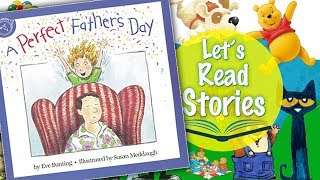
A Perfect Father's Day
by Eve Bunting
Illustrated by Susan Meddaugh
Read by Let's Read Stories
"I'm taking you out for Father's Day," Susie tells Dad. "First we'll go for lunch." "Good," Dad says. "May I drive?" "Certainly," Susie says. She chooses the restaurant, and pretty soon Dad can see that she's filled this special day with treats--treats for both of them! When they get back home, Mom's final surprise (that isn't really a surprise at all) is a perfect ending for the perfect day.
Click here to purchase A Perfect Father's Day: https://www.amazon.com/Perfect....-Fathers-Day-Eve-Bun

Countdown to Kindergarten
by Alison McGhee
Illustrated by Harry Bliss
Read by Let's Read Stories
It's just ten days before kindergarten, and this little girl has heard all there is to know--from a first grader--about what it's going to be like. You can't bring your cat, you can't bring a stuffed animal, and the number one rule? You can't ask anyone for help. Ever. So what do you do when your shoes come untied, if you're the only one in the class who doesn't know how to tie them up again?
Told with gentle humor by Alison McGhee and brought to exuberant life by New Yorker cartoonist Harry Bliss, this lighthearted take on pre-kindergarten anxiety will bring a smile to the face of every child--and parent--having first-day jitters.
Click here to purchase Countdown to Kindergarten: https://www.amazon.com/Countdo....wn-Kindergarten-Alis
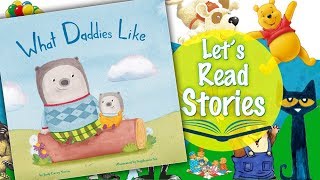
What Daddies Like
by Judy Carey Nevin
Illustrated by Stephanie Six
Read by Let's Read Stories
Find out what daddies like best in this story about a daddy bear and his cub's special day together.
Daddies like smooches.
Daddies like hugs.
Daddies like "Good morning to you!"
As a daddy bear and his cub spend the day together, readers find out all about daddies' favorite things to do, like having adventures in the park, splashes in the bath, playing peek-a-boo, and night-lights, it's true. But most of all, daddies like hearing and saying "I love you!"
Click here to purchase : https://www.amazon.com/What-Da....ddies-Like-Carey-Nev

There Was an Old Lady Who Swallowed a Bat
by Lucille Colandro
Illustrated by Jared Lee
Read by Let's Read Stories
This spooky twist on the wildly popular "There Was an Old Lady who Swallowed a Fly" is perfect for fun Halloween reading!
What won't this old lady swallow? This time around, a bat, an owl, a cat, a ghost, a goblin, some bones, and a wizard are all on the menu! This Halloween-themed twist on the classic "little old lady" books will delight and entertain all brave readers who dare to read it!
Click here to purchase There Was an Old Lady Who Swallowed a Bat: https://www.amazon.com/There-W....as-Old-Lady-Swallowe

Dragons Love Tacos 2: The Sequel
by Adam Rubin
Illustrated by Daniel Salmieri
The hilarious sequel to the smokin’ hot New York Times best seller, perfect for story time
News alert! It has just been discovered that there are NO MORE TACOS left anywhere in the world. This is a huge problem because, as you know, dragons love tacos. If only there was a way for the dragons to travel back in time, to before tacos went extinct. Then they could grab lots of tacos and bring them back! It’s the perfect plan, as long as there’s no spicy salsa. You remember what happened last time . . .
The award-winning creators of Robo-Sauce and Secret Pizza Party return with a gut-bustingly hilarious companion to the bestselling phenomenon Dragons Love Tacos.
Click here to purchase Dragons Love Tacos 2: The Sequel: https://www.amazon.com/Dragons....-Love-Tacos-2-Sequel

The Littlest Viking
by Alexandra Penfold
Illustrated by Isabel Roxas
Read by Let’s Read Stories
Click here to purchase The Littlest Viking: https://www.amazon.com/Littles....t-Viking-Alexandra-P
A hilarious story about what happens to the littlest and loudest Viking when an even littler and louder Viking arrives, perfect for fans of The Princess and the Pony and I Don't Want to Be a Frog.
Sven might be the littlest Viking, but he has no trouble making himself known. He has the loudest warrior cry and the fiercest set of teeth. He loves to pillage and plunder. But there's a new kid in town--a warrior princess, who is smaller than Sven and even louder. What's a little Viking to do?
"Penfold folds in fun ancient analogues to tried-and-true methods of appeasing cranky little ones, and Roxas's liberal use of a color perhaps best described as neon snot brings a punk edge to her scenes of Viking family life. Irreverent yet tender."--Publishers Weekly, Starred review
"A warm tale of family togetherness."--Kirkus
"A spirited tale about stopping a tantrum with a story, perfect for storytime or one-on-one sharing."--SLJ